TL;DR:
- A well-designed language curriculum integrates listening, speaking, reading, and writing to accelerate authentic proficiency. Using evidence-based pedagogies and ongoing teacher training ensures better learner engagement and sociolinguistic competence. Incorporating mother-tongue support, thematic units, and immersive methods enhances overall language mastery and real-world communication skills.
Curriculum is the structured framework that determines how learners acquire language skills, in what order, and at what depth. The role of curriculum in language mastery goes far beyond a list of topics to cover. A well-designed curriculum integrates listening, speaking, reading, and writing into a coherent progression that mirrors how language actually works in real life. Research consistently shows that curricula built around integrated skills, mother-tongue strategies, and progressive pedagogy produce measurably stronger outcomes in comprehension, communication, and learner engagement. Whether you are an educator designing a program or a learner choosing where to study, understanding what makes a curriculum effective is the most direct path to real proficiency.
How does curriculum design shape language mastery?
Curriculum design is the single greatest determinant of whether a language learner reaches genuine proficiency or plateaus at surface-level competence. A curriculum that treats listening, speaking, reading, and writing as separate, unrelated modules creates artificial divisions that slow acquisition. Integrated curricula combining all four skills within thematic units accelerate pragmatic language competence and learner engagement. That finding matters because pragmatic competence, the ability to use language appropriately in real situations, is exactly what most adult learners need for work and daily life.
Two frameworks dominate effective curriculum design for language learning: Content-Based Instruction (CBI) and Task-Based Language Teaching (TBLT). CBI organizes language learning around meaningful subject matter, so learners absorb grammar and vocabulary while engaging with content they actually care about. TBLT structures lessons around completing real-world tasks, such as negotiating a price or writing a professional email, which forces learners to deploy all four skills simultaneously. Both approaches shift the curriculum away from rote memorization toward authentic language use.
The contrast between integrated and compartmentalized curricula is stark in practice.
| Feature | Integrated curriculum | Compartmentalized curriculum |
|---|---|---|
| Skill development | All four skills taught together in context | Each skill taught in isolation |
| Learner engagement | Higher, due to meaningful content | Lower, due to repetitive drills |
| Pragmatic competence | Develops naturally through use | Develops slowly, if at all |
| Transfer to real life | Strong, because tasks mirror real situations | Weak, because tasks are artificial |
| Assessment alignment | Reflects actual communication ability | Reflects memorization and form |
Shifting from fragmented skill teaching to integrated skill modules aligns directly with authentic language use and fast-tracks communicative competence. The practical implication for educators is clear: design units around themes and tasks, not grammar points in isolation.
Pro Tip: When evaluating any language program, ask whether the curriculum connects skills across a single lesson. If a lesson teaches vocabulary in one block and speaking in a separate block with no connection between them, that is a compartmentalized design and it will slow your progress.
Does mother-tongue instruction improve language achievement?
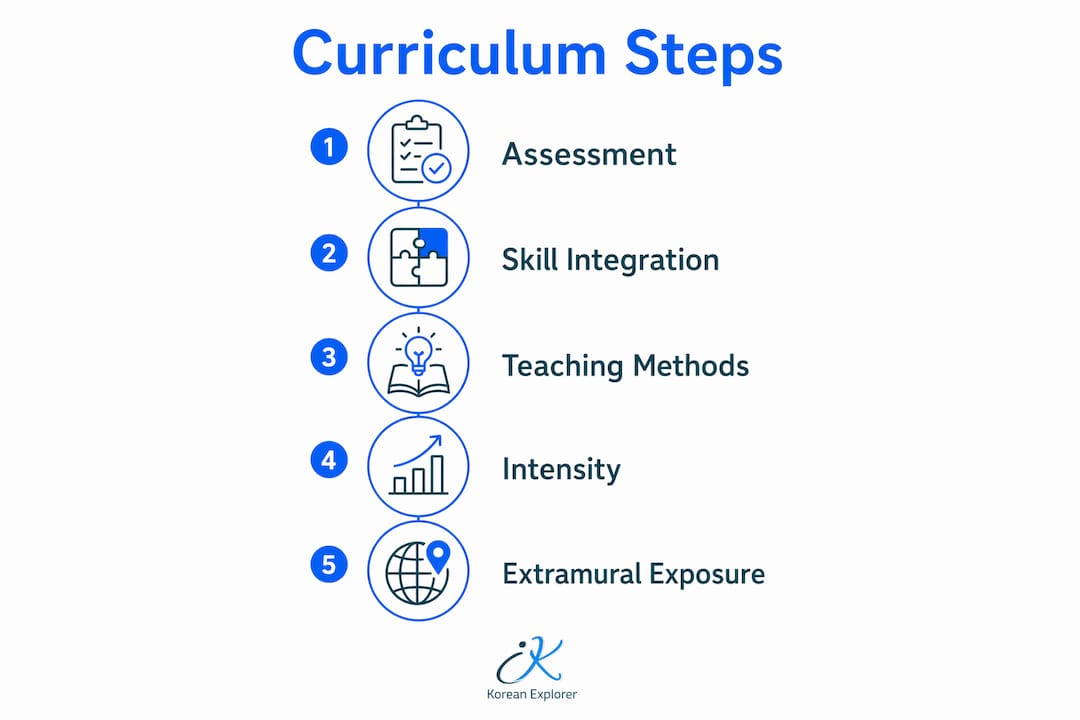
Mother-tongue instruction produces measurable gains in language achievement, and the research is specific. A study of 345 Nigerian secondary students found a positive correlation between bilingual curriculum strategies and both comprehension and classroom participation, with a Cronbach’s alpha reliability score of 0.88. That level of reliability means the finding is consistent and replicable, not a one-off result.
The mechanism is straightforward. When learners can anchor new vocabulary and grammar concepts to their first language, they process meaning faster and retain it longer. A curriculum that strategically uses the learner’s mother tongue for explanation, not as a crutch but as a scaffold, reduces cognitive overload at critical early stages. This is especially relevant for adult learners who bring strong first-language literacy to the classroom and can use that literacy as a resource.
Practical recommendations for educators designing bilingual curriculum strategies include:
- Use the first language to clarify complex grammar rules, then immediately practice the target language.
- Introduce new vocabulary with first-language equivalents, then remove the translation as learners gain confidence.
- Allow first-language discussion during collaborative tasks to deepen comprehension before requiring target-language output.
- Assess learners in the target language consistently, even when instruction uses bilingual support.
The goal is not to teach in two languages equally. The goal is to use the mother tongue as a precision tool that removes confusion at key moments, then step back so the target language fills that space. Educators who encourage language learning through this kind of scaffolded approach report stronger participation and faster vocabulary growth.
How do curriculum intensity and teaching methods affect proficiency?
Curriculum intensity, meaning the hours of instruction and depth of exposure per unit of time, directly predicts proficiency outcomes. Research on 392 primary school learners in Content and Language Integrated Learning (CLIL) programs found that medium-to-high intensity CLIL programs produce the greatest improvements in writing competence, specifically in communicative appropriateness. More hours in a well-structured program produce better writers. That relationship is not surprising, but the specificity of the finding, writing competence as the clearest measurable gain, is useful for curriculum planners.
Pedagogical method matters as much as intensity. Progressive approaches like project-based learning and flipped classroom instruction improve communicative skills and intercultural competence in ways that traditional lecture-based teaching does not. A qualitative study with accounting students found that project-based activities were perceived as highly effective for improving speaking, writing, and intercultural skills simultaneously. The flipped classroom model, where learners engage with input before class and use class time for production and feedback, maximizes the value of every contact hour.

| Pedagogical method | Primary skill gains | Key challenge |
|---|---|---|
| Project-based learning | Speaking, writing, intercultural competence | Requires strong task design and clear rubrics |
| Flipped classroom | Listening comprehension, speaking fluency | Learners need reliable access to pre-class materials |
| CLIL (high intensity) | Writing competence, communicative appropriateness | Assessment consistency across teachers |
| Task-Based Language Teaching | All four skills in authentic contexts | Needs careful task sequencing for lower levels |
One underappreciated factor is extramural exposure. Learners in low-intensity CLIL programs who watch TV in the target language show stronger gains than peers who rely solely on classroom time. This finding suggests that curriculum designers should actively recommend and structure out-of-class exposure, not treat it as optional enrichment.
Pro Tip: If your program runs fewer than four contact hours per week, build extramural exposure directly into the curriculum. Assign specific podcasts, videos, or reading tasks that connect to that week’s classroom theme. Passive exposure becomes active learning when it is tied to a lesson goal.
What makes sociolinguistic competence so hard to teach?
Sociolinguistic competence, the ability to use language appropriately across different social contexts, is the most consistently underdeveloped skill in formal language curricula. Research identifies a persistent gap between policy goals for sociolinguistic skill development and what actually happens in classrooms. The gap exists because sociolinguistic competence requires cultural knowledge, contextual judgment, and exposure to authentic social situations, none of which fit neatly into a grammar exercise.
Teacher preparation is the critical bottleneck. Many language teachers receive strong training in phonology, grammar, and vocabulary instruction but limited preparation for teaching register, politeness conventions, or culturally appropriate communication. Teacher training remains the most direct lever for improving sociolinguistic outcomes in any curriculum. Without it, even a well-written curriculum fails at the classroom level.
Curriculum reform also requires policy coherence to succeed. Analysis of language curriculum innovation shows that sustainable language gains depend on systemic support, including ongoing professional development and policy alignment, not on adding new methods without structural backing. Piecemeal changes rarely hold.
Common challenges and practical solutions for educators include:
- Challenge: Teachers lack confidence modeling sociolinguistic variation. Solution: Include explicit sociolinguistic scenarios in teacher training workshops, with role-play and video analysis.
- Challenge: Textbooks rarely include authentic social language. Solution: Supplement with real media, interviews, and conversation recordings from native speakers.
- Challenge: Assessment tools measure grammar accuracy, not social appropriateness. Solution: Add rubric categories for register and contextual fit in speaking and writing assessments.
- Challenge: Policy documents describe sociolinguistic goals without specifying how to teach them. Solution: Translate policy language into concrete lesson objectives with observable outcomes.
Using technology in language learning can also help close this gap. Authentic video content, interactive conversation simulations, and online cultural resources give learners exposure to real sociolinguistic variation that no textbook can fully replicate.
Key Takeaways
A curriculum that integrates skills, uses evidence-based pedagogy, and supports teachers with ongoing training is the most reliable path to genuine language mastery.
| Point | Details |
|---|---|
| Integrated skills accelerate mastery | Curricula combining listening, speaking, reading, and writing in thematic units build pragmatic competence faster than compartmentalized designs. |
| Mother-tongue scaffolding works | Bilingual curriculum strategies improve comprehension and participation, especially at early proficiency stages. |
| Intensity and method both matter | Medium-to-high intensity programs using project-based learning and CLIL produce the strongest measurable proficiency gains. |
| Sociolinguistic gaps need direct attention | Teacher training and authentic materials are the two most effective tools for developing sociolinguistic competence in learners. |
| Policy coherence sustains gains | Curriculum reform requires systemic professional development, not one-off method changes, to produce lasting results. |
What I have learned about curriculum after years in language education
The debate about curriculum design often gets stuck on method names. Educators argue about whether TBLT or CBI is superior, whether flipped classrooms work better than project-based learning, and whether bilingual instruction helps or hinders. In my experience, that debate misses the real issue.
The curricula that produce the best learners are not the ones built around the most fashionable method. They are the ones built around the clearest understanding of what learners actually need to do with the language. An adult learner preparing for a professional role in Korea needs a curriculum that prioritizes business register, formal writing, and culturally appropriate communication. A learner who wants to connect with Korean culture needs a curriculum that builds conversational fluency and cultural literacy. The method is secondary to that clarity of purpose.
What I find consistently undervalued is the role of curriculum evaluation. Most programs design a curriculum, launch it, and then treat it as fixed. The programs that produce the strongest learners revisit the curriculum regularly, collect data on where learners stall, and adjust. That cycle of design, delivery, and revision is what separates a living curriculum from a document that collects dust.
The other thing I would push back on is the idea that standardized frameworks and learner diversity are in tension. A well-designed framework, like the Seoul National University curriculum used at Korean Explorer, does not flatten learner differences. It provides a shared progression that teachers can adapt. The framework is the floor, not the ceiling. Teachers who understand this use it as a starting point and build from there based on who is in the room.
— Paul
Korean Explorer’s curriculum-driven approach to adult Korean learning
Korean Explorer’s adult Korean courses are built on a curriculum developed by Seoul National University, one of the most respected frameworks in Korean language education. That foundation means learners follow a progression that has been tested, refined, and aligned with real proficiency benchmarks.
The courses integrate speaking, listening, reading, and writing within each level, so learners build all four skills simultaneously rather than in isolation. Native Korean instructors fluent in English deliver lessons with a conversation-first focus, which means every class session builds the kind of practical fluency adult learners need for work, travel, or personal connection. Group classes, private sessions, and online Korean classes via Zoom give learners the flexibility to fit structured learning into a busy adult schedule. Korean Explorer is located at 10 Anson Road, level 22, International Plaza, Singapore 079903, right above Tanjong Pagar MRT. Confirm the campus for your preferred class on the current timetable. Explore adult Korean courses and find the format that fits your goals.
FAQ
What is the role of curriculum in language mastery?
Curriculum is the structured plan that sequences language skills, content, and assessment to guide learners toward proficiency. A well-designed curriculum integrates listening, speaking, reading, and writing in ways that reflect authentic language use.
How does curriculum design affect language acquisition?
Integrated curriculum designs that combine all four language skills within thematic units produce faster pragmatic competence than compartmentalized approaches. Research shows that thematic skill integration accelerates authentic language use and learner engagement.
Does the intensity of a language program matter for proficiency?
Yes. Research on CLIL programs found that medium-to-high intensity instruction produces the greatest gains in writing competence and communicative appropriateness. More structured contact hours in a coherent curriculum consistently outperform low-intensity exposure.
Why is sociolinguistic competence difficult to develop through curriculum?
Sociolinguistic competence requires cultural knowledge and contextual judgment that standard grammar instruction does not address. The gap between policy goals and classroom practice persists primarily because teacher training rarely covers sociolinguistic skill development in depth.
What teaching methods work best within a language curriculum?
Project-based learning, Task-Based Language Teaching, and flipped classroom instruction consistently show strong results for communicative skill development. The most effective curricula combine these methods with clear task sequencing and regular assessment of real-world language use.