TL;DR:
- TOPIK is the official Test of Proficiency in Korean, administered by NIIED. TOPIK I covers Levels 1–2 and TOPIK II covers Levels 3–6. Paper and computer results use different score scales.
TOPIK, the Test of Proficiency in Korean, is the official government-administered standardized exam that measures Korean language skills for non-native speakers. First introduced in 1997, it is managed by the National Institute for International Education (NIIED) under South Korea’s Ministry of Education and offered in over 80 countries worldwide. If you are studying Korean for university admission, a work visa, or personal growth, understanding what is TOPIK and how it works is the first step toward using it effectively.
What is the TOPIK exam structure?
TOPIK I covers Levels 1–2 and tests listening and reading. TOPIK II covers Levels 3–6 and adds writing. TOPIK Speaking is a separate test. See NIIED’s 2026 TOPIK notice for the published rules.
Here is a direct comparison of the two tiers:
| Feature | TOPIK I | TOPIK II |
|---|---|---|
| Levels covered | 1–2 | 3–6 |
| Sections | Listening, Reading | Listening, Reading, Writing |
| Total points | 200 PBT / 400 IBT | 300 PBT / 600 IBT |
| Target learners | Beginners | Intermediate to advanced |
| Writing section | No | Yes |
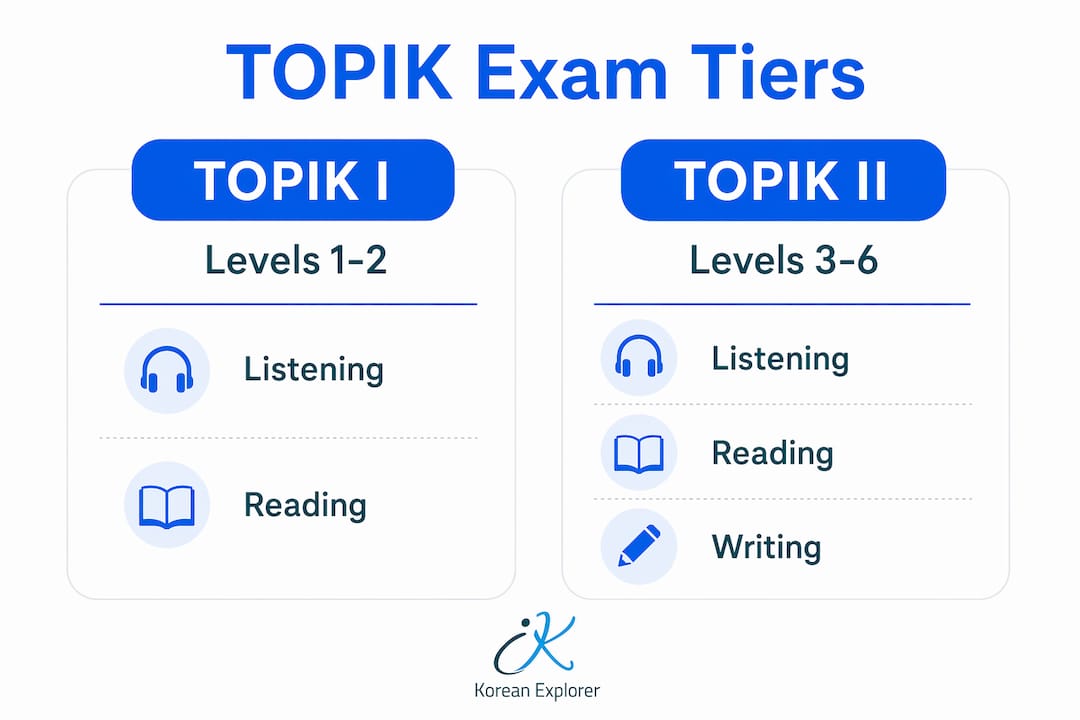
Both tiers have paper and computer formats in NIIED’s calendar. The computer version is delivered at a test centre. Check the TOPIK score bands by format and the official TOPIK site before choosing a session.
Key facts about the exam format:
- Listening: Multiple choice, tests comprehension of spoken Korean in everyday and academic contexts
- Reading: Multiple choice, tests vocabulary, grammar, and text comprehension
- Writing (TOPIK II only): Short answer and essay questions that assess grammar accuracy and coherent expression
- Scoring: Level assignment is based on your total score within the tier you registered for
- Format options: Paper-based tests are available at most international centers; internet-based testing is expanding
Why is TOPIK certification important?
TOPIK certification is the standardized proof of Korean language competency that institutions require. Without it, universities, government agencies, and employers rely on informal self-assessment, which carries no consistent standard. TOPIK removes that ambiguity entirely.
The practical uses of TOPIK certification include:
- University admissions: Check the programme’s language requirement and accepted evidence.
- Work visas: Certain visa categories require demonstrated Korean proficiency
- Immigration: Check the official requirements for your exact application category.
- Korean Government Scholarship Program (KGSP): TOPIK results are a core requirement for this scholarship
- Employment: An employer can specify the evidence it needs.
NIIED states that TOPIK results are valid for two years from the results announcement date. Check when the receiving organisation needs the result to be valid.
Pro Tip: Plan your test date so that your certificate validity window overlaps with your application deadline and any processing time. Sitting the exam too early is a common and avoidable mistake.
A separate exam called EPS-TOPIK differs significantly from the general TOPIK. EPS-TOPIK is designed for workers entering Korea under the Employment Permit System in specific labor sectors. It does not substitute for the general TOPIK in academic or residency applications. Knowing which exam your institution or visa category requires saves you from preparing for the wrong test entirely.
You can read more about the benefits of TOPIK certification and how it applies to your specific goals.
How do TOPIK levels work?
Choose TOPIK I or II based on the level you need. Your total score in the format you take determines the level awarded.
| Level | Tier | Proficiency description |
|---|---|---|
| Level 1 | TOPIK I | Basic survival Korean, simple vocabulary and sentences |
| Level 2 | TOPIK I | Everyday communication on familiar topics |
| Level 3 | TOPIK II | Functional use in most daily and social situations |
| Level 4 | TOPIK II | Comfortable use in professional and academic contexts |
| Level 5 | TOPIK II | Fluent use across complex topics with nuanced expression |
| Level 6 | TOPIK II | Near-native proficiency, suitable for advanced academic work |
Taking TOPIK I cannot yield a level 3 result or above, and vice versa. This is a critical point that many first-time test takers miss. If your target university requires a level 4, registering for TOPIK I is a wasted attempt regardless of how well you perform.
The awarded level depends on your score band. Check the organisation’s required level and accepted format before you register.
How to prepare for the TOPIK exam effectively
Effective TOPIK preparation starts with knowing your target level and working backward from it. Registering for the wrong tier wastes time and money. Once you confirm your target, structure your study plan around the specific sections of that tier.
- Audit your current level. Take a practice test before committing to a tier. Free sample papers are available on topik.go.kr. Your score on a practice test tells you whether to register for TOPIK I or TOPIK II.
- Study by section, not by topic. Listening, reading, and writing each require different skills. Allocate study time proportionally. TOPIK II test takers should spend extra time on the writing section since it is the most commonly underprepared area.
- Use structured course materials. A curriculum aligned with TOPIK standards, like the Seoul National University-based program used at Korean Explorer, builds the vocabulary and grammar patterns the exam actually tests.
- Practice under timed conditions. The exam has strict time limits per section. Practicing without a timer builds false confidence. Use past papers with a clock running from your first practice session.
- Register early and confirm your test center. Test seats fill quickly, especially at international centers. Late registration can leave you without a seat for your preferred exam date.
Pro Tip: Check the 2026 TOPIK study guide for a structured preparation timeline that maps study milestones to exam dates.
A common error is treating TOPIK preparation as general Korean study. The exam tests specific formats and question types. Knowing the format is as important as knowing the language. Read more about practical TOPIK preparation tips that go beyond standard advice.
How is TOPIK administered outside Korea?
NIIED works with local organisers outside Korea. Dates, formats and registration can differ by country.
Key facts for international test takers:
- Registration: Follow the current instructions from the organiser for your location and exam.
- Paper-based format: Check the local notice for venue and dates.
- Internet-based format: IBT is computer-delivered at participating test centres. Check local availability.
- Exam frequency: Use the local schedule for your format and tier.
- EPS-TOPIK: This is a separate test for the Employment Permit System. Check which exam your application requires.
For Singapore, check current Singapore Korean International School notices and the official TOPIK site for the venue, registration period, fees and format.
Key Takeaways
TOPIK I and II cover six levels in total. Results are valid for two years from the announced results date.
| Point | Details |
|---|---|
| Two tiers, six levels | TOPIK I covers levels 1–2; TOPIK II covers levels 3–6 with an added writing section. |
| Register for a tier, not a level | Your final level is determined by your score within the tier you chose at registration. |
| Certificate validity | TOPIK certificates expire 2 years after results are announced; time your exam accordingly. |
| EPS-TOPIK is a separate exam | EPS-TOPIK applies to labor visa applicants only and does not substitute for the general TOPIK. |
| Global availability | Check the current schedule and formats in your location. |
Why TOPIK matters more than most learners expect
Most learners treat TOPIK as a box to check. That framing causes real problems. The exam is a precise instrument, and the gap between levels carries concrete consequences. A level 3 result does not satisfy a requirement for level 4, no matter how close the score was.
Check both your application deadline and the date through which your result needs to be valid.
The tier registration rule also trips up more people than it should. Many learners assume they can aim for any level by performing well on either test. That is not how TOPIK works. If your target institution requires level 4 and you register for TOPIK I, no score you achieve will satisfy that requirement. Confirming the exact score requirement before you register is a five-minute task that prevents months of wasted preparation.
Use the separate TOPIK Speaking information if the organisation requests evidence of speaking ability.
Korean Explorer’s TOPIK preparation courses
Korean Explorer publishes a one-to-one preparation option. Ask which level and exam format the class can help you prepare for.
See Korean Explorer’s TOPIK preparation course for one-to-one preparation in person or online. Use the school placement forms if you need help choosing a course level. Follow the official test organiser’s instructions to register for the exam.
FAQ
What does TOPIK stand for?
TOPIK stands for Test of Proficiency in Korean. It is the official standardized exam administered by NIIED under South Korea’s Ministry of Education for non-native Korean speakers.
What is the difference between TOPIK I and TOPIK II?
TOPIK I tests listening and reading at levels 1 and 2, while TOPIK II adds a writing section and covers levels 3 through 6. You register for one tier, and your score determines which level you achieve within that tier.
How long is a TOPIK certificate valid?
A TOPIK certificate is valid for 2 years from the date results are officially announced. Plan your exam date so the certificate remains valid through your application and processing period.
Can I take TOPIK outside of South Korea?
Yes. Check the current local organiser’s notice for available formats, venues and registration.
Is EPS-TOPIK the same as the general TOPIK exam?
No. EPS-TOPIK is a separate exam for workers applying to enter Korea under the Employment Permit System in specific labor sectors. It does not satisfy requirements for university admissions, residency visas, or scholarships that specify the general TOPIK.