TL;DR:
- Conversation-based learning uses active speaking and listening to build fluency and communication skills. Structured, goal-oriented conversations, supported by AI tools, enhance vocabulary and sociolinguistic competence. Effective teaching in this method involves intentional session design focusing on real-world scenarios and clear objectives.
Conversation-based learning is defined as a structured approach to language acquisition where active speaking and listening practice drives fluency, vocabulary retention, and real-world communication confidence. Unlike passive study methods such as grammar drills or reading exercises, this approach places dialogue at the center of every lesson. Communicative Language Teaching, the recognized academic term for this method, has decades of research behind it. The role of conversation-based learning goes far beyond casual chatting. It builds the four core competencies every fluent speaker needs: linguistic, sociolinguistic, discourse, and strategic competence. For adult learners aiming at professional or personal fluency, this distinction changes everything about how you should study.
What is the role of conversation-based learning in building fluency?
Structured conversation improves language fluency because it forces learners to retrieve and apply vocabulary in real time. That retrieval process is far more demanding than recognizing a word on a flashcard. Communicative Language Teaching improves vocabulary usage in context and oral fluency compared to traditional lecture methods. The implication is direct: if your lessons are mostly teacher-led explanations, you are leaving the most effective part of learning on the table.
Goal-oriented conversations outperform unstructured talking every time. Unstructured conversation often leads to stagnation, while goal-oriented conversations with clear roles and topics yield measurably better language progress. A learner who spends 30 minutes discussing a specific topic with a defined role, such as a customer negotiating a refund, gains more than one who simply chats freely for the same duration.
Three mechanisms explain why structured dialogue works so well:
- Scaffolding: Scaffolding in conversation targets language just above the learner’s current level, providing guided support to push progress without causing frustration.
- Active listening: Active listening requires decoding intonation, idioms, and speech patterns, all of which are critical for natural conversational responsiveness.
- Repetition in context: Hearing and using a word in multiple conversational turns embeds it far more deeply than rote memorization.
Pro Tip: When practicing Korean or any second language, set a specific communication goal for each session, such as ordering food, describing your weekend, or handling a complaint. Purposeful framing turns practice into real skill-building.
How does AI improve conversation-based language practice?
AI-powered tools have changed what independent practice looks like for adult learners. AI conversational tools increase learner efficiency by 23.2% and boost confidence by 43%, while halving dropout rates among adult learners. Those numbers reflect a fundamental shift: AI makes consistent practice accessible at any hour, removing the scheduling barriers that cause most adult learners to quit.

The key distinction is between conversational AI as an interactive coaching tool versus a static chatbot. A static chatbot responds to keywords. A conversational AI coach adapts to your proficiency level, flags pronunciation errors, and asks follow-up questions that push you to produce more complex language. Advanced AI models now achieve up to 98.85% accuracy in assessing speaking competence, including fluency and pronunciation. That level of precision was previously available only through certified human examiners.
Conversational AI also shifts the learning dynamic from passive content consumption to active questioning and rehearsal. AI in learning provides interactive, immediate feedback similar to a personal tutor, improving both accessibility and learner engagement. For learners using apps to supplement their Korean classes, this means you can rehearse a dialogue from your last lesson at midnight and get corrective feedback before your next session.
AI does have real limits. It cannot fully replicate the cultural nuance, emotional intelligence, or spontaneous humor that a native-speaking instructor brings to a conversation. The best results come from using AI tools to practice volume and consistency, then bringing those gains into structured human-led sessions. Resources like language learning apps can help you identify which tools complement classroom work most effectively.
What are best practices for educators in conversation-focused teaching?
Effective conversation-focused teaching starts with intentional session design. Educators who structure sessions around clear goals, defined roles, and guided topics consistently produce better learner outcomes than those who rely on open-ended discussion. The importance of structured sessions is well established: educators must carefully structure conversation sessions to maximize language gains and avoid learner stagnation.
A practical framework for structuring conversation sessions looks like this:
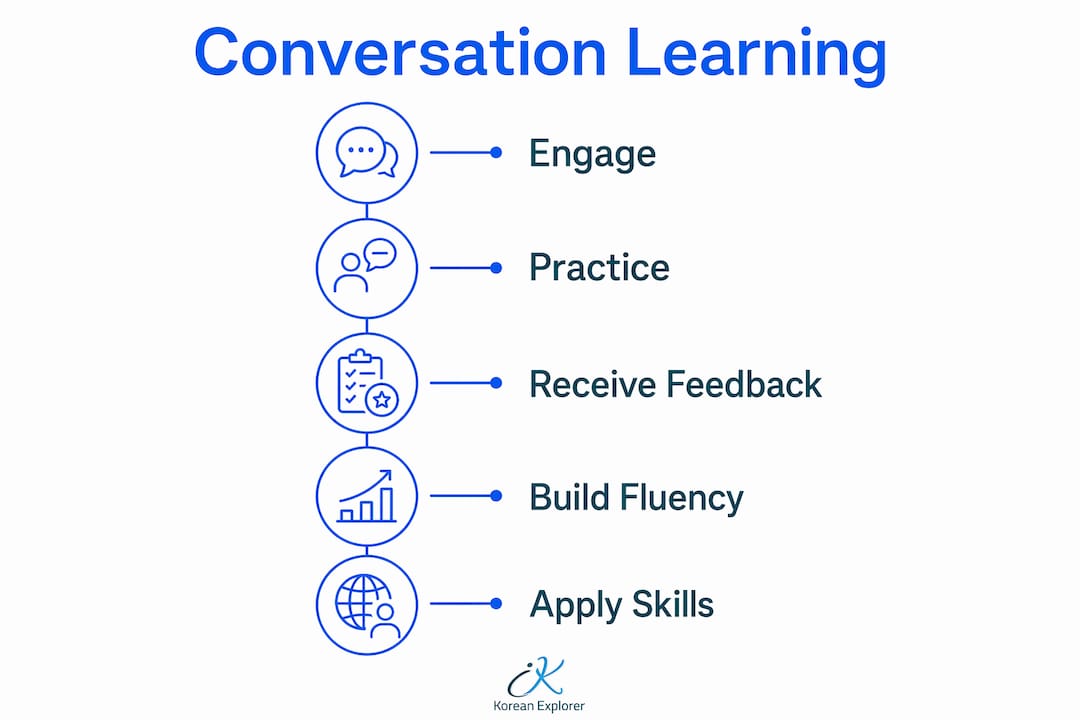
- Set a clear communicative goal. Define what learners should be able to do by the end of the session, such as describe a past event or negotiate a price.
- Use scenario-based tasks. Role-plays, debates, and real-world simulations give learners a reason to speak and a context for vocabulary use.
- Provide scaffolding before the task. Pre-teach key phrases and model the target language before asking learners to produce it independently.
- Give corrective feedback without breaking flow. Note errors during the conversation and address them in a dedicated feedback phase afterward, not mid-sentence.
- Build in reflection time. Ask learners to identify one phrase they used well and one they struggled with. Self-awareness accelerates progress faster than correction alone.
A common pitfall is prioritizing fluency at the expense of discourse competence. Fluency gained without discourse skills leaves learners unable to manage communication breakdowns, shift register appropriately, or handle the sociolinguistic demands of real conversations. An adult learner who speaks quickly but cannot repair a misunderstanding will struggle in professional settings.
Pro Tip: After each conversation task, ask learners to replay one exchange in a different social context, for example, changing from a casual chat to a formal business meeting. This single exercise builds sociolinguistic awareness faster than any grammar worksheet.
Educators working with adult learners can also draw on resources like interactive language learning strategies to design scenario-based discussions that build both vocabulary and cultural competence simultaneously.
How does conversation-based learning prepare you for professional communication?
Professional communication demands more than correct grammar. It requires the ability to read a room, manage misunderstandings, and adjust your language register depending on whether you are in a client meeting or a team debrief. Comprehensive conversation training integrates sociolinguistic and discourse competencies to handle real-life communication breakdowns, which is exactly what workplace scenarios demand.
The specific skills that conversation-based training builds for professional use include:
- Clarity under pressure: Practicing timed responses in role-play scenarios trains you to express ideas concisely when it counts.
- Register flexibility: Moving between formal and informal Korean, for example, is a skill that only develops through repeated conversational exposure in varied contexts.
- Breakdown management: Knowing how to ask for clarification, rephrase, or signal confusion without losing face is a sociolinguistic skill that grammar books never teach.
- Active listening in meetings: Decoding fast speech, accented speakers, and idiomatic expressions requires the same active listening skills built through structured conversation practice.
Corporate language training programs that use conversation-based methods consistently outperform those built around grammar instruction and vocabulary lists. The reason is simple: workplace communication is almost entirely spoken and interactive. Training that mirrors that reality produces learners who perform better from day one on the job.
| Professional skill | How conversation training builds it |
|---|---|
| Meeting participation | Role-plays simulate turn-taking and interruption norms |
| Negotiation language | Scenario tasks practice persuasion and concession phrases |
| Presentation delivery | Structured speaking tasks build fluency and pacing |
| Email follow-up clarity | Discourse competence transfers from spoken to written form |
For adult learners working toward professional Korean fluency, building real fluency through targeted exercises accelerates the transition from classroom competence to workplace confidence.
Key takeaways
Conversation-based learning accelerates language acquisition by combining structured dialogue, scaffolded practice, and real-world communicative tasks that build fluency, confidence, and professional competence simultaneously.
| Point | Details |
|---|---|
| Structured dialogue beats unstructured talk | Goal-oriented conversations with clear roles produce measurably better language progress. |
| AI tools multiply practice volume | AI conversational tools boost learner confidence by 43% and cut dropout rates significantly. |
| Scaffolding prevents frustration | Targeting language just above current ability builds progress without overwhelming learners. |
| Discourse competence is non-negotiable | Fluency without sociolinguistic and breakdown skills leaves learners unprepared for real communication. |
| Professional training needs conversation methods | Workplace communication is interactive; training must mirror that reality to produce job-ready speakers. |
Why intentionality separates good conversation practice from great results
Most learners I have seen plateau at an intermediate level share one habit: they practice conversation, but they do not practice it with purpose. They repeat the same comfortable topics, use the same vocabulary, and avoid the situations where they might stumble. That comfort zone feels productive. It is not.
The research on scaffolding confirms what I have observed directly. Progress happens at the edge of your current ability, not inside it. If every conversation feels easy, you are rehearsing, not learning. The best conversation sessions are slightly uncomfortable, because that discomfort signals that your brain is working to retrieve and produce language it has not fully automated yet.
AI tools have genuinely changed what is possible for adult learners with limited time. I think they are most valuable not as replacements for human interaction, but as a way to build the repetitions needed before a high-stakes conversation. Practice the vocabulary with an AI coach, then bring that prepared confidence into your class or your next business meeting in Korean.
Active listening deserves equal attention to speaking. Most learners focus entirely on what they will say next and miss half of what their conversation partner actually said. Developing listening as a proactive decoding skill, not a passive waiting exercise, is the single fastest way to improve conversational responsiveness. Treat every conversation as a two-way exercise in both production and comprehension, and your progress will accelerate noticeably.
— Paul
Korean Explorer’s conversation-focused Korean courses for adults
Korean Explorer offers adult Korean courses built around the conversation-focused methods described throughout this article. Every course integrates structured speaking tasks, native instructor feedback, and real-world scenarios designed for personal and professional use.
Group classes, private sessions, and online Zoom lessons are all available, giving you the flexibility to practice consistently regardless of your schedule. Corporate training programs are also offered for teams that need professional Korean communication skills. Korean Explorer’s curriculum is developed in alignment with Seoul National University standards, taught by native Korean instructors fluent in both Korean and English. Whether you are starting out or building toward business fluency, Korean language courses at Korean Explorer give you the structured conversational practice that actually moves your skills forward. You can also browse the full course offerings to find the right level for where you are now.
FAQ
What is conversation-based learning in language acquisition?
Conversation-based learning is a structured method where active speaking and listening practice drives fluency and vocabulary retention. It is the applied form of Communicative Language Teaching, which prioritizes real-world dialogue over grammar-focused instruction.
How does conversation-based learning differ from traditional language study?
Traditional study focuses on grammar rules and vocabulary memorization in isolation. Conversation-based learning requires learners to produce and respond to language in real time, which builds fluency and sociolinguistic competence that passive study cannot replicate.
Can AI replace human conversation partners in language learning?
AI conversational tools provide immediate feedback and increase practice volume effectively, but they cannot fully replicate the cultural nuance and spontaneous interaction of a native-speaking instructor. The most effective approach combines AI practice with human-led conversation sessions.
Why is active listening part of conversation-based learning?
Active listening involves decoding intonation, idioms, and speech patterns, all of which are required for natural conversational responsiveness. Treating listening as a proactive skill rather than passive reception directly improves a learner’s ability to respond accurately and fluently.
How does conversation training help with professional Korean communication?
Conversation-based training builds register flexibility, breakdown management, and discourse competence, all of which are required in meetings, negotiations, and presentations. These skills transfer directly to workplace scenarios in ways that grammar-focused study does not.