TL;DR:
- Effective TOPIK preparation relies on using official materials, targeted skill practice, and precise exam strategies to maximize scores. Candidates who consistently practice with past papers, focus on weak areas, and memorize key templates tend to perform best, regardless of their fluency level. Balancing study across listening, reading, and writing, while tracking progress, is essential for score improvement.
Effective TOPIK preparation is defined by three pillars: official materials, targeted skill practice, and exam-specific strategy. The Test of Proficiency in Korean (TOPIK) measures Korean language ability across six levels, and your score directly determines eligibility for universities, visa applications, and professional roles in Korea. Knowing how to prepare for TOPIK the right way means using resources like topik.go.kr, the TOPIK GO app, and structured grammar references rather than relying on general Korean media consumption. The candidates who score highest are not necessarily the most fluent speakers. They are the most prepared test takers.
What materials and tools do you need to prepare for TOPIK?
The single most important resource for TOPIK test preparation is the official past-paper archive at topik.go.kr. Every past exam, including audio files for listening sections, is available free of charge. Timed past paper practice followed by structured review is the most effective self-study cycle available, and no paid product replaces it.

Beyond the official site, a small set of supplementary tools covers the gaps. TOPIK GUIDE (topikguide.com) provides vocabulary lists, grammar explanations, and free practice tests organized by level. The Migii TOPIK app offers mobile-friendly mock exams with answer analysis, which is useful for commute-time practice. For grammar, Korean Grammar in Use (Intermediate and Advanced editions) by Ahn Jean-myung remains the most widely referenced textbook among TOPIK II candidates.
Here is a direct comparison of the core tools:
| Tool | Format | Best use | Cost |
|---|---|---|---|
| topik.go.kr | Website | Official past papers and audio | Free |
| TOPIK GUIDE | Website | Vocabulary, grammar, practice tests | Free |
| Migii TOPIK app | Mobile app | Mock exams and answer analysis | Free/paid |
| Korean Grammar in Use | Textbook | Grammar reference and exercises | Paid |
| TopikLab (info.topiklab.com) | Website | Writing task guides and scoring rubrics | Free |
Digital tools win on accessibility and speed of feedback. Textbooks win on depth of grammar explanation and structured progression. The strongest preparation combines both: use topik.go.kr and Migii for timed simulation, and Korean Grammar in Use alongside TopikLab for targeted skill building.
Pro Tip: Download at least five full past exams from topik.go.kr before you begin studying. Having them on hand lets you rotate through fresh material without interrupting your study rhythm.
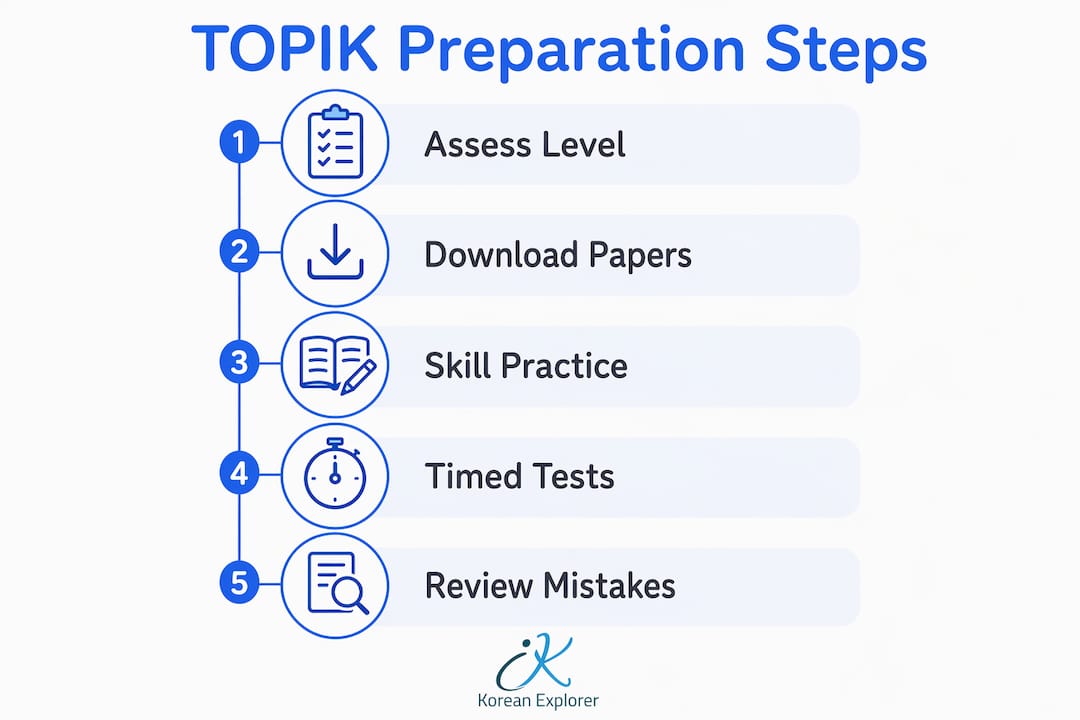
How should you study for each TOPIK section step by step?
A structured weekly schedule is the backbone of any effective TOPIK exam strategy. Without one, most candidates over-invest in their strongest skill and neglect the sections that cost them the most points. The following approach works for TOPIK II candidates targeting Levels 3 through 6.
Listening (매일, daily): Play official past-exam audio from topik.go.kr every day for 20 to 30 minutes. Skim questions before the audio plays to direct your attention to specific facts. This reduces cognitive load and improves accuracy on multi-part questions. Training with authentic exam audio transfers better to the actual test than K-drama dialogue or YouTube content, because the pacing, vocabulary register, and question types match the real exam format.
Reading (three times per week): Work through full 50-question reading sections under timed conditions. Timed reading practice simulates real test pressure and builds the speed needed to finish within the allotted time. After each session, categorize every wrong answer by error type: vocabulary gap, grammar misread, or comprehension failure. Fix the pattern, not just the individual question.
Vocabulary (daily, 15 minutes): Use TOPIK GUIDE’s level-specific word lists. Flashcard apps like Anki with pre-built TOPIK decks accelerate retention through spaced repetition. Aim for 20 to 30 new words per day, reviewed across three days before moving on.
Writing (three times per week): Practice all four writing tasks (Q51 to Q54). The TOPIK II essay Q54 carries up to 50 points out of a possible 100 for the writing section, making it the single highest-value task on the entire exam. Treat Q51 to Q53 as warm-up. Treat Q54 as the main event.
Mock tests (once per week): Simulate full exam conditions. Sit the complete paper in one session, time each section, and score yourself immediately after. Track your section scores in a log so you can see trends over weeks, not just days.
Pro Tip: Preparation time varies significantly by target level. Reaching Level 1 or 2 typically takes 3 to 6 months at one to two hours per day. Levels 5 and 6 require two to three or more years of sustained study. Set your timeline before you set your schedule.
How do you avoid common mistakes in TOPIK writing and listening?
The writing section is where most TOPIK II candidates lose preventable points. The most common error is using informal speech (반말 or 해요체) instead of the required formal register (합쇼체). Every essay response must use 합쇼체 endings such as 합니다 and 습니다. Using informal endings signals a fundamental misunderstanding of the task and directly lowers your score regardless of content quality.
Time management within the writing section is the second critical factor. The section runs 50 minutes and covers four tasks with very different weights. Allocate roughly five minutes to Q51 and Q52 combined, ten minutes to Q53, and the remaining 35 minutes to Q54. Most candidates who fail to finish Q54 do so because they spent too long on lower-value tasks.
For the essay specifically, memorizing three introduction templates saves two to three minutes and signals clear structure to raters from the first sentence. A strong introduction template follows this pattern: state the topic, acknowledge two perspectives, and declare your argument. Raters score for argument clarity and task completion, not just grammar. Writing section grading prioritizes sustained argument clarity and full task completion over grammatical perfection.
For the listening section, apply these four tactics:
- Read each question set before the audio begins. You have a short window between tracks.
- Write key words as you listen, not full sentences. Note numbers, names, and contrasting ideas.
- Do not linger on a question you missed. Mark it and move forward. The audio does not pause.
- After practice sessions, replay audio for questions you got wrong and identify exactly where your attention broke down.
Pro Tip: Treat each TOPIK II writing subtask as a separate genre. Q53 requires data description (graphs, charts), while Q54 demands an argumentative essay. Each format needs its own practice routine and template, not a one-size-fits-all approach.
How do you track progress and adapt your study plan?
Tracking your TOPIK preparation progress is not optional. Without data, you cannot tell whether your study hours are producing results or just producing comfort. Keep a weekly log with three columns: section practiced, score or accuracy rate, and error type. Review it every Sunday before planning the next week.
Score by section, not overall. A combined score hides which skill is dragging you down. A candidate scoring 65% on listening and 40% on writing needs a completely different plan than one scoring 50% across all three sections.
Use feedback on every essay. Writing improves through targeted feedback cycles: write, get specific corrections, rewrite the same prompt. Self-review works if you use a rubric. Peer review works if your partner is at a higher level. AI writing tools like ChatGPT or Papago can flag unnatural phrasing and grammar errors, though they cannot replicate official TOPIK scoring criteria.
Prioritize your weakest section, but do not abandon the others. A common mistake is spending 80% of study time on writing because it feels most urgent, then watching listening scores drop from neglect. Maintain minimum weekly contact with every section even during intensive remediation phases.
Repeat error-prone question types. If you consistently miss long-dialogue listening questions or inference-based reading questions, pull those specific question types from multiple past papers and drill them in isolation. Pattern recognition builds faster through concentrated repetition than through full-exam practice alone.
Run a full timed simulation two weeks before your exam date. This is not for learning new material. It is for building confidence, identifying last-minute gaps, and calibrating your time allocation under real pressure.
Key takeaways
Effective TOPIK preparation requires official materials, section-specific strategies, and consistent progress tracking to produce measurable score gains.
| Point | Details |
|---|---|
| Official materials first | Use topik.go.kr for past papers and audio before any paid resource. |
| Q54 is the priority | The TOPIK II essay carries up to 50 points and determines level boundaries. |
| Formal register is non-negotiable | All writing responses require 합쇼체; informal endings cost points regardless of content. |
| Skim before you listen | Previewing questions before audio plays directs attention and improves accuracy. |
| Track section scores weekly | Logging results by section reveals which skill needs more time, not just overall performance. |
What I’ve learned from watching candidates prepare for TOPIK
The candidates I’ve seen make the fastest progress share one habit: they treat official past papers as their primary textbook, not as a final check before exam day. They start with past papers in week one and build their vocabulary and grammar knowledge around the gaps those papers reveal. That approach is the opposite of how most people study, and it works significantly better.
The writing section is where I’ve seen the most preventable score losses. Candidates spend months building vocabulary and grammar knowledge, then walk into the exam without a single memorized essay template. Those two to three minutes saved on the introduction are not trivial. They are the difference between a complete, well-argued Q54 and a rushed, unfinished one. If you only do one thing differently after reading this article, memorize three introduction templates and practice writing full essays under a 35-minute timer.
One more thing worth saying directly: neglecting your weakest skill because it feels discouraging is the most expensive mistake in TOPIK preparation. The exam scores all three sections, and a very low writing score cannot be rescued by a perfect listening score. Balanced preparation is not a nice idea. It is a scoring requirement.
You can find more targeted preparation strategies that go beyond the basics if you want to push into the higher levels.
— Paul
Accelerate your TOPIK preparation with Korean Explorer
Korean Explorer offers adult Korean language courses in Singapore designed for learners at every stage, from conversational beginners to candidates targeting TOPIK Levels 4 and above. Courses follow a curriculum developed by Seoul National University and are taught by native Korean instructors fluent in both Korean and English.
Flexible options include group classes, private sessions, and online Zoom learning, so your schedule does not have to change to fit your study goals. Whether you are building foundational skills or refining your writing and listening for exam day, Korean Explorer’s structured Korean language courses give you a clear path forward. Classes are available at International Plaza above Tanjong Pagar MRT, as well as Jurong and Tampines centers.
FAQ
What is the best way to start preparing for TOPIK?
Download official past papers from topik.go.kr and take one untimed to identify your current level and weakest sections. Build your study plan around those gaps from day one.
How long does it take to prepare for TOPIK?
Preparation time depends on your target level: Levels 1 and 2 typically require 3 to 6 months at one to two hours per day, while Levels 5 and 6 require two to three or more years of consistent study.
What is the most important section to focus on for TOPIK II?
Writing deserves the most focused preparation because Q54 carries up to 50 points and is the primary differentiator between adjacent score levels. That said, all three sections contribute to your total score and none can be neglected.
Do I need paid resources to prepare for TOPIK?
No. The official topik.go.kr archive, TOPIK GUIDE, and TopikLab are all free and cover past papers, vocabulary, grammar, and writing rubrics. Paid apps like Migii TOPIK add convenience but are not required for strong results.
How do I improve my TOPIK writing score specifically?
Practice Q54 essays under a 35-minute timer, use formal 합쇼체 throughout, and get targeted feedback on each attempt before rewriting. Memorizing introduction templates and treating each subtask as a distinct genre accelerates improvement faster than general writing practice.