TL;DR:
- Beginner Korean encompasses reading, writing, listening, and speaking skills built on a fundamental understanding of Hangul, vocabulary, and grammar. Mastering Hangul early accelerates progress and prevents bad pronunciation habits caused by romanization. Consistent short practice sessions focusing on structured dialogues and core patterns are vital for steady improvement and reaching basic conversational proficiency within months.
Most people assume beginner Korean means downloading a phrase app and memorizing “hello” and “thank you.” That’s not beginner Korean. That’s tourism prep. What is beginner Korean, really? It’s the structured foundation that teaches you to read, write, listen, and speak in a language built on an entirely different logic than English. Beginner Korean starts at zero, with the writing system Hangul, and builds upward through grammar, vocabulary, and real conversation skills. This guide breaks down every piece of that foundation so you know exactly what you’re getting into and how to get it right from day one.
Table of Contents
- Defining beginner Korean: the foundation for your language journey
- Why starting with Hangul is the smartest beginner step
- Core vocabulary, grammar, and polite speech in beginner Korean
- Effective listening and speaking strategies for beginners
- How long does it take to reach beginner proficiency and beyond?
- The thing nobody tells you about learning beginner Korean
- Start your beginner Korean journey with structured guidance
- Frequently asked questions
Key Takeaways
| Point | Details |
|---|---|
| Beginner Korean scope | It includes learning Hangul, basic vocabulary, grammar, polite speech, and simple conversations for everyday life. |
| Start with Hangul | Mastering the Korean writing system first ensures accurate pronunciation and faster vocabulary acquisition. |
| Polite 요-form | The 요-form is essential for respectful and neutral speech in most beginner conversations. |
| Short dialogues for listening | Beginner listening improves best through short, predictable dialogues and gradual practice. |
| Realistic timelines | Basic conversational ability is achievable within months with consistent study, long before professional fluency. |
Defining beginner Korean: the foundation for your language journey
Beginner Korean is not a single skill. It’s four skills working together: reading, writing, listening, and speaking. Before you can hold even a short conversation, you need building blocks that go deeper than phrase memorization.
Here’s what the beginner Korean language level actually covers:
- Hangul, the Korean writing system, consisting of letters combined into syllable blocks
- Basic vocabulary covering greetings, numbers, family members, food, places, and common verbs
- Core grammar including subject-object-verb sentence order and grammatical particles
- Polite speech levels, specifically the 요 (yo) form used in everyday social situations
- Simple listening and speaking through structured dialogues and beginner-level role-play
Beginner Korean courses cover all four language skills, with topics like greetings, introductions, family, and daily life woven throughout. This isn’t a list of isolated facts to memorize. It’s an integrated system where each piece supports the others.
A useful comparison: learning beginner Korean is closer to learning to drive than to learning a new dance move. You are not just adding one technique. You’re coordinating multiple systems at once, reading the road, managing speed, checking mirrors. The skills reinforce each other. When you study Korean and learn Hangul properly from the start, that coordination clicks into place faster than you’d expect.
Now that you understand what beginner Korean covers, let’s explore why starting with Hangul is crucial for success.
Why starting with Hangul is the smartest beginner step
Hangul is one of the most deliberately designed writing systems in the world. King Sejong created it in 1443 specifically to be learnable, and it shows. The system uses 14 consonants and 10 vowels arranged into syllable blocks, so the word 한국 (Korea) is written in two blocks, not four separate letters scattered in a row.
Here’s why this matters for you as a beginner:
- Speed of acquisition. Hangul is readable within a weekend for most learners, with fluent reading possible within two weeks. That’s an unusually fast return on effort for any writing system.
- Pronunciation accuracy. Hangul letters map to sounds in a consistent way. Once you know the system, you can read any Korean word and say it correctly, even before you know the meaning.
- Vocabulary retention. When you see Korean text rather than romanized guesses, words stick faster because you’re processing them through the actual language.
- Real-world readiness. Korean menus, signs, and apps are all in Hangul. If you rely on romanization, you’re reading a translation of a translation.
Romanization, where Korean sounds are written in English letters, is the most common beginner crutch and one of the most damaging. It masks critical sound distinctions that Hangul captures clearly. The Korean letter ㅂ has different sound qualities in different positions, and no romanization system represents that cleanly. Romanization creates a false sense of progress while quietly building bad pronunciation habits.
Pro Tip: Spend your first five to seven study days entirely on Hangul. Write each syllable block by hand. Drill flashcards. Read simple Korean words out loud. Once reading feels automatic, every other skill accelerates because you’re working with the real language, not a workaround.
With the writing system mastered, let’s look at how beginner Korean builds practical vocabulary and grammar.
Core vocabulary, grammar, and polite speech in beginner Korean
This is where beginner Korean gets genuinely interesting, because Korean grammar is structured very differently from English in ways that feel surprising at first but quickly become logical.
Essential vocabulary at the beginner level includes:
- Family terms: 어머니 (mother), 아버지 (father), 친구 (friend)
- Numbers: both the native Korean system and the Sino-Korean system, each used in different contexts
- Common verbs like 하다 (to do) and 되다 (to become), which appear constantly in everyday Korean
- Everyday nouns: food, places, days of the week, time expressions
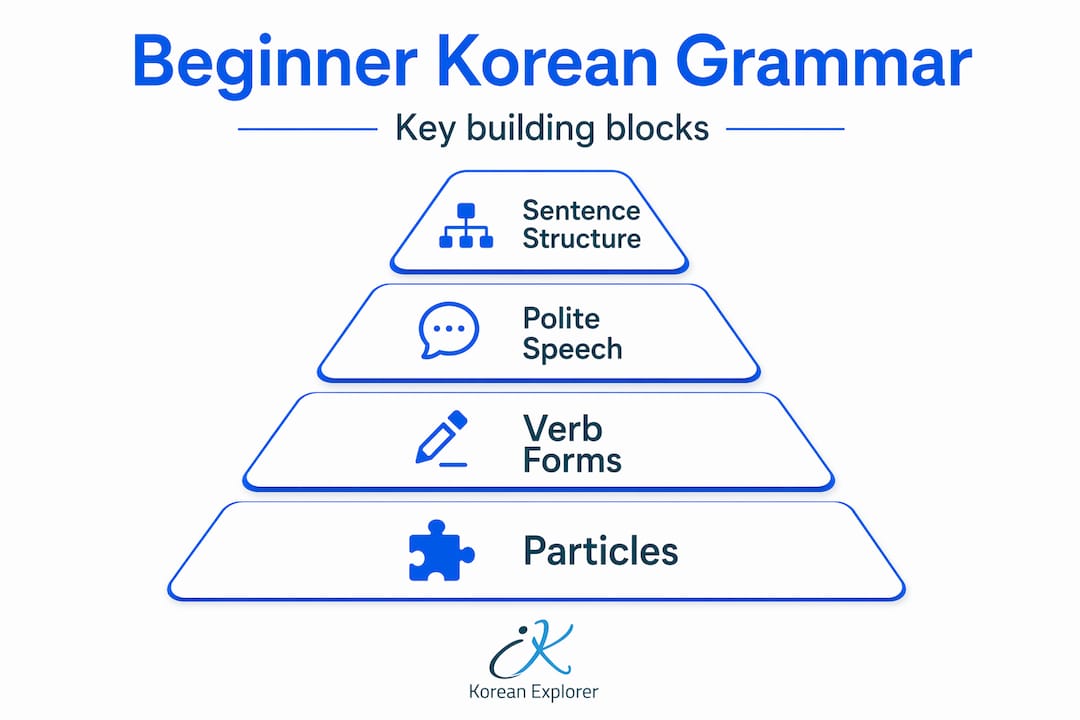
Grammar patterns are where beginner Korean language learners often hit their first real challenge. English uses subject-verb-object order (I eat rice). Korean uses subject-object-verb order (I rice eat). On top of that, Korean uses particles, small syllables attached to nouns that tell you the role of each word in the sentence.
The two most important particles for beginners are 은/는 (topic markers) and 을/를 (object markers). They do the grammatical work that word order does in English.
| Grammar element | Korean example | English meaning |
|---|---|---|
| Topic marker | 저는 학생이에요 | I am a student |
| Object marker | 커피를 마셔요 | I drink coffee |
| Polite verb ending | 가요 | (I/you/they) go |
| Want to | 먹고 싶어요 | I want to eat |
| Can do | 말할 수 있어요 | I can speak |
The 요-form verb conjugation is the polite speech level you’ll use for about 90% of beginner conversations. It’s appropriate with strangers, acquaintances, service staff, and anyone older than you. Starting here is not a shortcut. It’s the correct foundation.
You can explore the difference between beginner and intermediate levels once you’re comfortable with the 요-form and these core sentence patterns.
After grasping vocabulary and grammar, understanding how to improve listening and speaking at beginner level is essential.
Effective listening and speaking strategies for beginners
Here’s a mistake almost every beginner makes: they find a Korean drama they love and try to use it as study material in week two. The result is frustration, not progress. Native-speed Korean drama dialogue uses casual speech levels, slang, rapid connected speech, and cultural references that are completely invisible to a beginner. It’s like trying to learn English from an Aaron Sorkin screenplay.

Structured beginner curricula use short dialogues and role-play exercises to build comprehension in stages, and there’s a specific reason for that design. Predictable sentence-final verb endings, the way Korean sentences consistently close with a conjugated verb, give you an anchor in each sentence. Once you recognize the 요-form ending, you can orient yourself even when the middle of the sentence is unclear.
Practical strategies that work:
- Start with 2-3 minute audio clips that use the vocabulary and grammar you’ve already studied
- Use role-play scenarios like ordering coffee, introducing yourself, or asking for directions
- Focus on functional phrases you’ll use immediately, not comprehensive vocabulary lists
- Repeat the same short dialogues multiple times until they feel automatic before moving on
- Practice speaking out loud even when alone; your mouth needs the repetition, not just your eyes
Speaking at beginner level requires tips to kickstart your learning that keep your sessions short and consistent. Twenty minutes daily will move you forward faster than a two-hour weekend session. The brain consolidates language patterns during rest, so frequent short exposures outperform occasional marathon sessions.
Pro Tip: Record yourself saying a short dialogue on day one, then record the same dialogue after two weeks of practice. The difference is usually dramatic and genuinely motivating. Progress in speaking is hard to feel from the inside. Recordings make it visible.
Understanding these learning strategies prepares you for setting realistic expectations on your Korean progress.
How long does it take to reach beginner proficiency and beyond?
This is the question every new learner wants answered, and the honest answer is: sooner than you fear for basic conversation, and later than you hope for fluency.
Professional Korean fluency requires approximately 2,200 classroom hours, according to the Foreign Service Institute (FSI). That’s a significant commitment. But professional fluency and useful conversation ability are very different targets.
| Proficiency level | TOPIK standard | Realistic timeline |
|---|---|---|
| Beginner | TOPIK 1 / CEFR A1-A2 | 3 to 6 months |
| Lower intermediate | TOPIK 2 / CEFR B1 | 6 to 12 months |
| Upper intermediate | TOPIK 3-4 / CEFR B2 | 1 to 2 years |
| Advanced | TOPIK 5-6 / CEFR C1-C2 | 3+ years |
Beginner proficiency at TOPIK 1 level is achievable in three to six months with consistent study of three to seven hours per week. That gets you to the point of holding simple conversations, understanding basic information, and reading short texts in Hangul.
Here’s how to approach those months effectively:
- Month 1: Master Hangul completely and learn your first 100 vocabulary words
- Month 2: Focus on the 요-form, basic particles, and sentence structure
- Month 3: Build vocabulary around specific topics (food, transport, time) and practice dialogues
- Month 4 onward: Introduce Korean proficiency goals beyond beginner, add more varied listening material, and begin moving toward what is intermediate Korean territory
The six-month plateau is real. Many learners reach basic conversation ability and then stall because beginner material feels repetitive and intermediate material feels too hard. The solution is to plan your progression before you hit the plateau, not after.
The thing nobody tells you about learning beginner Korean
Most beginner Korean guides treat the language as a puzzle to solve: learn the pieces, assemble the picture, done. That framing is wrong, and it’s why so many learners quit around month three.
Korean is not a puzzle. It’s a practice. The grammar you learn in month one doesn’t graduate you to new grammar. It becomes the floor you stand on as everything else builds upward. The learners who progress fastest are not the ones who study the most vocabulary. They’re the ones who return to the same grammar patterns and vocabulary sets repeatedly, in new contexts, until those patterns become instinct rather than rules they consciously retrieve.
There’s also a real value in learning Korean inside a structured environment rather than through apps alone. Apps are excellent for drilling Hangul and vocabulary flashcards. They’re genuinely poor at teaching you when to use formal speech versus polite speech versus casual speech, a distinction that matters enormously in Korean culture. Getting that wrong isn’t just a grammar error. It’s a social one. A native instructor who understands both Korean culture and how English speakers think can explain those distinctions in ways that no algorithm currently replicates. That’s not an argument against self-study. It’s an argument for using the right tool for each job.
Start your beginner Korean journey with structured guidance
If you’ve read this far, you already understand more about the beginner Korean language than most learners do when they sign up for their first class. That clarity gives you a real advantage.
At Korean Explorer, beginner Korean lessons follow a curriculum developed by Seoul National University and aligned with TOPIK standards, so every class builds on the last. Native instructors who are fluent in both Korean and English walk you through Hangul, grammar, vocabulary, and real conversation in a way that makes sense from the start. With group, private, and online class options available across multiple locations in Singapore, including Tanjong Pagar, Jurong, and Tampines, you can find a format that fits your schedule. Explore beginner Korean courses and take the first step with a plan that’s actually built for how language learning works.
Frequently asked questions
What does “beginner Korean” exactly include?
Beginner Korean covers the Hangul writing system, basic vocabulary, core grammar structures, polite speech levels, and simple conversation topics. Beginner Korean involves Hangul first, then basic vocabulary and sentence structures for everyday communication.
How fast can I learn to speak basic Korean as a beginner?
With regular study of three to seven hours per week, most learners reach basic conversational skills within three to six months. Basic conversation milestones are achievable in the early months, while professional fluency requires approximately 2,200 classroom hours.
Should I start learning with romanization or Hangul?
Start with Hangul. It teaches accurate pronunciation and lets you read actual Korean text from day one. Romanization hides crucial sound distinctions and should only be used temporarily as a transitional aid.
What are some effective ways to practice listening at the beginner level?
Begin with short, structured dialogues that use predictable sentence-final verb endings, and build up gradually as your vocabulary grows. Structured curricula use short dialogues and role-plays to prevent the comprehension failure that comes from attempting too much too early.