TL;DR:
- Mastering advanced Korean involves understanding social context, hierarchy, and cultural nuance beyond grammar. Recognizing Sino-Korean root patterns and speech levels ensures authentic communication in diverse settings. Developing 눈치 and recognizing regional dialects are crucial for true fluency and cultural mastery.
Most learners hit a plateau around intermediate level and assume the fix is more vocabulary drills or grammar charts. It rarely is. Advanced Korean explained properly means understanding that the language is socially wired. Every sentence you choose carries information about your relationship with the listener, your awareness of context, and your grasp of cultural values that no textbook spells out. This article breaks down the elements that actually separate an advanced Korean speaker from a fluent one, covering speech levels, Sino-Korean vocabulary strategies, cultural nuance, regional dialects, and real-world application.
Table of Contents
- Key takeaways
- Advanced Korean explained: why it’s more than grammar
- Speech levels and honorifics in real conversations
- Cultural nuance: 눈치, indirectness, and emotional expression
- Using advanced Korean in professional and social settings
- Dialects and advanced media comprehension
- My take on what actually moves the needle
- Take your Korean further with Korean Explorer
- FAQ
Key takeaways
| Point | Details |
|---|---|
| Advanced Korean is socially layered | Grammar alone won’t get you there. Social context, hierarchy, and cultural awareness drive authentic fluency. |
| Sino-Korean roots accelerate learning | About 60% of the Korean lexicon is Sino-Korean, so learning root patterns multiplies vocabulary gains fast. |
| Speech levels are non-negotiable | Korean has seven distinct speech levels that shift verb forms and carry strong social meaning in every conversation. |
| 눈치 shapes real communication | Understanding unspoken social cues is a skill advanced learners must develop to communicate with cultural accuracy. |
| Roleplay beats passive study | Scenario-based practice creates the social stakes that make speech level and honorific usage stick long-term. |
Advanced Korean explained: why it’s more than grammar
Learning advanced Korean requires a mental shift that most study plans never explicitly make. Once you have the foundations, adding more vocabulary or memorizing grammar patterns gives you diminishing returns. What changes the game is understanding how Korean organizes social reality through language.
Sino-Korean words make up roughly 60% of the Korean lexicon. This is not a trivia fact. It is a strategic insight. Sino-Korean vocabulary follows predictable root patterns borrowed from Classical Chinese, which means once you learn the meaning of a root like 학 (學, study) or 국 (國, country), you can decode dozens of unfamiliar words. 학교 (school), 학생 (student), 학습 (learning), 학기 (semester) all share the same root. That is a vocabulary builder approach that scales far more efficiently than memorizing isolated words.
Here are the most practical methods for building Sino-Korean vocabulary at an advanced level:
- Learn root families, not single words. Group words by shared Sino-Korean roots. Start with high-frequency roots like 사 (事, matter), 생 (生, life), 문 (文, writing/culture), and 동 (動, movement).
- Read Korean news and editorials. Formal written Korean relies heavily on Sino-Korean vocabulary. Outlets like 조선일보 or 한국일보 will expose you to professional-register words that rarely appear in conversation classes.
- Use a spaced repetition system. Apps like Anki let you build custom decks organized by root families. This reinforces pattern recognition instead of rote memorization.
- Study vocabulary in context, not lists. Reading full sentences and paragraphs gives you collocations. You learn not just what a word means, but which other words it lives next to in real usage.
Pro Tip: When you encounter an unfamiliar Sino-Korean word, try to break it into its two-character components before looking it up. You will often find you already know both parts, and that combination gives you the meaning.
Speech levels and honorifics in real conversations
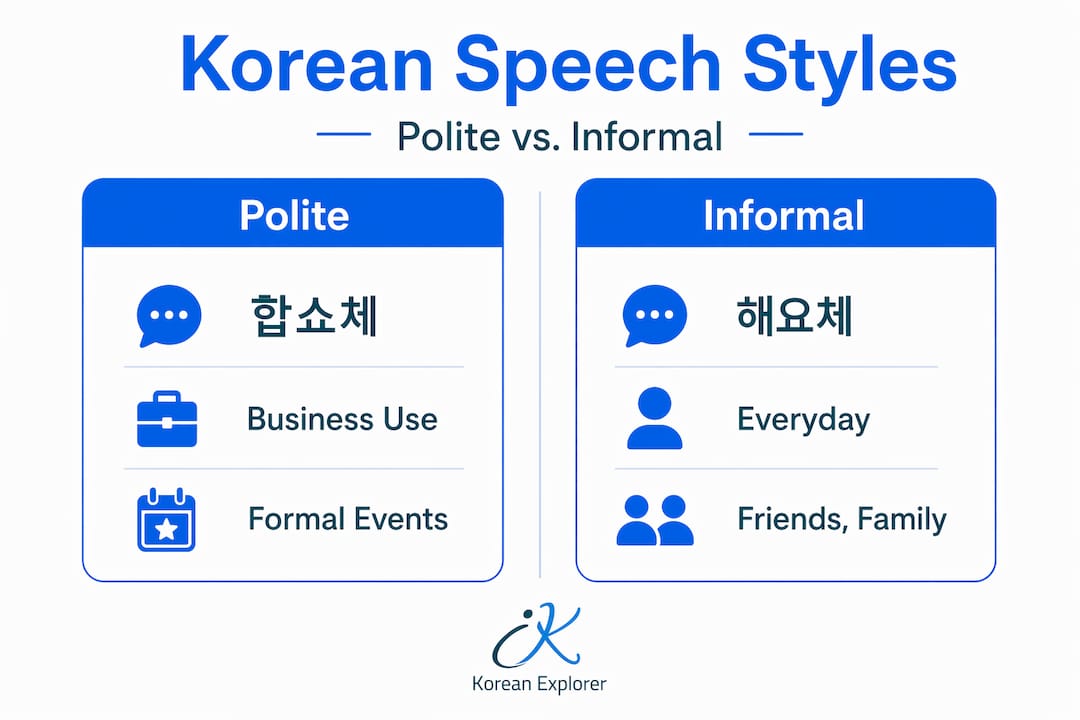
Korean has seven distinct speech levels that change verb endings, vocabulary choices, and the entire social texture of what you say. Most learners learn 해요체 (polite informal) and maybe 합쇼체 (deferential formal), then stop there. That gap shows immediately in professional or social settings.
The core contrast most people know is 존댓말 (formal/polite speech) versus 반말 (informal speech). But the reality is more layered. Between those poles sit speech forms used with close colleagues, older friends, or in service contexts. Honorifics are rooted deeply in Confucian values around age, hierarchy, and social harmony. Getting them wrong is not just a grammar error. It reads as a social misstep.
Here is a quick reference for the speech levels you need to master at an advanced stage:
| Speech level | Korean name | When to use |
|---|---|---|
| Deferential formal | 합쇼체 | Business presentations, customer service, TV broadcasts |
| Polite informal | 해요체 | Standard polite speech with strangers, new acquaintances |
| Intimate informal | 해체 | Close friends, peers after agreement to use 반말 |
| Plain form | 해라체 | Written instructions, diaries, news articles |
| Familiar | 하게체 | Older person speaking to a younger adult in formal contexts |
Beyond verb endings, honorific vocabulary swaps entire words. You do not use 먹다 (to eat) for a senior. You use 드시다. You do not ask someone older if they 자다 (sleep). You ask if they 주무시다. Relational correctness matters more than grammatical accuracy in real Korean communication. Knowing the technically correct sentence structure means little if you use the wrong register for the person in front of you.
Pro Tip: When unsure which level to use, default to 해요체 until the other person explicitly invites 반말. Stepping down prematurely signals disrespect, while staying polite longer is almost always forgiven.
Cultural nuance: 눈치, indirectness, and emotional expression
This is where learning advanced Korean gets genuinely fascinating and where most learners underestimate how much work is left. The cultural values embedded in Korean communication are not decorative. They shape the grammar you choose, the words you reach for, and the silences you read correctly.

눈치 (nunchi) is the Korean concept of reading a room, picking up on unspoken social cues, and adjusting your behavior accordingly. Native speakers emphasize social context and nunchi over dictionary definitions when conveying authentic meaning. When a Korean speaker says 괜찮아요 (it’s fine) with a specific intonation in response to an invitation, they may be declining politely. A learner with strong grammar but weak nunchi will take it at face value and misread the entire exchange.
Indirectness is baked into the language at the phrase level. Expressions like 혹시 (perhaps/by any chance) and 괜찮으시면 (if it’s alright with you) soften requests and preserve the other person’s ability to say no without embarrassment. Using direct requests in contexts that call for indirect phrasing can come across as aggressive or inconsiderate, even if your grammar is perfect.
Korean also uses 의성어 and 의태어 extensively. These are onomatopoeia and mimetic words that carry emotional and sensory precision that full sentences would struggle to match. 울퉁불퉁 (bumpy and uneven), 반짝반짝 (sparkling), 두근두근 (heart pounding with excitement). When a native speaker uses these in conversation, they are not being poetic. They are being precise.
Advanced Korean fluency is not about knowing every word. It is about knowing which words a person with good 눈치 would choose.
Mastering these Korean language nuances means listening not just for what is said, but for what is deliberately left unsaid, softened, or expressed through a single evocative word rather than a full explanation.
Using advanced Korean in professional and social settings
Foreign nationals made up 5.44% of South Korea’s population in 2025, reaching 2.78 million residents. For professionals working in or with Korean companies, advanced Korean speaking techniques are not optional polish. They determine whether you are taken seriously in meetings, included in informal decision-making, and trusted with sensitive responsibilities.
Here is how to apply your advanced Korean skills effectively across professional and social contexts:
- Match speech level to hierarchy before you speak. Before your first meeting or call, find out the seniority of the people involved. Entering with the wrong speech level signals you do not understand Korean workplace culture.
- Use formal Sino-Korean vocabulary in written communication. Emails and reports lean on formal registers. Knowing business Korean vocabulary for contexts like meetings, proposals, and feedback conversations sets you apart from other non-native professionals.
- Practice timing, not just vocabulary. In Korean professional culture, speaking at the right moment is as important as what you say. Jumping in too quickly or too late both read as social miscues.
- Use roleplay scenarios for deliberate practice. Scenario-based learning that replicates real social dynamics, such as requesting a favor from a senior colleague or declining a work invitation politely, makes correct speech form usage memorable.
- Debrief after real conversations. After speaking Korean in a professional or social context, note the moments where you hesitated or defaulted to the wrong register. Targeted reflection accelerates correction faster than general review.
Pro Tip: Record yourself doing a roleplay scenario in Korean, then play it back. You will catch speech level inconsistencies and unnatural phrasing that you miss in real time.
Dialects and advanced media comprehension
Understanding major Korean dialects is the final layer that separates textbook fluency from real-world comprehension. Standard Seoul Korean is what you learn in class. It is not always what you hear in dramas, variety shows, podcasts, or conversations with native speakers from outside the capital.
| Dialect | Region | Notable features |
|---|---|---|
| 서울말 (Seoul) | Seoul, Gyeonggi | Standard reference dialect, neutral intonation |
| 경상도 사투리 | Busan, Daegu | Distinct pitch accent, shortened vowel sounds |
| 제주도 사투리 | Jeju Island | Heavily distinct, classified by some as a separate language |
| 전라도 사투리 | Gwangju, Jeonju | Softer endings, characteristic intonation patterns |
You do not need to speak dialects. You need to recognize them. Here is how advanced learners build that recognition:
- Watch Korean variety shows featuring guests from different regions. Shows like 런닝맨 or 무한도전 feature natural regional speech patterns in unscripted moments.
- Follow Korean webtoon communities online. Comment sections and fan forums use heavy slang and internet language that reflects how modern Korean actually evolves.
- Listen to regional Korean podcasts or radio. Exposure to non-Seoul speech in longer-form audio trains your ear without the pressure of live conversation.
- Study slang systematically. Internet Korean like 어케 (어떻게), ㅋㅋㅋ (laughter), or 갑분싸 (sudden awkward silence) appears constantly in digital communication and understanding it is part of mastering advanced Korean in the current era.
My take on what actually moves the needle
I’ve worked with hundreds of learners who arrive at advanced stages with solid grammar and good vocab retention, and the same gap shows up almost every time. They’ve studied the language but haven’t yet learned to read the room in Korean. Those are two different skills, and only one of them gets you treated like an insider.
In my experience, the biggest mistake advanced learners make is treating Korean cultural behavior as context for the language rather than as part of the language itself. 눈치 is not a soft skill you pick up naturally over time. It needs to be studied deliberately, practiced in real conversations, and reflected on after the fact. The Korean language skills that matter most in authentic settings are the ones tied to relationship management, not sentence construction.
What I’ve found works is committing to uncomfortable practice early. Speak Korean with native speakers before you feel ready. Use the wrong speech level once in a real conversation and the correction from a patient native speaker will stay with you longer than any grammar note. Fluency is not a destination you arrive at when you know enough. It is a disposition you develop through exposure, error, and recalibration. The learners who get there fastest are the ones who accept being imperfect in Korean out loud, often, and with real people.
— Paul
Take your Korean further with Korean Explorer
If you’ve recognized yourself in any of the gaps described above, structured learning with experienced native instructors can close them faster than self-study alone. Korean Explorer offers adult conversational and corporate Korean training built around real-world communication, speech level mastery, and cultural fluency. Classes are available online via Zoom or in person at the center above Tanjong Pagar MRT.
The curriculum is grounded in Seoul National University materials and taught by native Korean instructors who understand how to explain nuance clearly to English-speaking adults. Whether your goal is professional confidence in Korean workplaces or authentic conversational fluency, online Korean classes and group or private formats are available to match your schedule and learning pace. The gap between textbook Korean and real Korean closes faster with the right guidance.
FAQ
What does “advanced Korean” actually mean?
Advanced Korean means communicating with speech level accuracy, cultural awareness, and contextual vocabulary. It goes well beyond grammar to include honorifics, nunchi, indirect communication, and professional register.
How many speech levels does Korean have?
Korean has seven distinct speech levels that change verb endings and social tone. Advanced learners need to recognize and use at least four of these in different professional and social contexts.
Why is Sino-Korean vocabulary so important at advanced levels?
Sino-Korean vocabulary accounts for approximately 60% of the Korean lexicon. Recognizing shared root patterns lets advanced learners decode unfamiliar formal and technical words far more efficiently than memorizing individual entries.
What is 눈치 and why does it matter for Korean learners?
눈치 is the Korean concept of reading unspoken social cues and adjusting your behavior accordingly. Without it, even grammatically correct Korean can misfire socially, especially in professional or formal settings.
Do I need to learn Korean dialects to be advanced?
You do not need to speak dialects, but you should be able to recognize major ones like Busan and Jeju. Dialect awareness significantly improves your comprehension of regional vocabulary differences in media and real conversations.