TL;DR:
- Most learners quit Korean in their first month due to ineffective study routines rather than difficulty. A practical system centered on short daily sessions, active immersion, and speaking practice ensures sustainable progress and fluency. Consistent, structured routines with proper foundational skills like Hangul, alongside intelligent tool use and self-assessment, accelerate language mastery.
Most people who try to learn Korean quit within the first month. Not because Korean is impossibly hard, but because their study korean workflow is either too scattered or too rigid to survive a real week. They download five apps, binge grammar videos, and then wonder why nothing sticks. This guide cuts through that noise. You will get a practical, repeatable system built around short daily loops, smart immersion, and real speaking practice. Whether you are learning for personal travel, career advancement, or cultural connection, this is the Korean language workflow that actually holds up.
Table of Contents
- Key takeaways
- Your study Korean workflow starts here
- Executing your daily routine effectively
- Common mistakes that break your workflow
- Measuring your Korean learning progress
- My honest take on sustainable Korean study
- Take your workflow further with Korean Explorer
- FAQ
Key takeaways
| Point | Details |
|---|---|
| Start with Hangul immediately | You can learn the Korean alphabet in 1 to 2 days, unlocking real reading and pronunciation from day one. |
| Use the small loop method daily | A 25 to 35 minute daily session covering one pattern, vocabulary, speaking, and review beats occasional long study marathons. |
| Immerse actively, not passively | Watching Korean content twice with focused word lookup builds listening skills far faster than background watching. |
| Review yesterday’s mistakes first | Starting each session by revisiting previous errors improves retention and prevents one-way information overload. |
| Track fluency with self-assessments | Regularly testing your speaking confidence and media comprehension tells you when to advance your workflow. |
Your study Korean workflow starts here
Before you execute anything, you need the right foundation. Skipping this step is why so many learners spend weeks confused about pronunciation and never build real momentum.
Learn Hangul before anything else. This is non-negotiable. Learning Hangul in 1 to 2 days is genuinely achievable. The Korean alphabet has 24 basic letters organized into syllable blocks, and once you crack the pattern, you can sound out words immediately. Apps like Drops or Pimsleur work well for Hangul drills, and a free YouTube crash course can get you through the basics in a single evening. The payoff is immediate because you stop guessing at pronunciation and start building real phonetic accuracy.
Once Hangul is down, choose your tools intentionally. You do not need a dozen apps. You need:
- A spaced repetition system such as Anki for vocabulary cards with sentence context
- A listening resource such as Talk To Me In Korean (beginner audio lessons) or a Korean drama on a platform with subtitle controls
- A speaking practice method, even if it is just recording yourself out loud
Your study environment matters more than most people admit. A distraction-free space with your phone on Do Not Disturb and a fixed 25 to 35 minute time slot each day removes the decision fatigue that kills consistency. Schedule your sessions the same way you would a meeting. Distributing study across short daily sessions is more sustainable and more effective than a three-hour weekend session you dread.
Pro Tip: Set a recurring calendar reminder titled “Korean loop” at the same time each day. The goal is to make showing up automatic, not motivational.

Here is a simple tool reference to set up your korean beginner workflow:
| Tool | Purpose | Best for |
|---|---|---|
| Anki | Spaced repetition flashcards | Vocabulary with sentence context |
| Talk To Me In Korean | Structured audio lessons | Grammar patterns and listening |
| Naver Dictionary | Word lookup with examples | Real-time comprehension during immersion |
| Korean drama (Netflix) | Immersive input | Listening comprehension and culture |
Executing your daily routine effectively
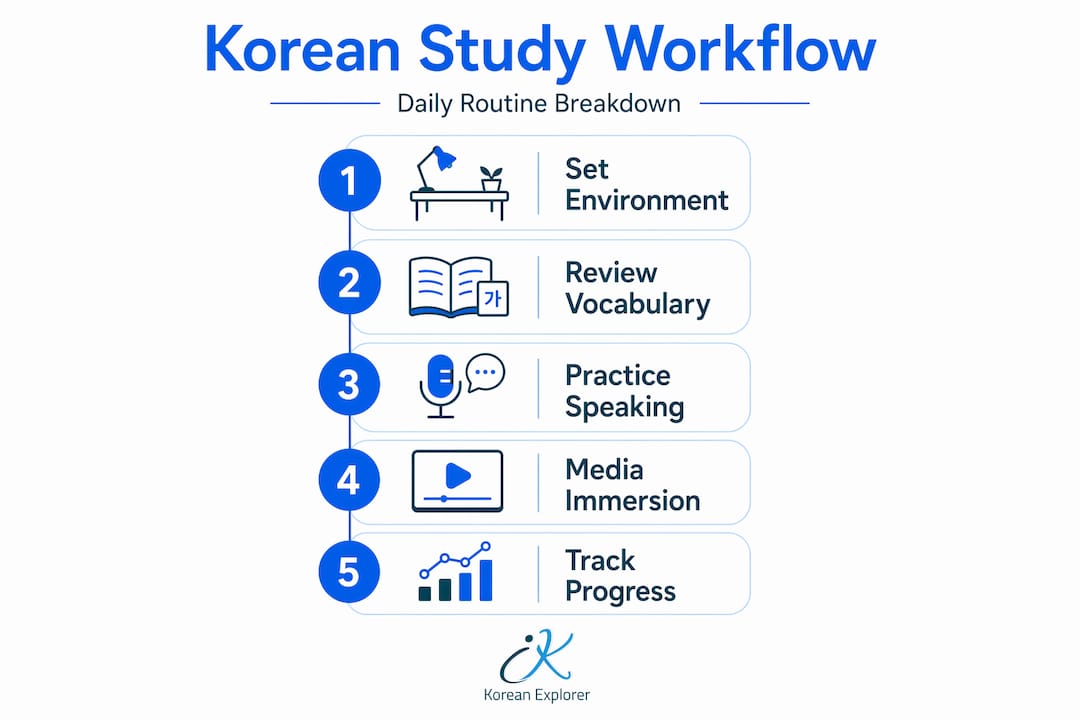
This is where the real work happens. The small loop method gives you a repeatable structure that fits inside 30 minutes and compounds over weeks into genuine fluency.
Here is how a single daily loop looks in practice:
- Review yesterday’s material first. Spend 5 minutes on your Anki deck or written notes from the previous session. Check which words or patterns you got wrong and repeat them out loud before touching anything new.
- Learn one grammar pattern. Pick one sentence structure such as “I want to…” (저는 ~고 싶어요) and understand how it works through two or three example sentences. Avoid memorizing grammar rules in isolation. Context is everything.
- Add three to five vocabulary words in sentence form. Cloze exercises and sentence-based cards outperform isolated word lists by a significant margin. Add new words inside the pattern you just learned so your brain connects grammar and vocabulary at the same time.
- Say everything out loud. This is the step most people skip because it feels awkward. Do it anyway. Producing language activates a different part of memory than reading or listening. Even talking to yourself counts.
- Listen before you dive into full lessons. Listening before individual phrase practice reduces overwhelm and builds phrase familiarity. Play your audio lesson or podcast clip first without doing anything else, just absorbing the sound and rhythm.
- Reuse the pattern in a new sentence. Before you close your study session, write or say one original sentence using the day’s pattern and at least two new words. This forces active production and locks in retention.
Pro Tip: If you miss a day, do not try to double up. Just resume the loop the next day. Consistency beats volume every time.
For immersion, build a weekly rhythm. Two or three times a week, watch 20 to 30 minutes of Korean content. Watch once without subtitles, then replay the same clip using pause-and-lookup. Active drama study for 30 minutes daily using Korean subtitles and targeted pauses builds vocabulary and listening speed far more than passive viewing. This approach, combined with your Korean language immersion practice, compounds your gains across both comprehension and speaking.
Woven throughout, speaking practice should start in week one. Not when you feel ready. Not after you finish a textbook. You can find fun verbal exercises that fit even a beginner’s limited vocabulary and get your mouth and brain working together from the start.
Common mistakes that break your workflow
Even a solid plan falls apart when a few recurring mistakes go unchecked. These are the traps that kill momentum for learners at every level.
- Relying on romanization. Reading Korean words as English phonetics feels easier at first, but it permanently distorts your pronunciation and slows reading speed. Commit to Hangul from day one and treat romanization as a training wheel you remove immediately. You can find solid Hangul study tips to make this transition fast and painless.
- Trying to master grammar before speaking. Grammar awareness grows through use, not through memorizing conjugation charts. Starting with core sentence patterns and speaking them immediately is far more effective than studying grammar in isolation.
- Practicing production before recognition. Practicing listening and recognition first before attempting to produce language reduces errors and builds confidence. If you try to speak a sentence before you have heard it multiple times, your pronunciation and rhythm will be off.
- Trying to learn every new word you encounter. This leads to a bloated flashcard deck and poor retention. Prioritize frequency (the 1,000 most common Korean words cover most daily conversation) and personal relevance (words tied to your work, hobbies, or life).
Slow down your immersion content before you give up on it. Level-checking before slowing immersion reduces frustration significantly. If you feel lost, the issue is usually speed, not your ability.
Frustration in Korean learning is almost always a pacing problem, not a talent problem. Adjust the speed of audio content, reduce the amount of new material per session, and return to simpler source material for a week. Progress almost always resumes.
Measuring your Korean learning progress
A good efficient Korean study plan needs a feedback loop. Without one, you are studying blind and will either plateau or burn out without realizing why.
Here are the clearest indicators that your workflow is working:
- You recognize words and phrases in new content you have never explicitly studied
- Your recall during Anki review is getting faster and more accurate
- You can produce sentences from patterns you learned weeks ago without looking anything up
- Korean media feels slightly less overwhelming each week
Spaced repetition data tells a precise story about your vocabulary retention. If your Anki retention rate drops below 70%, you are adding new cards too fast. Slow down and reinforce what you already have before expanding your deck.
A simple weekly self-check keeps your study methods honest:
| Self-assessment area | What to check |
|---|---|
| Vocabulary recall | Can you recall this week’s words without hints within 24 hours? |
| Listening comprehension | Did this week’s drama clip feel easier than last week’s? |
| Speaking production | Can you make a new sentence using each pattern from this week? |
| Review accuracy | What was your Anki accuracy rate today, and did it improve? |
Pro Tip: Spend the last 2 minutes of each session writing down one thing you got wrong today. That list becomes your first review priority tomorrow. This single habit, designed around reviewing previous mistakes, accelerates retention faster than most tools.
Scheduling reviews at optimal intervals matters more than most learners realize. Retrieving a memory just before you forget it is the most effective form of practice. Trust the spaced repetition algorithm rather than reviewing cards you already know by heart.
Adjust your workflow every two to three weeks based on what the data shows. If comprehension is rising but speaking lags, add more verbal production to your loop. If vocabulary retention is strong but listening feels weak, increase your immersion frequency. Your workflow should evolve with you.
My honest take on sustainable Korean study
I have watched a lot of learners come into structured study with the best intentions and burn out within two months. Not because Korean is too hard, but because they built a workflow around motivation instead of around a repeatable system.
Here is what I have learned: motivation is a terrible foundation. It spikes when you feel inspired and disappears the moment life gets busy. What actually works is a loop so short and repeatable that you do it almost without thinking. Twenty-five minutes. One pattern. Three words. Speak once. Review once. That loop, done daily, compounds in ways that even a four-hour weekend session cannot match. Building a repeatable study loop is what separates learners who reach conversational Korean from those who restart from scratch every few months.
I also think the obsession with grammar study is genuinely counterproductive for most people. Grammar is a description of how language works, not a prescription for how to learn it. You did not learn your first language by studying grammar charts. You absorbed patterns, used them, got them wrong, and corrected course. Korean works the same way. Focus on patterns you can use in real sentences within 24 hours of learning them.
The other insight I keep coming back to: immersion and active production together create a compound effect that neither can achieve alone. Immersion without speaking builds passive comprehension. Speaking without immersion builds awkward, disconnected output. Combine them daily, even in small doses, and your progress becomes visible within weeks.
Mistakes are not setbacks. They are data. When you get something wrong in your review, that is the system working exactly as it should.
— Paul
Take your workflow further with Korean Explorer
If you want structure to complement your self-study routine, Korean Explorer offers adult-focused Korean courses built for real-world use. Whether you are aiming for confident conversation or professional Korean communication, every course is designed by experienced native instructors who understand how adult learners build fluency efficiently.
Classes are available as group, private, or online Zoom sessions, making it easy to fit structured learning around your work schedule. Corporate training programs are also available for teams. If you have been piecing together your Korean language courses through apps and free resources, adding a structured program gives your workflow a spine. You will move faster, make fewer detours, and have an instructor to catch the mistakes no app will flag. Explore what Korean Explorer offers at koreanexplorer.com.sg.
FAQ
How long does it take to learn Hangul for beginners?
Most beginners can learn Hangul in one to two days with focused practice. A 7-day beginner workflow typically dedicates the first session entirely to the Korean alphabet before moving into vocabulary and sentence patterns.
What is the small loop method for studying Korean?
The small loop method is a 25 to 35 minute daily routine where you learn one grammar pattern, add three to five vocabulary words in context, practice speaking, and review the previous day’s material. It is designed to make consistent daily practice the default.
Should I study grammar before speaking Korean?
No. Starting with core sentence patterns and using them immediately in speech is more effective than mastering grammar rules first. Grammar awareness builds naturally through repeated use and active production.
How do I know if my Korean study workflow is working?
Signs include faster vocabulary recall during review, growing comprehension of Korean media, and the ability to produce new sentences from patterns learned weeks ago. Tracking your spaced repetition accuracy rate weekly gives you precise, objective data.
How much time should I study Korean each day?
Twenty-five to thirty-five minutes of focused daily practice consistently outperforms occasional longer sessions. Short daily loops build the habit muscle and allow spaced repetition to work at its optimal retrieval intervals.