TL;DR:
- The TOPIK grading system assigns proficiency levels from 1 to 6 based on total test scores without minimum section thresholds. Scores from PBT and IBT formats differ greatly, affecting interpretation by institutions, and scores are valid for two years. Higher levels reflect increasing Korean ability, from basic survival skills at Level 1 to full professional mastery at Level 6.
How does TOPIK grading work?
The TOPIK grading system assigns a Korean proficiency level from 1 to 6 based on your total score across two separate tests. TOPIK I covers Levels 1 and 2 for beginners, with a maximum of 200 points on the paper-based test (PBT). TOPIK II covers Levels 3 through 6 for intermediate and advanced learners, with a PBT maximum of 300 points. Your level is determined entirely by where your total score falls within the defined bands. There is no pass/fail verdict. You either earn a level or you don’t, and if your score falls below the minimum threshold, you simply retake the exam.
Here is a quick reference for the approximate PBT score bands corresponding to each TOPIK level.
The internet-based test (IBT) uses a completely different scale. TOPIK I IBT scores run up to 400 points, while TOPIK II IBT scores run up to 600. That distinction matters when you submit results to a university or employer, since the number on your report looks very different depending on which format you sat.
TOPIK scores are valid for a limited time from the date results are announced, which affects deadlines for university applications, visa submissions, and job applications. Practically speaking, if you are applying to a Korean university program or a work visa in the US context, you need to plan your test date so the certificate does not expire before your application is processed.
What each TOPIK level actually means for your Korean ability
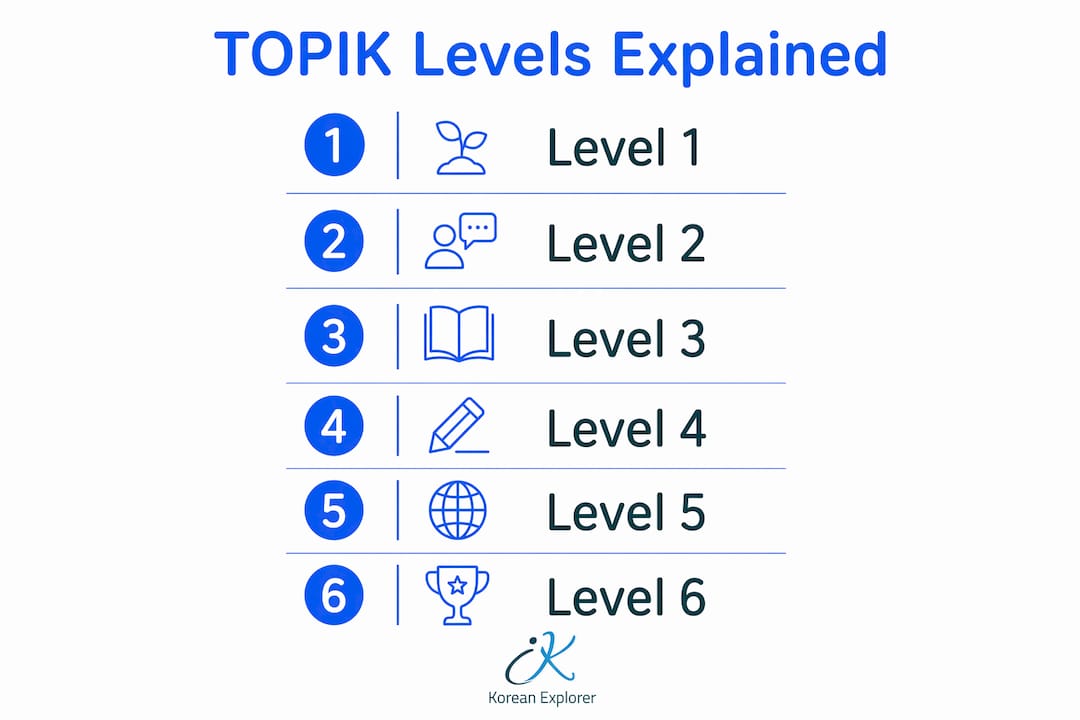
1. Level 1: Survival Korean
Level 1 covers the most basic communication needs: greetings, simple self-introduction, shopping, and ordering food. Learners at this stage typically know around 800 core vocabulary words and can handle predictable, everyday exchanges. On the CEFR scale, Level 1 roughly corresponds to A1.
2. Level 2: Everyday independence
At Level 2, you can handle familiar daily tasks without much difficulty, including using public transportation, making appointments, and understanding simple written notices. Vocabulary expands to around 1,500–2,000 words. CEFR equivalent is approximately A2.
3. Level 3: Social fluency begins
Level 3 marks the entry point for TOPIK II and signals a real shift in ability. You can describe and discuss familiar social topics, write organized paragraphs, and follow conversations on non-specialized subjects. This is the minimum Korean university admission requirement for most undergraduate programs. CEFR equivalent: B1.

4. Level 4: Confident communicator
Level 4 learners can discuss a broad range of social and cultural topics accurately and appropriately. Written output at this level includes well-structured narrative and commentary paragraphs. Graduate programs at Korean universities often require Level 4. CEFR equivalent: B2.
5. Level 5: Near-professional proficiency
At Level 5, you can read and write on abstract, professional, and specialized topics with reasonable accuracy. The writing tasks at this level include longer argumentative essays. Level 5 is often required for professional employment and certain visa categories. CEFR equivalent: C1.
6. Level 6: Full professional mastery
Level 6 represents the highest TOPIK certification. Learners at this level write accurately and appropriately on complex social, abstract, and professional topics. The distinction between Level 5 and Level 6 is precision and stylistic control, not just vocabulary size. For permanent residency applications in Korea, Level 5 or 6 is typically required. CEFR equivalent: C2.
How the TOPIK scoring system is structured
The test structure differs significantly between TOPIK I and TOPIK II, and understanding those differences helps you target your preparation.
Key scoring facts:
- TOPIK I tests only listening and reading, each contributing equally to the 200-point PBT total.
- TOPIK II adds a writing section, bringing the PBT total to 300 points across three components.
- There are no minimum scores required per section. Your total aggregate score determines your level, so a strong reading performance can offset a weaker listening score.
- The IBT format uses a scaled scoring system that produces higher raw numbers than PBT, so the two formats are not directly comparable without knowing which scale applies.
TOPIK I and II test structure (PBT):
| Test | Section | Questions | Time (minutes) | Max Points |
|---|---|---|---|---|
| TOPIK I | Listening | — | — | — |
| TOPIK I | Reading | — | — | — |
| TOPIK II | Listening | — | — | — |
| TOPIK II | Writing | 4 | — | — |
| TOPIK II | Reading | — | — | — |
The writing section in TOPIK II carries real weight for Levels 5 and 6. Two of the four writing tasks are extended essays, and they are graded by two independent raters on content, structure, grammar and vocabulary, and stylistic appropriateness. The shorter sentence-completion tasks contribute less to the final writing score than the essays do.
One thing worth knowing: the TOPIK speaking test is a completely separate evaluation, scored out of 200 points across six levels, and it does not factor into your TOPIK I or TOPIK II result at all.
How TOPIK scores translate into certificates
Your official TOPIK certificate shows your level, not your raw score. A typical score within the Level 4 band on TOPIK II PBT earns you a Level 4 certificate. The certificate itself does not display the number; it states the level. That matters because institutions requesting proof of Korean proficiency typically specify a level requirement, not a point threshold.
Key points about certificate issuance and score interpretation:
- If your TOPIK I score falls below 80, or your TOPIK II score falls below 120, no certificate is issued. You are eligible to retake the exam at the next available sitting.
- TOPIK scores are valid for two years from the announcement date, not the test date.
- US universities with Korean studies programs or Korean-language admission requirements typically specify a minimum TOPIK level rather than a raw score.
- For US-based employers hiring for roles requiring Korean language skills, Level 4 or above is the most commonly cited threshold for professional communication roles.
- Visa applications, particularly those tied to Korean immigration categories, may require Level 5 or above for permanent residency pathways.
A common confusion: test takers sometimes assume that a very high score within a level band upgrades them to the next level. It does not. A score of 189 on TOPIK II PBT is Level 4, not Level 5, regardless of how close it is to the 190-point threshold.
Pro Tip: Before submitting your TOPIK results to a US university or employer, confirm whether they accept PBT or IBT scores. The two formats produce very different raw numbers for the same proficiency level, and some institutions specify which format they recognize.
How to improve your TOPIK score strategically
Knowing how the grading system works gives you a real advantage when you study. Most learners waste time trying to be equally strong in every section when the scoring structure actually rewards a smarter approach.
Study tips grounded in the grading system:
- Identify your target level first, then work backward to the score band you need. If you are aiming for Level 4 on TOPIK II PBT, you need 150 points across three sections, not perfection in any one of them.
- If listening is your stronger skill, lean into it. Since total score determines your level, a strong listening score combined with a moderate writing score can still earn you a Level 4 certificate.
- For Levels 5 and 6, writing cannot be deprioritized. The essay tasks carry the most weight in the writing section, and two raters assess them independently. Practicing argumentative essay structure in Korean is not optional at this stage.
- Read authentic Korean materials at your target level: news articles for Level 4, academic or policy texts for Level 5 and 6.
- Take full-length timed practice tests under real conditions. Pacing matters, especially in the reading section where question volume is high.
Pro Tip: If your target institution is in the US, verify whether it requires PBT or IBT scores before you register for the exam. The scoring scales differ significantly between formats, and submitting the wrong format’s score report can delay your application.
If you want structured preparation aligned with the TOPIK exam format, Korean Explorer offers adult courses built around the same curriculum framework used by Seoul National University.
What the scoring criteria actually look like for each section
Listening and reading
Listening and reading questions in both TOPIK I and TOPIK II are multiple choice. Each correct answer carries equal weight within its section, and there is no penalty for wrong answers. The difficulty of questions increases progressively within each section, so the later questions in the reading section are considerably harder than the earlier ones.
Writing in TOPIK II
The writing section has four tasks. The first two ask you to complete sentences by filling in grammatically appropriate expressions. These are shorter and more mechanical. The third task is a descriptive or analytical essay targeting Levels 3 and 4. The fourth task is a full argumentative essay targeting Levels 5 and 6.
Each essay is graded by two raters on four criteria: content and task completion, text organization and structure, vocabulary range and accuracy, and grammatical accuracy and stylistic appropriateness. The essay tasks carry substantially more weight than the sentence-completion items. A learner who writes a well-organized, accurate 650-word essay will score considerably higher than one who writes a grammatically weak response of the same length.
For Level 3 and 4 writing, the evaluation focuses on whether you can construct organized paragraphs on familiar social topics using appropriately formal language. For Levels 5 and 6, raters assess whether your essay demonstrates control of abstract and specialized content, not just grammatical correctness.
How to read a TOPIK score report
Your TOPIK score report shows your name, registration number, test date, test type (TOPIK I or II), section scores, total score, and the level awarded. The level is the most prominent element because it is what institutions actually use.
Section scores appear individually, so you can see exactly where you performed well and where you lost points. A test taker with balanced scores across listening, reading, and writing on TOPIK II PBT may earn a Level 5 certificate. The report shows all three figures, but the certificate itself states only “Level 5.”
For IBT test takers, the score report uses the IBT scale. A Level 5 result on IBT corresponds to a score range that is different from the PBT equivalent due to differing scoring scales. When you send your score report to a US institution, include a note clarifying which format you sat if the institution’s requirements reference PBT score bands. Some admissions offices are not yet familiar with the IBT scale.
Common misconceptions about TOPIK grading
You need to pass each section separately. This is false. TOPIK uses total aggregate scoring. No section has a minimum threshold. A strong reading score can compensate for a weaker writing score, as long as the total clears the level band.
A higher score within a level means a better certificate. The certificate shows only your level. A score of 82 and a score of 138 both produce a Level 1 certificate on TOPIK I PBT. The raw score does not appear on the certificate itself.
TOPIK I and TOPIK II are sequential steps everyone must take. They are not. If you are confident in your ability, you can sit TOPIK II directly without having taken TOPIK I. The two tests are separate exams targeting different proficiency ranges, not a two-stage progression.
IBT and PBT scores are interchangeable. They are not. The scoring scales differ entirely between formats. A score of 250 on TOPIK II PBT means Level 6. A score of 250 on TOPIK II IBT falls below Level 3. Always specify the format when sharing your results.
TOPIK scores never expire. They do. Results are valid for two years from the announcement date. Plan your test date with your application deadlines in mind.
Key Takeaways
TOPIK assigns a proficiency level from 1 to 6 based entirely on total score, with no minimum required in any individual section, across two tests covering beginner through advanced Korean.
| Point | Details |
|---|---|
| Two tests, six levels | TOPIK I covers Levels 1–2 (max 200 PBT points; Level 1: 80–139, Level 2: 140–200); TOPIK II covers Levels 3–6 (max 300 PBT points; Level 3: 120–149, Level 4: 150–189, Level 5: 190–229, Level 6: 230–300). |
| Total score determines level | No section minimum exists; strong performance in one area can offset a weaker score in another. |
| PBT and IBT scales differ | IBT TOPIK I runs to 400 points; IBT TOPIK II runs to 600. Never compare the two formats directly. |
| Certificates show level, not score | The official certificate states your level only; institutions use level requirements, not raw point thresholds. |
| Scores valid for two years | Results expire two years from the announcement date, affecting university, visa, and job application timelines. |
FAQ
What’s a good score on TOPIK?
A “good” score depends on your goal. Level 3 (120–149 on TOPIK II PBT) meets most Korean undergraduate admission requirements, while Level 4 (150–189) is the standard for graduate programs and many professional roles.
What level of TOPIK is considered fluent?
Level 5 and Level 6 are generally considered professional or near-native fluency. Level 5 demonstrates the ability to handle abstract and specialized topics in both spoken and written Korean.
Is TOPIK harder than JLPT?
The two exams test different languages and use different structures, so a direct difficulty comparison is not straightforward. TOPIK II includes a writing component that JLPT does not, which many test takers find more demanding. At the highest levels, both exams require significant long-term study.
Can you retake TOPIK if you don’t reach a level?
Yes. If your score falls below 80 on TOPIK I or below 120 on TOPIK II, no certificate is issued, and you can register for the next available exam sitting with no restrictions.
Do US universities accept TOPIK scores?
Yes. US universities with Korean language requirements, particularly those offering Korean studies or dual-language programs, typically accept TOPIK certificates. Most specify a minimum level rather than a raw score, and you should confirm whether they require PBT or IBT format results before registering.