TL;DR:
- Exam-focused Korean learning tailors practice to specific test formats, question types, and timing constraints for better results. It emphasizes timed mock exams, error analysis, and strategic question recognition, complementing broader language skills. Combining structured exam prep with conversational practice optimizes both test performance and real-world Korean proficiency.
You study Korean consistently. You build vocabulary, practice grammar drills, and watch Korean shows to absorb the language. Then exam day arrives, and the score does not reflect the work you put in. This is the gap that what is exam-focused Korean learning addresses directly. Unlike general language study, exam-focused learning treats every practice session as preparation for a specific test format, question type, and time constraint. It is a deliberate method that targets Korean language proficiency tests with precision, and it produces results that unfocused study rarely does.
Table of Contents
- Key takeaways
- Understanding Korean language proficiency tests
- What exam-focused Korean learning actually means
- Effective study techniques for Korean exams
- Common pitfalls in Korean exam preparation
- Balancing exam prep with broader Korean skills
- My honest take on what actually works
- How Korean Explorer helps you prepare
- FAQ
Key takeaways
| Point | Details |
|---|---|
| Exam structure shapes your study | Understanding TOPIK I and II formats lets you prioritize reading, listening, and writing practice strategically. |
| Backward planning drives results | Effective Korean exam preparation starts from actual question types and works backward into a study schedule. |
| Timed simulation is non-negotiable | Practicing under real exam conditions builds both time management skills and the mental stamina exams demand. |
| Mistake logging accelerates progress | Reviewing and logging every error after practice tests is faster than redoing lessons from scratch. |
| Balance exam prep with real use | Pairing exam-focused techniques with conversational practice keeps your Korean functional beyond test day. |
Understanding Korean language proficiency tests
Before you can study for an exam, you need to understand exactly what that exam tests. The Korean language proficiency test most widely recognized internationally is TOPIK, the Test of Proficiency in Korean. It is divided into two levels, and the structure of each shapes your entire study plan.
TOPIK I covers listening and reading, targeting beginner to intermediate learners at Levels 1 and 2. TOPIK II, designed for Levels 3 through 6, adds a writing section that tests your ability to construct structured arguments and interpret data in Korean. Each additional level means the question depth increases significantly.
Here is a quick reference for the exam structure:
| Exam | Levels | Sections | Focus |
|---|---|---|---|
| TOPIK I | 1, 2 | Listening, Reading | Comprehension of basic Korean |
| TOPIK II | 3, 4, 5, 6 | Listening, Reading, Writing | Advanced comprehension and expression |
The writing section is where many TOPIK II candidates lose the most points because they prepare for it last, or not at all. The listening section runs at a fixed pace with no rewind option. Reading sections require speed as much as comprehension, since time pressure is real at every level. Knowing this shapes where you spend your study hours and how you practice.
What exam-focused Korean learning actually means
What is exam-oriented Korean study if not just studying Korean harder? The distinction matters. General Korean learning builds broad language ability through vocabulary accumulation, grammar practice, and exposure. Exam-focused learning does something different. It plans backward from test requirements rather than building knowledge forward from lesson one.
The core principles of this approach include:
- Targeting question types specifically. Every section of TOPIK has recurring question formats. You learn to recognize them and practice your response to each type, not just the language inside them.
- Practicing with time limits from day one. Sitting comfortably with unlimited time and reading Korean is enjoyable. Passing an exam requires completing 40 reading questions in under 70 minutes. Those are different skills.
- Building exam stamina through simulation. Practicing under realistic conditions is consistently more effective for exam results than passive review. A full mock test trains your focus to hold for the duration of a real exam.
- Treating strategic guessing as a skill. On difficult questions, recognizing recurring grammar patterns from past tests helps you make informed guesses rather than random ones, and that can change your score category entirely.
Pro Tip: Approach your Korean exam like a question-type game. Drill specific prompt structures under time limits, and review every error carefully. Repeating this cycle compresses months of passive study into weeks of targeted improvement.
This mindset shift is what separates learners who plateau from those who score. The shift from general study to exam-focused preparation can dramatically improve test outcomes when you commit to it fully.
Effective study techniques for Korean exams
The principles above only work when paired with concrete techniques. Here is how to build a practice routine that actually moves your score.
- Start with past exam papers. Past TOPIK papers are publicly available, and they are your primary resource. They reveal the question formats you will face, the difficulty curve within each section, and the vocabulary domains that appear repeatedly. Use them from the beginning, not just as a final check.
- Practice with past audio recordings. Listening under exam conditions requires familiarity with actual audio speed. Paying attention to audio pacing, including pauses and question intervals, trains you to stay oriented during the real test. When you hit vocabulary you do not recognize, practicing the discipline to keep moving rather than freeze is itself a skill.
- Pre-scan your listening questions. Before each listening track begins, read the question and answer options. Pre-scanning listening questions helps lock onto key information the moment the audio starts, which directly reduces errors during fast-paced sections.
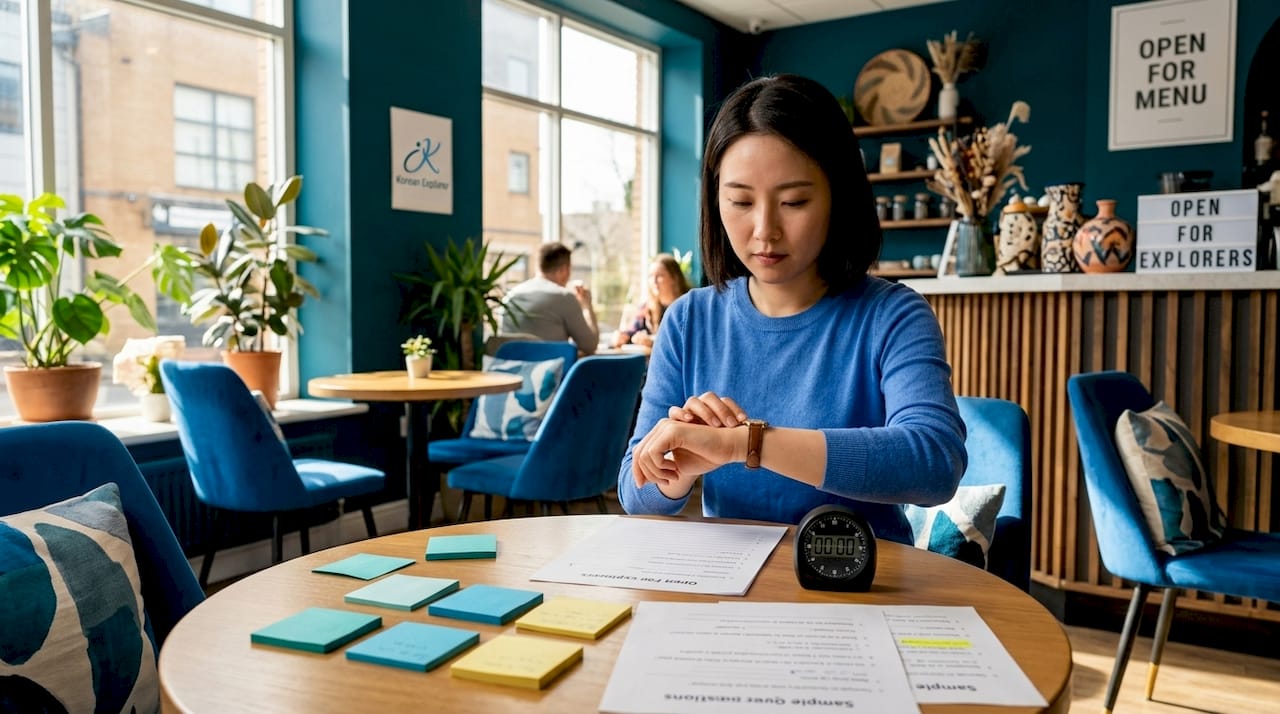
- Run full timed mock tests weekly. The month before your exam, take full timed mock tests at least once per week. Sit in a quiet space, use actual timing, and do not pause. This builds both stamina and time management, two qualities that lesson study alone cannot develop.
- Practice structured writing with grid paper. For TOPIK II, using exam-specific writing prompts on wongoji grid paper and building a bank of memorized transition phrases dramatically improves your writing score. Opinion essay formats and data interpretation tasks have templates you can learn and adapt.
- Log every mistake with a reason. After each practice test, do not just check which answers were wrong. Write down why you got each one wrong. Pattern recognition in your errors is what guides your next study session toward real improvement.
Pro Tip: Korean schools are known for using 50-minute focused study blocks followed by short breaks to maintain concentration. Borrow this structure for your exam prep sessions. It keeps you productive without burning out.
Beyond individual techniques, check these resources for Korean learning that work specifically for structured exam preparation. The right material makes a real difference when your study time is limited.
Common pitfalls in Korean exam preparation
Even motivated learners make predictable mistakes. Knowing them in advance saves you weeks of misdirected effort.
- Drilling grammar without simulating the exam. Grammar knowledge matters, but over-investing in drills without running full timed tests often stalls score improvement. The test is not a grammar quiz. It is a timed, multi-section performance under pressure.
- Skipping question type analysis. Many learners read a passage, check if they got the answer right, and move on. This misses the point. Identifying which question type tripped you up, and why, is where the actual learning happens.
- Poor time distribution during practice. Spending 90% of your study time on reading while barely touching listening or writing creates uneven preparation. Allocate practice time to reflect the actual weight and difficulty of each section for your target level.
- Avoiding mock exams until the last week. Waiting until the week before the exam to take your first full practice test is one of the most common and costly mistakes. The role of mock exams in building test-day readiness is well established across exam contexts. Start them early.
- Treating all vocabulary study as equal. Not all Korean vocabulary appears in proficiency exams with the same frequency. Studying exam-relevant academic and formal Korean is a better use of your time than memorizing conversational slang, at least in the context of Korean exam preparation.
Balancing exam prep with broader Korean skills
What is exam-focused Korean learning in the long run? It is a phase, not a permanent identity. The techniques that work for Korean language proficiency tests can coexist with, and even accelerate, your broader Korean development.
- Listening practice for the exam also sharpens real comprehension. The audio tracks in TOPIK draw on formal Korean across news, announcements, and discussions. Practicing these builds listening skills that transfer directly to professional and academic Korean use.
- Writing essays for the exam improves your written communication. The structured opinion essays and data summaries in TOPIK II mirror the kind of writing adults use in business Korean contexts. You are not just preparing for a test. You are building a skill that has practical value.
- Courses that combine exam prep with conversation. The best Korean learning strategies for exams do not wall off test preparation from real language use. Courses that teach exam techniques alongside conversation and listening give you both.
For adult learners balancing work and study, online Korean courses offer the scheduling flexibility that classroom-only options cannot match. Structured programs that align with TOPIK standards give you the framework to progress without having to design your own curriculum from scratch. Once your exam goal is achieved, the vocabulary, grammar precision, and comprehension habits you built carry forward into professional or personal Korean use.
My honest take on what actually works
I have seen a consistent pattern among learners who struggle with Korean proficiency exams. They know a lot of Korean. They have watched dramas, learned vocabulary, worked through textbooks. But they have never actually sat down and treated the exam as its own subject.
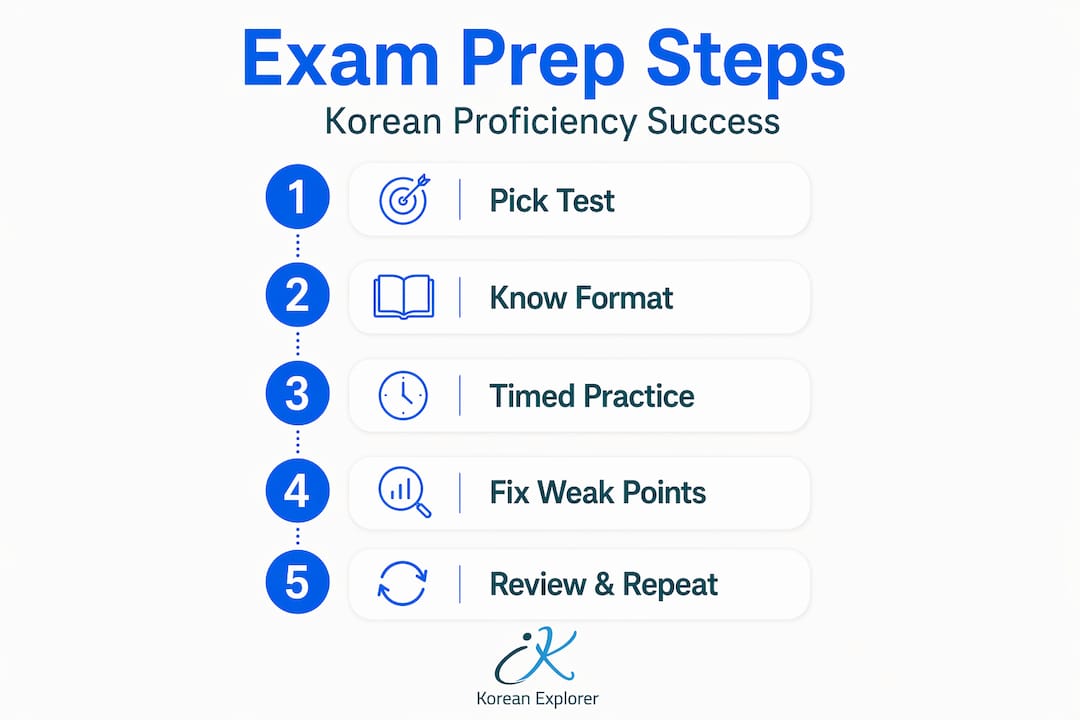
The test has a format. That format is learnable. And the learners who treat it as such, drilling question types systematically and reviewing mistakes without skipping the uncomfortable ones, are the ones who improve fastest. In my experience, the biggest single upgrade for a stalled learner is not more vocabulary. It is their first real, fully timed, distraction-free mock test sitting, followed by an honest error review.
I will also say this directly: casual Korean study and exam-focused Korean study serve different goals. Both are valid. But if you have an exam date coming up, being attached to your existing study routine because it feels comfortable is not a strategy. Exam preparation for adults works best when it is time-boxed, deliberate, and structured around what the test actually rewards. Build that system first. Once the score reflects your ability, you can return to the broader, more relaxed language exploration you enjoy.
— Paul
How Korean Explorer helps you prepare
Korean Explorer offers structured Korean courses for adult learners designed to align with TOPIK standards, so your classroom time directly supports your exam goals. Whether you prefer group sessions, private coaching, or online Zoom classes, the courses are built around a Seoul National University curriculum that covers the language skills TOPIK actually tests.
If you are not sure which level to target, the Korean placement test helps you identify where you currently stand and which exam tier is the right next goal. Korean Explorer’s native Korean instructors, fluent in both Korean and English, can explain exam strategies clearly and adapt their teaching to the test sections where you need the most work. For learners in Singapore, classes are available at the International Plaza center above Tanjong Pagar MRT, as well as Jurong and Tampines locations. Read the TOPIK preparation guide to see how structured learning connects with the exam-focused techniques covered in this article.
FAQ
What is exam-focused Korean learning?
Exam-focused Korean learning is a study approach that targets specific test formats, question types, and time constraints of Korean language proficiency exams like TOPIK, rather than building general language fluency. It prioritizes timed practice, mock tests, and mistake analysis over broad vocabulary or grammar study.
How is TOPIK I different from TOPIK II?
TOPIK I tests listening and reading at Levels 1 and 2, while TOPIK II adds a writing section and covers Levels 3 through 6. The writing component in TOPIK II requires structured essays and data interpretation, making targeted writing practice a separate and significant preparation task.
How often should I take practice tests before the TOPIK exam?
Taking timed practice tests at least twice a week, with one full mock test per week in the final month before the exam, is a widely recommended frequency. Each session should be followed by a detailed review of every incorrect answer.
Why do timed practice tests matter so much?
Full timed mock tests build the stamina and time management skills that lesson-based study cannot replicate. Without practicing under real exam conditions, many learners find that their knowledge does not translate into exam performance because they are unprepared for the time pressure.
Can I prepare for Korean exams while also building conversational skills?
Yes. The best study methods for Korean exams overlap with practical language use. Listening sections draw on formal spoken Korean, and writing tasks mirror professional communication. Courses that combine exam preparation with conversation practice give you the most complete result.