TL;DR:
- Interactive Korean teaching emphasizes active participation through real communicative tasks rather than passive listening, which accelerates fluency. Research shows that engaging learners with conversation, role-plays, and peer interaction leads to faster, more durable language acquisition than traditional methods. Combining AI tools for practice with human instructors for cultural nuance creates the most effective approach to mastering Korean.
Most people who try to learn Korean hit the same wall: they can recite grammar rules, memorize vocabulary lists, and recognize Hangul characters, but the moment someone speaks to them in Korean, their mind goes blank. That gap between knowing Korean and using Korean is exactly what interactive Korean teaching is designed to close. Rather than treating learners as passive recipients of information, interactive methods put you in the middle of real communicative situations from day one, building fluency through doing rather than just absorbing.
Table of Contents
- Key takeaways
- What interactive Korean teaching actually means
- Research evidence on effectiveness
- AI tutors versus human instructors
- Practical tips to learn Korean interactively
- My take on what interactive teaching actually changes
- Start learning Korean interactively with Korean Explorer
- FAQ
Key takeaways
| Point | Details |
|---|---|
| Interaction beats memorization | Active participation in speaking and listening tasks builds real fluency that vocabulary drills alone cannot achieve. |
| Research backs engagement | Video completion and homework participation show correlation coefficients above 0.82 with better course outcomes. |
| AI has real limits | AI tutors support vocabulary and grammar practice but cannot replicate the cultural and emotional nuance of a human instructor. |
| Syllable-first Hangul learning works | Teaching Korean script through syllable blocks outperforms grapheme-by-grapheme methods for adult English speakers. |
| Blended learning is the sweet spot | Combining AI practice tools with human-led conversation classes produces faster, more durable progress. |
What interactive Korean teaching actually means
Interactive Korean teaching is an approach where learners actively produce, respond to, and negotiate meaning in Korean rather than simply watching or listening. It replaces the traditional lecture model with tasks that require you to speak, react, question, and collaborate. Think of it as the difference between watching a cooking show and actually cooking.
At its core, this approach draws on several well-established Korean teaching strategies:
- Task-based learning: You complete real-world tasks in Korean, such as ordering food, negotiating a business deal, or describing directions. The task is the vehicle; language practice is the result.
- Role-plays and simulations: Structured scenarios where you take on a character or professional role and must respond in Korean in real time.
- Conversational drilling with feedback loops: You produce language, your instructor corrects or reshapes it immediately, and you try again. This feedback cycle is what accelerates progress.
- Peer interaction: Group discussions, debates, and collaborative presentations where multiple learners must negotiate meaning together.
- Cultural immersion activities: Understanding Korean speech levels (formal, informal, honorific) in context rather than as abstract rules, which is a form of what is Korean language immersion in a classroom setting.
When it comes to Hangul, the Korean writing system, interactive methods also change how beginners approach reading. Research shows that syllable-based Hangul instruction produces higher reading accuracy in adult English speakers than grapheme-by-grapheme methods, because Korean is fundamentally organized around syllable blocks rather than individual letters.
Pro Tip: If you are just starting Korean, ask your instructor to teach you Hangul by building syllable blocks from the start rather than isolated consonants and vowels. It maps more naturally to how Korean words are actually constructed.
You can also explore verbal exercises for Korean that put these methods into practice right away, even at the beginner level.
Research evidence on effectiveness
The data behind interactive Korean language methods is compelling and worth knowing before you choose a learning format.
A study examining Korean language learners on online platforms found that active learning behaviors including discussion participation, course access, and homework completion are significant predictors of achievement. Specifically, video viewing behavior correlated with grades at 0.824, while homework completion time correlated at an even stronger 0.896. These are not marginal effects. They represent a strong relationship between how much you engage interactively with material and how well you actually perform.
Task-based oral activities tell a similar story. Studies using pre and post tests with language learners show that role-plays and presentations produce measurable gains in motivation, interaction frequency, and speaking fluency within just four weeks of treatment. Control groups receiving traditional instruction showed far smaller gains in the same period.

| Learning method | Motivation gain | Fluency gain | Interaction frequency |
|---|---|---|---|
| Task-based interactive instruction | High | Significant within 4 weeks | High |
| Traditional lecture-based instruction | Low to moderate | Slow | Low |
| Passive digital content only | Low | Minimal | Very low |
There is also a deeper cognitive reason why interaction matters. Research on Korean learners consistently shows that advanced learners struggle to apply explicit grammar automatically in real-time speech. You might know a grammar rule perfectly on paper but freeze when a native speaker uses it at full conversational speed. Interactive practice is what trains your brain to deploy that knowledge automatically, without stopping to think.
“Interactive Korean teaching is evolving from simple digital content to a participatory, technology-enhanced learner-teacher collaboration model.” — Integration of AI Digital Textbooks in Korean educational practices
AI tutors versus human instructors
The rise of AI language tools has added a genuinely useful layer to engaging Korean lessons, but it has also created some confusion about what AI can and cannot do.
Here is an honest comparison:
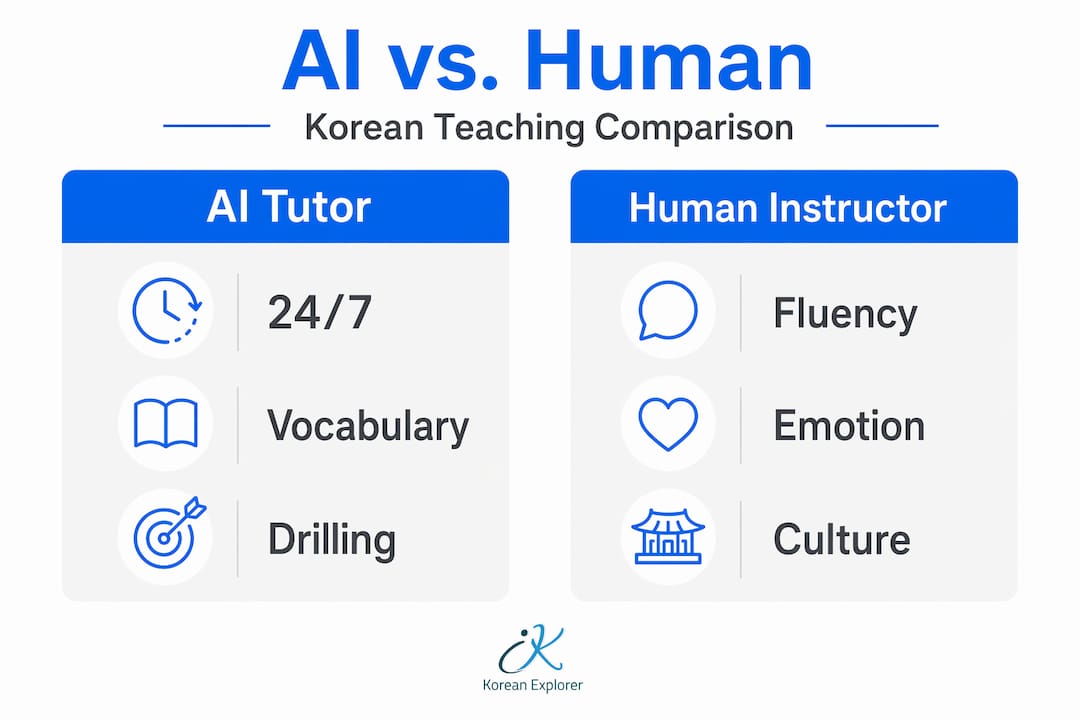
| Feature | AI tutors | Human instructors |
|---|---|---|
| Vocabulary drilling | Excellent, available 24/7 | Good, but limited by class time |
| Grammar pattern recognition | Strong for repetitive practice | Strong with contextual explanation |
| Real-time conversational adaptation | Limited | High, responds to tone and context |
| Cultural and pragmatic nuance | Weak | Strong, instructor draws on lived experience |
| Emotional support and motivation | Minimal | Significant, especially for anxious learners |
| Error correction with social context | Basic | Nuanced, accounts for formality level |
Research comparing AI and human tutor outcomes confirms that AI accelerates vocabulary recall and grammar pattern recognition but falls short in real-time conversational adaptability and pragmatic nuance. Korean has exceptionally complex speech level systems, honorifics, and indirect expression patterns that shift based on relationship, context, and emotional subtext. An AI tutor cannot feel the awkwardness of using the wrong speech level with a senior colleague or the warmth of switching to casual speech with a new friend.
As one key insight from that research puts it: fluency is co-constructed in real time, requiring the kind of emotional and social sensitivity that human instructors uniquely provide.
The most effective approach combines both. Use AI tools for vocabulary repetition, pronunciation drilling, and grammar exposure between classes. Use human-led sessions for the messy, unpredictable, socially rich conversations that actually build fluency.
Pro Tip: Treat AI apps as your personal gym for Korean mechanics and your human class as the actual game. Both matter, but they are training different skills.
Practical tips to learn Korean interactively
Knowing that interactive methods work is one thing. Putting them into practice, especially in a virtual or corporate learning context, requires some deliberate choices.
Choose courses that prioritize speaking time. A Korean class where the instructor talks for 80% of the session is not interactive by any meaningful definition. Look for programs that guarantee regular speaking practice and peer interaction built into the lesson structure.
Use error mining actively. When you make a mistake in conversation, do not just move on. Ask your instructor to give you a repair script: the correct version of what you were trying to say. Then use it again in the same class session. This single habit accelerates conversational fluency faster than almost anything else.
Treat virtual Zoom classes as real classrooms. Keep your camera on, prepare a few things you want to say before class, and volunteer to answer questions first. Passive attendance in an online class is the equivalent of sleeping in a library. The tools are there but you have to use them.
Practice one Korean speech level at a time. Many learners get overwhelmed trying to learn formal and informal Korean simultaneously. Pick one register, drill it until it feels natural in conversation, then layer on the next. Your instructor can guide this progression based on your goals.
For business Korean specifically, role-play professional scenarios before you need them in real life. Practice introducing yourself in a meeting, asking for clarification politely, and giving feedback in Korean. You can find practical methods for Korean mastery that cover exactly this kind of situational preparation.
Pro Tip: Record yourself speaking Korean for 60 seconds before and after each month of classes. Listening back is uncomfortable at first, but it gives you concrete evidence of progress that motivates you to keep going.
A common pitfall is treating audiobooks and passive listening content as a substitute for live interaction. Audio resources can be useful supplements. For a clear breakdown of how audio tools support language learners, they work best when combined with active recall and speaking practice, not as a standalone strategy.
My take on what interactive teaching actually changes
I have seen learners come to Korean Explorer after years of self-study who could read Hangul fluently, recall hundreds of vocabulary words, and explain grammar rules with impressive accuracy. And I have seen those same learners completely freeze when asked to order coffee in Korean during a class simulation. That gap is not a personal failing. It is exactly what the research describes: explicit grammatical knowledge and automatic real-time language use are genuinely different cognitive skills.
What I have learned from watching this happen repeatedly is that the turning point is almost always social. The moment a learner stops trying to be correct and starts trying to be understood, something shifts. That shift only happens through interaction, not through more studying.
I will also say this directly: blended learning is not just a trend. It is the most practical model for adult learners with real schedules and real goals. AI tools handle the repetition you cannot always get in a weekly class. Human instructors handle the judgment calls that require cultural fluency and emotional intelligence. Neither alone is enough.
The learners I have seen make the most dramatic progress are the ones who accept being uncomfortable in the interactive space. They make mistakes in front of others, they get corrected, and they come back the next week to do it again. That willingness is more predictive of success than any aptitude test I have ever seen.
— Paul
Start learning Korean interactively with Korean Explorer
Korean Explorer brings together everything this article describes: structured interactive lessons built on a Seoul National University curriculum, native Korean instructors who understand what adult learners in Singapore actually need, and flexible formats that fit real schedules. Whether you want to hold a business conversation with confidence, connect with Korean culture on a deeper level, or build professional Korean skills for work, the courses are designed around speaking and interaction from the very first lesson. Group classes, private sessions, and online Korean classes via Zoom are all available, so you can find the format that works for you. Explore the full range of Korean language courses in Singapore and take the first step toward Korean you can actually use. Korean Explorer is located right above Tanjong Pagar MRT at 10 Anson Road, Level 22, International Plaza, Singapore 079903, with additional centers in Jurong and Tampines.
FAQ
What is interactive Korean teaching?
Interactive Korean teaching is a learner-centered approach where students actively speak, respond, and collaborate in Korean rather than passively receiving instruction. It uses strategies like role-plays, task-based activities, and real-time conversation practice to build fluency beyond rote memorization.
Does interactive learning actually improve Korean faster?
Research confirms that task-based speaking activities produce measurable gains in fluency and motivation within four weeks, significantly outperforming traditional lecture-based methods. Active engagement with course content also correlates strongly with better grades in Korean language programs.
Can AI tools replace human Korean teachers?
AI tools are effective for vocabulary drilling and grammar pattern practice, but they cannot replicate the cultural nuance, speech level sensitivity, and emotional responsiveness that human instructors provide. The best outcomes come from combining both.
How do I find an interactive Korean class in Singapore?
Look for programs that build speaking time and peer interaction into every session, prioritize conversational practice over passive listening, and are taught by native instructors who can correct pragmatic errors in real time. Korean Explorer offers exactly this type of adult-focused, interactive Korean learning across multiple locations and online.
Is group or one-to-one Korean class better for interaction?
Both formats offer distinct interactive benefits. Group classes expose you to varied conversational partners and peer correction, while one-to-one classes maximize your personal speaking time and allow instruction tailored to your specific goals. You can compare the interactive dynamics of both formats to decide which suits your learning style.