TL;DR:
- The “Seoul National Curriculum” actually refers to South Korea’s national standardized education framework mandated for all public schools. Its 2022 revision emphasizes competency, creativity, and digital literacy, including mandatory AI coding, while gradually phasing in across levels by 2027. Despite reform efforts, persistent testing culture challenges hinder full implementation of holistic, student-centered assessment practices nationwide.
When students and educators search for what is seoul national curriculum, they often hit an immediate roadblock: the term does not name a single, tidy document tied to Seoul. It is, in most cases, a shorthand for South Korea’s nationally standardized education framework. Specifically, it refers to the 2022 Revised National Curriculum, which the Ministry of Education mandates for all public schools across the country. Understanding what this framework actually covers, and what it recently changed, is the foundation for any serious academic or curriculum development conversation.
Table of Contents
- Key takeaways
- What is the Seoul national curriculum, really
- Core features of the 2022 revised curriculum
- Curriculum structure by education level
- Challenges in South Korean curriculum development
- My honest take on what this curriculum shift means
- Learn Korean the way the curriculum intended
- FAQ
Key takeaways
| Point | Details |
|---|---|
| It is a national framework | The Seoul National Curriculum is actually South Korea’s centralized national standard, not a Seoul-exclusive document. |
| The 2022 revision is now active | Phased implementation runs from 2024 to 2027, covering all levels from elementary through high school. |
| Competency over content | The revision shifts focus from memorizing facts to building creativity, autonomy, and digital literacy. |
| AI and coding are now mandatory | All students encounter AI coding and digital problem-solving subjects as part of the updated curriculum. |
| Assessment reform is underway | Process-oriented and portfolio-based evaluations are replacing purely test-centered grading practices. |
What is the Seoul national curriculum, really
The phrase “Seoul National Curriculum” is, technically, a misnomer in Korean education. South Korea operates a centralized education system, which means the Ministry of Education sets a single, uniform set of standards that applies to every public elementary, middle, and high school in the country. Seoul does not have its own separate curriculum. What it does have is the Seoul Metropolitan Office of Education, which supports local schools in implementing the national framework in ways that suit their communities.
This distinction matters more than it might seem. When educators and students talk about the Seoul National Curriculum in the context of academic planning or curriculum development, they are almost always referring to the national document that governs learning goals, subject requirements, and competency expectations for all Korean students.
The curriculum framework encourages cooperation among schools, local education offices, students, parents, and teachers. Rather than dictating every classroom minute from the top down, the framework sets standards and invites schools to apply them with flexibility and local judgment. That balance between national consistency and local autonomy is one of the defining features of how South Korea governs education.
Pro Tip: If you are researching this topic for academic purposes, always use the official term “2022 Revised National Curriculum” (2022 개정 교육과정) in your citations. This specificity signals to reviewers that you understand the governance structure behind the framework.
The goals of this curriculum are broad but deliberate. The Ministry designed it to help students develop the capacity to thrive in a rapidly changing society, adapt to new technologies, and contribute meaningfully to democratic life. These are not abstract ideals. They are embedded directly into the subject requirements and assessment philosophy that schools follow nationwide.
Core features of the 2022 revised curriculum
The most significant thing to know about the current version is what changed from the version before it. The 2022 revision shifted South Korea away from a content-heavy model, where success meant memorizing large volumes of factual material, toward a learner-centered, competency-based model. The focus now sits on creativity, student agency, and adaptability. This shift directly reflects pressures from AI technology growth, demographic changes, and the increasing complexity of modern professional life.
Here is how the updated framework breaks down in practical terms:
- Competency-based learning replaces rote memorization as the primary educational goal. Students are expected to apply knowledge, not just recall it.
- AI coding and digital literacy are now mandatory subjects. The information curriculum hours were doubled across all grade levels, with AI coding and digital problem-solving integrated at every stage.
- Ecological transition education introduces sustainability as a thread across subjects, rather than a one-off lesson.
- Select-subject structures give high school students more freedom to choose electives aligned with their career directions and interests.
- School autonomous time is built into the schedule, creating space for schools to design programs that match their specific student populations.
| Reform area | Previous approach | 2022 revision approach |
|---|---|---|
| Learning focus | Content mastery and factual recall | Competency development and application |
| Technology education | Basic computer skills, limited scope | Mandatory AI coding and digital literacy |
| Subject flexibility | Fixed national subject lists | Student-selected electives and credit flexibility |
| Ecology and sustainability | Minimal integration | Embedded across multiple subjects |
| Assessment | Primarily standardized tests | Combination of tests, portfolios, and process evaluation |
Pro Tip: For curriculum developers studying this framework, pay close attention to the credit flexibility system. The tiered subject choice structure is one of the most transferable design elements, and it offers real lessons for any education system looking to balance national standards with personalized learning pathways.
The phased rollout timeline is worth knowing if you are tracking implementation. Elementary schools began adopting the revised curriculum in 2024. Middle schools followed in 2025. High schools complete the transition by 2027, at which point the new framework is fully operational across all levels.
Curriculum structure by education level
One of the most useful ways to understand the Seoul National Curriculum is to see how its goals evolve as students move through the education system. Each stage builds on the previous one, and the progression is deliberate.
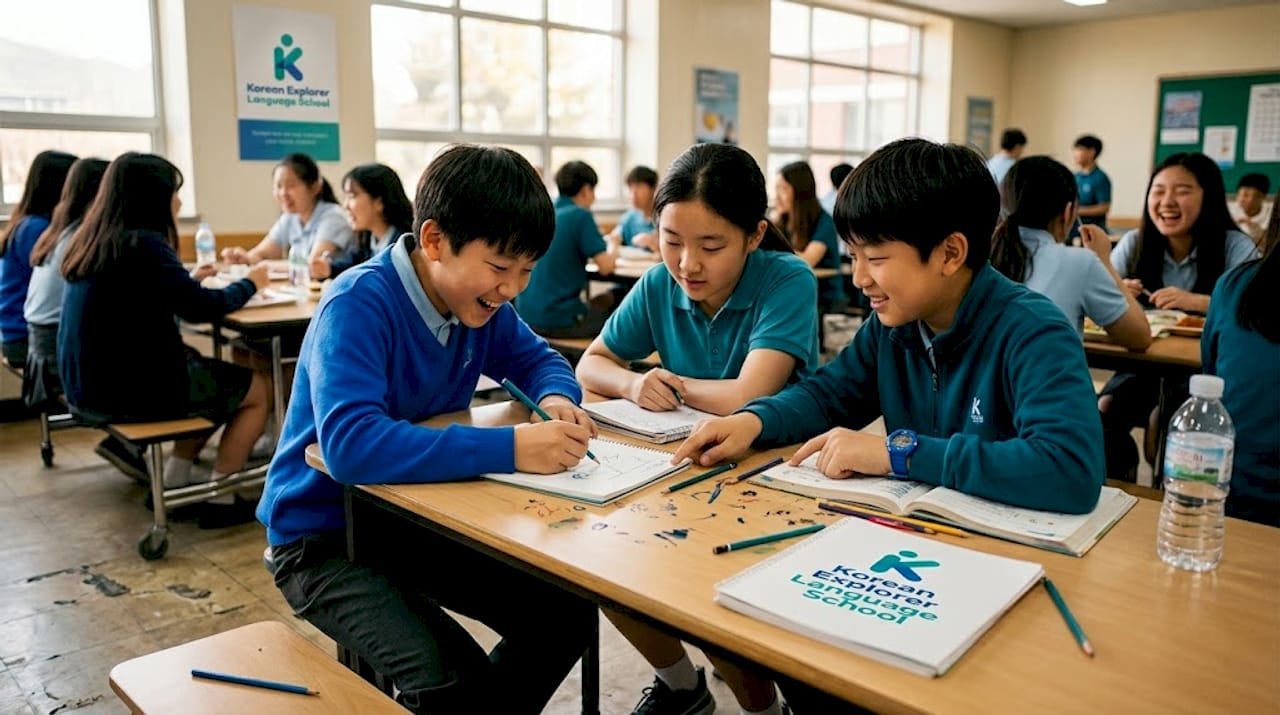
At the elementary level, the curriculum focuses on foundational habits, healthy development, and early creativity. Students are introduced to subjects in an integrated, exploratory way that encourages curiosity rather than specialization. The curriculum goals at this stage prioritize building the emotional and social groundwork that later academic development depends on.
At the middle school level, the tone shifts meaningfully:
- Students take on more complex reasoning tasks and are expected to engage with problem-solving across subjects.
- Civic responsibility and democratic citizenship become explicit curriculum goals.
- Students begin connecting classroom learning to real-world questions and social issues.
- Critical thinking is introduced not just as a skill but as a habit to be practiced across disciplines.
The high school level is where the curriculum becomes most individualized. Students can choose subject tracks that align with their post-secondary plans, whether that is university preparation, vocational training, or career-specific pathways. Global citizenship takes on greater weight at this level, and students are expected to think beyond national boundaries when analyzing problems and forming opinions.
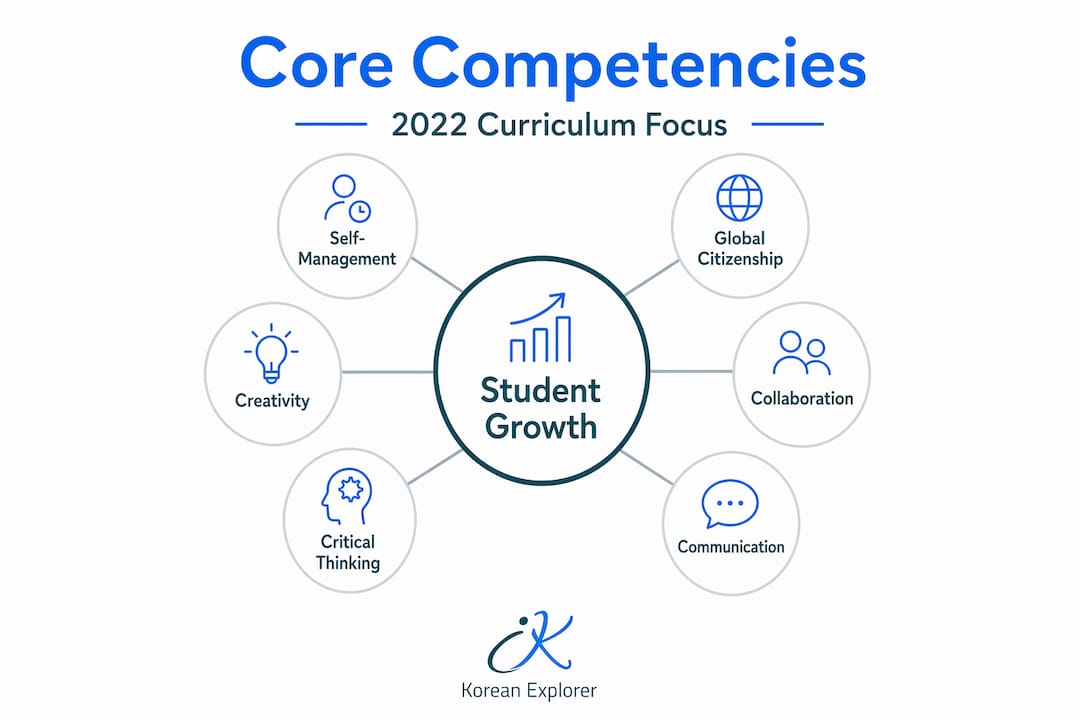
Throughout all three levels, six core competencies run as a spine through the entire framework. These are self-management, knowledge and information processing, creative thinking, aesthetic sensibility, communication, and community collaboration. Every subject, at every level, is designed to develop at least some of these competencies alongside its specific content goals.
Challenges in South Korean curriculum development
The 2022 revision represents a genuine philosophical shift. But implementing that shift in real classrooms, with real teachers and real exam pressures, is a different matter entirely. South Korea has significant tension between higher-order learning goals and a testing culture that still rewards factual classification over participatory thinking.
The Suneung, South Korea’s national college entrance exam, sits at the center of this tension. For millions of students and families, the Suneung still defines what education is for. A curriculum that emphasizes creativity and collaboration cannot fully deliver on those promises when students spend much of high school preparing for a single high-stakes test.
“Seoul’s education leadership advocates phased reforms aiming at dismantling the Suneung exam culture and fostering holistic student assessments by 2040.” — Korea Herald
That 2040 target is significant. It signals that reform is real, but also that it is slow. In the meantime, educators face a genuine practical challenge: how do you teach for competency in a system that still grades for content recall? The answer, increasingly, is portfolio-based assessments and process evaluation. These are gaining ground, but they require systemic change that goes beyond updating a curriculum document.
For curriculum developers looking at South Korea as a model, this tension is actually one of the most instructive parts of the story. The gap between stated curriculum goals and actual classroom practice is a universal challenge, and South Korea’s ongoing struggle with it offers concrete lessons for any education system attempting a similar transition.
My honest take on what this curriculum shift means
I’ve watched education systems attempt competency-based reforms for years, and the pattern is remarkably consistent. Governments update the document. Educators nod in agreement. Then the test-prep culture absorbs the reform and dilutes it into something that looks different on paper but feels the same in the classroom.
What makes South Korea’s 2022 revision worth watching more closely is the specificity of its technology requirements. Mandatory AI coding is not a vague aspiration. It is a concrete, measurable addition to the timetable. That specificity gives educators something real to build around, and it gives students a skill set with tangible value beyond the exam hall.
In my experience, the educators who navigate curriculum transitions best are the ones who stop waiting for systemic change and start experimenting at the classroom level. You do not need the Suneung to disappear before you can assign a project-based assessment or facilitate a student-led discussion. The curriculum’s emphasis on learner autonomy already gives you the permission structure to do that.
The deeper lesson from the 2022 revision, for anyone studying it from the outside, is that competency-based education requires a parallel shift in how teachers are trained and supported. A new curriculum document without professional development is just good intentions on paper.
— Paul
Learn Korean the way the curriculum intended
If the 2022 Revised National Curriculum’s emphasis on communication, adaptability, and real-world application resonates with you, that philosophy also describes how Korean Explorer structures its adult Korean language courses in Singapore. The courses at Korean Explorer are built around a curriculum developed by Seoul National University, which means you are learning with material grounded in the same pedagogical thinking that shapes Korean education at its highest level.
Whether you want conversational Korean for daily life, business Korean for professional contexts, or a flexible online Zoom format that fits around your schedule, Korean Explorer has a course designed for exactly that. Corporate training options are also available for teams. The school is located at International Plaza, Level 22, 10 Anson Road, Singapore 079903, right above Tanjong Pagar MRT. Explore the full range of adult Korean courses and find the format that matches how you actually want to learn.
FAQ
What does “Seoul National Curriculum” actually refer to?
“Seoul National Curriculum” is a commonly used but technically inaccurate term. It refers to South Korea’s nationally standardized education framework, the 2022 Revised National Curriculum, which the Ministry of Education mandates for all public schools across the country, not just those in Seoul.
When was the 2022 Revised National Curriculum implemented?
The phased rollout began in 2024 with elementary schools, continued into 2025 with middle schools, and reaches full implementation across all high school levels by 2027.
What subjects are new under the 2022 revision?
The 2022 curriculum added mandatory AI coding, digital literacy, and ecological sustainability education. Information curriculum hours were doubled across grade levels to reflect the growing importance of technology in students’ futures.
How does the Seoul National Curriculum connect to Seoul National University?
When people ask what is seoul national university curriculum, they are often looking for two different things. Seoul National University develops its own higher-education programs independently. However, language schools like Korean Explorer base their courses on a curriculum developed by Seoul National University, which makes that university’s academic standards directly accessible to adult language learners.
What is the biggest challenge facing the current curriculum?
The core tension is between the curriculum’s competency-based goals and South Korea’s still-dominant test culture centered on the Suneung exam. Assessment reform, including portfolio evaluations and process-based grading, is advancing but requires deep systemic change to become the norm by the 2040 reform target.