TL;DR:
- Most foreign professionals in Korea struggle with language as a hidden barrier to workplace integration, which impacts hiring and promotion decisions. Mastering 1,200 to 1,500 core vocabulary words, understanding cultural norms like hierarchy and indirect communication, and practicing structured learning accelerate proficiency. Cultural fluency, especially nunchi, is essential for professional success beyond basic language skills.
Most foreign professionals working in Korean companies discover too late that language is the hidden barrier between them and real workplace belonging. This korean for professionals guide exists to change that. Only 31.7% of foreign professionals report good Korean speaking ability, yet employers are increasingly factoring communication directly into hiring and promotion decisions. Whether you are based in Singapore and working with Korean clients, or planning a career move to Seoul, the combination of business Korean vocabulary and cultural fluency will determine how far you go.
Table of Contents
- Key takeaways
- The Korean language proficiency gap professionals face
- Business Korean vocabulary: what you actually need
- Korean business culture and why it changes everything
- Practical strategies for learning Korean effectively
- My honest take on what actually moves the needle
- Take your professional Korean to the next level
- FAQ
Key takeaways
| Point | Details |
|---|---|
| Proficiency gap is wide | Less than a third of foreign professionals speak Korean well enough for workplace settings. |
| Vocabulary breadth matters | Mastering 1,200 to 1,500 core words covers most professional scenarios you will encounter. |
| Culture shapes language | Honorifics, hierarchy, and indirect communication are not optional extras; they are the language itself. |
| Nunchi beats grammar | Reading unspoken cues in a Korean office often matters more than perfect sentence structure. |
| Structured training accelerates progress | Flexible online and in-person courses tailored to adults close the gap faster than self-study alone. |
The Korean language proficiency gap professionals face
The numbers tell a story that most career guides skip. 48.7% of employers in Korea expressed dissatisfaction with foreign workers’ Korean speaking abilities in 2026. That is nearly half of all hiring managers actively frustrated by communication breakdowns on their teams.
What makes this figure more striking is the writing gap. Speaking proficiency among foreign professionals sits at 31.7%, but writing proficiency drops further to 22.2%. In a workplace culture where formal written communication carries significant professional weight, that deficit shows up fast.
| Skill Area | Foreign Professional Proficiency (2025) | Employer Satisfaction Rate |
|---|---|---|
| Korean Speaking | 31.7% | Low (48.7% dissatisfied) |
| Korean Writing | 22.2% | Very Low |
| Cultural Communication Fit | Not measured | Cited as hiring factor |
Here is the part that matters for your career specifically. Korean employers do not treat language as a bonus qualification. Companies prefer candidates who integrate smoothly with existing workflows, and communication complexity is weighed as a hiring risk, not a minor inconvenience. That framing changes everything about how you should approach Korean language for work.
“Korean business culture’s strict hierarchy demands careful attention to seniority and respect in communication and decision-making.” — Korean Business Etiquette Guide, 2026
The takeaway is direct: language proficiency is not a soft skill in a Korean professional context. It is a core competency, and the gap between where most foreign professionals are and where employers need them to be is measurable, significant, and closeable.
Business Korean vocabulary: what you actually need
Learning Korean for professionals does not mean memorizing every word in the dictionary. It means prioritizing the right words in the right order.
EPS-TOPIK recommends mastering 1,200 to 1,500 core vocabulary words relevant to workplace scenarios. That range is achievable within several months of structured study, and it covers the bulk of what you will hear and read in professional settings. Think workplace procedures, safety instructions, team coordination, and task delegation.
Honorifics and polite speech levels
Korean grammar changes depending on who you are speaking to. This is not politeness layered on top of the language. It is built into the verb endings, pronouns, and sentence structure itself. Getting this wrong signals more than poor language skill. It signals cultural tone-deafness, which is far more damaging in a Korean office.
You need to recognize and use at least two registers: formal polite (합쇼체, hapjoche) for senior colleagues, clients, and written communication, and informal polite (해요체, haeyoche) for everyday office interactions with peers. Switching between them correctly tells your Korean colleagues that you understand the room.
Essential professional vocabulary categories
These are the categories worth prioritizing when you build your business Korean vocabulary:
- Job titles and forms of address: Korean titles carry significant weight. Suffixes like 님 (nim) after a name signal respect, while titles like 팀장 (teamjang, team leader) and 부장 (bujang, department head) determine how you should address and defer to colleagues. Understanding Korean professional titles builds rapport faster than almost any other vocabulary set.
- Meeting and presentation language: Phrases for agreeing, questioning, proposing, and summarizing are the backbone of professional interaction. Study expressions like 검토해 보겠습니다 (geomtohae bogesssumnida, “I will review it”) and 제안드립니다 (je-andeu-rimnida, “I would like to suggest”).
- Written communication conventions: Business emails use honorifics and follow a structured format that is more formal than what most Western professionals are used to. Subject lines, greetings, and sign-offs all follow conventions worth learning explicitly.
- Digital messaging etiquette: KakaoTalk is used widely in Korean workplaces as a primary communication channel. Tone, response time, and formality all carry professional meaning there, just as they do in a formal email.
Pro Tip: Build a personal vocabulary list organized by workplace scenario rather than alphabetically. “Phrases I need in a client meeting” will serve you far better than a generic word list.
Korean business culture and why it changes everything
Language and culture in a Korean professional context are not separate subjects. Understanding one without the other leaves you with technically correct sentences that still miss the point.
Korean workplace communication is deeply shaped by Confucian values emphasizing hierarchy, respect for seniority, and group harmony. This is called the Yeonggong framework, and it influences everything from how decisions are made to who speaks first in a meeting.
Here is how these cultural norms translate into practical communication differences:
- Seniority determines speech level. You will use different language with a colleague who joined the company one year before you versus a director. Korean professionals navigate this automatically. As a foreigner, you need to learn it deliberately.
- Indirect communication is the default. Saying no directly is uncommon. Responses like “I will look into this” or “that may be difficult” often mean no. If you interpret indirect responses as maybes, you will misread the room repeatedly.
- Nunchi shapes every conversation. Success in Korean workplaces is often determined by the ability to read unspoken expectations. Nunchi is the Korean concept of social awareness and reading between the lines. It is not a personality trait. It is a skill you can learn by paying close attention to tone, silence, and context.
- Group harmony over individual assertion. Offering an opinion that contradicts a senior colleague publicly is a significant misstep, regardless of whether you are right.
- Workplace social culture reinforces hierarchy. Practices like hoesik (company dining gatherings), bowing depth, and even gift-giving protocols all carry professional meaning. Participating appropriately, even at a basic level, signals respect and team orientation.
| Communication Style | Western Office Norm | Korean Office Norm |
|---|---|---|
| Disagreement | Direct and often verbal | Indirect, often implied |
| Decision-making | Individual input encouraged | Seniority-led, consensus-oriented |
| Formality level | Drops quickly | Maintained consistently |
| Feedback delivery | Direct and specific | Gentle, often private |
This table is not about generalizing. It is about preparing you for the default so you are not caught off guard on day one.
Practical strategies for learning Korean effectively
The challenge for working professionals is not motivation. It is time. Here is how to approach learning Korean for professionals without overhauling your schedule.
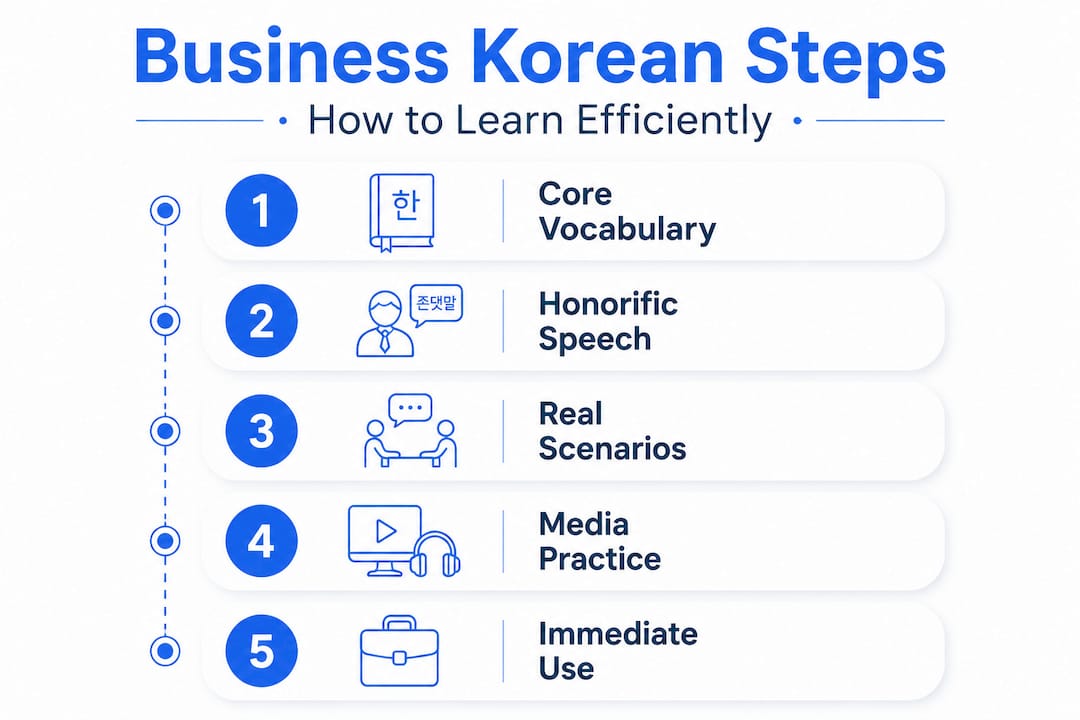
Start with structured vocabulary. Rather than learning words randomly, systematic vocabulary study by topic category accelerates retention significantly. Use the EPS-TOPIK word list as your professional baseline. Add to it with role-specific vocabulary as you progress.
Practice through realistic scenarios. Role-play exercises that simulate actual workplace situations, like presenting in a team meeting or responding to a client inquiry, beat flashcard repetition every time. If you have a language partner, structure your sessions around professional contexts rather than casual conversation.
Use media with professional relevance. Korean business dramas, workplace podcasts, and corporate YouTube channels expose you to natural speech patterns used by actual professionals. This is not passive learning. Combine it with note-taking on vocabulary and speech patterns you notice.
Prioritize flexible learning formats. One of the most common barriers for professionals is scheduling. Online Korean classes via Zoom let you fit structured learning into a workday without commuting or rigid timetables. Look for courses designed specifically for working adults, where curriculum reflects professional rather than academic contexts.
The article 9 proven techniques to improve Korean is worth reading alongside this guide for a practical breakdown of methods that work for adults with real schedules.
- Pair every new phrase with a memory hook connected to your specific job role.
- Set a 15-minute daily study window before meetings or during a commute rather than longer infrequent sessions.
- Review vocabulary in context, not in isolation. Reading a phrase in an email thread you save is more effective than reviewing a word on a flashcard.
- Ask Korean-speaking colleagues to correct your written messages occasionally. That is one of the fastest ways to close the writing gap.
Pro Tip: Do not wait until you feel “ready” to speak Korean at work. Attempting professional Korean phrases, even imperfectly, signals effort and respect to Korean colleagues in a way that silence never does.
My honest take on what actually moves the needle
I have watched professionals approach Korean language learning in two very different ways. The first group treats it like a technical certification. They study grammar rules, pass benchmarks, and arrive in professional settings technically prepared but culturally lost. The second group treats language and culture as the same subject. They make faster progress in actual integration and career advancement.
What I have found consistently is that nunchi matters more than vocabulary count past a certain point. Once you have the professional basics covered, your ability to read unspoken dynamics in a room, to sense when to defer and when to contribute, becomes the real differentiator. Grammar will not teach you that. Cultural immersion will.
The uncomfortable truth for many professionals is that language study without deliberate cultural engagement produces confident speakers who still get misread by Korean colleagues. Hiring decisions often hinge on whether a candidate adds communication complexity or reduces it. That judgment is made in moments of interaction, not on a resume.
My advice is to spend at least 30% of your Korean learning time on cultural context. Read about Korean workplace norms. Watch how seniority plays out in Korean media. Practice improving from beginner to proficient with a structured program, but do not outsource the cultural learning entirely to a classroom. That part you absorb by paying attention.
— Paul
Take your professional Korean to the next level
If you are serious about Korean language for work, self-study will only take you so far. Korean Explorer offers structured Korean language courses in Singapore built specifically for adult learners, with curriculum rooted in Seoul National University standards and designed around real communication outcomes.
Whether you prefer group classes, private instruction, or the flexibility of online Korean classes via Zoom, Korean Explorer has formats that fit around your working schedule. Corporate training is also available for teams looking to build Korean communication competency together. Native Korean instructors who are fluent in English deliver every session, so explanations are clear and practical from day one. Explore the full range of Korean language courses available at Korean Explorer and take a concrete step toward professional fluency.
FAQ
How long does it take to become work-ready in Korean?
Most professionals reach basic workplace communication ability within six to twelve months of structured weekly study. Reaching conversational fluency for meetings and written communication typically takes two to three years with consistent practice.
What Korean vocabulary should professionals prioritize first?
Focus on job titles, workplace procedures, meeting phrases, and written communication conventions first. Core EPS-TOPIK vocabulary of 1,200 to 1,500 words covers the majority of professional scenarios you will encounter day to day.
Why do Korean honorifics matter so much in a business setting?
Korean grammar changes at a structural level depending on who you address. Using the wrong speech level with a senior colleague signals disrespect, regardless of your intention. Learning at least formal and informal polite registers is a non-negotiable part of professional Korean communication.
Can I learn business Korean effectively online?
Yes. Online Zoom-based classes structured around professional Korean communication are highly effective, particularly for busy professionals who cannot commit to fixed in-person schedules. The key is choosing a program with experienced instructors and a curriculum built around adult, workplace-relevant goals.
How is Korean business culture different from Western office culture?
Korean workplaces operate on a seniority-based hierarchy rooted in Confucian values, where indirect communication and group harmony are prioritized over individual directness. Understanding these norms is as important as the language itself for effective professional Korean communication.