TL;DR:
- English plays a crucial role in Korean language learning by explaining grammar and vocabulary with a familiar reference point.
- For Singapore learners, English-assisted classes provide a manageable foundation and culturally relevant context, especially for beginners.
If you’ve ever signed up for a Korean class expecting to hear only Korean from minute one, you’re not alone — and you’re also likely to be caught off guard. The role of English in Korean classes is something many learners overlook before enrolling, yet it shapes how quickly and confidently you progress. For adult learners in Singapore, where English is already a primary language, understanding how English functions inside a Korean classroom can completely change how you approach your studies, whether your goal is cultural connection, TOPIK certification, or career advancement.
Table of Contents
- Why English is important in Korean language learning
- How English supports Korean grammar and communication skills
- Comparing Korean-only versus English-assisted Korean classes
- Practical tips for learners using English in Korean classes
- The role of English in Korean classes within Singapore’s cultural and learning context
- A fresh perspective on using English in Korean education for adults
- Explore English-supported Korean classes at Korean Explorer Singapore
- Frequently asked questions
Key Takeaways
| Point | Details |
|---|---|
| English as a bridge | English helps explain Korean grammar and vocabulary complexities for adult learners. |
| Blended teaching methods | Combining English with Korean in classes balances understanding and communication practice. |
| Learner suitability | Singapore learners benefit from English-assisted Korean courses due to their English background. |
| Balanced use essential | Over-reliance on English can hinder immersion; balance is critical for fluency. |
| Cultural context matters | Singapore’s English environment shapes the effective role English plays in Korean classes. |
Why English is important in Korean language learning
English has been woven into Korean education far longer than most learners realize. Since the 1990s education reforms, English has functioned as a global tool and bridge language in Korean education, helping teachers explain concepts that don’t have simple direct equivalents in Korean. For adult learners coming into Korean with zero prior exposure to the language, this matters enormously.
Korean belongs to a completely different linguistic family than English. Its sentence structure, honorific system, and particles have no direct parallels in English. Without a shared reference point, explaining why 은/는 (topic markers) behave differently from 이/가 (subject markers) becomes an abstract exercise in frustration. English gives the teacher and learner a common framework to work from.
Here’s what English actually does inside a well-structured Korean class:
- Explains grammar logic that has no intuitive equivalent for English speakers
- Defines vocabulary using precise English equivalents before Korean context is built
- Clarifies pronunciation rules by referencing familiar English sounds as approximations
- Reduces cognitive overload for beginners who are processing a new script, new sounds, and new grammar simultaneously
“The most effective language teachers don’t avoid the learner’s first language — they use it as a scaffold, then remove it as the learner grows stronger.”
Learning how to use English grammar as a reference point for Korean structures is a recognized technique, not a shortcut. Instructors who understand effective English methods in language learning know when to lean on the bridge and when to push students to cross it on their own.
How English supports Korean grammar and communication skills
Now that we understand why English is important, let’s examine how it specifically supports grammar and communication in a real classroom setting.
Korean grammar is not just “different” from English. It is structurally inverted in ways that take active retraining to internalize. Verbs come at the end of a sentence. Subjects are frequently dropped. Formality levels change the entire ending of a verb. For an adult learner in Singapore juggling work or school alongside language study, every minute of class time is precious. Korean elementary courses often blend English and Korean to balance grammar explanation and communicative practice, which is essential for adults who need to understand the “why” before they can confidently use the “how.”
Here is how English support plays out in practice:
- Grammar metalanguage: Terms like “subject,” “predicate,” and “object” give learners a map to navigate Korean sentence construction
- Error correction: When a student makes a grammar mistake, an English explanation of the rule saves 10 minutes of confusion
- Vocabulary anchoring: Learning 맛있다 (delicious) lands faster when paired with its English equivalent and a food context
- Comprehension checks: Teachers can quickly verify understanding without forcing students to explain Korean with Korean they don’t yet have
Understanding the differences between English and Korean grammar is not just academic knowledge. It is practical preparation for every sentence you will ever construct in Korean. Communicative activities, role plays, pair conversations, and scenario practice then reinforce what English explanations have clarified.
Pro Tip: When your teacher explains a grammar point in English, write the rule in your own words immediately. Don’t copy the textbook definition. Paraphrasing forces your brain to actually process the logic rather than just record it.

Knowing when to join a Korean class with English support versus an immersion-style class is one of the most important decisions you’ll make as a beginner.
Comparing Korean-only versus English-assisted Korean classes
To clarify the learning options, let’s compare Korean-only and English-assisted classes so you can make an informed choice.
| Feature | Korean-only classes | English-assisted classes |
|---|---|---|
| Best for | Intermediate to advanced learners | Absolute beginners and early intermediates |
| Grammar explanation | In Korean, through examples | Explained in English with Korean examples |
| Immersion level | High from day one | Gradually increases as proficiency grows |
| Learning curve | Steep initially | More manageable for adult learners |
| Risk | Overwhelming for beginners | Over-reliance on English if not managed |
| Singapore suitability | Better for post-beginner stages | Well-suited to English-proficient learners |
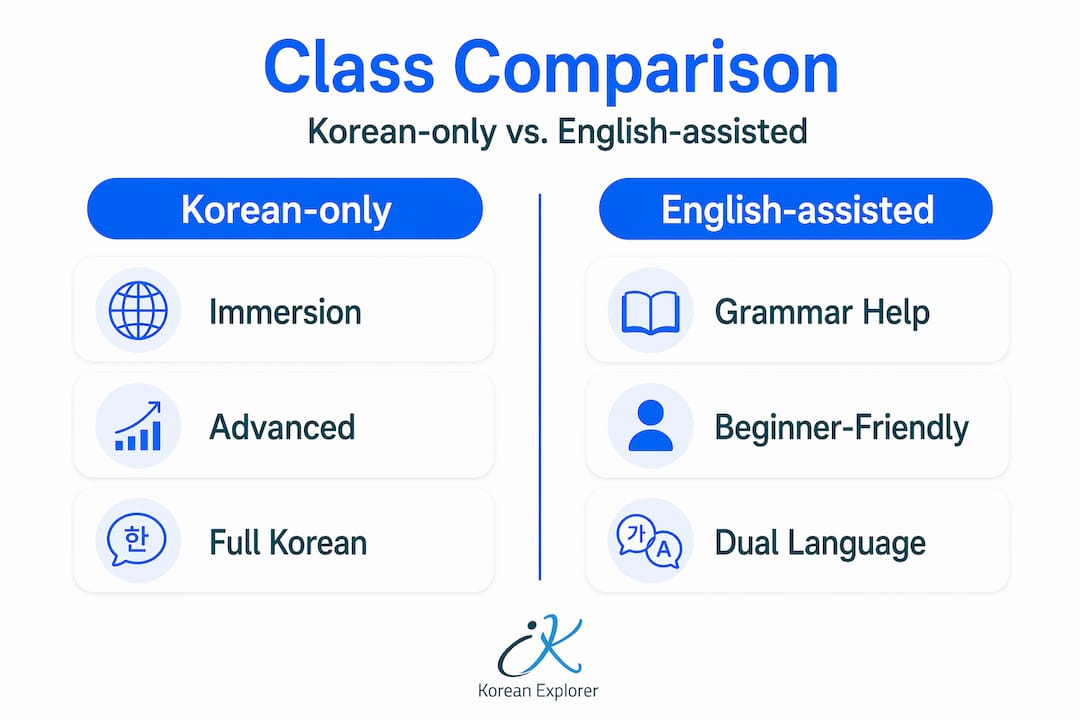
Korean-only instruction has real value. Full immersion forces your brain to adapt faster at certain stages. But for someone starting from scratch, it can create a paralysis where you are so focused on decoding what is being said that you absorb almost nothing. English helps explain Korean grammar differences like subject-object-verb order, which is foundational to understanding why Korean sentences feel “backwards” to English speakers.
The advantages of English-assisted classes for Singapore learners specifically include:
- Faster uptake of abstract grammar rules using familiar English terms
- Reduced frustration in early stages, which improves retention and class attendance
- Clearer cultural context, since English explanations can bridge Korean cultural norms to a Singapore frame of reference
- Better preparation for TOPIK, where understanding grammar categories is tested explicitly
You can explore how Korean differs from English structurally to get a clearer picture of why this support matters before you even walk into a classroom.
Practical tips for learners using English in Korean classes
Having seen the benefits and formats, here are practical ways to use English to boost your Korean learning without letting it become a crutch.
- Use English to understand, then immediately practice in Korean. When your teacher explains a grammar rule in English, your next move should be constructing Korean sentences, not writing English notes. The explanation is the entry point, not the destination.
- Build a Korean-first thinking habit from week three onward. The first two weeks, lean on English. After that, start narrating small actions in Korean in your head. “나는 버스를 탄다.” (I’m getting on the bus.) Simple. Consistent. Effective.
- Limit translation during speaking exercises. When you translate every sentence before speaking, you are writing English sentences in your head and converting them. This creates slow, awkward Korean. Push through the discomfort of thinking in incomplete Korean instead.
- Use English dictionaries strategically, not constantly. Look up a word when you genuinely cannot proceed. Do not look up every unknown word mid-conversation practice. Context guessing is a skill, and it is one of the secrets to Korean proficiency.
- Ask your teacher “why” in English, answer them in Korean. This is a simple classroom trick that keeps the learning bilingual without letting English dominate.
Pro Tip: Record your speaking exercises on your phone, even in class if your teacher allows it. Listen back in the evening and note which words you reached for English on. Those are your priority vocabulary targets for the week.
The role of English in Korean classes within Singapore’s cultural and learning context
Finally, let’s consider how Singapore’s language environment shapes the role of English in Korean classes, and why this makes Singapore learners uniquely positioned to benefit from English-assisted instruction.
Singapore is one of the few countries in the world where a significant portion of the adult population is genuinely fluent in English as a first or dominant language. This changes everything about how Korean can be taught effectively here. Unlike learners in countries where the teacher must bridge through a third language, Singapore learners and their Korean instructors share a strong common language in English. That shared language becomes a precision tool.
“Singapore learners don’t need to choose between English and Korean in class. They need a teacher who knows when to use each one.”
Here is how Singapore’s context specifically shapes Korean classes:
- Faster grammar onboarding: English grammar metalanguage (nouns, verbs, particles) is already familiar, so explaining Korean grammar takes less time than in non-English-speaking countries
- Cultural bridging: Teachers use English to explain Korean social norms like speech levels, bowing conventions, and workplace hierarchy, which connects to Singapore’s own multicultural professional environment
- Career-driven learning: Many Singapore learners are studying Korean for business with Korean companies or K-content industries. English remains the professional language of negotiation, and blended language learning reflects that reality
- TOPIK preparation: The test itself is entirely in Korean, but English-assisted study helps learners decode question formats and grammar rules more efficiently in the preparation phase
Learning Korean in Singapore through a school that understands this local context gives you a measurable advantage over generic online resources that treat all learners as identical.
A fresh perspective on using English in Korean education for adults
Here is something the standard “how to learn Korean” article will not tell you: the role of English in Korean learning is shifting, and not in the direction most people expect.
For decades, the debate was about how much English to use in Korean class. Now, with AI translation tools, language apps, and real-time captioning becoming standard, the rise of AI and digital tools is shifting English’s role from spoken classroom language to a source of information and translation available on demand. This changes the classroom’s job entirely.
What this means in practice: the English your teacher speaks in class is becoming less about grammar translation and more about cultural interpretation and metacognitive guidance. Explaining why Koreans communicate indirectly in professional settings, for example, is something no AI tool does well. That nuance requires a bilingual human who has lived both cultures.
The uncomfortable truth is that learners who over-rely on English, whether through constant app translation or English-heavy classes with too little Korean output, are not actually failing at immersion. They are failing at discomfort tolerance. Language acquisition requires spending time in confusion, not eliminating it. English is the scaffold, not the building.
Balance, in our experience at Korean Explorer, looks like this: English in the first 20 minutes for grammar instruction, Korean for the remaining 40 minutes of practice, with English available as a quick clarification tool but not as the default. This mirrors what research on fluency in second language acquisition consistently supports.
The learners who progress fastest are not the ones who eliminate English from their Korean study. They are the ones who use it precisely, then move past it.
Explore English-supported Korean classes at Korean Explorer Singapore
Ready to take the next step? If you’ve recognized yourself in this article, whether you’re a complete beginner who needs grammar explained clearly in English or an intermediate learner ready to push into more Korean-dominant practice, Korean Explorer’s courses are built with exactly that progression in mind.
Our Korean language courses are developed on a Seoul National University curriculum and aligned with TOPIK standards, taught by native Korean instructors who are fluent in English. That combination means you get accurate Korean and clear explanations, not one at the expense of the other. You can learn Korean in Singapore at our Tanjong Pagar, Jurong, or Tampines centers, or join our online Korean classes if flexibility is your priority. Whether your goal is K-drama fluency, a TOPIK certificate, or stronger relationships with Korean business partners, we have a format that fits.
Frequently asked questions
Why is English often used in Korean language classes for adults?
English is used to explain complex Korean grammar and vocabulary, making it accessible for adults already fluent in English, particularly for beginners navigating SOV sentence structure and particle systems that have no English equivalent.
Can I learn Korean effectively without English assistance?
Yes, Korean-only immersion works well for intermediate and advanced learners, but English-assisted classes generally help beginners build grammar foundations faster, which is especially true for Singapore learners with strong English proficiency.
Does using English in Korean classes hinder fluency development?
Only when overused. When English is limited to grammar explanation and cultural context while Korean dominates speaking and listening practice, it supports rather than slows fluency development.
How does Singapore’s English-speaking environment affect Korean learning?
Singapore learners share a strong common language with their English-fluent Korean instructors, which allows for faster and more precise grammar instruction and better cultural bridging than in many other learning contexts.
Are there online Korean courses with English support?
Yes, several language centers in Singapore, including Korean Explorer, offer online classes that blend English grammar instruction with Korean communicative practice to suit adult learners with varied schedules.