TL;DR:
- Korean immersion promotes real-time processing, leading to faster fluency than traditional study methods.
- Practical immersion activities in Singapore include conversation groups, Korean media consumption, and daily routines.
- Challenges like overwhelm and plateauing are normal; consistent exposure and tracking progress help overcome them.
You’ve spent months studying Korean vocabulary lists and grammar rules, yet the moment a native speaker talks to you, your mind goes blank. This is one of the most common frustrations among Korean learners in Singapore, and it points to a fundamental gap between traditional study methods and real-world communication. Korean language immersion is the approach that bridges this gap. Unlike standard classroom instruction, immersion puts you inside the language, forcing your brain to process, respond, and adapt in real time. This guide breaks down exactly what immersion means, why it works better than any other method, and how you can apply it right here in Singapore.
Table of Contents
- What is Korean language immersion?
- How does Korean immersion accelerate learning?
- Immersive activities: What really works for Singaporean learners
- Common challenges and how to overcome them
- Why true immersion outperforms every other method
- Ready to experience Korean immersion? Start your journey
- Frequently asked questions
Key Takeaways
| Point | Details |
|---|---|
| Immersion defined | Using Korean in real-life situations daily builds lasting fluency. |
| Science-backed approach | Research shows immersion-based methods boost reading and speaking skills more than traditional study. |
| Practical strategies | Joining conversation clubs and using Korean media accelerates your progress in Singapore. |
| Overcoming challenges | Feeling stuck is normal—small steps and persistence keep motivation high. |
| Next steps | Taking local immersive classes makes Korean mastery genuinely achievable. |
What is Korean language immersion?
Language immersion means using Korean as your primary tool for communication, information, and daily interaction, rather than treating it as a subject you study for an hour and then set aside. In a true immersion environment, you read Korean, listen to Korean, speak Korean, and think in Korean as much as possible. The goal is to shift Korean from a foreign code you consciously decode into a natural reflex.
This is very different from the grammar-translation method that many Singaporeans grew up with. Traditional textbook study teaches you about a language: its rules, its exceptions, its structure. Immersion teaches you to use the language without stopping to mentally translate every word. Think of it like learning to ride a bicycle. You can read every instruction manual ever written, but the real learning happens the moment you get on the bike and balance yourself without thinking.
For Singaporeans, the benefits are especially practical. Whether you want to study at a Korean university, work with Korean business partners, travel confidently through Seoul, or simply enjoy K-Dramas without subtitles, immersive learning builds the kind of fluency that actually serves you in those situations. Structured Korean learning is far more effective when it incorporates real-life usage alongside formal instruction.
Here’s what separates immersion from conventional study:
- Constant exposure over time, not just scheduled class hours
- Active production of language, not just passive memorization
- Real contexts like conversations, media, and tasks that carry genuine meaning
- Reduced reliance on your first language as a mental crutch
- Faster automatic recall because the brain connects words to experiences, not just definitions
The science backs this up. Syllable-based Hangul instruction is more effective for English-speaking adults, leading to higher accuracy on word reading tasks compared to grapheme-based methods. This finding directly reflects an immersion principle: learning Korean through its natural units of meaning produces better real-world reading ability.
“Real fluency isn’t knowing what a word means. It’s knowing what to say next without stopping to figure out the rules.”
Discovering the secrets to proficiency often comes down to this single realization: more exposure to authentic Korean use beats more hours of textbook drilling every time.
How does Korean immersion accelerate learning?
Immersion works because it mirrors the way every human being acquires their first language. As children, we didn’t study grammar tables. We were surrounded by language, made endless mistakes, and gradually built an intuitive understanding through constant exposure and feedback. Immersion applies this same powerful principle to adult Korean learning.
When your brain encounters Korean in a real situation, something different happens compared to a classroom exercise. You’re not just recalling a rule. You’re processing meaning, context, tone, and social cues all at once. This multi-layered processing creates stronger, more durable memory traces. The result is faster recall and more natural speech.
Research from MIT’s linguistics department highlights an important edge case: internal processing can generate some language gains even without direct input, and first-language similarity can help build explicit knowledge. However, this explicit knowledge doesn’t always translate to real-time spoken processing. That’s the gap immersion fills. Your brain needs to respond in the moment, not after a five-second mental translation.
Here’s a practical comparison of how immersion learners typically perform against traditional learners:
| Skill area | Traditional learners | Immersion learners |
|---|---|---|
| Listening comprehension | Often slow, misses natural speech pace | Adapts to native speed over time |
| Speaking fluency | Hesitant, relies on mental translation | More natural, fewer pauses |
| Reading speed | Strong for studied vocabulary, slow otherwise | Faster recognition across varied texts |
| Writing accuracy | Good with practiced structures | More flexible and creative output |
| Cultural confidence | Limited, often feels awkward | Higher, due to real context exposure |
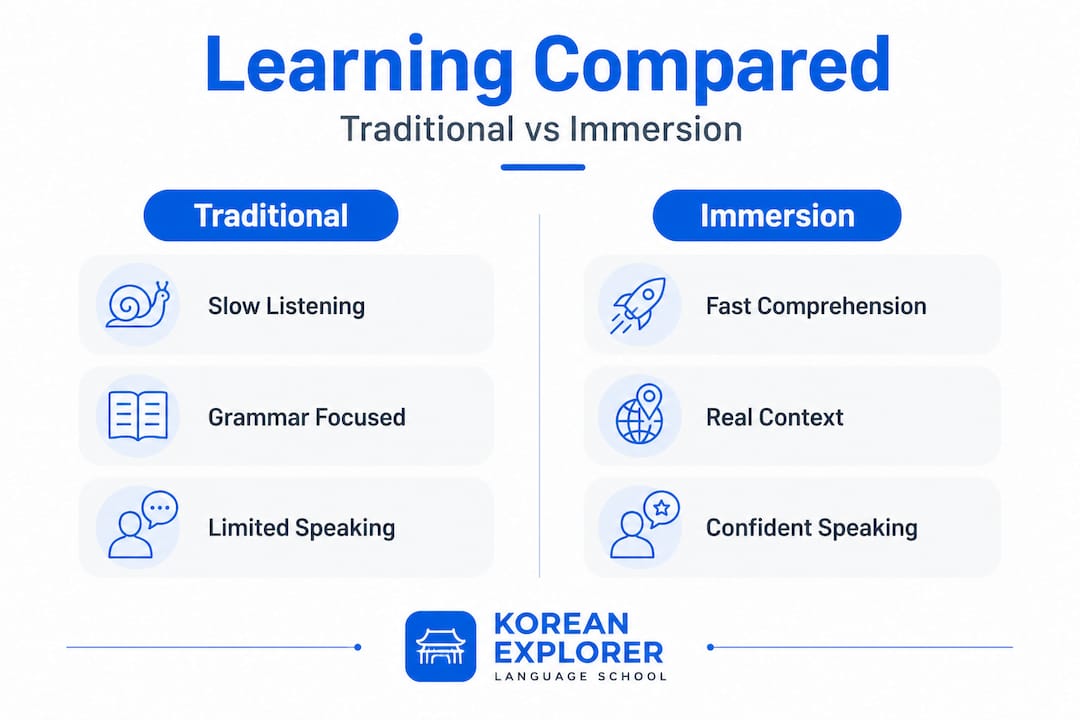
The difference is striking, especially in speaking and listening. These are the two skills that textbook methods struggle most to develop, and they’re exactly the skills you need most for real interactions.
The tips for mastering Korean that actually move the needle are almost always immersion-based: listening to native content daily, speaking in Korean even when it’s uncomfortable, and seeking out feedback from real speakers.

Pro Tip: Don’t wait until you feel “ready” to use Korean in real conversations. The brain accelerates most sharply when it’s slightly outside its comfort zone. Mild discomfort equals rapid growth.
Applying techniques for improving Korean becomes far more effective when they’re embedded in immersive habits rather than treated as isolated exercises.
Immersive activities: What really works for Singaporean learners
Understanding the science behind immersion is just the start. Here’s how you can put it into practice without a plane ticket to Seoul. Singapore’s unique environment, with its multicultural population, access to Korean media, and active Korean community, makes it one of the best places outside Korea to practice immersive language learning.
Here are five proven immersive strategies you can start this week:
Daily conversation clubs. Many community groups and language schools in Singapore organize weekly Korean conversation meetups. Join one and commit to speaking only Korean during the session, even if it’s clunky at first. The social pressure of a real conversation is one of the most powerful fluency accelerators available.
Watch K-Dramas without subtitles. Start with shows you’ve already seen, so the plot doesn’t distract you. Focus on picking out words and phrases you recognize. Gradually, your listening comprehension improves as your brain stops relying on the subtitle safety net. This connects directly to how syllable-based learning boosts reading and auditory recognition of Korean’s natural sound units.
Korean-only messaging groups. Create or join a WhatsApp or Telegram group where the rule is simple: Korean only. Writing in Korean daily, even casually, builds vocabulary and sentence structure instinctively. It’s low-stakes, high-frequency practice.
Local language exchange events. Find a Korean speaker in Singapore who wants to improve their English and set up a language exchange. You speak Korean for 30 minutes, they speak English for 30 minutes. Both of you get real practice, real correction, and real motivation.
Korean at home and at work. Change your phone settings to Korean. Label objects in your home with Korean words. Listen to Korean podcasts during your commute. These micro-exposures add up to hours of immersion every week without disrupting your schedule.
The key is to start with familiar situations before pushing yourself into complex interactions. Easy ways to build Korean habits often apply to adults too: repetition, routine, and relevance are what make new language stick.
Pro Tip: Use everyday tasks like grocery shopping or ordering food as immersion practice. Script what you need to say in Korean beforehand, then do it for real. The memory of actually using the language in a real context is far stronger than any flashcard drill.
Pair these activities with deliberate work on improving Korean vocabulary to accelerate how quickly new words become automatic.
Common challenges and how to overcome them
As you start applying immersive techniques, it’s normal to hit roadblocks. These challenges actually signal that your brain is working hard to reorganize itself around a new language system. Here’s how successful learners keep going.
The three most common obstacles for immersion learners in Singapore:
Overwhelm from constant Korean exposure. When everything around you is Korean and you can only catch a fraction of it, the experience can feel discouraging. The fix is to lower the input difficulty temporarily. Watch easier Korean content, listen to slower podcasts, or join a beginners’ conversation group before stepping into advanced settings.
Progress plateaus. After initial rapid gains, many learners feel stuck. This is where motivation often drops. The solution is to track micro-wins: new words you used spontaneously, conversations you completed, shows you followed without subtitles. Progress is still happening even when it’s invisible.
Social anxiety. Many Singaporean learners feel embarrassed about making mistakes in front of others. This is incredibly common and very natural. The reality is that native speakers almost universally appreciate the effort and rarely judge errors harshly. Reframing mistakes as data rather than failures changes everything.
Research confirms that while L1 similarity aids explicit knowledge, it doesn’t always transfer to fast, real-time spoken processing. In other words, even if your first language shares some features with Korean, your brain still needs immersion to wire itself for live conversation. There is no shortcut around this, but there is a fast track: consistent daily exposure.
Communicating fluently in a second language is a skill that follows predictable patterns, and understanding those patterns makes the hard phases feel less overwhelming.
Pro Tip: Keep a small notebook of words and phrases you successfully used in real conversations, not just ones you studied. Reviewing these wins before each practice session builds confidence and reinforces real-world memory.
It’s also worth understanding the broader picture of Korean vs. Chinese language learning to see why Korean immersion may suit certain Singaporean learners especially well given their existing language backgrounds.
Why true immersion outperforms every other method
Here is a view that many language schools won’t tell you directly: classroom study gives you rules, but rules alone cannot build instinctive fluency. You can memorize every conjugation pattern in the Korean language and still freeze when a native speaker asks you a simple question. This isn’t a failure of effort. It’s a failure of method.
The brain doesn’t store language the way it stores math formulas. Language is embedded in experience, emotion, and real interaction. When you only encounter Korean inside a classroom, your brain associates it with classroom behavior: sitting quietly, waiting your turn, answering when asked. This is not how language works in the real world.
True immersion, even at home or online, forces you to think and react in Korean without the safety net of pausing, translating, and carefully constructing a sentence. That discomfort is exactly where fluency lives. It’s the difference between knowing the word for “excuse me” and actually using it instinctively when you bump into someone.
Singapore’s diverse, multilingual environment is actually a tremendous asset here. You’re already surrounded by people who code-switch between languages daily. That cultural fluency with multiple languages makes Singaporean learners remarkably well-suited to immersion. You’ve seen it modeled your whole life. Korean immersion is just one more layer in an environment already built for it.
The practical methods for Korean mastery that work best are always the ones that put real usage first, not as a reward for “enough” studying, but as the practice itself.
The most important mindset shift is this: stop waiting to be ready, and start getting ready by doing.
Ready to experience Korean immersion? Start your journey
If you’ve seen yourself in any part of this guide, whether it’s the frustration of classroom limits or the excitement of what immersion can unlock, Korean Explorer is the place to start. Our courses are built around exactly the kind of active, conversation-focused, real-world learning that makes immersion work.
At Korean Explorer, our native Korean instructors design every class to push you into using Korean, not just learning about it. From placement tests to group conversation classes and one-on-one coaching, we offer formal Korean courses in Singapore that fit around your schedule and your goals. Our curriculum is grounded in Seoul National University’s framework and aligned with TOPIK standards. Courses are also SkillsFuture-claimable. Explore the best ways to learn Korean with guidance from instructors who’ve helped thousands of Singaporeans go from beginner to confident speaker.
Frequently asked questions
How is Korean language immersion different from regular classes?
Immersion uses Korean in real, daily contexts rather than focusing primarily on structured grammar lessons. Research shows that syllable-based Hangul instruction reflects this effectiveness by training learners through natural Korean sound units rather than abstract rules.
Can I achieve fluency through immersion without traveling to Korea?
Absolutely. You can build strong fluency by surrounding yourself with Korean speakers, media, and daily usage right here in Singapore. Research confirms that internal processing allows gains even without a full native-country environment, especially when paired with regular real-world practice.
What are the best first steps for Korean immersion in Singapore?
Join a local Korean conversation club and swap your current media diet for Korean shows and podcasts. These two changes alone dramatically increase your daily exposure and put your passive vocabulary to active use.
Does immersion work for both kids and adults?
Yes, though the best strategies differ by age. Adults benefit most from combining immersive daily habits with some structured instruction to make sense of patterns, while children tend to absorb language more intuitively through play and storytelling.
Is it normal to feel stuck or overwhelmed during immersion?
Very normal. Feeling overwhelmed is a sign your brain is actively processing more Korean than it’s comfortable with, which is precisely when growth happens fastest. Track small wins daily and keep your exposure consistent to push through the plateau.