TL;DR:
- Korean is part of the Koreanic language family, not a language isolate.
- Its structure features agglutinative grammar, SOV word order, particles, and Hangul writing.
- Learning Korean offers cultural, travel, career, and regional communication benefits.
You have probably seen it written somewhere online: “Korean is a language isolate with no known relatives.” It sounds fascinating, even a little mysterious. But here is the thing: that statement is outdated. Korean does have relatives, its grammar works in ways that are genuinely surprising to English speakers, and it is spoken by about 80 million people worldwide. Whether you are learning Korean for K-dramas, career opportunities, or travel, understanding how the language actually works, where it comes from, and why it is structured the way it is, will make your learning journey far more focused and rewarding.
Table of Contents
- Korean at a glance: Where does it fit in the language world?
- Is Korean really a language isolate? Unpacking the debate
- Key features of the Korean language: What makes it unique
- Why learn Korean? Relevance for global learners and Singaporeans
- A fresh perspective: What most guides miss about the Korean language
- Ready to start your Korean learning journey?
- Frequently asked questions
Key Takeaways
| Point | Details |
|---|---|
| Korean’s language family | Korean is part of the Koreanic family, not an isolate, including Jejuan and several extinct languages. |
| Unique structure | Korean uses agglutinative grammar and subject-object-verb word order, making it distinct from English or Chinese. |
| Widespread speakers | Korean is spoken by about 80 million people and is official in both Koreas. |
| Modern classification | Contemporary linguistics places Korean in the Koreanic family rather than isolating it entirely. |
| Learning motivation | Learning Korean opens doors to culture, business, and regional opportunities, especially for Singaporeans. |
Korean at a glance: Where does it fit in the language world?
When people think about Asian languages, they often assume Korean must be related to Chinese or Japanese. After all, they share a geographic neighborhood and even some borrowed vocabulary. But language families are not determined by geography or loan words. They are defined by shared ancestry, and Korean’s roots tell a different story entirely.
Korean is an East Asian language in the Koreanic language family and is the official language of both North Korea and South Korea, spoken by about 80 million people. That figure puts Korean firmly in the same tier as languages like French, Italian, and Vietnamese in terms of global speaker count. It is not a minor regional tongue. It is a major world language with a growing international footprint.
The Koreanic family is small but real. Its members include:
- Korean: The dominant living language, spoken on the Korean Peninsula and in diaspora communities worldwide
- Jejuanese (Jejuan): A closely related variety spoken on Jeju Island, recognized by UNESCO as critically endangered
- Extinct relatives: Several historical varieties documented in ancient texts but no longer spoken
For context, here is how Korean sits alongside neighboring language families:
| Language | Family | Approximate speakers |
|---|---|---|
| Korean | Koreanic | ~80 million |
| Mandarin | Sino-Tibetan | ~920 million |
| Japanese | Japonic | ~125 million |
| Vietnamese | Austroasiatic | ~90 million |
One common misconception is that because Korean does not belong to the massive Sino-Tibetan or Indo-European families, it must stand completely alone. The history of Korean language reveals a more nuanced picture, where a small but distinct family tree exists, even if it has fewer living branches than most. Learning more about the origin of Korean language also helps explain why its vocabulary and structure feel so different from languages learners may already know.
“Understanding a language’s family tree is not just academic trivia. It reframes how you approach learning, giving you realistic expectations and better study strategies from day one.”
With the confusion around Korean’s category addressed, it is time to examine what makes its structure and mechanics so distinctive for learners.
Is Korean really a language isolate? Unpacking the debate
If you have searched for Korean online, you have almost certainly encountered the phrase “language isolate.” A language isolate is a language with no demonstrated genealogical connection to any other known language. Think of Basque in Europe, which truly stands alone. Korean used to be placed in this category, but that view has shifted significantly in modern linguistics.
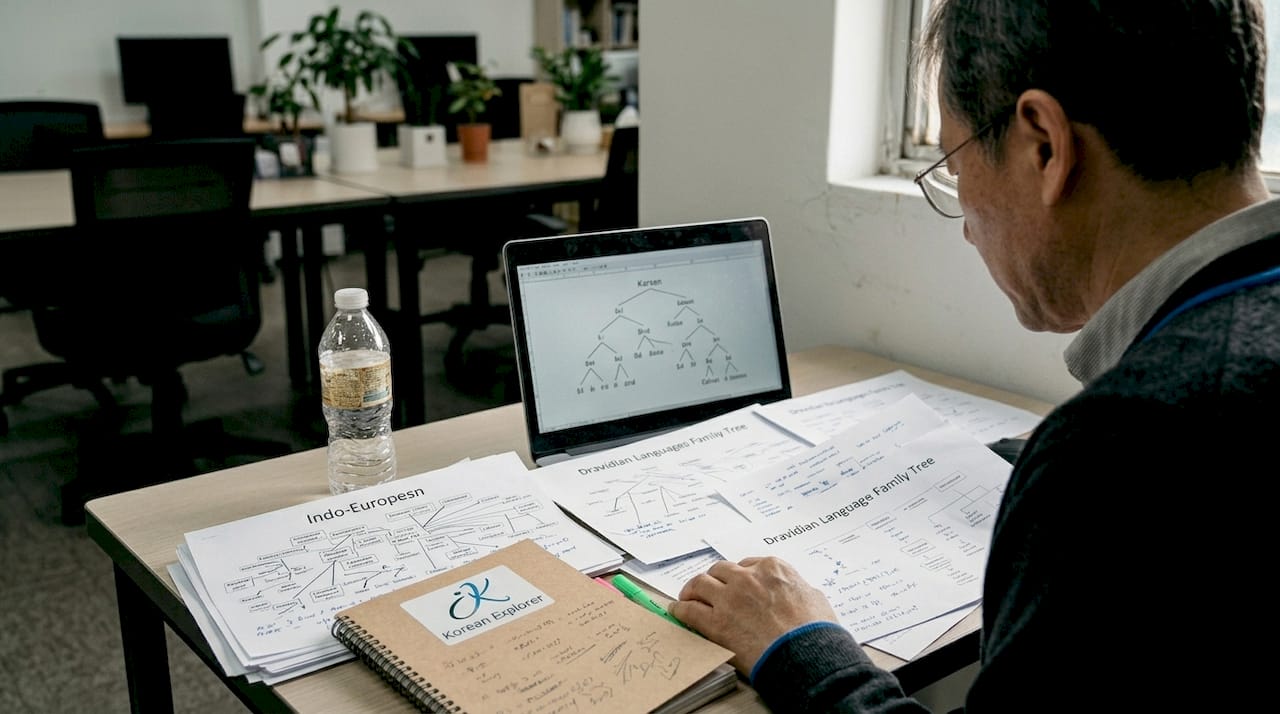
Korean’s classification as an isolate is now considered outdated. Contemporary mainstream scholarship places it within the Koreanic family, which includes Jejuanese and historical extinct varieties. The reclassification matters because it changes how linguists, and learners, think about the language’s internal logic.
Here is a quick comparison to clarify the difference:
| Category | What it means | Examples |
|---|---|---|
| Language isolate | No known living or historical relatives | Basque, Sumerian |
| Small language family | A few living or documented relatives | Koreanic (Korean, Jejuan) |
| Large language family | Many related languages across regions | Indo-European, Sino-Tibetan |
Jejuanese deserves a special mention here. Spoken on Jeju Island, it is distinct enough from standard Korean that native Korean speakers cannot fully understand it without prior exposure. That lack of mutual intelligibility is exactly what makes it a separate member of the Koreanic family rather than just a dialect. Korean’s origins trace back through both of these surviving branches.
So why does the “isolate” label keep appearing? Older encyclopedias, textbooks, and even some language learning apps have not caught up with current linguistic consensus. The internet recycles information quickly, and outdated classifications spread easily. If you see Korean described as a language isolate on a website or app, it is likely pulling from pre-2000s academic sources.
Pro Tip: When researching Korean’s classification, check the publication date. Sources from the early 2000s or earlier are far more likely to use the outdated isolate label. Look for references published after 2010 for the most current consensus.
Quick stat: Of all the world’s roughly 7,000 languages, only about 50 to 70 are considered true isolates. Korean is no longer among them.
Understanding where Korean fits in the global language map makes it easier to grasp its unique internal features.
Key features of the Korean language: What makes it unique
Once you get past the classification debate, the real adventure begins: the language itself. Korean has several structural features that will immediately feel unfamiliar if your native language is English, but once you understand the logic behind them, things start to click surprisingly fast.
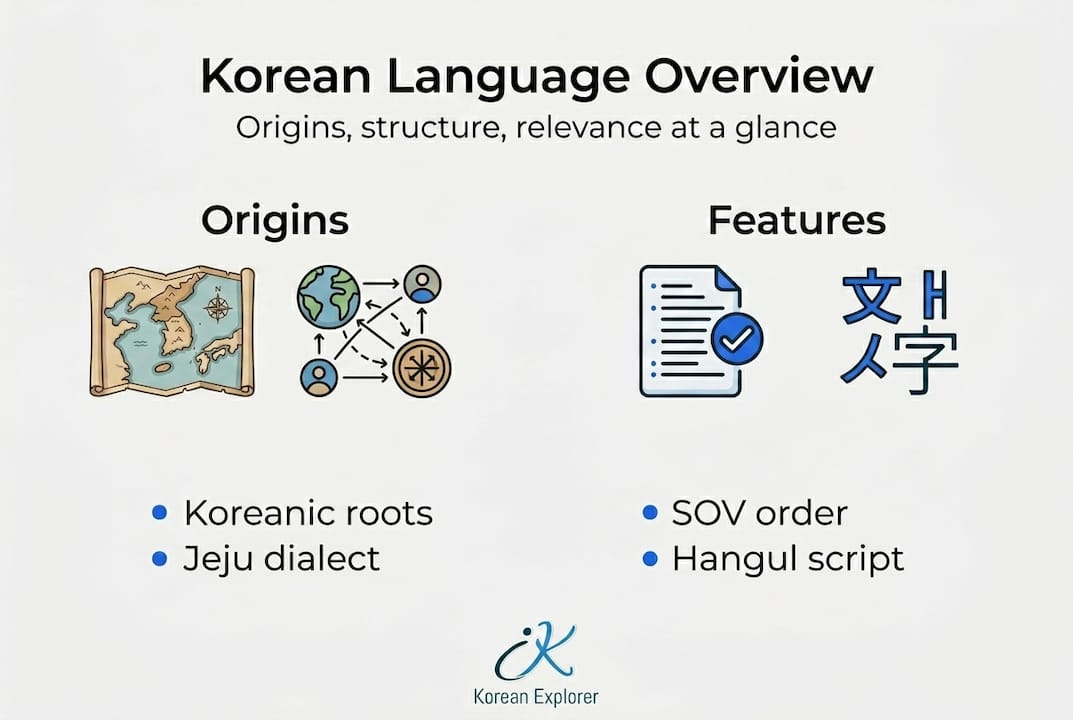
Korean is agglutinative and typically places the verb at the end, following a subject-object-verb (SOV) word order. Both of these features shape every sentence you will ever read or write in Korean.
Here are the four key structural features every learner should know:
- Agglutinative grammar: Korean builds meaning by attaching suffixes to root words. Instead of changing a word’s form entirely, you stack grammatical pieces onto a base. For example, one verb root can express tense, formality, negation, and politeness all through added endings.
- SOV word order: In English, you say “I eat rice.” In Korean, the structure is “I rice eat.” The verb always comes last. This means you hear or read the action only after all the context has been established.
- Particles for grammar: Korean uses small grammatical markers attached to nouns to show their role in the sentence (subject, object, topic, and so on). There are no articles like “a” or “the,” but particles do similar grammatical work.
- Hangul writing system: Created in the 15th century under King Sejong the Great, Hangul is a phonetic alphabet made up of 14 consonants and 10 vowels. Most learners can read it within a few days of focused study.
Some practical differences from English include:
- Verbs change form based on social formality, not just tense
- Word order is more flexible than in English because particles clarify meaning
- Questions are formed by changing the verb ending, not by rearranging the sentence
Knowing how English grammar compares to Korean can help you use what you already know as a reference point rather than starting from scratch. And understanding how Korean differs from English prepares you for the moments when direct translation simply will not work.
Pro Tip: Do not just memorize vocabulary lists in isolation. Focus on recognizing grammatical patterns first. Once you see how verb endings work, hundreds of sentences become readable even with a limited vocabulary.
Now that we have covered what makes Korean mechanically different, let’s explore how this impacts language learning and cultural connection.
Why learn Korean? Relevance for global learners and Singaporeans
Korean is no longer a niche interest. Its cultural reach has expanded dramatically over the past decade, driven by a wave of global media that has introduced millions of people to the language naturally and enthusiastically.
Korean is the official and national language of both North and South Korea, with about 80 million speakers globally. That global footprint comes with real practical benefits for learners:
- Cultural access: K-pop, K-dramas, and Korean cinema (including globally recognized films and series) have built massive fanbases across Southeast Asia, including Singapore. Understanding Korean lets you engage with this content without relying on subtitles.
- Travel and study: South Korea is a top destination for Singaporean travelers and students. Speaking even basic Korean significantly improves your experience on the ground.
- Career opportunities: Korean companies like Samsung, LG, Hyundai, and Lotte have global operations. Korean language skills can be a genuine differentiator on a resume in industries like technology, logistics, and finance.
- Academic access: Korean universities actively recruit international students, and many programs offer instruction in English alongside Korean. Language proficiency opens up more options.
- Regional communication: In Singapore, the Korean community and Korean business presence continue to grow. Language skills support stronger professional and personal relationships.
For Singaporeans specifically, Korean language learning is increasingly structured and accessible. Demand for organized courses has risen sharply alongside Korean cultural exports. Many learners start with interest in entertainment and discover a genuine passion for the language itself.
“When you understand why Korean is structured the way it is, studying it stops feeling like memorization and starts feeling like problem-solving.”
Exploring tips to learn Korean can help you turn that initial motivation into consistent, measurable progress.
A fresh perspective: What most guides miss about the Korean language
Here is something most introductory articles gloss over: the outdated “language isolate” label does not just create academic confusion. It actively discourages learners. When people believe Korean stands completely alone in the language world, they assume it must be impossibly difficult, with no reference points and no patterns to transfer from other languages. That assumption leads many learners to give up before they start.
The truth is that reclassifying Korean within the Koreanic family, however small, signals something important: the language has an internal logic, a systematic structure, and learnable patterns. It rewards effort with clarity. Every grammatical rule you learn applies consistently across thousands of sentences.
If you are hearing “Korean is an isolate” online, treat it as a historical or debated label. Contemporary mainstream classification places it in Koreanic, and more importantly, the language’s structure itself is far more approachable than its reputation suggests.
Our advice: stop asking whether Korean is hard, and start asking how it works. Use updated resources, focus on grammar patterns over rote memorization, and kickstart your Korean learning with a clear-eyed understanding of the language’s actual structure. That mindset shift alone can cut your learning curve significantly.
Ready to start your Korean learning journey?
Understanding how Korean works is one thing. Building real fluency takes structured practice, the right environment, and instructors who can bridge the cultural and linguistic gap effectively.
At Korean Explorer, we offer Korean language courses in Singapore designed for learners at every level, from complete beginners to those preparing for TOPIK certification. Our courses follow a curriculum developed by Seoul National University and are taught by native Korean instructors fluent in English. If you are looking to use SkillsFuture credits, we also offer SkillsFuture Korean language programs that make learning both accessible and affordable. Locations at Tanjong Pagar, Jurong, and Tampines mean you can find a class that fits your schedule and neighborhood.
Frequently asked questions
Is Korean related to Chinese or Japanese?
Korean is part of the Koreanic family and not directly connected to neighboring languages like Chinese or Japanese, despite sharing geographic proximity and some borrowed vocabulary.
Why do some sources still call Korean a language isolate?
Older sources labeled Korean a language isolate, but that classification is now outdated. Recent scholarship recognizes it as part of the Koreanic family, which includes Jejuanese and extinct historical varieties.
How many people speak Korean worldwide?
About 80 million people speak Korean worldwide, placing it among the top 20 most spoken languages globally and making it a highly practical language to learn.
What is the structure of a typical Korean sentence?
Korean typically uses SOV word order, meaning the verb comes at the end of the sentence. Instead of “I eat rice,” a Korean sentence follows the structure “I rice eat.”
What writing system is used for Korean?
Korean is written in Hangul, a phonetic alphabet developed in the 15th century under King Sejong the Great. It consists of 14 consonants and 10 vowels and is widely considered one of the most learnable writing systems in the world.