TL;DR:
- Small classes of 6 to 12 students enable faster learning and personalized feedback.
- Effective courses teach Hangul systematically using the syllable-block method and include cultural content.
- Consistent, structured study with cultural interest leads to faster fluency gains within 8 to 12 weeks.
You want to watch your favorite K-drama without reaching for the subtitles. Or maybe your company is expanding into South Korea, and you need professional Korean fast. Whatever the reason, more Singaporeans are signing up for Korean language classes than ever before, and the options have multiplied just as quickly as the demand. Choosing wrong means wasted months and lost momentum. This guide walks you through every step: what makes a class effective, how to match one to your goals, what a first term actually looks like, and how to measure real progress so you never feel stuck.
Table of Contents
- Understanding the essentials: What makes an effective Korean class
- How to choose the right Korean class in Singapore
- The learning journey: What to expect from your first term
- Measuring your progress: Tests, feedback, and real-world fluency
- Our experience: The real keys to lasting fluency
- Take your next step with Korean language classes in Singapore
- Frequently asked questions
Key Takeaways
| Point | Details |
|---|---|
| Small class advantage | Joining a 6–12 student class can double your learning speed compared to larger groups. |
| Comprehensive structure | Top Korean courses balance Hangul, grammar, culture, conversation, and media for effective learning. |
| Clear milestones | You’ll see measurable progress in 8–12 weeks with formal feedback, assessments, and practice. |
| Fit your goals | Choose a course format—group, private, online, hybrid—that aligns with your schedule and aims. |
Understanding the essentials: What makes an effective Korean class
Not all Korean classes are built the same. Before you register anywhere, it helps to understand the core features that separate a class that actually moves you forward from one that keeps you spinning at the same level.
The first thing to look at is class size. Small classes of 6 to 12 students enable twice the level completion speed compared to large group settings. That matters enormously. In a smaller room, your instructor notices when you mispronounce a sound, corrects it immediately, and gives you a second chance within the same lesson. In a class of 30, that feedback loop simply does not exist.
The second essential is how the school teaches Hangul, the Korean writing system. Structured courses in Singapore use a syllable-block approach: you learn how individual consonants and vowels combine into blocks, rather than memorizing each character in isolation. This method builds reading confidence within days, not months. Grammar is then introduced stepwise, each concept building on the one before it, so you never feel like you are swimming in disconnected rules.
Cultural integration is the third pillar. The best classes weave K-drama clips and K-pop lyrics directly into lessons. This is not just a fun add-on. Hearing natural spoken Korean through media trains your ear for real conversational pace, slang, and emotion. It also keeps motivation high when the grammar gets challenging.
Finally, look at format and cost. The main Korean course formats available in Singapore are in-person, online, and hybrid. Terms typically run 8 to 12 weeks, and structured courses cost between S$240 and S$400 per term, depending on format and schedule.
| Feature | What to look for |
|---|---|
| Class size | 6 to 12 students maximum |
| Hangul instruction | Syllable-block method |
| Grammar approach | Stepwise, cumulative |
| Cultural content | K-drama and K-pop integrated |
| Term length | 8 to 12 weeks |
| Cost per term | S$240 to S$400 |
Here is a quick checklist you can use when evaluating any school:
- Does the school cap class sizes at 12 or fewer?
- Is Hangul taught systematically from day one?
- Are lessons conversation-focused, not just textbook-driven?
- Does the curriculum include cultural context from real Korean media?
- Are instructors native Korean speakers with bilingual ability?
Pro Tip: Ask the school for a sample lesson plan before enrolling. Any quality provider will share one. If they cannot, move on.
For deeper detail on how structure connects to fluency outcomes, the fluency strategies page covers the research behind consistent, scaffolded learning.
How to choose the right Korean class in Singapore
Once you know what makes a class effective, the next step is matching one to your specific situation. Your goal drives everything.
If you are learning Korean to travel or connect with friends, a group class focused on conversational basics is the most efficient path. If you are preparing for the TOPIK exam (Test of Proficiency in Korean, the internationally recognized Korean language certification), you need a course that follows a TOPIK-aligned curriculum and includes timed practice tests. If your goal is professional use, look for intermediate or advanced classes that cover formal speech levels, a major feature of Korean that differs sharply from casual conversation.
Group classes versus private sessions is one of the most common decisions learners face. Small group classes enable 2x faster level completion than large formats, which means structured group classes of 6 to 12 students often outperform both large groups and unsupported self-study. Private sessions suit learners with irregular schedules, very specific goals, or who feel uncomfortable speaking in front of others. For a detailed breakdown, group vs individual learning is worth reading before you decide.
Here is how to compare your main options:
| Class type | Best for | Typical cost range | Pace |
|---|---|---|---|
| Group (6 to 12) | Most learners | S$240 to S$400/term | Faster than large groups |
| Private (1-to-1) | Specific goals, flexibility | Higher per hour | Fully customized |
| Online | Busy schedules, remote | Similar to in-person | Flexible |
| Hybrid | Those wanting both formats | Varies | Moderate |
Before you enroll, run through this numbered checklist:
- Write down your specific goal (exam, travel, career, hobby).
- Check your current level honestly, many schools offer a free placement test.
- Confirm the class size policy with the school directly.
- Ask whether the curriculum aligns with TOPIK levels.
- Find out what happens if you miss a session: is makeup support available?
Reviewing class levels explained helps you avoid the common mistake of enrolling too low or too high, both of which slow progress significantly.
Pro Tip: If you are unsure of your level, choose the school’s placement test over self-assessment. Learners almost always overestimate their reading ability and underestimate their listening gaps.
The learning journey: What to expect from your first term
With your class chosen, here is what awaits you when your first term begins.
A typical lesson in Singapore’s structured Korean classes runs about 90 minutes to two hours and follows a consistent rhythm. The first segment covers Hangul reading or writing practice, reinforcing the syllable blocks from previous sessions. The middle section introduces new grammar, modeled by the instructor in short sentences, then practiced in pairs or small groups. The final segment is culture and conversation, often built around a K-drama clip or a K-pop song lyric analysis. This flow keeps the lesson engaging while hitting all four language skills: reading, writing, listening, and speaking.
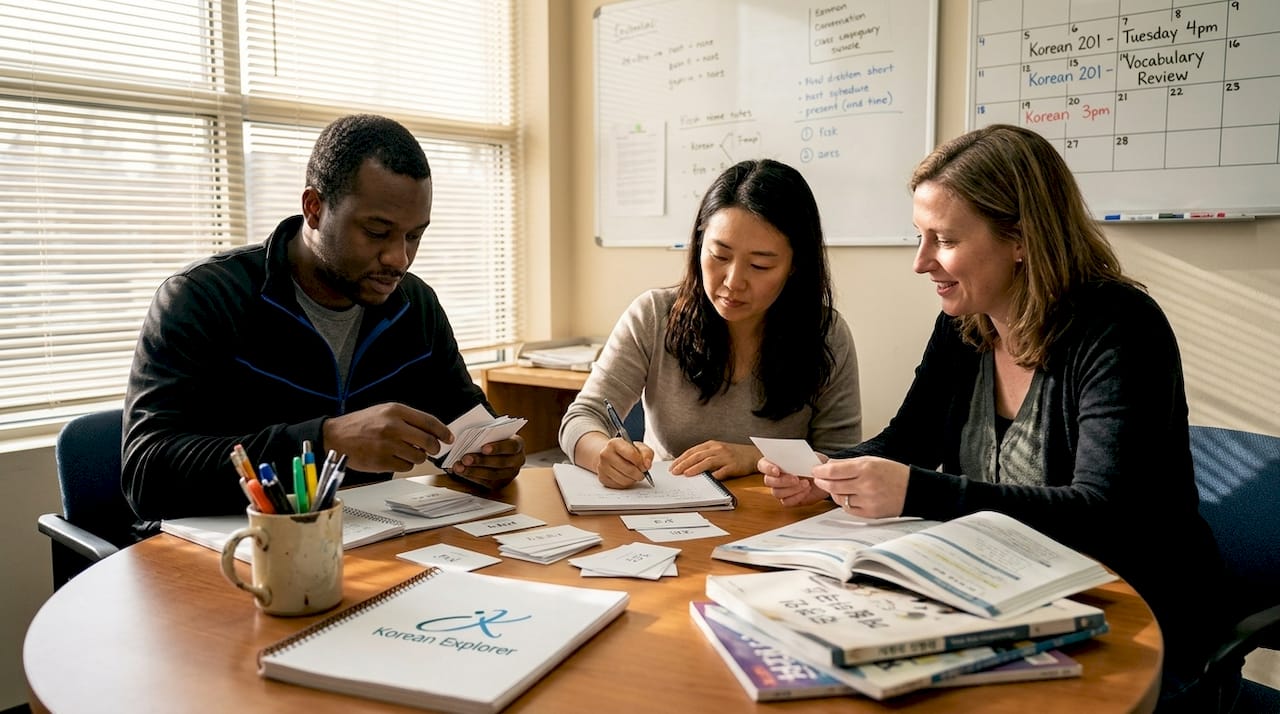
The role of Korean media in class is bigger than most beginners expect. K-pop integration in classes is a structured teaching tool, not just background entertainment. Instructors pause lyrics to highlight grammar patterns and use repeated listening to train pronunciation. K-drama clips serve a similar function for learning speech formality levels and everyday vocabulary that textbooks rarely capture.
Here is what a typical first-term week looks like:
- Lesson day: Hangul practice, grammar introduction, conversation drills
- Between lessons: Short vocabulary review (10 to 15 minutes daily)
- Weekly: One short written assignment or listening quiz
- By week 4: Reading simple Hangul text with confidence
- By week 8: Introducing yourself, ordering food, and asking directions in Korean
Progress milestones through a term:
- Weeks 1 to 2: Master Hangul consonants and vowels, read basic syllable blocks.
- Weeks 3 to 4: Form simple sentences using subject-object-verb structure.
- Weeks 5 to 6: Handle short conversations on everyday topics.
- Weeks 7 to 8: Use past and present tense, understand K-pop and drama clips at slow speed.
- Weeks 9 to 12 (if applicable): Build toward level completion and sit an end-of-term assessment.
“The biggest surprise for most first-term students is not the grammar. It is how quickly Hangul clicks once you learn the logic of the syllable blocks. Most people can read Korean text within the first week.”
The Korean course options page shows a full breakdown of what each level covers so you can map your journey before it starts.
Measuring your progress: Tests, feedback, and real-world fluency
Knowing what you will study is just the start. Tracking improvement and setting real goals is what separates learners who reach fluency from those who plateau after a term or two.
Structured classes in Singapore use multiple layers of assessment. Within each term, you will typically encounter:
- Short vocabulary and grammar quizzes after each major topic, usually 15 to 20 minutes.
- Speaking assessments mid-term, often a short role-play or oral response exercise.
- Listening exercises using K-drama audio clips or TOPIK-style recordings.
- End-of-term projects or written tests that confirm whether you are ready to advance.
Teacher feedback in small classes is continuous, not just at formal test time. Your instructor will correct pronunciation in real time, flag recurring grammar errors in writing, and guide your speaking rhythm during conversation drills. This ongoing loop is precisely why small group formats produce twice the level advancement rate of large classes.
Key stat: Learners in small structured classes complete a proficiency level in 8 to 12 weeks, compared to significantly longer timelines in unsupported or large-group settings.
For learners with formal goals, TOPIK is the benchmark. This is a government-administered exam with six levels, and many Singapore employers and Korean universities recognize it. The good news is that structured courses built on Seoul National University curriculum align closely with TOPIK standards, so you are test-ready without additional cramming.
Some ways to self-assess outside the classroom:
- Watch a familiar K-drama episode you have seen before and note new words you recognize.
- Try ordering at a Korean restaurant in Korean from start to finish.
- Write a short diary entry in Korean after each lesson.
- Use flashcard apps to check vocabulary retention between classes.
For a full list of class venues and tests available in Singapore, including where to sit TOPIK, you will find location-specific details there. If you are ready to find your current level, placement testing is the cleanest starting point.
Our experience: The real keys to lasting fluency
After years of helping Singaporeans learn Korean, we have noticed a clear pattern. The learners who quit are rarely the ones who struggled most with grammar. They are the ones who treated Korean as an intensive short burst rather than a consistent habit.
One uncomfortable truth: consuming K-dramas and K-pop without any structure builds passive recognition, not active fluency. You might understand the vibe of a scene without being able to replicate a single sentence yourself. Structure is what converts passive exposure into usable language.
Consistency beats intensity every time. Two 90-minute classes per week with small-group feedback will outperform a weekend marathon session every single time. The brain needs spaced repetition and correction, not volume.
What actually sustains adults through the journey is genuine cultural curiosity. Learners who find a K-drama they love, a K-pop artist they follow, or even a Korean colleague they want to connect with, stick with their classes far longer than those who are learning out of obligation. Motivation rooted in real interest compounds over time.
Most importantly: the first year is where the biggest leaps happen. With the right real fluency tips and a class that matches your goals, progress in months one through twelve is faster than anything you will experience later. Do not waste it by picking the wrong format.
Take your next step with Korean language classes in Singapore
You now have a clear picture of what effective Korean learning looks like and what to demand from any class you join.
Korean Explorer offers structured courses at all proficiency levels, from complete beginners mastering Hangul to advanced learners preparing for TOPIK exams. Classes are led by native Korean instructors at our Tanjong Pagar, Jurong, and Tampines centers, with online options available. If you are ready to explore what is on offer, the Learn Korean in Singapore page is your starting point. For a direct look at group, private, and exam prep options, browse the full Korean course selection and find the format that fits your schedule, budget, and goal.
Frequently asked questions
How long does it take to complete a Korean language level in Singapore?
In a structured small class, you can complete a level in 8 to 12 weeks, which is about twice as fast as what learners experience in large group formats.
Are Korean classes in Singapore suitable for total beginners?
Yes. Beginner classes start with Hangul using the syllable-block method, so no prior knowledge or experience with Korean is needed to enroll.
What is the usual cost for Korean classes in Singapore?
Most structured Korean classes in Singapore cost between S$240 and S$400 per term, with variation based on class format and whether you choose group or private sessions.
Does joining a Korean class include cultural activities like K-pop or K-drama?
Many quality Singapore classes use K-drama and K-pop as structured teaching tools within lessons to build listening comprehension and real-world vocabulary alongside formal grammar instruction.