TL;DR:
- A structured study routine and clear goals are essential for effective online Korean learning.
- Combining multiple resources and engaging with Korean culture accelerates fluency progress.
- Regular practice, real interaction, and milestone tracking help maintain motivation and measure improvement.
You want to watch K-dramas without subtitles, hold a real conversation in Seoul, or add Korean to your resume. But every time you open a new app or search for lessons, you hit a wall of options with no clear direction. Sound familiar? Learning Korean online is genuinely achievable, but only when you have a structured roadmap instead of random trial and error. This guide walks you through exactly what tools to gather, how to build a study routine that sticks, which mistakes to avoid, and how to measure your real progress so you can move forward with confidence.
Table of Contents
- What you need to start learning Korean online
- Step-by-step guide: Building your Korean study routine online
- Common pitfalls and mistakes in online Korean learning
- How to track your progress and stay motivated
- A real-world perspective: Why combining tools and culture matters most
- Ready for the next level? Explore structured Korean classes
- Frequently asked questions
Key Takeaways
| Point | Details |
|---|---|
| Clear goals boost results | Setting specific targets and choosing the right tools make Korean learning efficient online. |
| Routines drive progress | Consistent study and tracking milestones help learners move from basics to real conversations. |
| Avoid one-app plateaus | Combining multiple tools, speaking practice, and cultural learning prevents stagnation. |
| Motivation is key | Celebrating small wins and joining a community keep you engaged through challenges. |
What you need to start learning Korean online
Before you open a single app, you need to be honest about why you are learning Korean. Your goal shapes everything else. Someone preparing for TOPIK (Test of Proficiency in Korean) needs a completely different setup than someone who just wants to chat with Korean friends or understand K-pop lyrics. Write your goal down. Make it specific. “I want to hold a five-minute conversation about my daily life within six months” is far more useful than “I want to learn Korean.”
Once your goal is clear, gather your core toolkit. You do not need expensive gear. Here is what actually matters:
- A reliable device. A laptop or tablet works best for extended study sessions. Phones are fine for quick vocabulary reviews on the MRT.
- Stable internet. Streaming audio dialogues and video lessons requires a consistent connection. Singapore’s broadband infrastructure makes this easy, but check your home setup.
- A quiet study space. This sounds obvious, but pronunciation practice requires you to speak out loud. Find a space where you can do that without embarrassment.
- A good Korean dictionary app. Naver Dictionary is the gold standard. It handles Hanja, romanization, and example sentences in one place.
- A note-taking system. Whether you prefer a physical notebook or an app like Notion, write down new vocabulary and grammar patterns by hand at least once. The physical act of writing reinforces memory.
Now, the big question: which platform do you actually use? The table below compares the most popular options for beginners.
| Platform | Best for | Level range | Cost | Standout feature |
|---|---|---|---|---|
| KoreanClass101 | Structured learning | Beginner to advanced | Free/Premium | Audio dialogues + cultural insights |
| Duolingo | Building habits | Beginner (A1-A2) | Free/Plus | Gamified, easy to start |
| Talk To Me In Korean | Grammar depth | Beginner to intermediate | Free/Premium | Clear English explanations |
| Coursera (Korean courses) | Academic learners | Varies | Free to audit | University-backed content |
| italki | Speaking practice | All levels | Pay per lesson | Live tutors and language partners |
KoreanClass101 offers structured pathways with over 130 tasks at the beginner level alone, plus audio dialogues, transcripts, vocabulary lists, grammar notes, and cultural insights, all available on both free and premium plans. That breadth makes it one of the strongest starting points for learners who want more than just flashcards.
For the best ways to learn Korean, combining two or three of these platforms works far better than relying on just one. Check the top Korean learning resources to see how experienced learners stack their tools.
Pro Tip: Always start with the free version of any platform. Spend two weeks testing it before you pay for anything. Your learning style will tell you quickly whether a platform fits.
Step-by-step guide: Building your Korean study routine online
Having the right tools is only half the equation. Without a consistent routine, even the best apps collect digital dust. The key is building a schedule that is realistic enough to maintain on a busy weekday and structured enough to produce measurable results.
Here is a proven sequence for building your Korean study routine from scratch:
- Master Hangul first (Week 1 to 2). Hangul, the Korean writing system, has 24 basic letters and can be learned in as little as a week with focused practice. Do not skip this step. Trying to learn Korean through romanization (writing Korean sounds in English letters) creates bad pronunciation habits that are very hard to fix later.
- Build a core vocabulary base (Week 3 to 6). Aim for 300 to 500 high-frequency words before worrying about grammar rules. Use spaced repetition flashcard apps like Anki to review words at scientifically optimized intervals.
- Introduce basic grammar patterns (Week 4 onward). Korean grammar is structured very differently from English. Subject-Object-Verb word order, sentence-ending particles, and levels of formality (formal versus informal speech) are the three biggest shifts. Tackle them one at a time.
- Add real audio exposure (Week 5 onward). Start listening to slow, clear Korean audio. KoreanClass101 dialogues work well here. The goal is training your ear to hear where words begin and end.
- Start speaking out loud (Week 6 onward). Even if you are practicing alone, say your vocabulary and sentences out loud every session. Speaking activates different memory pathways than reading or listening alone.
- Schedule a weekly review session. Every Sunday, go back over the week’s vocabulary and grammar. This prevents the common “I learned it but forgot it” cycle.
How long does all of this take? Research on Duolingo Korean learners shows that consistent study of 30 minutes per day can bring you to an A1-A2 level (basic conversation) within 3 to 6 months. That is a realistic benchmark for most beginners.

Here is a sample weekly time investment guide based on your goals:
| Goal | Daily study time | Estimated timeline |
|---|---|---|
| Read Hangul fluently | 20 minutes | 1 to 2 weeks |
| Basic travel phrases (A1) | 30 minutes | 1 to 2 months |
| Simple conversation (A2) | 30 to 45 minutes | 3 to 6 months |
| Intermediate fluency (B1) | 45 to 60 minutes | 12 to 18 months |
| TOPIK Level 4 (B2) | 60 to 90 minutes | 2 to 3 years |
For a more detailed breakdown, the step-by-step Korean study guide from Korean Explorer covers this in depth. If you are just starting out, the beginner lessons for Korean page explains what to expect in your first few months.
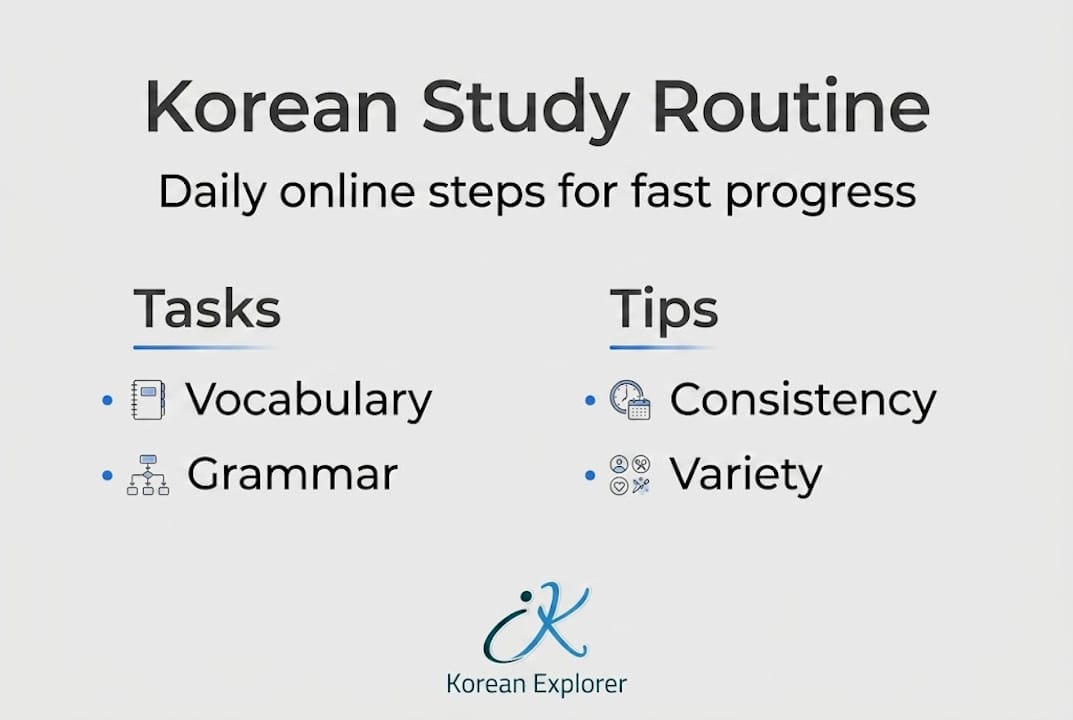
Pro Tip: Vary your activity types within each study session. Spend 10 minutes on vocabulary, 10 minutes on grammar, and 10 minutes on listening or speaking. Variety prevents boredom and forces your brain to engage differently with the same material, which strengthens retention.
Common pitfalls and mistakes in online Korean learning
With your routine in place, it is essential to steer clear of the learning traps that stall progress. Most learners hit a wall not because Korean is too hard, but because they fall into predictable patterns that feel productive without actually building real skills.
Here are the most common mistakes and what to do instead:
- Relying solely on gamified apps. Duolingo is genuinely fun and great for building the habit of daily study. But it has real limitations. As one analysis notes:
“Duolingo Korean is good for habits and building a basic foundation, but it lacks grammar depth, natural pronunciation, and cultural nuances. Most learners plateau at A1-A2 with this approach alone.”
Treat Duolingo as a warm-up, not your main course.
- Ignoring pronunciation from the start. Korean has sounds that do not exist in English or Mandarin, including aspirated consonants (ㅍ, ㅋ, ㅌ) and tense consonants (ㅃ, ㄲ, ㄸ). If you practice with wrong pronunciation for months, you will need to unlearn those habits before you can sound natural. Use audio-rich resources from week one.
- Never actually speaking. Reading and listening are passive skills. Speaking is active. Many online learners spend months studying without ever saying a word out loud. This is a serious mistake. Even five minutes of speaking practice per session makes a dramatic difference over time.
- Skipping cultural context. Korean language is deeply tied to Korean social culture. The honorific speech system (존댓말, jondaemal) is not just grammar. It reflects real social relationships. If you do not understand why Koreans speak differently to elders versus friends, you will make socially awkward mistakes even if your grammar is technically correct.
- Studying only one skill. Some learners obsess over vocabulary but never practice listening. Others focus on grammar but cannot read Hangul quickly. Balance all four skills: reading, writing, listening, and speaking.
The fix for most of these pitfalls is the same: supplement your app-based study with real interaction. Find a language exchange partner on apps like HelloTalk. Watch Korean YouTube channels without subtitles for 10 minutes a day. The easy tips for Korean page covers practical ways to add variety, and the Hangul learning strategies guide is especially useful if pronunciation is your weak spot.
How to track your progress and stay motivated
Avoiding mistakes is one thing. Staying consistent and seeing real improvement is another. Progress in language learning is not always obvious from day to day, which makes it easy to feel like you are not moving forward even when you are.
Here is a simple framework for tracking your Korean progress:
- Set a 30-day goal. Not “learn Korean” but something specific: “I will learn 150 new words and be able to introduce myself in Korean by the end of this month.”
- Do a weekly mini-test. Cover your notes and try to recall vocabulary from memory. Write out five sentences using this week’s grammar pattern. If you can do it, the knowledge is moving from short-term to long-term memory.
- Record yourself speaking. Once a month, record a 60-second self-introduction or description of your day in Korean. Compare recordings over time. The improvement you hear will be one of the most motivating experiences in your learning journey.
- Use course checkpoints. Platforms like KoreanClass101 include quizzes and level assessments. Structured learning with checkpoints keeps you accountable and shows you exactly where gaps exist.
- Adjust your plan every 60 days. If you have been at the same level for two months, something needs to change. Add a new resource, increase your study time, or try a different method.
Beyond tracking, motivation requires active maintenance. Here are strategies that actually work:
- Connect with other Korean learners in Singapore. Online study communities on Reddit (r/Korean) and Discord servers for Korean learners give you accountability partners.
- Reward yourself at milestones. Finished your first 100 Anki cards? Watch a K-drama episode without subtitles as a reward. Completed your first month? Treat yourself to Korean food at Tanjong Pagar.
- Follow Korean content creators you genuinely enjoy. If you love cooking, follow Korean cooking channels. If you love gaming, find Korean gaming streamers. Interest makes the language feel alive rather than like homework.
- Track streaks, but do not worship them. A missed day is not a failure. Missing a week is a pattern worth addressing.
For more ideas on building your word bank efficiently, the vocabulary building tips page at Korean Explorer offers practical strategies that work alongside any platform you choose.
Pro Tip: Celebrate every milestone, no matter how small. The learner who celebrates finishing Hangul is far more likely to reach B1 than the one who dismisses early wins as “not real progress.”
A real-world perspective: Why combining tools and culture matters most
After years of watching Korean learners in Singapore make progress or stall, one pattern stands out clearly. The learners who reach conversational fluency fastest are not the ones who found the perfect app. They are the ones who stopped treating Korean as a code to crack and started treating it as a living culture to participate in.
The most successful learners we see use two or three platforms alongside real-world engagement. They might use KoreanClass101 for structure, Anki for vocabulary, and then spend 20 minutes a week in a Korean language chat group or at a Singapore Korean cultural event. They watch K-dramas not just for entertainment but as active listening practice. They notice how characters speak differently to their bosses versus their friends, and they bring those observations back to their study sessions.
App-only progress has a ceiling. You can feel very busy studying without ever building the instinct to respond naturally in a real conversation. Real interaction, even imperfect and awkward interaction, forces your brain to retrieve language under pressure. That is where fluency actually forms.
If K-pop or Korean cinema is what drew you to the language, use that passion. The Korean culture guide is a great starting point for understanding the cultural layer beneath the language. Do not just learn Korean. Live it a little, even from Singapore.
Ready for the next level? Explore structured Korean classes
Self-study gets you started, but expert guidance accelerates your growth in ways that apps simply cannot replicate.
At Korean Explorer, our Korean language courses are built on a Seoul National University curriculum aligned with TOPIK standards, so every lesson you complete maps directly to recognized proficiency benchmarks. Whether you are aiming for conversational fluency, exam preparation, or career advancement, our native Korean instructors provide real-time feedback that no algorithm can match. We also offer fully flexible online Korean classes that fit around your schedule. Pair structured lessons with the Korean culture resources on our site, and you will progress faster than self-study alone can take you.
Frequently asked questions
What is the best online platform to start learning Korean for beginners?
KoreanClass101 is a top choice for beginners because it offers structured pathways with 130+ tasks at the beginner level, plus audio dialogues, cultural insights, and both free and premium options.
How much time do I need to reach basic Korean conversational skills online?
With 30 minutes of daily study, you can reach basic conversation level (A1-A2) in 3 to 6 months. Duolingo data shows this is a realistic benchmark for consistent beginners using app-based learning.
Can I become fluent in Korean with just apps like Duolingo?
No. Apps like Duolingo are excellent for building habits and mastering Hangul, but they lack grammar depth and cultural nuance required for fluency beyond the A1-A2 level.
How do I stay motivated while learning Korean online?
Set specific 30-day goals, record yourself speaking monthly to hear your own progress, and connect with other learners in online communities or local Singapore language groups to stay accountable.
What should I do if I hit a plateau with online learning tools?
Add conversation practice with a real person through platforms like italki or HelloTalk, and supplement with cultural content like K-dramas or Korean podcasts to push past the plateau.