TL;DR:
- Korean has a logical, structured curriculum aligned with internationally recognized TOPIK levels.
- Passing TOPIK demonstrates measurable language proficiency, with levels 1-6 covering basic to advanced skills.
- Using a curriculum-based approach in Singapore includes local courses, exam centers, and real-world immersion opportunities.
Most people assume that learning Korean is a battle against an alien script and grammatical rules that seem to have no parallel in English. That assumption stops a lot of potential learners before they even begin. The truth is, Korean has one of the most logical and learnable writing systems in the world, and the language curriculum built around it is structured, standardized, and designed to take you from absolute beginner to near-native speaker through clear, measurable stages. Whether your goal is to enjoy K-dramas without subtitles, study at a Korean university, or advance your career, understanding the curriculum first will save you months of guesswork.
Table of Contents
- How the Korean language curriculum is structured
- Understanding TOPIK: The cornerstone of Korean proficiency
- What you’ll study: Core skills and topics by level
- Applying the Korean curriculum in Singapore
- What most people misunderstand about the Korean curriculum
- Start your Korean journey with expert guidance
- Frequently asked questions
Key Takeaways
| Point | Details |
|---|---|
| Structured learning path | The Korean curriculum clearly maps each stage from beginner to advanced for step-by-step progress. |
| TOPIK as the benchmark | The TOPIK exam is the recognized standard for measuring Korean language proficiency worldwide. |
| Local opportunities | Singapore offers accredited courses and official TOPIK testing centers for all learners. |
| Real-world application | The curriculum supports everyday conversation, academic goals, and professional skills in Korean. |
How the Korean language curriculum is structured
Think of the Korean language curriculum as a staircase. Each step builds directly on the one before it, and you cannot skip steps without losing stability. The curriculum divides learning into three main phases: Beginner, Intermediate, and Advanced. These phases map closely to the internationally recognized TOPIK framework, which means every hour you invest is traceable against a global benchmark.
Here is how the three phases look in practice:
- Beginner (Levels 1 to 2): You learn Hangul (the Korean alphabet), basic sentence structures, everyday vocabulary, and simple conversational exchanges. Greetings, shopping, asking for directions.
- Intermediate (Levels 3 to 4): You tackle more complex grammar, news-level reading, and professional or social conversation. You start expressing opinions and understanding context.
- Advanced (Levels 5 to 6): You engage with academic and professional texts, nuanced cultural references, and formal writing. This is near-native territory.
The curriculum is internationally benchmarked via TOPIK I and TOPIK II, making your qualifications recognized whether you are in Singapore, Seoul, or anywhere else in the world.
| Phase | TOPIK Levels | Key Focus Areas |
|---|---|---|
| Beginner | 1 to 2 | Hangul, basic vocab, simple sentences |
| Intermediate | 3 to 4 | Complex grammar, reading, social speech |
| Advanced | 5 to 6 | Academic texts, formal writing, nuanced speech |
Singapore adopts these international standards directly. Reputable Korean language courses in Singapore align their syllabi with TOPIK levels, which means your progress in a local classroom translates to globally recognized proficiency. This alignment matters especially if you ever plan to study or work in Korea. When choosing where to study, look for language schools for Korean study that explicitly follow a TOPIK-aligned curriculum, so your learning path has a clear direction. Just as an education system comparison can help parents choose the right school structure for their child, choosing a curriculum-aligned Korean program helps you invest your time wisely.
Pro Tip: Do not start with random YouTube videos or apps alone. Begin with a curriculum-aligned path so every lesson connects to a measurable goal and you can track real progress month by month.
Understanding TOPIK: The cornerstone of Korean proficiency
A closer look at the curriculum would not be complete without understanding its main checkpoint: the TOPIK exam. TOPIK stands for Test of Proficiency in Korean, and it is the official, internationally accepted measure of Korean language ability for non-native speakers.
There are two versions of the exam. TOPIK I covers Levels 1 and 2, testing reading and listening only. TOPIK II covers Levels 3 through 6, adding writing as a tested skill. Here is how the scoring breaks down:
| Level | Exam | Skills Tested | Minimum Score |
|---|---|---|---|
| 1 | TOPIK I | Reading, Listening | 80/200 |
| 2 | TOPIK I | Reading, Listening | 140/200 |
| 3 | TOPIK II | Reading, Listening, Writing | 120/300 |
| 4 | TOPIK II | Reading, Listening, Writing | 150/300 |
| 5 | TOPIK II | Reading, Listening, Writing | 190/300 |
| 6 | TOPIK II | Reading, Listening, Writing | 230/300 |
One fact that surprises many learners: a TOPIK certificate is only valid for two years from your test date. If you are applying to a Korean university, most institutions require at least Level 3. Some competitive programs ask for Level 4 or higher. Understanding what TOPIK test means for your specific goals, whether academic, professional, or personal, will help you decide which level to target first.
The benefits of TOPIK for students go far beyond university admission. Employers in Korea and Korean companies globally recognize TOPIK scores as a hiring credential.
To take TOPIK in Singapore, follow these steps:
- Check the official TOPIK exam schedule for Singapore, usually announced several months in advance.
- Register online through the official TOPIK application portal during the open registration window.
- Pay your registration fee, which is typically available at SKIS Bukit Timah in Singapore.
- Prepare using past papers, mock exams, and your curriculum-aligned coursework.
- Attend on exam day with your registration confirmation and valid ID.
What you’ll study: Core skills and topics by level
Now that you grasp the framework and benchmarks, let’s get specific about what you will actually learn at every step.
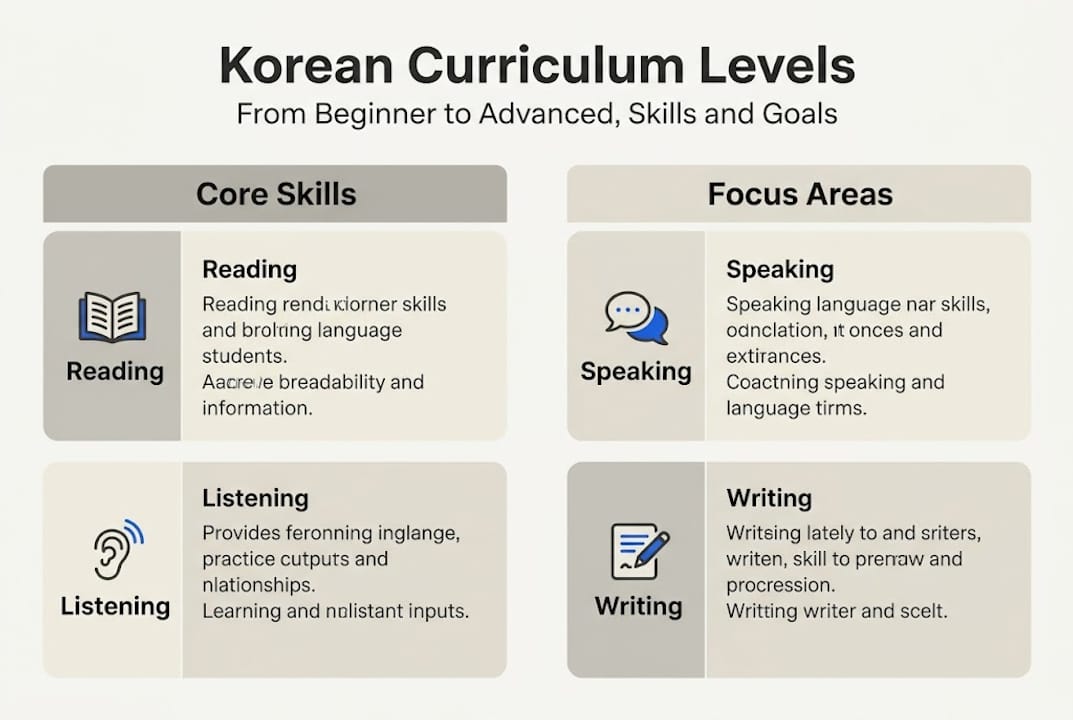
The Korean curriculum develops four core skills: reading, listening, speaking, and writing. Each phase emphasizes different combinations of these skills, and the communicative goals become progressively more sophisticated.
Beginner outcomes (Levels 1 to 2):
- Recognize and write all Hangul characters accurately
- Understand and use around 800 words for basic conversation
- Handle everyday situations like introductions, ordering food, and asking for help
- Form simple present and past tense sentences
Intermediate outcomes (Levels 3 to 4):
- Read and understand newspaper articles and online content
- Follow the main points of TV programs and spoken discussions
- Communicate in professional and social settings with confidence
- Express opinions, make comparisons, and describe experiences fluently
Advanced outcomes (Levels 5 to 6):
- Read academic papers, legal documents, and complex literary texts
- Produce formal written reports and structured arguments
- Speak with near-native fluency, including idiomatic expressions
- Understand subtle cultural references and humor in context
“At Level 1, a learner might manage a convenience store transaction. At Level 6, that same learner can argue a legal case, write a research paper, or anchor a news broadcast in Korean. The distance between those two points is exactly what the curriculum is designed to bridge.”
In real-world terms, intermediate learners in Singapore often use their skills in Korean-owned businesses, tourism, and customer service roles. Advanced learners pursue graduate studies in Korea or work in Korean multinational companies. Exploring the ways to study Korean that include immersive practice, not just textbook drills, will accelerate this progression significantly.
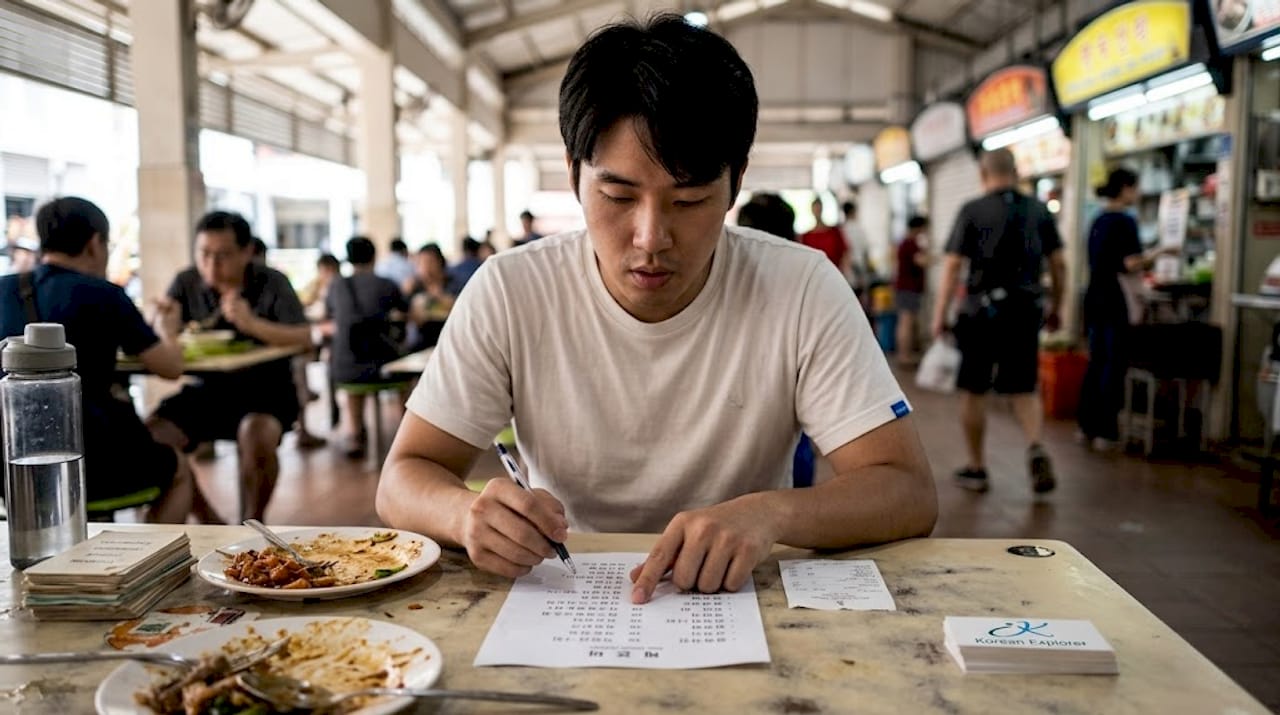
Pro Tip: At every level, practice with actual TOPIK past papers. They reveal exactly what vocabulary, grammar, and comprehension skills examiners test, and they train your brain to perform under real exam conditions. Pair this with our structured Korean study tips for a complete study system.
Applying the Korean curriculum in Singapore
Equipped with curriculum knowledge, let’s see how you can put it into practice right here in Singapore.
Singapore has a vibrant Korean learning community. Several reputable providers offer curriculum-aligned courses, and the TOPIK exam is administered locally, so you do not need to travel to Korea to get certified.
Here is a snapshot of how major providers and test centers serve Singapore learners:
| Provider / Center | Role | Notes |
|---|---|---|
| Korean Explorer | Korean language courses, TOPIK prep | TOPIK-aligned curriculum, multiple locations |
| SKIS Bukit Timah | Official TOPIK exam center | Fees around S$100 to S$120 per sitting |
| Community centers | Basic Korean classes | Less structured, good for casual learners |
| Online platforms | Supplementary study | Best paired with a structured classroom course |
When you find classes that explicitly build toward TOPIK levels, you gain several concrete advantages:
- Your teacher knows exactly what exam skills to develop at each stage
- Lessons follow a proven progression, so no important grammar point is skipped
- You have clear milestones to celebrate and a timeline to plan around
- Class materials are often drawn from past TOPIK papers, which doubles as exam practice
- You connect with other learners at similar stages, creating a study community
Cultural exposure in Singapore also works in your favor. The local Korean community, Korean restaurants, K-pop events, and Korean films create natural immersion opportunities outside the classroom. Using these touchpoints consciously, like trying to read Korean menus or listening to Korean radio, reinforces classroom learning in ways that flashcard apps simply cannot replicate. Similarly, preparing for language certification in any context requires combining structured study with real-world practice.
What most people misunderstand about the Korean curriculum
After exploring how the curriculum can guide your journey, let’s address a few persistent misunderstandings.
Many learners resist curriculum-based study because they assume it means rigid, boring lessons that prioritize grammar drills over real conversation. That impression is outdated and, frankly, wrong. A well-designed curriculum actually accelerates fluency by removing the guesswork about what to study next. Without structure, learners drift between random vocabulary lists and isolated phrases, never building the connected knowledge that enables natural speech.
Another common mistake is treating TOPIK as the end goal rather than a checkpoint. Passing Level 4 does not mean you have “finished” Korean. It means your communication tools are now powerful enough to use authentically in professional and academic environments. The test measures your skills; it does not define your ceiling.
Real fluency comes from integrating all four skills, reading, listening, speaking, and writing, not from memorizing word lists in isolation. Understanding what it takes for Singaporeans to genuinely master Korean shows that consistent, structured effort always outperforms sporadic cramming.
Pro Tip: Embrace the curriculum as your map, not your cage. Use it to know where you are, where you are going, and exactly how to get there.
Start your Korean journey with expert guidance
Ready to move from understanding to action?
At Korean Explorer, every course is designed around the same curriculum framework this article has walked you through. From your very first lesson to advanced TOPIK preparation, you learn with experienced native instructors who know exactly how to move you through each level efficiently.
Our Korean language courses cover every stage of the curriculum, with group, private, and online options to fit your schedule. Not sure which level you belong in? We offer placement tests to match you to the right class immediately. If your goal is exam success, our dedicated TOPIK courses in Singapore will prepare you with targeted practice. Learn more about understanding TOPIK before you register and take the first step with confidence.
Frequently asked questions
What is the main standard for Korean language proficiency?
The TOPIK exam is the official proficiency benchmark for Korean, covering six levels across reading, listening, and writing skills for non-native speakers.
Where can I take TOPIK in Singapore and what does it cost?
You can sit the TOPIK exam in Singapore at SKIS Bukit Timah, with registration fees generally ranging from S$100 to S$120 per sitting.
How long is the TOPIK certificate valid for university applications?
The TOPIK certificate is valid for two years from the test date, and Korean universities typically require at least Level 3 for admission, with competitive programs asking for Level 4 or above.
How many words do you need to know for beginner versus advanced levels?
TOPIK Level 1 requires around 800 words for basic conversation, while Level 6 reflects near-native command of over 6,000 words across diverse academic and professional contexts.
Is the Korean curriculum the same worldwide?
The curriculum aligns with TOPIK standards globally, so the proficiency benchmarks are consistent internationally, even though individual schools may adapt their teaching materials and methods.