TL;DR:
- The top alternatives to Korean Stack Exchange focus on correction, conversation, and structured lessons, filling gaps left by the original site. Combining platforms like Reddit for grammar questions, HiNative for quick corrections, and HelloTalk or Tandem for speaking practice offers a balanced approach. Using multiple tools tailored to specific goals accelerates progress and ensures comprehensive language development.
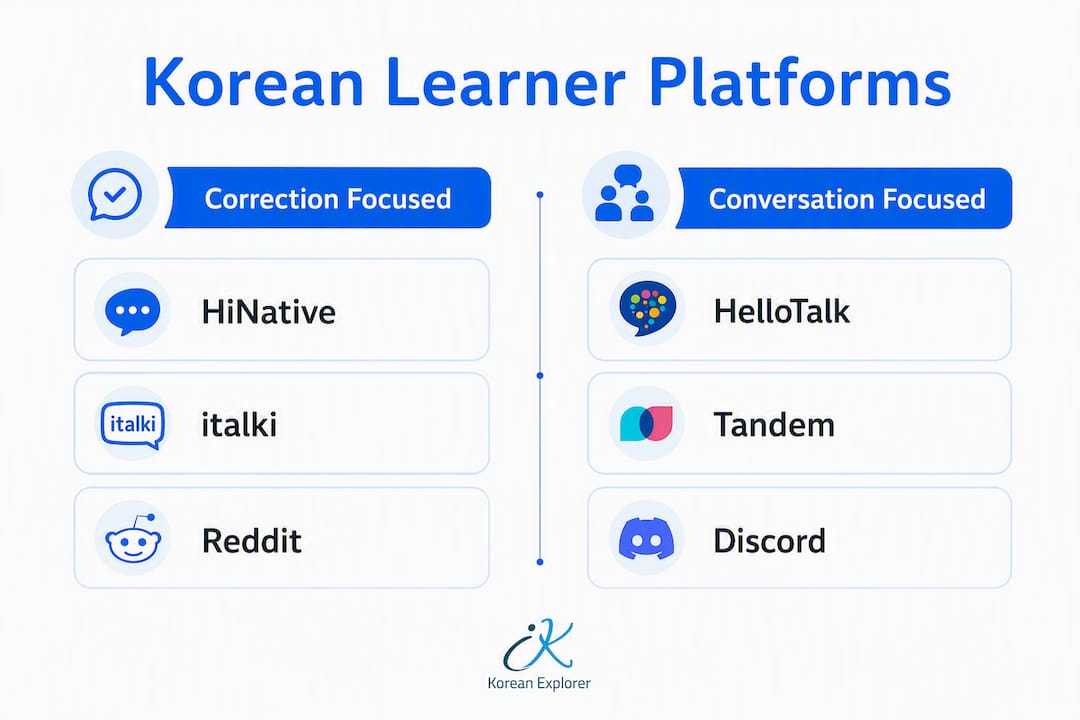
The four strongest alternatives to Korean Stack Exchange right now are HiNative (fast native-speaker corrections), HelloTalk or Tandem (real-time conversation practice), Reddit’s r/LearnKorean (structured community Q&A), and italki’s Community Notebook (written corrections plus tutor access). Each one fills a gap that the original site left open when it went read-only.
Here’s the quick breakdown:
- HiNative — Best for fast, one-off phrase checks and pronunciation questions; native volunteers typically respond within hours.
- HelloTalk / Tandem — Best for speaking practice and real-time exchange; corrections happen inline during chat.
- Reddit (r/LearnKorean, r/Korean) — Best for longer grammar questions and resource recommendations; free, asynchronous, community-moderated.
- italki Community Notebook — Best for written corrections with optional paid tutor follow-up; hybrid free-and-paid model.
Table of Contents
- How these alternatives differ from a Stack Exchange–style Korean Q&A site
- 1. Reddit: r/LearnKorean and r/Korean
- 2. HiNative gets you fast native-speaker corrections
- 3. HelloTalk connects you with native Korean speakers in real time
- 4. Tandem offers verified tutors alongside language exchange
- 5. italki Community Notebook combines free corrections with paid lessons
- 6. Discord Korean language servers give you community in real time
- 7. Duolingo forums cover Korean grammar discussions
- 8. Facebook Learn Korean groups offer casual community support
- 9. Quora covers Korean language questions with mixed results
- 10. Structured communities like Everyday Korean and KTalk fill the forum gap
- How to pick the right platform for your goal
- How to ask Korean questions that get helpful answers
- When a paid structured course beats community Q&A
- Key Takeaways
- What actually works when you combine platforms
- Useful sources and places to join
- FAQ
How these alternatives differ from a Stack Exchange–style Korean Q&A site
Korean Stack Exchange was built around a strict Q&A format: one question, one accepted answer, heavy moderation, and permanent searchable records. The alternatives below work differently, and knowing the tradeoff saves you from frustration.
Most of these platforms prioritize correction formats, real-time practice, or structured lessons over the terse, citation-backed answers Stack Exchange demanded. That means faster responses but also more variable quality. A native speaker on HiNative will correct your sentence in two hours; they won’t necessarily explain the underlying grammar rule the way a curated Stack Exchange answer would. Reddit threads can run long and contradictory. HelloTalk corrections vanish when a conversation ends.
The seven dimensions that matter most when comparing platforms:
| Dimension | What to expect across alternatives |
|---|---|
| Best for | Corrections, conversation, grammar Q&A, or structured lessons |
| Interaction style | Q&A, inline corrections, language exchange, tutor notes |
| Response speed | Fast (HiNative, HelloTalk) to slow (Quora, Facebook groups) |
| Native-speaker presence | High on HiNative/Tandem; variable on Reddit and Discord |
| Cost | Mostly free or freemium; italki and Tandem Pro are paid |
| Moderation | Ranges from strict (Reddit rules) to minimal (Facebook groups) |
| Real-time vs async | HelloTalk/Tandem = real-time; Reddit/italki Notebook = async |
Pro Tip: Use two platforms in tandem: one async forum (Reddit or HiNative) for durable, searchable answers, and one exchange app (HelloTalk or Tandem) for speaking practice. You get the permanence of Q&A and the fluency of conversation.
1. Reddit: r/LearnKorean and r/Korean
Both subreddits are free, public, and moderated by community volunteers. r/LearnKorean skews toward learners helping learners, with frequent grammar threads, resource lists, and weekly check-in posts. r/Korean attracts more native speakers and covers culture alongside language.
Pros: Large active community; searchable archive of past questions; no account required to read.
Cons: Answer quality varies; no inline correction tool; posts can go unanswered during off-peak hours.
Best for: Grammar questions, resource hunting, and beginner-to-intermediate learners who want a searchable thread history.
2. HiNative gets you fast native-speaker corrections
HiNative is purpose-built for short questions: “Is this sentence natural?” “How do you pronounce 이거?” Native Korean speakers volunteer answers, often within a few hours. The format is closer to Stack Exchange than any other free option, but without the strict citation requirements.
Pros: Quick turnaround; native-speaker answers; free tier covers most needs.
Cons: Not suited for long grammar explanations; free account limits daily questions; no voice-lesson option.
Best for: Quick phrase checks, translation confirmation, and pronunciation questions.
3. HelloTalk connects you with native Korean speakers in real time
HelloTalk is a language-exchange app where you chat with native Korean speakers who are learning your language. Corrections happen inline: a native speaker can highlight your sentence and suggest a fix without breaking the conversation flow. Voice notes and short audio clips make it useful for pronunciation too.

Pros: Real-time corrections; voice note support; large Korean-speaker user base.
Cons: Exchange dynamic means you spend time helping others; answers aren’t archived for future reference; data privacy depends on your account settings.
Best for: Conversational practice, pronunciation feedback, and learners who want a speaking partner rather than a grammar explainer.
4. Tandem offers verified tutors alongside language exchange
Tandem works similarly to HelloTalk but adds a layer of verified community tutors you can pay for structured sessions. The free exchange side covers casual conversation; the paid side gives you accountability and lesson structure.
Pros: Verified tutor option; voice and video calls built in; strong moderation policy.
Cons: Freemium model; best features require payment; smaller Korean-speaker pool than HelloTalk.
Best for: Learners who want to graduate from casual exchange to light tutoring without switching apps.
5. italki Community Notebook combines free corrections with paid lessons
italki’s Community Notebook lets you post a written passage in Korean and receive corrections from native speakers for free. If you want to go deeper, you can book a paid lesson with a professional tutor directly from the same platform. It’s the closest thing to a hybrid model among all the alternatives.
Pros: Free written corrections; large tutor marketplace; asynchronous corrections fit busy schedules.
Cons: Notebook corrections can be inconsistent in depth; paid lessons add up; no real-time chat for free users.
Best for: Intermediate learners who write regularly and want both free feedback and occasional paid instruction.
6. Discord Korean language servers give you community in real time
Active Discord servers dedicated to Korean learning range from tightly moderated study groups to open chat rooms. Moderation and quality vary enormously by server, so check the rules channel and activity level before committing. The best servers run weekly speaking events and correction channels.
Pros: Real-time community; voice channels for pronunciation practice; often free.
Cons: Highly variable moderation; answer quality depends on who’s online; data privacy settings differ by server.
Best for: Learners who want a live community feel and are comfortable vetting server quality themselves.
Pro Tip: Before posting sensitive writing samples on any Discord server, check whether the server is public or invite-only. Public servers index content in ways you may not expect.
7. Duolingo forums cover Korean grammar discussions
The Duolingo Korean forum hosts threads on grammar, vocabulary, and sentence discussions organized by topic. It’s most useful for learners already using the Duolingo Korean course, since threads often reference specific lessons.
Pros: Organized by grammar and vocabulary topics; free; moderated by Duolingo staff.
Cons: Narrow scope tied to Duolingo’s curriculum; less useful for advanced or off-curriculum questions.
Best for: Duolingo users who want to dig deeper into a specific lesson or grammar point.
8. Facebook Learn Korean groups offer casual community support
Facebook groups like “Learn Korean” and “Korean Language Learners” have large memberships and active daily posts. Moderation is inconsistent, and answer accuracy is not guaranteed, but these groups are good for motivation, cultural questions, and finding study partners.
Pros: Large membership; easy to find study partners; good for cultural questions.
Cons: Low moderation; frequent spam; Facebook’s data practices mean your posts are broadly visible.
Best for: Casual learners seeking community motivation and cultural conversation rather than precise grammar answers.
9. Quora covers Korean language questions with mixed results
Quora has a reasonable archive of Korean language questions, some answered by native speakers or linguists. The platform’s algorithm surfaces older answers prominently, so check the date before trusting a response. It’s better for “why does Korean grammar work this way” questions than for real-time corrections.
Pros: Searchable archive; some high-quality long-form answers; free.
Cons: No correction format; answer quality is inconsistent; no community moderation for language accuracy.
Best for: Conceptual questions about Korean grammar or culture where a long-form answer adds value.
10. Structured communities like Everyday Korean and KTalk fill the forum gap
Everyday Korean combines daily lessons with weekly live classes and group support, making it closer to a course than a forum. KTalk runs as a discussion-board community for free-form Korean language conversation. A Spoonful of Korean adds small-group lessons led by a named instructor alongside free grammar guides. Study-Korean.com offers curated learning content with personalized study pathways. The Korean Part:Time is a free community built around a video course but open to general learners as a study hub.
These platforms sit between a forum and a course. They’re worth trying if you want more structure than Reddit but aren’t ready to pay for private lessons.
Best for: Self-directed learners who want curriculum scaffolding alongside peer discussion.
How to pick the right platform for your goal
Lead with your learning goal, not the platform’s feature list. If you need a grammar correction today, HiNative or italki’s Notebook gets you there fastest. If you need speaking confidence, HelloTalk or Tandem. If you want a searchable archive of answered questions, Reddit or the WordReference Korean forum are your best bets.
| Goal | Platform type | What to look for |
|---|---|---|
| Quick corrections | Correction-focused app | Native-speaker volunteers, fast response |
| Speaking practice | Language exchange app | Voice/video support, active Korean speakers |
| Grammar answers | Forum or Q&A site | Moderation rules, searchable threads |
| Structured progress | Course-community hybrid | Daily lessons, live sessions, instructor access |
| Tutor-led feedback | Paid platform | Verified tutors, lesson booking, correction tools |
On cost: Most platforms are free or freemium. Paid features (Tandem Pro, italki lessons) typically run a few dollars per session. Budget $10–$30 per month if you want regular tutor access.
On privacy: Before posting written work or voice clips, check whether the platform is public or private. Reddit posts are indexed by search engines. Facebook group posts are visible to all members. HiNative and italki have account-level privacy settings worth reviewing.
Red flags to avoid: No visible moderation rules, high spam volume, many unanswered posts older than a week, or requests to move conversation to personal messaging outside the platform.
How to ask Korean questions that get helpful answers
A well-structured question gets faster, higher-quality corrections. The format that works across every platform:
- Context: One sentence explaining the situation (e.g., “I’m writing a text to a Korean colleague”).
- Your sentence: Write it in Hangul. Romanization is a supplement, not a replacement.
- Intended meaning: What you were trying to say in English.
- What you’ve tried: Show your reasoning so responders correct the right thing.
- Specific ask: “Is this natural?” or “Is the honorific level correct?” beats “Is this right?”
Example (grammar-focused):
Context: Texting a friend to reschedule plans. My sentence: 내일 만날 수 있어요? Intended meaning: “Can we meet tomorrow?” Question: Is the politeness level right for a close friend, or should I use 반말?
Example (pronunciation-focused):
I recorded myself saying 감사합니다 (audio attached). Does my pronunciation of the final syllable sound natural to a native speaker?
Pro Tip: When asking for corrections, specify the format you want: “Please correct inline” or “Please rewrite the whole sentence.” Responders who know your preference give more useful answers.
For more on building good study habits around community feedback, the tips for studying Korean guide at Korean Explorer covers Hangul practice and study structure in practical detail.
When a paid structured course beats community Q&A
Choose a paid course or tutor when you need a systematic curriculum, guaranteed feedback, or measurable outcomes. Forums are excellent for one-off questions, but they can’t sequence your learning or hold you accountable. Structured daily lessons plus community practice tend to produce faster progress than forums alone, because forums can overwhelm beginners with unfiltered, sometimes contradictory answers.
Common scenarios where a course makes sense:
- You need Korean for work within a specific timeframe (corporate training, job interview preparation).
- You’ve been stuck at the same level for months despite active forum participation.
- You want personalized correction rather than crowd-sourced opinions.
- You’re preparing for a professional presentation or business meeting in Korean.
For Singapore-based adult learners, Korean Explorer offers online Korean classes via Zoom and private Korean classes with native instructors, covering conversational and business Korean for all adult levels. The curriculum is built around real communication, not just grammar drills, and corporate training is available for teams.
Pro Tip: Try a community platform for two weeks first. If you’re still confused about the same grammar point after multiple answers, that’s the signal to book a lesson. One focused session with a tutor often resolves what three forum threads couldn’t.
Key Takeaways
The most effective approach to replacing Korean Stack Exchange is combining one correction-focused platform for quick answers with one exchange or course option for speaking practice and structured progress.
| Point | Details |
|---|---|
| Match platform to goal | Use HiNative for quick corrections, HelloTalk or Tandem for speaking, Reddit for grammar threads. |
| Check moderation first | Active rules and low spam volume are the clearest signs of a reliable community. |
| Ask structured questions | Include context, your Hangul sentence, intended meaning, and a specific ask to get useful corrections. |
| Privacy matters | Review account settings before posting voice clips or written work on public platforms. |
| Upgrade when stuck | If the same question keeps coming back after forum answers, a paid lesson resolves it faster. |
What actually works when you combine platforms
The conventional advice is to pick one platform and stick with it. In practice, that’s how learners plateau. The people who make the fastest progress tend to use a forum for reference answers, a language-exchange app for daily speaking reps, and a monthly paid lesson to catch the errors neither source flags.
A simple cadence that works: spend ten minutes a day on HiNative or Reddit for vocabulary and phrase questions. Do one thirty-minute HelloTalk or Tandem session per week for conversation. Book one structured lesson per month to review accumulated errors and get a progress check. That rhythm keeps you active without burning out on any single platform.
The part most guides skip: community platforms are excellent at answering the question you asked, but they rarely tell you what question you should be asking. A tutor or structured course does that. Forums give you answers; a curriculum gives you a map. Both matter, and neither fully replaces the other.
Useful sources and places to join
Official community pages and learning hubs worth bookmarking:
- Everyday Korean — Daily lessons and weekly live classes with group support; good for learners who want structure alongside community.
- A Spoonful of Korean — Free grammar guides, small-group lessons, and travel/culture support for learners at all levels.
- KTalk — Discussion-board community for free-form Korean language conversation and knowledge sharing.
- Study-Korean.com — Curated learning content with personalized study pathways and global community access.
- The Korean Part:Time — Free community built around a video course; open to general learners as a study hub.
- WordReference Korean Forum — Long-running forum with free grammar and vocabulary threads in Korean.
- LingQ Korean Forum — Ask a Tutor — Tutor-answered threads for learners using the LingQ reading method.
For adult learners in Singapore who want paid, structured options: Korean Explorer’s Korean language courses cover group classes, private lessons, and corporate training online and in person. Check each platform’s moderation and privacy settings before posting personal writing or audio.
FAQ
What is the best free alternative to Korean Stack Exchange?
HiNative is the closest free replacement for quick, native-speaker corrections. Reddit’s r/LearnKorean covers longer grammar questions with a searchable thread archive.
How long does it take to get an answer on these platforms?
HiNative and HelloTalk typically respond within a few hours. Reddit varies from minutes to a day depending on post timing. Facebook groups and Quora can take days or go unanswered.
Are language exchange apps safe for sharing personal information?
Most apps (HelloTalk, Tandem, italki) have account-level privacy settings, but public platforms like Reddit index posts in search engines. Review each platform’s privacy policy and avoid sharing personal contact details outside the platform.
When should I use a paid tutor instead of a free community?
Book a paid tutor when you’ve been stuck at the same level for more than a few weeks, need Korean for a specific professional goal, or want personalized feedback rather than crowd-sourced answers.
Can I use multiple Korean learning platforms at the same time?
Yes, and most effective learners do. A practical combination is one async forum for grammar questions, one exchange app for speaking practice, and an occasional paid lesson for structured correction and progress review.