Learning Korean pays off in three clusters: culture access through K-pop and K-dramas, quick early wins from Hangul’s phonetic alphabet, and real career and travel advantages tied to Korea’s global business reach. Interest driven by genuine curiosity tends to carry learners further than practical motives alone. The reasons and a simple starting plan follow below.
TL;DR:
- Learning Korean enables quicker comprehension of cultural content like songs and dramas, especially when studying with a direct focus on vocabulary related to favorite scenes.
- Hangul’s phonetic design allows most adults to read basic syllables within days, making early reading milestones achievable without memorization.
- Proficiency increases job prospects in Korea-linked sectors such as technology, entertainment, trade, and tourism, often leading to higher wage premiums in those fields.
- Starting to speak within the first two weeks supports faster progress, since early speaking practice highlights gaps that memorization alone cannot address.
- A structured beginner plan combining Hangul mastery, regular practice, and speaking exposure enhances motivation and improves retention for long-term fluency.
Table of Contents
- Why Learn Korean Language: 8 Reasons That Actually Hold Up
- Culture and Media: How Hallyu Motivates Real Learning
- Career, Study, and Practical Opportunities From Korean Proficiency
- What Korean Is Actually Like: Hangul, Grammar, and Speech Levels
- Motivation, Retention, and Realistic Milestones
- Your First Week: A Simple 3-Step Starting Plan
- Balancing Fan Enthusiasm With Real Progress
- Start Learning Korean With Structured Adult Classes
- Sources
- FAQ
Why Learn Korean Language: 8 Reasons That Actually Hold Up
Some reasons to learn Korean sound good on a poster but fall apart once you sit down to study. These don’t.
You get instant cultural access. Song lyrics, drama dialogue, variety show banter, and film scripts stop being subtitled mysteries and start being things you actually understand in real time.
Hangul is phonetic, not a memorization marathon. Unlike Chinese characters or Japanese kanji, Hangul was deliberately engineered in the 15th century so each letter shape maps to a specific sound. Most adult learners read basic syllables within days.
Korean companies are hiring globally. Samsung, Hyundai, and a growing wave of Korean tech and entertainment firms operate offices well beyond Seoul, and bilingual staff fill a real gap in those markets.
Travel gets deeper, not just easier. Ordering food without pointing at a photo is nice, but the bigger shift is conversational: taxi drivers, market vendors, and guesthouse owners open up differently once you can speak even broken Korean.
Study-abroad and exchange programs value it. University language departments, including Boston University’s world languages program, pair Korean instruction with cultural coursework that strengthens applications for exchange placements and area-studies tracks.
It gives your brain a genuine workout. Switching between subject-object-verb sentence structure and English’s subject-verb-object habit forces new mental pathways, the kind of cognitive flexibility language researchers link to sharper problem-solving, as explained in detail by Dlaczego warto uczyć się języków obcych: korzyści dla mózgu i kariery – Nowa Szkoła Sopot.
You join a built-in community. Fan forums, gaming guilds with Korean players, and language exchange meetups give you low-stakes practice partners who already share your interests.
Daily life gets more convenient. Korean skincare labels, food packaging, and streaming menus stop requiring a translation app the moment you can read Hangul and parse basic vocabulary.
None of these reasons need to stand alone. Most learners who stick with Korean long term stack two or three of them, usually starting with culture and discovering the career or travel angle later.
Culture and Media: How Hallyu Motivates Real Learning
K-pop and K-drama consumption creates a feedback loop that plain vocabulary drills can’t match. You hear a phrase in a song, look it up, and the next time that song plays you understand it. That small win triggers the urge to learn the next line, then the next scene, then the next episode without subtitles.
Global learning platforms have documented this directly:
- Enrollment in Korean courses has spiked repeatedly after major cultural releases, with platform-level data tied to shows like Squid Game showing measurable jumps in new learners.
- Fan communities built around specific idols or dramas often become informal study groups, trading vocabulary lists and slang explanations faster than any textbook updates.
- Practicing with a favorite drama scene or song lyric delivers reinforcement in minutes rather than days, since the emotional payoff of understanding a favorite line is immediate.
This is the practical case for treating K-dramas as a study tool rather than a distraction worth cutting out.
Career, Study, and Practical Opportunities From Korean Proficiency
Language skills tend to carry more weight in job markets where trade and investment ties to a country are already strong. A cross-country academic analysis found that demand for Korean language ability rises alongside trade and foreign direct investment connections to South Korea, with proficiency linked to wage premiums in those markets. That doesn’t mean fluency guarantees a raise, but in the right sector it becomes a genuine differentiator on a resume.
Sectors where Korean shows up as a practical asset include:
- Technology and gaming, where Korean firms lead in mobile gaming, semiconductors, and consumer electronics.
- Entertainment and media, from K-pop label operations to streaming content licensing.
- Trade and logistics, particularly roles coordinating with Korean manufacturers or suppliers.
- Tourism and hospitality, serving the steady flow of Korean travelers and business visitors.
University exchange programs and area-studies departments also treat Korean proficiency as a meaningful credential for scholarship consideration, separate from any exam-specific pathway.
What Korean Is Actually Like: Hangul, Grammar, and Speech Levels
Korean sentences follow a subject-object-verb pattern, the reverse of English’s subject-verb-object order. That single shift trips up beginners in the first few weeks, then becomes second nature. Particles attached to nouns mark grammatical role instead of word order doing that job, and honorifics shift verb endings depending on who you’re addressing. None of this is optional vocabulary. It’s baked into how every sentence gets built.
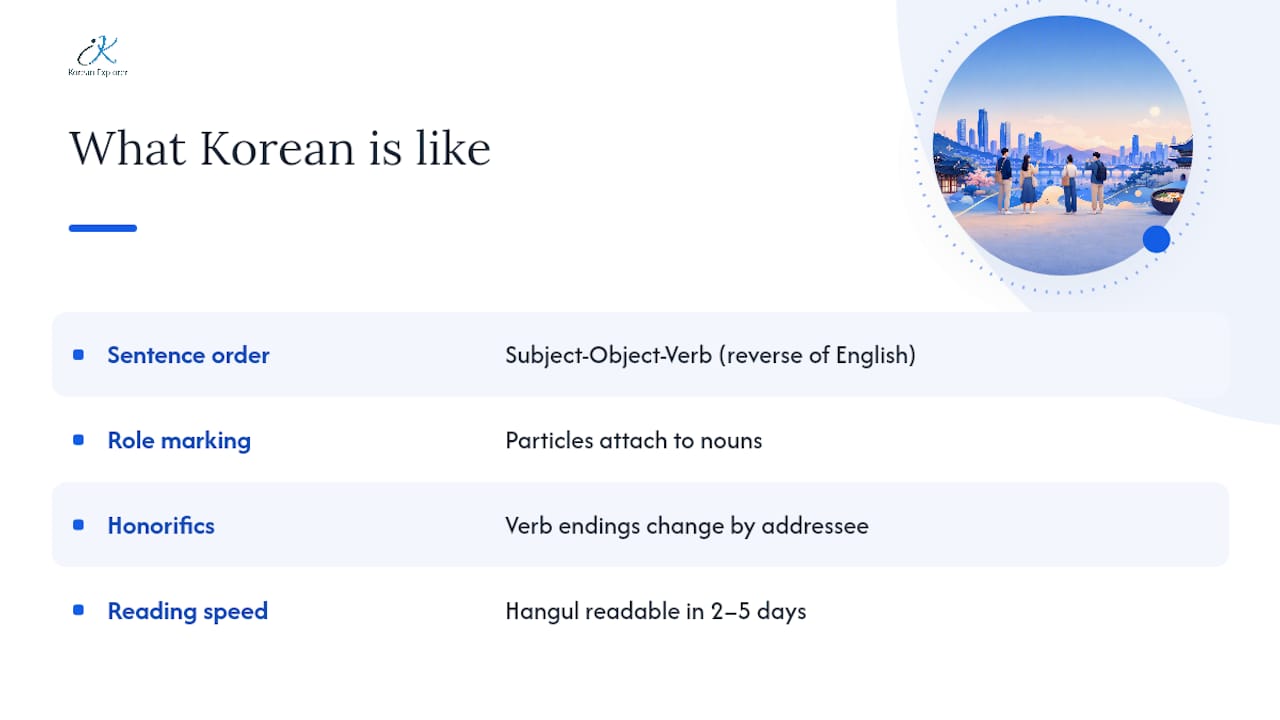
The good news sits in the alphabet. Hangul’s phonetic design means most adult learners can start reading basic syllables within two to five days of focused practice, far faster than logographic systems demand.
Pro Tip: Skip romanized Korean entirely, even in your first week. Reading “annyeonghaseyo” instead of 안녕하세요 locks in pronunciation habits that are hard to unlearn later, and it delays the moment you can actually read signs, menus, and lyrics on your own.
Speech levels add another layer worth knowing early: how you address a grandparent, a boss, and a friend all require different endings. It sounds intimidating on paper but becomes intuitive with repetition, and honorific patterns are learnable as a system rather than memorized case by case.
Motivation, Retention, and Realistic Milestones
Why you’re learning matters more than how hard you try. Research on language-learning motivation shows that intrinsic motivation, genuine interest in the culture, music, or films, predicts sustained progress more reliably than purely practical goals like a resume line item.
Set milestones that give you visible proof of progress:
- Read Hangul confidently within your first week.
- Hold a basic self-introduction conversation within a month or two.
- Follow a simple drama scene without subtitles within three to six months, depending on practice frequency.
Spaced repetition apps help vocabulary stick, but speaking out loud from day one, even to yourself, builds the muscle memory that flashcards can’t.
Your First Week: A Simple 3-Step Starting Plan
Motivation fades fast without a concrete plan. Here’s the order that works.
- Learn Hangul over a weekend. Spend an hour a day on vowel and consonant shapes, then move straight to reading simple syllable blocks. Skip romanization entirely.
- Pair structured lessons with daily micro-practice. A beginner-focused class gives you grammar structure, while ten minutes a day with an app or a drama clip keeps vocabulary fresh.
- Start speaking within your first two weeks. Language exchange partners, tutors, or conversation-focused classes matter more than perfect grammar early on.
Pro Tip: Don’t wait until you “know enough” to speak. Beginners who start talking in week two consistently outpace those who wait until month three, because speaking exposes the gaps flashcards hide.
Balancing Fan Enthusiasm With Real Progress
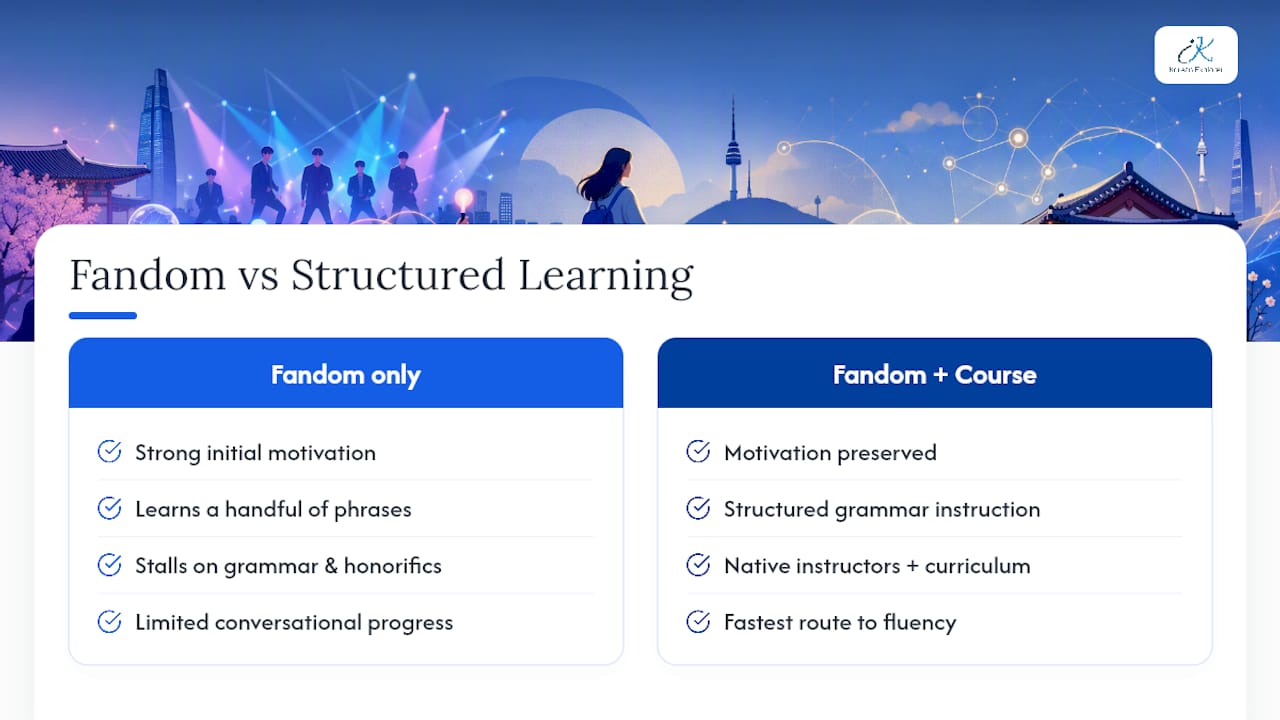
Culture pulls people in, but structure keeps them going. I’ve seen the pattern repeat: someone falls for a drama or a group, learns a handful of phrases, and then stalls because enthusiasm alone doesn’t teach grammar or honorifics. The learners who actually reach conversational fluency are the ones who let their fandom set the motivation and let a structured course handle the mechanics.
That combination isn’t a compromise. It’s the fastest route available, and it’s why programs pairing native instructors with a real curriculum tend to outperform self-study alone. If you’re curious what that looks like in practice, sampling a few free resources or an introductory lesson costs you nothing but time.
— Paul
Start Learning Korean With Structured Adult Classes
Korean Explorer gives you what self-study and scattered apps can’t: a real instructor correcting your pronunciation before bad habits set in. That’s the concrete edge over grinding through an app alone or piecing together random drama clips. The school runs group classes, private lessons, online Zoom sessions, and corporate training built specifically for adult learners who want conversational or business Korean, taught by native instructors fluent in both Korean and English, with recorded class videos so you never lose a session you missed.
Classes run from the central Singapore location at 10 Anson Road, Level 22, International Plaza, right above Tanjong Pagar MRT, alongside the Jurong and Tampines centres for learners closer to those areas. Whether you’re chasing K-drama fluency or building Korean skills for work, you can check current class schedules and course options and reach out for a trial session to see how the teaching style fits before committing.
Sources
For deeper context on the points above, the University of Oregon’s open textbook on language motivation breaks down why intrinsic drive outperforms practical goals. The cross-country PMC analysis covers Korean’s economic value in trade-linked markets, and Seoul Vision 2030’s overview documents Hallyu’s role in global enrollment spikes.
- What is your motivation to learn languages? — Open Textbook, University of Oregon
- Determinants of international Korean language promotion: A cross-country analysis — PMC
- Korean language global spread — Seoul Vision 2030
FAQ
What Are Some Good Reasons to Learn Korean?
The strongest reasons cluster around three areas: cultural access to K-pop and K-dramas, quick early progress thanks to Hangul’s phonetic alphabet, and practical career or travel advantages in markets with strong ties to Korea.
Is Korean a Useful Language to Learn?
Yes, particularly if you’re interested in entertainment, tech, or trade sectors connected to Korea, where language proficiency has been linked to wage advantages and expanded job opportunities.
Is It Better to Learn Chinese or Korean?
It depends on your goals rather than one language being objectively better. Korean’s phonetic Hangul alphabet gives faster early reading wins than Chinese characters, while Chinese may offer broader reach if your priority is sheer number of speakers.
How Long Does It Take to Learn Hangul?
Most adult learners can read basic Hangul syllables within two to five days of focused practice, making it one of the fastest alphabets to pick up compared with logographic writing systems.
Should Beginners Use Romanized Korean to Start?
No. Relying on romanization delays real reading progress and locks in pronunciation mistakes that become harder to correct once they’re habitual, so starting with Hangul directly works better long term.