The fastest way to raise a TOPIK score is to diagnose your biggest weaknesses first, then drill those specific gaps before running timed full simulations. Skip the diagnostic and you waste weeks reviewing material you already know. Start today: take one timed past paper from Topik, score it honestly, and let the results decide where the next two to four weeks of study actually go.
TL;DR:
- Prioritize diagnosing your weakest section with a full timed past paper and focus two to four weeks of targeted drilling on these gaps.
- Use official past papers from topik.go.kr for authentic test practice, supplemented by AI and human feedback for writing and speaking improvement.
- Practice listening by predicting questions before hearing, reading by skimming and scanning strategically, and writing by using templates with focused proofreading.
- Schedule at least two to three full simulations in the final month, thoroughly reviewing each to identify and address specific errors by category.
- Tailor preparation for PBT or IBT formats by practicing handwriting or typing speed, and familiarize yourself with the official testing interface to avoid unnecessary penalties.
Table of Contents
- What Materials Do You Need for Korean TOPIK Preparation?
- How Should You Practice Listening, Reading, and Writing?
- 30-Day and 90-Day TOPIK Study Plan Templates
- How Many Practice Tests Should You Take Before TOPIK?
- Should You Prepare Differently for PBT vs IBT?
- Why a Guided Course Accelerates TOPIK Progress
- Exam-Day Checklist: What to Confirm Before You Walk In
- Detailed Vocabulary Strategies for TOPIK
- Common Grammar Points on TOPIK and How to Master Them
- Reading Section: Note-Taking and Answer Elimination
- Writing Task Types, Sample Structures, and Scoring Criteria
- Preparing for the Speaking Section at Higher TOPIK Levels
- Author Perspective: What Actually Moves TOPIK Scores
- How Korean Explorer Can Help You Execute This Plan
- Sources
- FAQ
What Materials Do You Need for Korean TOPIK Preparation?
Official past papers from topik.go.kr are the single most important resource in any Korean TOPIK preparation plan. The National Institute for International Education releases actual retired exams with audio files and answer keys, which means you are studying the real test format instead of a guess at it. Nothing else replicates the phrasing quirks and question logic quite as accurately.
Beyond that, you need three categories of tools:
- Timed mock-test platforms. TopikLab runs full simulations using real past questions and includes AI writing evaluation that scores essays on content, structure, grammar, and vocabulary.
- Grammar and vocabulary drills. Use a dedicated grammar reference alongside a spaced-repetition app, and always cross-check new grammar points against how they appear in actual past papers.
- Writing feedback loops. AI scoring gives you speed; a human instructor gives you nuance on argument structure and register that automated tools still miss.
- Format-matched practice. If you registered for the paper-based test, practice handwriting under time pressure. If you registered for the internet-based test, practice on a keyboard from day one.
How Should You Practice Listening, Reading, and Writing?
Each section rewards a different kind of practice, and treating them identically is the most common mistake self-studiers make.
- Listening: predict before you hear the answer. Read the question and options first, then listen for keywords rather than trying to catch every word. Take shorthand notes in Korean or English, whichever is faster for you, and replay only the segments where you missed the main idea.
- Reading: skim first, scan second. Read the question and answer choices before the passage, skim for structure, then scan back for the specific detail that confirms your answer. Practice recognizing question types (main idea, inference, detail, order) so you know which strategy to apply within seconds.
- Writing (TOPIK II): template, then personalize. Learn a flexible structure for the data-description task and a separate one for the argumentative essay, then practice filling those templates with different prompts. Leave the last three minutes of any writing block for proofreading spelling and particle usage.
Time allocation should track your target level. If you are stuck at a mid-range score, reading pacing is usually the leak. If you are aiming for level 5 or 6, writing quality carries disproportionate weight, so it deserves the largest share of your practice minutes.
Pro Tip: Keep a running list of every vocabulary word you miss during listening practice. Words that trip you up in audio form are usually the same words slowing you down in reading passages.
30-Day and 90-Day TOPIK Study Plan Templates
A tight, well-sequenced 30-day plan can meaningfully improve performance if you already have the underlying language foundation. The sequence that consistently works follows a diagnostic, then repair, then mixed practice, then exam-mode, then taper structure.
30-day intensive template:
- Days 1 to 3: Diagnostic. Take one full past paper under real time conditions. Score every section and tag each wrong answer by cause: vocabulary gap, grammar confusion, misread question, or time pressure.
- Days 4 to 18: Repair. Spend 60 to 70 percent of study time drilling your two weakest tagged categories. Rotate daily between vocabulary sprints, grammar isolation exercises, and short reading or listening sets.
- Days 19 to 26: Mixed practice and exam-mode. Run two to three additional full simulations under strict timing, reviewing each one before moving to the next.
- Days 27 to 30: Taper. Light review only. Revisit your error log, skim high-frequency vocabulary, and rest the night before the test.
90-day balanced template:
- Weeks 1 to 3: Vocabulary and grammar foundation building, plus one diagnostic test in week 1.
- Weeks 4 to 8: Section-specific blocks, roughly two weeks each on listening, reading, and writing, with weekly error-log review.
- Weeks 9 to 11: Mixed practice sessions combining all three sections in single sittings.
- Week 12: Two to three timed full simulations followed by a short taper.
For a 30 to 90 minute daily session, split time roughly into ten minutes of vocabulary review, thirty minutes of section drills targeting your weakest tag, and the remainder on either a partial simulation or writing practice. Adjust every template using your own error log rather than following it blindly; the schedule is a starting frame, not a fixed rule.
How Many Practice Tests Should You Take Before TOPIK?
Fewer full simulations, reviewed deeply, beat a large pile of practice tests that never get properly analyzed. Running timed full simulations sharpens pacing and cuts down on time panic, but only if you actually dissect the results afterward instead of just checking your score and moving on.
Use this review workflow after every simulation:
- Log every wrong answer immediately, including the question type and section.
- Categorize each miss by root cause: vocabulary, grammar, misread question, or time pressure.
- Drill the single most frequent category for the next two to three days before touching another full test.
- Re-test only that section or question type to confirm the fix actually worked.
Stamina matters as much as accuracy. Schedule at least two or three full-length simulations in the final month under real exam timing, including breaks placed exactly where the actual test places them, so your focus doesn’t collapse in the final section.
Pro Tip: Use AI writing evaluation for daily practice essays since it gives instant feedback on structure and grammar, but save at least one essay per week for a human instructor’s review. AI tools catch mechanical errors well; they miss subtler issues in argument coherence that a trained eye picks up immediately.
Should You Prepare Differently for PBT vs IBT?
The paper-based and internet-based formats test the same content but reward different physical skills, and preparing for the wrong delivery format costs points that have nothing to do with your Korean ability.
- PBT candidates should practice handwriting essays under time pressure, since legibility and speed both affect how much you can write.
- IBT candidates should build sustained Korean typing fluency, aiming for comfortable typing well above casual speed under timed conditions.
- IBT candidates must also train on the official IBT tutorial before test day, since unfamiliar navigation and input methods can quietly cost non-language points.
- Bring a backup plan for IBT: know your test center’s device policy, confirm your login credentials in advance, and rehearse what to do if the interface freezes mid-section.
Why a Guided Course Accelerates TOPIK Progress
Self-study covers a lot of ground, but writing feedback and consistent accountability are where most independent learners stall. Korean Explorer structures its TOPIK preparation courses around a curriculum built with TOPIK standards in mind, delivered by native Korean instructors fluent in both Korean and English, across group, private, and online formats.
Guided instruction tends to matter most for three types of learners: those who need regular writing correction beyond what automated scoring catches, those who study better with a fixed schedule and outside accountability, and those aiming for a specific level within a tight timeline. A hybrid plan works well for most people: run your own diagnostic and section drills at home, then bring your error log and writing samples into class so an instructor can target exactly what self-study alone can’t fix.
Exam-Day Checklist: What to Confirm Before You Walk In
Confirm your test center address, start time, and required identification documents at least 48 hours ahead. Pack your admission slip, a valid photo ID, and two pencils or pens matching your registered format.
- 48 hours out: Light review only. Skim your error log and high-frequency vocabulary; stop full simulations.
- During the test: Answer easy questions first, mark uncertain ones, and return only if time allows. Never let one question eat more than its fair share of the clock.
- Pacing rule: If you’re stuck for more than 20 to 30 seconds on a reading question, guess your best option and move on.
- After the test: Write down every question type that felt shaky while it’s fresh. That note becomes next cycle’s diagnostic.
Detailed Vocabulary Strategies for TOPIK
Vocabulary gaps quietly sink more TOPIK attempts than grammar mistakes do, mostly because vocabulary problems disguise themselves as reading or listening failures. If you consistently misunderstand a passage’s main idea, check whether the real issue is one or two unfamiliar words sitting in a key sentence.
Build your vocabulary list from actual past papers rather than generic frequency lists pulled from unrelated sources. Past exams repeat certain categories heavily: connectors and sentence-ending patterns, workplace and academic vocabulary for TOPIK II, and everyday situational vocabulary (shopping, transportation, health, weather) for TOPIK I. Pull every unfamiliar word from each practice test into a running list, tagged by the section where it appeared.
Spaced repetition beats cramming for retention, but the spacing only works if you review words in context, not as isolated flashcards. Write one original sentence for every new word using a grammar pattern you’re also practicing, so the two reinforce each other instead of competing for separate study time.
For higher TOPIK II levels, prioritize Sino-Korean vocabulary common in news articles, editorials, and formal writing, since these words show up disproportionately in advanced reading passages and writing prompts. For TOPIK I, focus on high-frequency conversational vocabulary and don’t over-invest in rare or formal words you won’t see at that level.
Set a weekly cap, something like 40 to 60 new words, so the list stays reviewable instead of ballooning into something you never revisit. A vocabulary list you actually cycle through twice a week beats a 2,000-word list you build once and abandon.
Common Grammar Points on TOPIK and How to Master Them
Grammar mistakes on TOPIK cluster around a small set of recurring patterns, which means targeted drilling beats broad textbook coverage almost every time. Connective endings (그래서, 그런데, 반면에), sentence-final forms indicating tense and honorifics, and particle pairs that native speakers use almost unconsciously (에/에서, 은/는 versus 이/가) show up constantly across both reading and writing sections.
The most efficient way to master a grammar point is not to memorize its definition but to collect five to ten real example sentences from past papers, then write your own sentences using the identical structure. This forces you to internalize how the grammar behaves in actual context rather than as an abstract rule in a textbook.
Particle confusion is the single most common error category among intermediate learners, especially the distinction between topic markers and subject markers. If your error log keeps flagging the same particle mistake, isolate it for a focused two or three day micro-sprint rather than folding it into general review, since tagging errors by cause and drilling the highest-frequency category produces faster, measurable gains than unfocused practice.

For TOPIK II, pay close attention to indirect speech patterns and formal writing endings (다/-ㄴ다), since informal endings in a formal essay context cost points on the writing rubric even when the content itself is strong. Review your last five practice essays specifically for register consistency; it’s an easy fix once you notice the pattern.
Reading Section: Note-Taking and Answer Elimination
Efficient note-taking during the reading section means marking, not transcribing. Underline or bracket only the sentence that answers the question, and jot a single keyword in the margin rather than copying full phrases. The goal is a five-second visual anchor you can return to, not a second set of notes to read.
Answer elimination works best as a two-pass process. On the first pass, cross out any option that contradicts something explicitly stated in the passage. These are usually the easiest wrong answers to spot and eliminating them early narrows your real decision to two options instead of four. On the second pass, compare the remaining two choices against the specific sentence you flagged, since TOPIK reading traps often hinge on one option being almost right but subtly overstating or understating what the passage says.
Watch for absolute language in wrong-answer choices. Options using words equivalent to “always,” “never,” or “completely” are frequently distractors, since passages tend to hedge with more moderate claims. This isn’t a universal rule, but it’s a useful tiebreaker when you’re down to two plausible answers and running low on time.
Practice pacing separately from accuracy. Time yourself on isolated reading sets of five to ten questions until you can consistently finish with time to spare, then only afterward layer in full-passage sets under strict exam timing. Trying to fix speed and accuracy simultaneously usually improves neither.
Writing Task Types, Sample Structures, and Scoring Criteria
TOPIK II’s writing section includes a short-answer sentence completion task, a data-description task built around a chart or graph, and a longer argumentative essay. Each is scored on content and task fulfillment, structure and organization, and grammar and vocabulary accuracy, and a strong score requires performing reasonably across all three, not excelling at one while neglecting the others.
For the data-description task, a reliable structure introduces the topic and data source in one sentence, describes the overall trend in the next two or three sentences, highlights the most significant specific figure or change, then closes with a brief interpretation of what the data suggests. Avoid simply restating every number on the chart; graders reward selective emphasis on what matters most.
For the argumentative essay, a dependable template states your position clearly in the introduction, develops two or three supporting points each with a brief example, addresses a counterargument or limitation, and closes with a restated position. Practicing this structure with different prompts, rather than memorizing one essay outline, builds the flexibility to adapt under exam conditions.
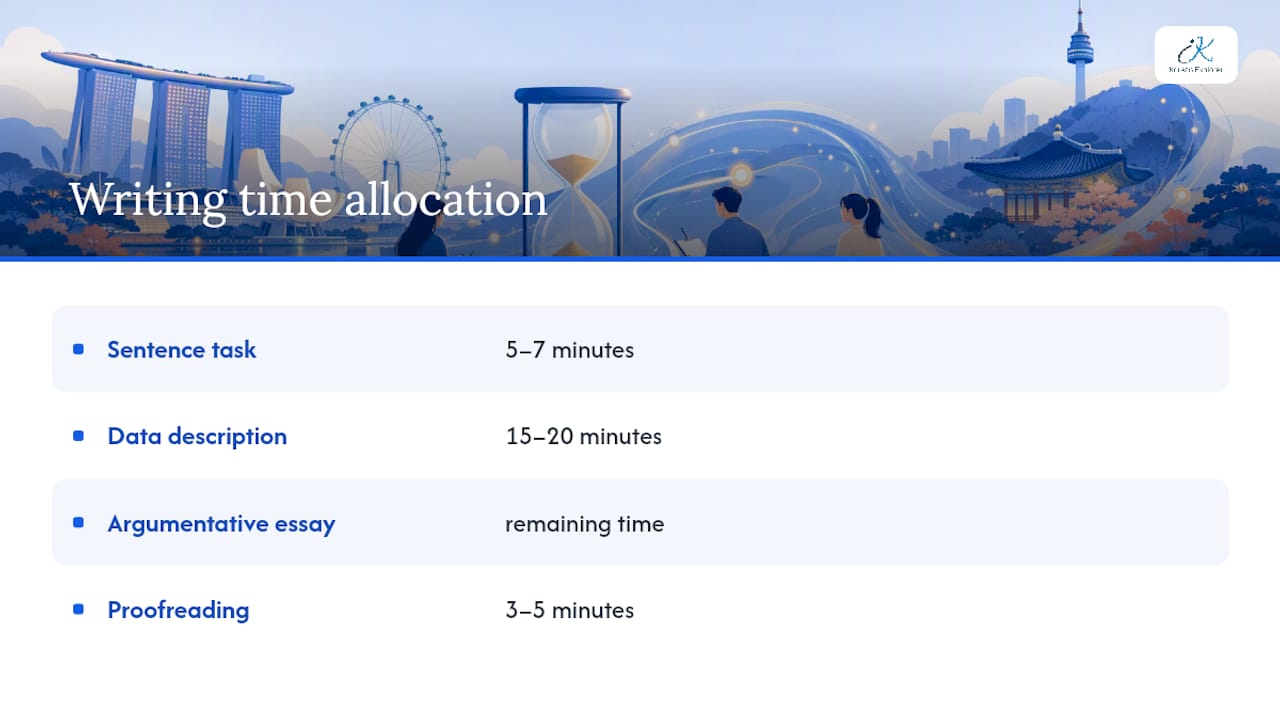
Time management matters as much as content. A workable split for the full writing section allocates roughly five to seven minutes to the short sentence task, fifteen to twenty minutes to the data description, and the remaining time to the essay, leaving three to five minutes at the end strictly for proofreading. Check for particle errors, spelling, and register consistency in that final pass, since small mechanical slips are the easiest points to lose and the easiest to recover with a careful reread.
Preparing for the Speaking Section at Higher TOPIK Levels
The speaking component, used for higher-level assessment, evaluates fluency, pronunciation, grammar accuracy, and the ability to sustain a coherent response under time pressure. Unlike the written sections, there’s no answer to eliminate; your response is generated in real time, which makes structured practice even more important.
Record yourself answering common prompt types, opinion questions, comparison questions, and situational role-play scenarios, then listen back for filler words, unnatural pauses, and grammar slips you wouldn’t catch while speaking. This single habit, uncomfortable as it feels the first few times, produces faster improvement than unrecorded practice ever does.
Build a small bank of flexible phrases for organizing a spoken response: ways to introduce an opinion, transition between points, and wrap up a conclusion. These connective phrases carry more weight in a speaking evaluation than in writing, since they signal organized thinking even when your response is happening under time pressure.
Practice speaking at a natural pace rather than either rushing through or over-enunciating for the microphone. Graders assess fluency partly through rhythm and pacing, and unnatural pauses inserted to “sound careful” often read as hesitation instead. If possible, get feedback from a native speaker or instructor who can flag pronunciation habits you can’t hear in your own recordings.
Author Perspective: What Actually Moves TOPIK Scores
Most candidates I’ve seen coach through TOPIK prep don’t fail from lack of effort. They fail from spreading that effort evenly across skills they’ve already mastered instead of concentrating it on the two or three gaps actually holding their score down. A realistic claim: consistent, targeted practice over four to eight weeks moves most motivated learners up one level, sometimes two. Combine your own drilling with periodic outside feedback, since the gaps you can’t see are usually the ones costing you the most points.
— Paul
How Korean Explorer Can Help You Execute This Plan
Templates and past papers get you far, but the fastest gains usually come from someone catching the writing habits and pronunciation quirks you can’t hear or see in yourself. Korean Explorer runs structured Korean language courses in group, private, and online formats over Zoom, taught by native instructors who give the kind of direct feedback a self-study schedule can’t replicate on its own.
If you’re not sure where your current level sits, start with a Korean placement test to see which course track fits your target TOPIK level. From there, browse the full course schedule to find a group, private, or online option that matches your timeline, or visit the training center at 10 Anson Road, Level 22, International Plaza, Singapore 079903, right above Tanjong Pagar MRT, to talk through a study plan in person.
Sources
Start with topik.go.kr for official past papers and audio files, then use TopikLab for timed simulations and AI-scored writing practice.
- Topik
- TopikLab — Free TOPIK Practice Tests & AI Writing Evaluation
- 30-Day TOPIK Study Plan Before Test Day | Chamelingo
FAQ
How Can I Prepare for the TOPIK Test?
Diagnose your weakest section with one timed past paper, drill that specific gap for two to four weeks, then confirm progress with additional timed full simulations before test day.
Is the TOPIK Exam Difficult?
Difficulty depends heavily on your target level and current foundation; TOPIK I tests everyday conversational Korean while TOPIK II demands academic and professional vocabulary along with a full writing section, making it noticeably harder to reach the top levels.
How Do I Take TOPIK if I’m Based in Singapore?
Registration and test dates run through the official NIIED TOPIK site, which lists authorized test centers and administrative deadlines; check the site directly for the current schedule and location details.
Should I Take TOPIK I or TOPIK II?
Choose TOPIK I if you’re targeting basic conversational proficiency (levels 1 to 2), and TOPIK II if you need intermediate to advanced certification (levels 3 to 6) for academic or professional purposes; a closer breakdown is available in this TOPIK I vs TOPIK II comparison.
How Many Practice Tests Should I Take Before the Exam?
A small number of full timed simulations, reviewed deeply through an error-log workflow, produces better results than many practice tests taken without careful review afterward.