TL;DR:
- Interactive learning actively engages learners through cognitive, social, and emotional involvement, leading to better retention and skills transfer. Its effectiveness relies on intentional task design, fostering metacognition, social interaction, and emotional investment, which surpass passive instruction. Real-world language skills improve most through conversation, immediate feedback, and varied, meaningful activities.
Interactive learning methods are approaches that actively involve learners through meaningful cognitive, social, and emotional engagement to improve retention, motivation, and skill transfer. Unlike passive instruction, where learners receive information without responding to it, interactive methods require learners to process, apply, and reflect. Research confirms that collaborative problem-solving and simulation-based tasks yield effect sizes between Cohen’s d = 0.50 and 0.82 across STEM and humanities domains. That range represents a substantial, measurable advantage over traditional lecture-based instruction. Korean Explorer builds its adult Korean courses on exactly these principles, using conversation-focused, interactive teaching to accelerate real-world fluency.
Why interactive learning methods outperform passive instruction
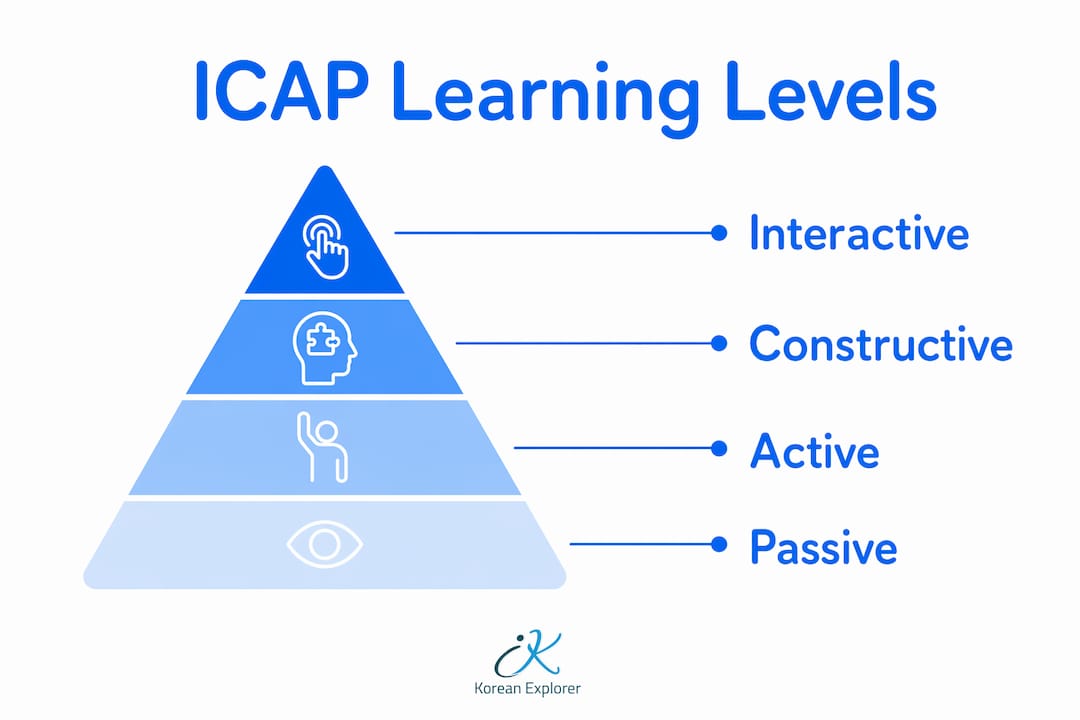
The core reason interactive learning works is cognitive engagement. When you actively respond to material rather than simply receive it, your brain encodes information more deeply. The ICAP framework (Interactive, Constructive, Active, Passive) ranks interactive engagement as the highest mode of learning, placing it above constructive and active modes. Research published in march 2026 confirms that interactive learning’s superiority stems from three converging mechanisms: shared cognitive processing, social interaction triggering dopaminergic reward, and metacognitive co-regulation through feedback.

Each mechanism reinforces the others. Shared cognitive processing means learners distribute the mental effort of understanding across a group, which reduces individual cognitive load. Dopaminergic reward means the brain releases a small dose of motivation-sustaining chemistry when social interaction goes well. Metacognitive co-regulation means learners adjust their understanding in real time based on feedback from peers or instructors. Together, these three processes create a learning environment that passive instruction simply cannot replicate.
The benefits of interactive learning also extend beyond memory. Interactive methods improve 21st century skills such as critical thinking, creativity, and collaboration, along with higher engagement and satisfaction. These are the skills that matter in professional and academic settings, not just test scores.
The ICAP framework explained
The ICAP framework categorizes learning behaviors by how deeply they engage the learner. Passive learners receive information. Active learners manipulate it. Constructive learners generate new ideas from it. Interactive learners co-construct knowledge with others. Each step up the ladder produces stronger learning outcomes. For language learners, this means that reading a Korean grammar rule (passive) is far less effective than debating its use with a partner in a live conversation (interactive).
How curiosity and motivation drive retention
Curiosity activates the brain’s reward system before learning even begins. When a learner genuinely wants to know the answer, the brain primes itself to encode the incoming information more durably. Interactive tasks, by their nature, create moments of productive uncertainty that trigger this curiosity response. A well-designed role-play scenario in a Korean class, for example, creates a real communicative need that motivates the learner to find the right word or phrase.
- Collaborative problem-solving tasks produce effect sizes of Cohen’s d = 0.50–0.82.
- Adaptive quizzes and simulation-based activities fall within the same high-performance range.
- Inquiry-based learning improves long-term retention and transfer of language skills better than explicit instruction alone.
- The ICAP framework identifies interactive engagement as the highest-impact learning mode.
- Dopaminergic reward from social interaction sustains motivation across a learning session.
Pro Tip: Design interactive tasks around a genuine communicative goal, not just an activity format. A task where learners must reach a real decision together produces deeper engagement than one where interaction is optional.
How social and emotional engagement amplify learning
Social interaction is a cognitive benefit, not just a social one. Research confirms that social interaction expands working memory capacity by distributing cognitive demands across learners. When two people work through a problem together, each person carries less of the mental load, freeing up cognitive resources for deeper processing. This is why group problem-solving often produces better understanding than solo study, even when the solo learner spends more time on the material.
Emotional engagement works through a different but equally powerful channel. Positive emotions during learning, such as curiosity, excitement, and a sense of connection with peers, strengthen the neural pathways associated with the material being studied. Learners who feel emotionally invested in a task remember it longer and apply it more readily. A Korean learner who laughs during a role-play exercise is not wasting time. That emotional moment is anchoring the vocabulary and grammar into long-term memory.
Four social and emotional strategies that consistently produce stronger learning outcomes:
- Structured group discussions. Assign specific roles such as facilitator, note-taker, and challenger. Rotating these roles, as research on collaborative learning roles recommends, distributes social engagement rewards evenly and sustains motivation across sessions.
- Collaborative problem-solving with real stakes. Give groups a problem that requires a decision, not just an answer. The social pressure of reaching consensus deepens engagement with the material.
- Peer teaching. Asking a learner to explain a concept to a classmate forces retrieval and reorganization of knowledge, two processes that dramatically improve retention.
- Emotionally resonant scenarios. In language learning, scenarios drawn from real life, such as ordering food, negotiating at work, or navigating a social situation, create emotional investment that generic drills cannot.
The persistence effect is significant. Learners who experience positive emotional engagement during a course are more likely to continue studying after the course ends. Emotional investment converts short-term motivation into long-term learning behavior.
What most people get wrong about interactive learning
The most common misconception is that any digital activity or group task counts as interactive learning. Merely adding activities or digital content does not guarantee interactivity. Intentional design that links learners meaningfully to the material is required. Clicking through slides, watching embedded videos, or completing drag-and-drop exercises can all feel interactive without producing the cognitive engagement that drives learning. True interactivity requires the learner to generate, evaluate, or co-construct knowledge, not just respond to prompts.
A second major misconception is that active engagement alone is sufficient. Metacognitive engagement is a stronger predictor of long-term knowledge retention than active engagement alone in digital learning environments. Metacognition means monitoring your own understanding: knowing what you know, recognizing what you don’t, and adjusting your approach accordingly. Without it, a learner can complete dozens of interactive tasks and still fail to consolidate durable knowledge. For language learners, this means pausing after a conversation exercise to ask: “What did I struggle with? What would I say differently next time?”
Cognitive overload is a third risk that poor interactive design creates. When a task is too complex, too ambiguous, or too disconnected from prior knowledge, the learner’s working memory becomes saturated. Learning stops. Interactive tasks must align with clear pedagogical objectives to avoid this outcome. The fix is not simpler tasks but better-sequenced ones.
| Element | Superficial interactivity | Effective interactivity |
|---|---|---|
| Learner role | Responds to prompts | Co-constructs knowledge |
| Feedback | Automated right/wrong | Formative, explanatory |
| Task design | Activity-based | Objective-linked |
| Metacognition | Absent | Built into the task |
| Emotional engagement | Incidental | Intentionally designed |
Pro Tip: Add one metacognitive prompt to every interactive task. Ask learners to write one sentence about what they found difficult before moving on. That single habit produces measurable gains in long-term retention.
Understanding what makes digital activity truly interactive versus superficially engaging is a skill that separates effective educators from busy ones.
Practical strategies for implementing interactive learning
Effective implementation starts with task design, not tool selection. The right activity format matters far less than whether the task requires learners to generate, evaluate, or discuss ideas. That said, certain tools and techniques consistently support high-quality interactive engagement.
- Real-time polling and quizzes. Tools that display live results during a lesson create immediate feedback loops. Learners see where they stand relative to the group, which triggers both metacognitive reflection and social motivation.
- Learner modeling and personalized feedback. Real-time analytics dashboards help instructors identify which learners are falling behind and adjust tasks in real time. This is the difference between guessing and knowing.
- Structured pair and group work. Assign clear roles before the task begins. Rotate roles across sessions to distribute engagement and prevent social loafing.
- Metacognitive prompts. Build self-assessment moments into every lesson. A simple “What was the hardest part of this task?” question at the end of an activity activates the reflection process that converts short-term engagement into lasting knowledge.
- Formative assessment checkpoints. Brief, low-stakes checks during a lesson, not just at the end, allow both learners and instructors to catch misunderstandings before they compound.
- Spaced repetition with interactive review. Returning to material at increasing intervals, combined with active recall tasks rather than re-reading, dramatically improves long-term retention.
For language learning specifically, the most effective interactive techniques combine conversation-focused practice with immediate corrective feedback. A learner who speaks Korean in a structured role-play and receives targeted feedback on pronunciation or grammar within the same session consolidates that correction far more effectively than one who reviews written notes later. The gap between doing and correcting must be short.
Sustaining motivation over time requires variety. Rotating between pair work, group tasks, individual reflection, and instructor-led discussion prevents the engagement drop that occurs when any single format becomes predictable. The goal is a learning environment where the learner never quite knows what form the next challenge will take, but always knows why it matters.
Key Takeaways
Interactive learning methods outperform passive instruction because they engage cognitive, social, and emotional processes simultaneously, producing measurable gains in retention, motivation, and skill transfer.
| Point | Details |
|---|---|
| Cognitive engagement drives retention | Interactive tasks produce effect sizes of Cohen’s d = 0.50–0.82, far above passive instruction. |
| Social interaction expands working memory | Distributing cognitive load across learners frees up mental resources for deeper processing. |
| Metacognition is non-negotiable | Active engagement without self-monitoring produces weaker long-term retention than metacognitive engagement. |
| Design beats technology | Adding digital tools does not create interactivity; intentional, objective-linked task design does. |
| Emotional investment sustains learning | Positive emotions during learning anchor material into long-term memory and drive continued study. |
What I’ve learned after years of watching interactive learning succeed and fail
The most important thing I’ve observed is that educators often confuse busyness with engagement. A classroom full of activity is not the same as a classroom full of learning. I’ve watched well-intentioned instructors run back-to-back group tasks where learners were socially active but cognitively coasting. The tasks felt interactive. The retention data told a different story.
The second thing I’ve learned is that technology is a multiplier, not a solution. A poorly designed task delivered through a polished digital platform is still a poorly designed task. The educators who get the best results from interactive methods are the ones who start with a clear learning objective and then choose the format that serves it, whether that’s a live debate, a structured pair conversation, or a simple written reflection.
Metacognition is the piece most educators underinvest in. Building self-monitoring habits into learners takes time and deliberate practice. But the payoff is disproportionate. A learner who knows how to assess their own understanding can self-correct between lessons, which multiplies the effect of every class session.
For language learning specifically, I believe the conversation-first approach is the right one. Grammar and vocabulary are tools. The goal is communication. When learners practice speaking Korean in real contexts from the very first lesson, they build both competence and confidence simultaneously. That combination is what makes the difference between a learner who completes a course and one who actually uses the language.
— Paul
Korean Explorer’s adult Korean courses put these methods to work
Korean Explorer applies interactive learning principles across all its adult Korean courses in Singapore. Every class is built around conversation, real-time feedback, and structured social engagement, not passive grammar drills.
Whether you prefer group classes at the International Plaza center above Tanjong Pagar MRT, live online sessions via Zoom, or corporate training for your team, Korean Explorer offers a format that fits your schedule and goals. Native Korean instructors who are fluent in both Korean and English deliver every session, so explanations are clear and corrections are immediate. If you’re ready to build real conversational and business Korean skills through methods that actually work, explore adult Korean courses at Korean Explorer or browse the full Korean language course catalog to find the right level for you.
FAQ
What are interactive learning methods?
Interactive learning methods are instructional approaches that require learners to actively engage with material through cognitive, social, or emotional participation, rather than passively receiving information. Examples include collaborative problem-solving, structured discussions, adaptive quizzes, and simulation-based tasks.
Why do interactive methods improve learning outcomes?
Interactive methods engage three reinforcing mechanisms: shared cognitive processing that reduces individual mental load, social interaction that triggers dopaminergic reward, and metacognitive co-regulation through feedback. Research shows effect sizes of Cohen’s d = 0.50–0.82 across multiple subject domains.
Is digital learning automatically interactive?
No. Adding digital content or activities does not guarantee interactivity. Effective interactive learning requires intentional design that links learners meaningfully to the material and demands knowledge generation, not just prompt responses.
What role does metacognition play in interactive learning?
Metacognition, the practice of monitoring and regulating your own understanding, is a stronger predictor of long-term retention than active engagement alone. Building self-assessment moments into interactive tasks converts short-term participation into durable knowledge.
How does interactive learning apply to language learning?
Inquiry-based and conversation-focused interactive methods improve long-term retention and transfer of language skills better than explicit instruction alone. Immediate corrective feedback during live practice is the most effective way to consolidate new vocabulary and grammar.