TL;DR:
- Cultural immersion enhances Korean language learning by immersing students in authentic social and cultural contexts. Active participation in real-life interactions accelerates vocabulary retention, comprehension, and intercultural sensitivity. Combining structured lessons with immersive experiences leads to faster, more lasting fluency.
Cultural immersion is defined as the deliberate process of surrounding yourself with a target language’s culture to accelerate acquisition beyond what a classroom alone can deliver. The role of cultural immersion in language learning goes far deeper than geography. It shapes how you think, how you interpret meaning, and how naturally you communicate. For Korean language learners in Singapore, this distinction matters enormously. Korean is a language where social context, honorifics, and cultural cues are inseparable from the words themselves. Understanding the culture is not supplementary to learning Korean. It is the learning.
How does cultural immersion improve language learning outcomes?
Immersion works because language is not a code you decode. It is a social behavior you perform. The ecological-enactive approach to language acquisition holds that fluency emerges from synchronizing bodily actions with social environments, not from memorizing grammar rules. This means your brain learns Korean most effectively when it is actively responding to real Korean social situations.
Research confirms this at the neurological and motivational level. A study of 53 undergraduate learners found that VR-based cultural immersion over six weeks produced sustained gains in intercultural sensitivity and language motivation that lasted more than six months. That is not a short-term boost. It is a structural shift in how learners relate to the language.
The social benefits are equally significant. Cultural immersion programs increase willingness to communicate in authentic settings, which is the single most important predictor of real-world fluency. Learners who are willing to speak make more mistakes, get more corrections, and improve faster.
Key cognitive and social benefits of immersion include:
- Faster vocabulary retention through emotional and contextual associations rather than rote memorization
- Improved listening comprehension from exposure to natural speech rhythms, not scripted audio
- Greater intercultural sensitivity, which reduces communication anxiety with native speakers
- Stronger motivation sustained over months, not just during the initial excitement of a new language
Pro Tip: Treat every cultural encounter as a language lesson. Watching a Korean drama, attending a Korean food festival, or chatting with a Korean colleague all count as immersive input when you pay active attention to the language being used.
What are the different forms of cultural immersion?
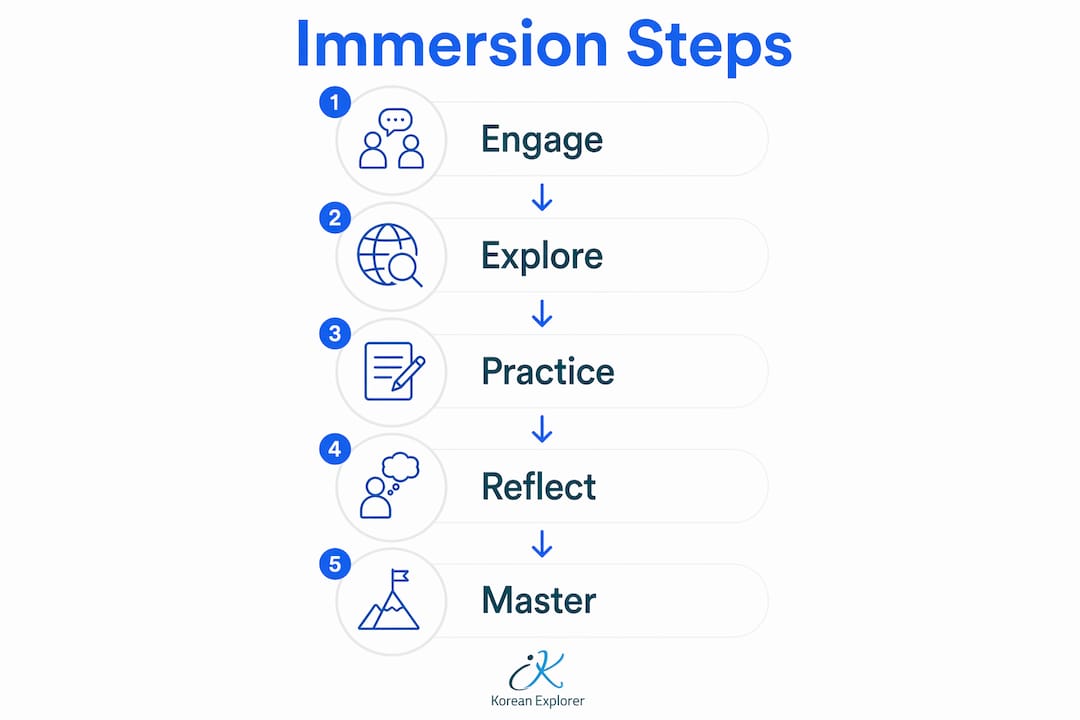
Not every learner can relocate to Seoul. The good news is that immersion takes multiple forms, and each has measurable value.

Traditional immersion
Traditional immersion means living within the target culture, shopping at local markets, using public transit, and building relationships with native speakers. This method produces the deepest results, but only when the learner is actively engaged. Living abroad alone does not guarantee fluency. Deliberate participation in local life is what creates true immersion. Passive presence in a foreign country produces far less progress than active engagement in the same environment.
Short-term immersion programs
Short trips are more effective than most learners expect. A 10-day exchange program produced measurable improvements in language proficiency that persisted six months after the trip ended. The intensity of short-term immersion compresses learning in ways that slow, weekly study cannot replicate. Even a brief cultural exchange in language learning can reset a learner’s motivation and proficiency trajectory.
Virtual and digital immersion
Virtual immersion is the most accessible option for adult learners in Singapore. The critical factor is reciprocity. Structured digital exchanges between learners of different languages outperform one-way tutoring because both participants have skin in the game. A Korean speaker learning English and a Singaporean learning Korean create a natural incentive for genuine communication.
| Immersion type | Best for | Key strength | Main limitation |
|---|---|---|---|
| Traditional (living abroad) | Committed long-term learners | Deepest cultural integration | Cost and time commitment |
| Short-term programs | Working adults with limited time | Intense, measurable proficiency gains | Requires planning and travel |
| Virtual and tandem learning | Learners based in Singapore | Accessible, reciprocal, flexible | Requires structured format to be effective |
Pro Tip: If you use a language exchange app or platform, set a clear agenda for each session. Unstructured chat rarely produces the same gains as a session with defined vocabulary goals and cultural topics.
Why is cultural context crucial for Korean language learners?
Korean is one of the world’s most context-dependent languages. The same sentence can carry entirely different meanings depending on who is speaking, who is listening, and what the social relationship between them is. This is not a quirk of Korean. It is the architecture of the language.
Honorifics are the clearest example. Korean has multiple speech levels, and choosing the wrong one is not just grammatically incorrect. It signals a misunderstanding of the social situation. No grammar textbook fully prepares you for the moment a Korean colleague shifts from formal to informal speech because they now consider you a friend. Recognizing that shift and responding appropriately requires cultural knowledge, not just linguistic knowledge.
Learners who pursue advanced fluency through cultural immersion consistently outperform those who rely solely on classroom instruction when it comes to idioms, humor, and context-dependent meaning. This gap widens at higher proficiency levels. Reaching C1 or C2 Korean without cultural grounding is extremely difficult.
Specific Korean cultural elements that directly shape language use include:
- Honorifics and speech levels: Formal, informal, and casual registers each require different verb endings and vocabulary
- Nunchi (눈치): The Korean concept of reading a room and responding to unspoken social cues, which affects how and when you speak
- Communal dining culture: Shared meals are a primary social bonding ritual, and the language around food, invitations, and refusals carries specific cultural weight
- K-drama and K-pop as immersive input: These are not just entertainment. They model natural speech patterns, slang, and emotional expression that textbooks rarely capture
Korean Explorer’s guide to Korean culture gives learners a structured entry point into these cultural layers before they encounter them in real conversation. Understanding the cultural logic behind the language makes every grammar lesson stick faster.
How can learners maximize the benefits of cultural immersion?
Active participation is the non-negotiable ingredient. Passive exposure alone does not produce fluency. You need to engage, respond, and reflect.
The most effective immersion techniques for adult Korean learners include:
- Reflection journaling: Learners who keep reflective journals during immersion show faster intercultural competence and better emotional adjustment. Write down what confused you, what surprised you, and what you want to understand better.
- Engaging with native speakers: Find a language exchange buddy and commit to regular sessions with a structured format.
- Consuming Korean media intentionally: Watch Korean content with Korean subtitles, not English ones. Pause and look up unfamiliar expressions rather than skipping past them.
- Participating in Korean cultural activities: Korean food festivals, cultural events, and community gatherings in Singapore all provide low-stakes immersive practice.
Cognitive fatigue is real in the early stages of immersion. Your brain is processing language and culture simultaneously, and that is exhausting. Expect an adjustment dip in the first few weeks of intensive immersion. Structured reflection turns that discomfort into learning momentum rather than a reason to quit.
Combining structured classroom learning with immersive experiences produces the fastest results for adult learners. Technology enhances this combination by giving learners access to authentic Korean content, virtual exchange partners, and spaced repetition tools between formal lessons.
Pro Tip: Set a “Korean-only” window each day, even 20 minutes, where you consume, think, or communicate exclusively in Korean. Consistency over intensity wins for adult learners with busy schedules.
Key Takeaways
Cultural immersion accelerates Korean language acquisition by embedding learners in authentic social contexts where language, culture, and communication are inseparable.
| Point | Details |
|---|---|
| Active engagement is required | Passive exposure does not produce fluency; deliberate participation in cultural life does. |
| Short-term immersion works | Even a 10-day program produces measurable proficiency gains that last months. |
| Virtual immersion needs structure | Reciprocal tandem exchanges outperform unstructured digital conversation. |
| Korean culture shapes the language | Honorifics, nunchi, and social rituals are not optional context; they are core to communication. |
| Reflection accelerates progress | Journaling during immersion builds intercultural competence and prevents dropout. |
Why I think most learners underestimate what immersion actually demands
Most people treat cultural immersion as a background condition. They assume that being around Korean speakers, watching Korean dramas, or visiting Korea will naturally transfer into fluency. That assumption is the most common reason learners plateau.
What I have observed, both in language education and in talking with adult learners, is that immersion without intention produces familiarity, not fluency. You can recognize Korean when you hear it. You can follow the emotional arc of a conversation. But you cannot participate in it. The gap between recognition and production is where most learners get stuck.
The learners who make the fastest progress treat every cultural encounter as a two-way exchange. They are not just absorbing Korean culture. They are bringing their own perspective into the interaction and noticing where the two worldviews create friction or surprise. That friction is where the deepest learning happens. Cultural exchange in language learning is not about becoming Korean. It is about developing the cultural empathy to communicate authentically with Korean speakers on their terms.
The other misconception I see regularly is that immersion is only for advanced learners. The opposite is true. Beginning learners who immerse early build intuitions about Korean social logic that make every subsequent grammar lesson make sense. They are not just learning rules. They are learning why the rules exist.
— Paul
Korean Explorer: structured learning that meets immersion head-on
Korean Explorer offers adult Korean courses in Singapore designed to complement exactly the kind of immersive learning this article describes. Whether you are building conversational confidence, preparing for professional use, or deepening your cultural understanding, the curriculum is built on Seoul National University materials and taught by native Korean instructors fluent in both Korean and English.
Group classes, private sessions, and online Zoom courses are all available, giving you the flexibility to combine structured learning with your own immersive practice outside the classroom. Corporate training programs are also offered for teams working with Korean partners or clients. If you are ready to move beyond textbook Korean and into authentic communication, explore Korean courses at Korean Explorer and find the format that fits your schedule and goals.
FAQ
What is the role of cultural immersion in language learning?
Cultural immersion accelerates language acquisition by placing learners in authentic social contexts where language and culture reinforce each other. Active participation in cultural life produces faster fluency gains than classroom study alone.
How does culture affect Korean language use?
Korean grammar and vocabulary shift based on social relationships, making cultural knowledge inseparable from linguistic competence. Honorifics, speech levels, and social cues like nunchi directly determine which words and structures a speaker uses.
Can short-term immersion programs really improve language skills?
A 10-day immersion program has been shown to produce measurable proficiency improvements that persist six months after the experience ends. Intensity and active engagement during the program determine how much learners gain.
Is virtual immersion effective for Korean learners?
Virtual immersion works best when structured as a reciprocal exchange rather than one-way instruction. Tandem learning with a Korean speaker who is learning your language creates genuine communication incentives that improve retention.
How do I combine classroom learning with cultural immersion?
Pair structured lessons with daily Korean media consumption, a language exchange partner, and reflective journaling. Korean Explorer’s courses are designed to build the grammatical foundation that makes immersive experiences more productive.