TL;DR:
- Academic Korean is a specialized formal register used in scholarly writing, emphasizing objectivity, technical vocabulary, and complex sentence structures. It differs from everyday and general formal Korean by prioritizing neutrality and structured logic essential for research and academic credibility. Mastery involves disciplined practice, authentic reading, and understanding its unique cultural and linguistic conventions.
Academic Korean is defined as a specialized formal register of the Korean language used in scholarly writing, research communication, and university-level academic work. It differs from everyday Korean not just in vocabulary, but in grammar, sentence structure, tone, and the conventions that signal credibility to academic readers. If you are studying Korean for university, professional research, or advanced communication, understanding this register is not optional. It is the foundation of how serious academic work gets done in Korean.

What is academic Korean and why does it matter?
Academic Korean is a specialized formal register used for scholarly writing, featuring an objective tone and complex sentence structures that distinguish it from both casual and general polite Korean. The term “academic Korean” is widely used among learners, but the recognized field term is 학술 한국어 (haksul hangugeo), meaning scholarly or academic Korean language. Both terms refer to the same set of discourse practices, and knowing the formal term helps you find the right resources.
The importance of academic Korean goes beyond passing exams or writing papers. It is the standard through which Korean universities, research institutions, and professional academic bodies evaluate the quality and credibility of written work. A paper written in casual or inconsistently formal Korean signals a lack of rigor, regardless of the quality of the ideas inside it.
Academic Korean emphasizes formal honorifics, technical terms, and structured logic to meet scholarly communication standards. Failure to maintain these features can reduce the perceived credibility of academic work. This is why learners who want to operate in Korean academic environments need to treat this register as a distinct skill set, not simply an extension of general Korean fluency.
What linguistic features distinguish academic Korean from everyday Korean?
The gap between conversational Korean and academic Korean is wider than most learners expect. It is not just about using polite speech. Academic Korean integrates formal register control, extensive nominalization, and connective phrases that minimize subjective expressions, creating a detached, scholarly tone throughout.
Here are the core linguistic features that define academic Korean:
- Formal sentence endings: Academic Korean uses endings like 습니다 and 다 (in written form) consistently. Mixing in casual endings like 야 or 어 immediately breaks the register.
- Nominalization: Turning verbs and adjectives into noun phrases is a hallmark of academic writing. Instead of saying “we analyzed,” academic Korean restructures the sentence around the noun form of “analysis.”
- Connective structures: Logical flow markers such as 따라서 (therefore), 그러므로 (consequently), and 반면에 (on the other hand) replace the casual connectors used in everyday speech.
- Technical vocabulary: Each academic field in Korean carries its own specialized lexicon. Using the correct disciplinary terms signals that the writer belongs to that scholarly community.
- Objectivity markers: Academic Korean includes discourse-level choices like objectivity markers and citation conventions that signal credibility. Personal opinions are suppressed in favor of evidence-based claims.
- Citation conventions: Referencing sources follows structured patterns that parallel academic citation norms in other languages, establishing the writer’s position within existing scholarship.
Pro Tip: Inconsistent register is one of the most common pitfalls for learners. Write your entire draft in academic Korean first, then review every sentence ending and connector before submitting.
Understanding these features as a system, rather than a checklist, is what separates learners who produce credible academic Korean from those who produce something that reads like a formal translation of casual speech.
How does academic Korean compare with general formal Korean and conversational Korean?
Korean operates across a spectrum of registers, and academic Korean sits at the most formal and structured end. Many learners confuse “polite Korean” with “academic Korean,” but they serve very different purposes.
| Feature | Conversational Korean | General formal Korean | Academic Korean |
|---|---|---|---|
| Sentence endings | Casual: 아/어요, 야 | Polite: 습니다/ㅂ니다 | Written formal: 다, 이다 |
| Vocabulary | Everyday, colloquial | Standard, professional | Technical, field-specific |
| Tone | Personal, expressive | Respectful, neutral | Objective, detached |
| Sentence complexity | Short, fragmented | Moderate structure | Long, nominalized, layered |
| Typical context | Daily conversation, texting | Business meetings, news | Research papers, dissertations |
| Use of opinion | Frequent | Occasional | Avoided; evidence replaces it |
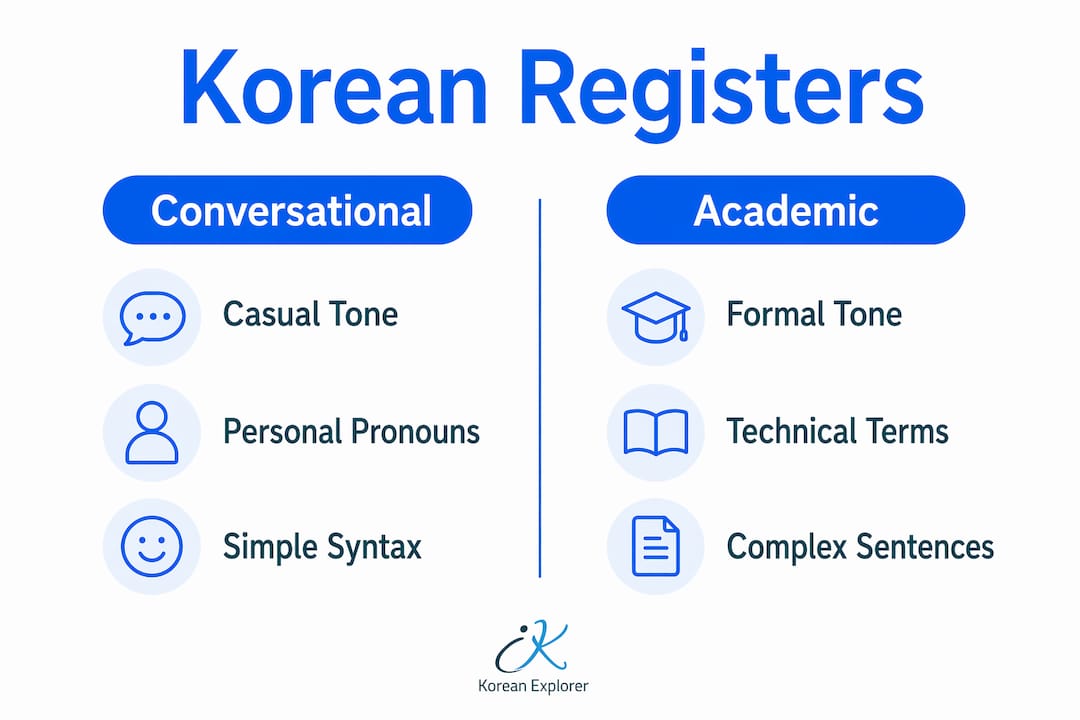
Conversational Korean prioritizes connection and speed. General formal Korean, used in business settings and news broadcasts, prioritizes clarity and respect. Academic Korean prioritizes objectivity, precision, and replicability. These are not just stylistic differences. They reflect fundamentally different communicative goals.
The differences in academic Korean become most visible in how sentences are constructed. Where a conversational speaker might say “I think this method works well,” an academic Korean writer restructures that into a nominalized, evidence-anchored claim that removes the personal subject entirely. This shift in perspective is one of the hardest adjustments for learners to internalize.
What are the main applications of academic Korean?
Academic Korean for purposes of real-world use appears across a range of high-stakes contexts in Korean universities and research institutions. Knowing where it applies helps learners prioritize what to study.
- Research papers and dissertations: Korean academic papers follow a structure of claim, evidence, and replicability regardless of academic level, with common sections including abstract, introduction, related work, methods, results, discussion, conclusion, and bibliography. This modular structure is consistent across undergraduate and graduate work.
- Academic essays and assignments: University-level Korean writing assignments require consistent use of formal register, logical connectors, and evidence-based argumentation. Casual phrasing in these contexts is penalized.
- Presentations and lectures: Academic presentations in Korean follow formal speech patterns, using structured transitions and technical vocabulary to guide the audience through an argument.
- Scholarly communication: Conferences, peer review, and academic correspondence all operate within the conventions of academic Korean. Knowing how to write a formal abstract or respond to reviewer comments in Korean is a practical professional skill.
- Research writing process: Writing Korean academic papers typically follows a modular process, starting with methods and results, then discussion, followed by introduction and related work, and concluding with the abstract and bibliography. This non-linear process surprises many learners trained in Western writing conventions.
Effective academic Korean writing requires avoiding overuse of personal opinion in favor of objective evidence and reproducible results. This is the standard that separates academic Korean from personal or journalistic writing, and it applies across every context listed above.
How can learners effectively acquire proficiency in academic Korean?
Learning academic Korean requires a structured approach that goes beyond general language study. Academic Korean instruction bundles formal register control, nominalization, connective machinery, and research-genre writing conventions into a coherent skill set. Here is how to build that skill set systematically:
Build your formal grammar foundation first. Before tackling academic texts, you need a solid command of formal sentence endings, connective structures, and nominalization patterns. Formal grammar patterns are the scaffolding that holds academic writing together. Without them, even good ideas read as informal.
Read authentic academic Korean texts regularly. Exposure to real Korean research papers, journal articles, and academic essays trains your eye for the patterns that define the register. Start with fields you already know well so you can focus on language rather than content.
Practice writing in the academic register daily. Reading alone does not build writing proficiency. Set a goal to write one paragraph of academic Korean each day, focusing on nominalization and logical connectors. Use resources like Korean study tips to structure your practice sessions.
Study academic vocabulary by discipline. General Korean vocabulary is not enough. Build a working glossary of terms in your specific academic field, whether that is social sciences, engineering, or humanities.
Seek feedback from native academic Korean writers. Self-study has limits. Getting your writing reviewed by someone who produces academic Korean professionally reveals register inconsistencies you cannot catch on your own.
Use structured courses that address formal Korean explicitly. Programs focusing on active speaking, reading authentic materials, and writing practice enhance proficiency significantly. Look for courses that cover formal register and advanced grammar, not just conversational fluency.
Pro Tip: When you encounter a new academic Korean text, highlight every connective phrase and every nominalized structure before reading for content. This trains pattern recognition faster than passive reading alone.
A common mistake is treating academic Korean as simply “harder Korean.” It is a different mode of communication with its own logic. Learners who approach it as a distinct genre, rather than an advanced level of general Korean, progress much faster. Explore resources for learning Korean that specifically address formal and academic registers to accelerate this process.
Key takeaways
Academic Korean is a distinct discourse system requiring formal grammar, technical vocabulary, and objective argumentation. Treating it as a separate genre, not just advanced Korean, is the fastest path to proficiency.
| Point | Details |
|---|---|
| Definition of academic Korean | A formal scholarly register defined by objective tone, nominalization, and technical vocabulary. |
| Core linguistic features | Formal sentence endings, logical connectors, and objectivity markers distinguish it from polite or casual Korean. |
| Register comparison | Academic Korean differs from general formal Korean in complexity, vocabulary, and the suppression of personal opinion. |
| Real-world applications | Used in research papers, dissertations, academic presentations, and scholarly correspondence. |
| Learning strategy | Combine formal grammar study, authentic text reading, and disciplined writing practice with expert feedback. |
Why most learners underestimate academic Korean
Most learners I have worked with arrive at academic Korean thinking it is just polite Korean with harder words. That assumption costs them months of frustration. The real challenge is not vocabulary. It is the complete shift in communicative stance.
In conversational Korean, you are present in your language. You express opinions, use personal pronouns freely, and let your personality come through. Academic Korean asks you to disappear from the text. The writing should read as if the ideas exist independently of the person who wrote them. That is a cognitive shift, not just a grammatical one.
What I have found works best is immersion in authentic academic texts before attempting to write. Read Korean journal articles in your field, even if you only understand 60 percent. Your brain starts absorbing the rhythm of the register, the way sentences build on each other, and the way evidence is introduced and concluded. That rhythm is what makes academic Korean feel natural rather than forced.
The other underestimated factor is cultural context. Korean academic writing carries specific conventions around how you position your work relative to existing scholarship. Humility markers, citation density, and the way you frame your contribution all reflect Korean academic culture, not just language rules. Learners who engage with that cultural layer produce writing that feels genuinely academic, not just grammatically correct.
Mastering academic Korean is a long game. But learners who treat it as a genre with its own logic, rather than a difficulty level to unlock, get there with far less wasted effort.
— Paul
Take your Korean further with Korean Explorer
Korean Explorer offers structured adult Korean courses in Singapore designed for learners who want to move beyond conversational fluency into formal and professional Korean. The curriculum, developed in alignment with Seoul National University standards, covers advanced grammar, formal register, and the kind of structured language skills that underpin academic and professional communication. Classes are available as group sessions, private lessons, and online Zoom courses, giving you flexibility without sacrificing rigor. Native Korean instructors fluent in both Korean and English guide you through the nuances that self-study misses. If you are ready to build the formal Korean foundation that academic and professional contexts demand, explore Korean language courses at Korean Explorer or browse course options to find the right fit.
FAQ
What is academic Korean in simple terms?
Academic Korean is the formal register of Korean used in universities, research papers, and scholarly communication. It is defined by objective tone, technical vocabulary, and complex sentence structures that differ significantly from everyday Korean.
How is academic Korean different from polite Korean?
Polite Korean uses respectful speech levels for social interaction, while academic Korean goes further by requiring objectivity, nominalization, logical connectors, and field-specific vocabulary suited to research and scholarly writing.
Can beginners start learning academic Korean?
Beginners should first build a solid foundation in standard Korean grammar and vocabulary before tackling academic Korean. Most learners begin focusing on academic Korean at an intermediate level, once formal sentence structures feel natural.
What are the best resources to learn academic Korean?
Authentic Korean journal articles, structured formal grammar courses, and programs that combine reading and writing practice are the most effective resources. Korean Explorer’s intermediate Korean course provides the formal grammar foundation that academic Korean requires.
Why is objectivity so important in academic Korean writing?
Effective academic Korean writing requires avoiding overuse of personal opinion in favor of objective evidence and reproducible results. Objectivity signals scholarly credibility and distinguishes academic Korean from personal or journalistic writing styles.