Register for TOPIK in Singapore through the official Topik portal for Korea-based logistics, then complete your actual seat booking through the local channel that administers the exam here, the Singapore Korean International School. The fastest path is simple: watch the registration window, submit your application the day it opens, and pay immediately, because popular sessions fill within 24 to 48 hours.
Here’s the sequence that matters most:
- Create an account on the relevant registration portal if you haven’t already
- Check when the registration window opens and closes for your target test date
- Register through the correct local channel, not a Korea-only student page
- Pay using the accepted payment method as soon as your slot is confirmed
- Save your payment receipt and registration confirmation immediately
The Seoulstart tracker shows that PBT registration windows for Korea-based seats typically open at 10:00 KST and usually remain open for a limited registration window lasting about a week. Overseas centers, including those serving Singapore, don’t always follow that exact pattern, which is exactly why knowing where to look matters more than knowing the date by itself. Com and other local training providers frequently field questions from students who missed a window simply because they were watching the wrong page.
Key Takeaways
TOPIK registration in Singapore succeeds when candidates register through the correct local channel within days of the window opening and pay immediately to lock in a seat.
| Point | Details |
|---|---|
| Use the right portal | Register through the Singapore Korean International School’s local page, not topik.go.kr directly. |
| Move fast on opening day | Popular sessions can sell out within 24 to 48 hours of the window opening. |
| Keep payment proof | Save your transaction ID, confirmation email, and receipt right after paying. |
| Match your ID exactly | Your registration name must match your passport or NRIC to avoid test-day issues. |
| Prepare with local instruction | Com offers group, private, and online TOPIK preparation to help convert your registered seat into a strong score. |
Table of Contents
- What Is the TOPIK Test Schedule for Singapore Candidates?
- Where Do You Officially Register for TOPIK?
- How Do You Register for TOPIK Step by Step?
- What Does TOPIK Registration Cost in Singapore?
- Who Can Take TOPIK and What Should You Bring on Test Day?
- How Does TOPIK Scoring and Format Work?
- When and How Do You Get Your TOPIK Results?
- What Goes Wrong During TOPIK Registration and How Do You Fix It?
- How Do You Track TOPIK Registration Windows in Real Time?
- Get Ready for TOPIK With Structured Local Preparation
- Where to Check Official TOPIK Information
- Sources
- FAQ
What Is the TOPIK Test Schedule for Singapore Candidates?
TOPIK offers three test formats, though not all of them run on the same calendar or even in the same country every cycle. The Paper-Based Test (PBT) is the most widely available format for overseas candidates, including those in Singapore. The Internet-Based Test (IBT) has expanded in recent years but isn’t guaranteed at every overseas center, and the Speaking test remains the least predictable in terms of overseas availability.
Overseas test dates are not set centrally by NIIED in the same way Korea-based dates are published. Local institutions, like the Singapore Korean International School, receive their allocation and publish their own confirmed dates, which can lag behind the general schedule you see on aggregator sites.
A typical PBT cycle looks roughly like this:
- Registration opens for a defined window, often around seven days, sometimes shorter for overseas centers
- The test itself takes place on a fixed date roughly six to eight weeks after registration closes
- Results are released on a set date, usually about a month after the test
TopikGuide’s 2026 schedule lists the annual pattern of PBT and IBT sessions, which is useful for spotting which months typically carry a Singapore-relevant sitting. But treat it as a planning reference, not a final confirmation. The one certainty: IBT and Speaking windows for Singapore are not often published far in advance, so if you’re aiming for one of those formats, check the local center directly rather than assuming a global date applies to you.
Pro Tip: Bookmark both the official schedule and your local center’s page. Aggregators are great for spotting patterns; local pages are the only source that confirms your actual seat is available.
Where Do You Officially Register for TOPIK?
Two different systems handle TOPIK registration, and mixing them up is the single most common mistake Singapore candidates make. topik.go.kr is the official NIIED-run portal, and it’s the authoritative source for test dates, official notices, and Korea-side registration. If you’re sitting the exam inside Korea, this is where you register directly.
If you’re testing in Singapore, registration is instead handled through the local institution appointed to administer TOPIK here, the Singapore Korean International School. This split trips people up constantly. Someone finds topik.go.kr, assumes it’s the only place to register, and either registers for the wrong location or gives up when the Korea-side system doesn’t show a Singapore option.
Here’s how to confirm you’re on the right local page:
- Check that the domain and contact details match what’s referenced in official topik.go.kr notices or reputable schedule aggregators.
- Look for a physical Singapore address and a working local phone number or email, not just a generic contact form.
- Cross-reference the registration dates listed with the general pattern shown on trackers like Seoulstart, so an oddly early or late date doesn’t catch you off guard.
- If anything looks inconsistent, email or call the center directly before entering payment details.
Once you’ve confirmed the right page, the process itself follows a familiar rhythm:
- Locate the current registration announcement on the local center’s site
- Note the exact opening and closing time, not just the date
- Read the fee and payment instructions before the window opens, so there’s no scrambling later
Pro Tip: Save the local registration page to your phone’s home screen. Singapore-based candidates have lost seats simply because they were searching for the link again while registration was already filling up.
For deeper context on what TOPIK actually measures and why local candidates take it, Korean Explorer’s overview of the exam is worth reading before you commit to a test date.
How Do You Register for TOPIK Step by Step?
Once the window opens, speed and preparation both matter. Here’s the order of operations:
- Log in to the local registration portal the moment the window opens, ideally within the first hour.
- Select your intended test format (PBT, and IBT or Speaking if offered) and confirm the test center location.
- Choose your preferred session if multiple center options or timings are listed.
- Enter your personal details exactly as they appear on your identification document.
- Review the fee amount displayed before proceeding to payment.
- Complete payment through the accepted method shown on the portal.
- Download or screenshot your confirmation and payment receipt immediately.
Watch for a few interface quirks: some registration systems show seat availability per session, and popular time slots can disappear while you’re still filling out personal details. If you see a countdown or a “seats remaining” indicator, that’s your cue to move faster, not slower.
Pro Tip: Register on day one with your payment card already saved or ready to enter. A ten-minute delay between opening the page and submitting payment is often the gap between a confirmed seat and a sold-out session.
What Does TOPIK Registration Cost in Singapore?
Expect three components when you register: the base exam fee, any processing charge the local center applies, and the payment method fee if your card issuer adds one. Exact amounts vary by test format and by cycle, so always confirm the figure shown on the local registration page at the time you register rather than relying on a number from a previous sitting.
Most local registration systems accept credit or debit card payment directly through the portal, which is the most common method reported by candidates in Singapore. After paying, keep three things:
- Your transaction ID or reference number
- The confirmation email from the registration system
- A screenshot or PDF of the payment receipt itself
These aren’t just paperwork. If a payment fails to register correctly, or if there’s a dispute about whether your seat was confirmed, this is the evidence the local center will ask for first.
Refund policies differ by center and by how far in advance you cancel, so don’t assume a standard percentage applies. Contact the Singapore Korean International School directly for the specific refund terms attached to your registration cycle, and do this before the registration window closes if you think there’s any chance you’ll need to cancel.
Who Can Take TOPIK and What Should You Bring on Test Day?
TOPIK registration in Singapore is open to anyone who meets the local test center’s identification and registration requirements. It isn’t restricted by nationality or by prior Korean study, which is part of why it draws such a wide range of candidates, from university applicants to working professionals adding a certification to their résumé.
On test day, bring the identification document you used to register, typically a passport or National Registration Identity Card, since the name and details must match your registration exactly. A mismatch, even a minor one like a missing middle name, can cause delays or, in stricter cases, refusal of entry.
Test-day essentials to keep in mind:
- Arrive with enough buffer time before your listed check-in, since late arrivals are often turned away
- Bring your identification document and printed or digital confirmation
- Leave phones and smart devices switched off and stored as instructed, since they’re typically prohibited in the test room
- Bring only the writing materials the center specifies; some formats provide their own
Pro Tip: If your ID document has a name discrepancy, such as a recent legal name change, contact the local center by email at least a week before the test date. Sorting it out on test-day morning is far harder than fixing it in advance.
How Does TOPIK Scoring and Format Work?
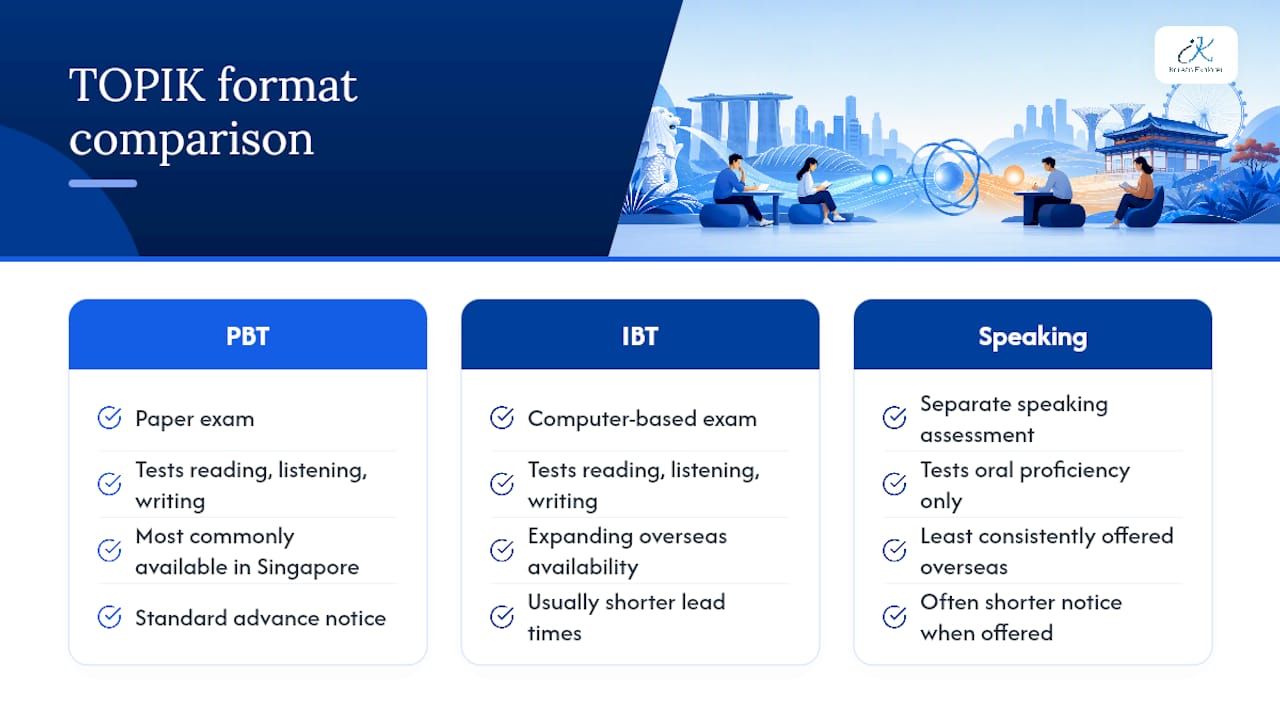
The three formats test the same underlying language ability in different ways. PBT is a traditional paper exam covering reading, listening, and writing, and it’s the most commonly available format for Singapore candidates. IBT delivers the same skill areas through a computer interface and has been expanding, though overseas availability still lags behind Korea. The Speaking test is a separate, newer assessment focused specifically on oral proficiency, and it’s the least consistently offered overseas.
TOPIK results are reported across two overall tiers, TOPIK I and TOPIK II, which then break down into six proficiency levels ranging from beginner to advanced. Your raw score on the sections you sit determines which level you’re placed into, with higher composite scores corresponding to more advanced levels. NIIED publishes the exact scoring thresholds on the official site, so treat any third-party number you see as a general guide rather than the final word.
For Singapore candidates, PBT remains the safest bet if you want certainty about availability. If IBT or Speaking are offered locally, they typically come with shorter lead times and less advance notice, so it pays to check directly with the local center rather than assuming they’ll follow the PBT pattern. Korean Explorer’s format guide breaks down what each section actually measures if you want to plan your study time around your weakest skill area.
When and How Do You Get Your TOPIK Results?
Results are typically released around a month after the test date, following the schedule published on the official NIIED site rather than a local center’s own timeline. Check topik.go.kr directly using your registration number, since this is the definitive source, not a third-party aggregator.
Certificates generally follow one of two paths depending on how your local center administers distribution: either a downloadable digital certificate through the official portal, or a physical certificate collected or mailed through the local test center. Since this varies, confirm which applies to your sitting when you register, not after the results are already out.
A few practical steps for after the test:
- Save your registration number somewhere accessible; you’ll need it to check results
- Check the official site first before contacting the local center about a missing result
- If a certificate is delayed beyond the local center’s stated timeline, email them directly with your registration number and test date
- Keep a digital copy of your certificate the moment you’re able to download or receive it
What Goes Wrong During TOPIK Registration and How Do You Fix It?
A handful of problems show up again and again during registration windows, and most have a straightforward fix if you catch them early.

Sold-out sessions. Popular centers and time slots can fill very quickly during the initial registration period. If your preferred slot disappears, check back periodically, since cancellations do open seats, or consider a different session time at the same center.
Payment not confirmed. If your payment goes through on your bank’s end but the registration system doesn’t show confirmation, don’t attempt the payment again immediately. Screenshot the transaction and contact the local center with your bank reference number.
Incorrect personal details. A typo in your name or identification number can cause problems at check-in. Contact the local center as soon as you notice the error, ideally the same day you registered, since some systems allow corrections only within a short window.
Pro Tip: Scan your identification document and save your payment card details in a password manager before the registration window opens. The candidates who lose seats are almost always the ones typing information for the first time while the countdown is running.
If a problem persists after contacting the local center, escalate through the enquiry channel listed on the official topik.go.kr notices for that test cycle.
How Do You Track TOPIK Registration Windows in Real Time?
PBT registration windows for Korea-based seats tend to open at exactly 10:00 KST and close after seven days, a pattern confirmed by the live Seoulstart tracker. Overseas windows, including Singapore’s, don’t always mirror that timing precisely, which makes active monitoring worthwhile rather than optional.
Build a simple monitoring routine:
- Check official topik.go.kr notices periodically in the weeks before your target cycle
- Sign up for any mailing list or notification system the local Singapore center offers
- Use a live tracker like Seoulstart to cross-check dates and spot upcoming windows early
- Set a calendar alert a few days before the expected opening, then another for the opening day itself
Pro Tip: Create your registration account and fill in your personal details in advance wherever the system allows it. Logging in at the exact opening minute with everything pre-saved shaves off the minutes that separate a confirmed seat from a waitlist.
A Local Perspective on TOPIK Registration Stress
Most of the frustration we hear about TOPIK in Singapore isn’t about the exam content, it’s about missed windows and last-minute scrambling. Working adults juggling jobs rarely have time to refresh a registration page all day. What consistently helps is pairing early registration with structured exam preparation well before the test date, so the exam itself isn’t the thing you’re least prepared for.
Get Ready for TOPIK With Structured Local Preparation
Registering for your seat is only half the job. Com is the practical next step for Singapore candidates who want their registration to actually pay off, not just secure a slot, but also walk in with real command of the material. Our courses build on a curriculum shaped by Seoul National University’s approach, with native Korean instructors who understand exactly where PBT and IBT candidates typically lose marks.
Whether you prefer group classes, private one-on-one sessions, or online Zoom lessons that fit around a work schedule, targeted TOPIK preparation, including timed mock tests and section-specific strategy, turns registration into results rather than just an entry on your calendar. Our training center sits at 10 Anson Road, Level 22, International Plaza, Singapore 079903, directly above Tanjong Pagar MRT, with additional locations in Jurong and Tampines for learners who prefer a center closer to home.
Explore our TOPIK-focused preparation options and pick a class format that fits your schedule before your next registration window opens.
Where to Check Official TOPIK Information
- Topik for official notices, results, and Korea-side registration details
- The Seoulstart tracker for live countdowns on registration windows and results dates
- Korean Explorer’s local TOPIK guidance for Singapore-specific registration tips and class options
Sources
FAQ
How Much Does TOPIK Registration Cost?
Fees vary by test format and cycle, so confirm the exact amount shown on the local registration page at the time you register rather than relying on a previous cycle’s figure.
When Should I Register for TOPIK?
Register the day the window opens, since PBT registration for Korea-based seats runs for about seven days at 10:00 KST and popular overseas sessions can fill within the first day or two.
Can TOPIK Be Taken Online?
The Internet-Based Test (IBT) format exists and is expanding, but it isn’t guaranteed at every overseas center, so check with the Singapore Korean International School directly for current availability.
Is TOPIK Only Offered Once a Year?
No, TOPIK runs multiple sessions per year across PBT and IBT formats, though not every session is offered at every overseas location, including Singapore.
Where Can I Prepare for TOPIK in Singapore?
Com offers group, private, and online Zoom classes built around TOPIK-aligned material, giving Singapore candidates a structured path from registration to test-day readiness.