For most adults chasing a career milestone, university admission, or visa requirement, a TOPIK preparation course is worth paying for because it compresses study time and closes the gap on writing, which is the section self-taught learners struggle with most. If your goal is casual fluency with no deadline, disciplined self-study using official materials works fine. The evidence for that split follows below.
TL;DR:
- Structured TOPIK courses offer faster correction cycles, especially for writing and essay practice, helping learners achieve higher scores more efficiently.
- Timed mock exams, official past-paper drills, and detailed feedback are key components that self-study often cannot replicate effectively.
- A typical preparation timeline for adults aiming for Level 3 or 4 spans several months, with targeted focus on writing and speaking; shorter timelines rely on intensive, structured courses.
- Courses with small class sizes, recorded lessons, and experienced instructors provide the most value, especially for correcting essays and tracking progress.
- Self-study can suffice for reaching Level 3 or 4 if learners are disciplined, have access to authentic materials, and can simulate exam conditions independently.
Table of Contents
- Why Structured TOPIK Prep Courses Improve Exam Outcomes
- What a Good TOPIK Prep Class Actually Teaches
- Course vs. Self-Study: Which Fits Your Situation
- How Long Prep Takes and Whether the Cost Pays Off
- Choosing a TOPIK Prep Course: What to Ask Before You Pay
- A Repeatable Study Cycle You Can Run Every Week
- When a Course Makes Sense, Based on What Actually Works
- How Korean Explorer’s TOPIK Courses Match Your Goals
- Where to Verify Test Dates and Practice Materials
- Sources
- FAQ
Why Structured TOPIK Prep Courses Improve Exam Outcomes
The advantage a course gives you isn’t motivation. It’s correction speed. A self-study learner writing practice essays has no reliable way to know if their argument structure, spacing, or grammar choices would actually score well. A course closes that loop within days instead of weeks.
TOPIK breaks into two formats: TOPIK I, covering levels 1 and 2, and TOPIK II, covering levels 3 through 6. If your target is level 3 or above for a job or graduate program, you need to sit TOPIK II specifically, which carries a heavier writing and reading load than most beginners expect.
Students who scored at the top of the scale consistently point to the same habits: repeated past-paper attempts under timed conditions, speeded listening drills, and essay templates practiced until they’re automatic. High scorers interviewed by Korea JoongAng Daily credit heavy past-paper repetition and focused writing training as the difference between a passing score and a top-tier one. A course structures that repetition for you instead of leaving you to guess at a schedule.

Pro Tip: Before enrolling anywhere, confirm the exact level your university, employer, or visa officer requires. A course sold as “TOPIK prep” without a level target is a red flag, not a feature.
What a course typically delivers that self-study rarely replicates on its own:
- Timed mock exams in the actual PBT or IBT format, not just practice questions
- Individual correction on writing samples, especially the long essay
- A cohort or instructor holding you to a weekly practice cadence
- Diagnostic feedback that tells you which skill is actually capping your score
One detail worth flagging before you spend a dollar: TOPIK certificates are valid for two years from the result release date, and formats differ between paper based and internet based testing. Confirm which format your recipient accepts before you build a study plan around the wrong one.
What a Good TOPIK Prep Class Actually Teaches
Not every course billed as “TOPIK prep” earns the name. Some are general conversation classes with a test-prep label slapped on. Here’s what separates a course that moves your score from one that just fills a time slot.
- Full timed mock exams in the correct format. You need practice under the same PBT or IBT time pressure you’ll face on test day, not just untimed worksheets.
- Structured past-paper drills. Official test papers are the only materials guaranteed to match real question phrasing and difficulty.
- Intensive writing workshops. This means essay templates, spacing rules, and repeated drafts of the long essay, question 54 on TOPIK II, which carries disproportionate weight on the writing score and rewards template mastery more than almost any other single skill.
- Speeded listening and reading strategy. Time management, not just vocabulary, decides whether you finish the reading section at all.
- Homework with real correction. Assignments returned with generic checkmarks don’t help. You need error annotation that tells you why an answer was wrong.
- Progress tracking across mock attempts. A course should show you a score trend, not just a single number after each test.
Pro Tip: Ask to see a sample corrected essay before you enroll. If the “correction” is just a grade with no annotated feedback, keep looking.
Course vs. Self-Study: Which Fits Your Situation
Self-study can absolutely get you to Level 3 or 4. It works when three conditions hold: you’re genuinely disciplined about sticking to a schedule, you have consistent access to official past papers, and you can find enough timed mock opportunities to simulate real exam pressure repeatedly.
Where self-study tends to break down is writing. It’s nearly impossible to self-correct an essay when you don’t know what a Level 5 answer looks like versus a Level 3 one. Candidates preparing alone often report joining study groups specifically to get outside feedback and stay accountable, which is essentially reinventing a course’s core function from scratch.
A course adds three things self-study struggles to replicate:
- Fast correction cycles on writing, especially the long essay
- Built-in accountability through scheduled classes and deadlines
- Access to an instructor who has seen hundreds of essays and knows what separates score bands
A hybrid approach often makes the most financial sense: a short, focused course to fix writing and speaking weaknesses, paired with independent past-paper drilling for reading and listening, where self-correction is more straightforward.
How Long Prep Takes and Whether the Cost Pays Off
Timelines vary wildly by starting point, but a realistic pattern for adult learners moving from intermediate ability toward Level 3 or 4 involves several months of consistent weekly study, not a few weeks of cramming. One learner’s account of taking the exam twice notes that reaching Level 4, a common career-relevant threshold, is a realistic target for focused adult learners, and that structured, test-focused prep can shorten the timeline compared with general-purpose language study.
Start exam-specific preparation at least two to three months before your target test date if you’re already conversational, longer if you’re building from near-beginner Korean.
Cost drivers to weigh before you decide:
- How many hours of instructor-led writing correction the course includes
- Whether mock exams are timed and full-length, or just isolated question sets
- Class size, since one-on-one feedback compresses correction time significantly
- Whether an earlier certification date unlocks a job offer, visa step, or admission deadline that outweighs the course fee
If a certified score by a fixed deadline determines whether you get a job offer or visa approval, faster feedback cycles from a course usually pay back the cost through earlier certification alone.
Choosing a TOPIK Prep Course: What to Ask Before You Pay
Vetting a course takes fifteen minutes of questions and saves you months of wasted study.
- How often do students take full timed mock exams? Weekly or biweekly mocks in the correct PBT or IBT format matter more than any other single feature.
- Can I see a sample corrected essay? Detailed, annotated feedback on the long essay is the single highest-leverage thing a course provides.
- What are the instructors’ backgrounds? Native fluency alone isn’t enough. Ask whether instructors have taught TOPIK-specific content and understand scoring rubrics.
- How large are the classes? Smaller classes generally mean faster, more individualized writing correction.
- Are lessons recorded? If you miss a session or want to review a grammar point, recorded access matters for adults balancing work schedules.
Pro Tip: Treat “guaranteed Level 5” marketing as a red flag. No course can guarantee a specific band score, since testing outcomes depend on individual effort and baseline ability. Reputable providers talk about typical timelines and study intensity instead.
Other red flags: no timed practice at all, vague descriptions of “conversation-based” prep for an exam that’s heavily writing and reading dependent, and no clear answer when you ask how corrections are delivered.
A Repeatable Study Cycle You Can Run Every Week
Skip generic weekly schedules. A tested, repeatable cycle gives you a clearer read on whether your studying is actually working.
- Baseline attempt. Take one full, timed past paper to establish your current level.
- Diagnose errors. Identify whether mistakes cluster around vocabulary, grammar, timing, or essay structure.
- Focused practice. Drill only the weakest skill for several days, not everything at once.
- Comparable repeat. Take a similar-difficulty past paper section and compare results directly.
- Full rehearsal. Every few weeks, sit a complete timed mock to check whether gains transfer under real exam conditions.
For a 12-week plan targeting Level 3 to 4, a workable split is roughly four hours a week on reading and listening drills, three hours on writing and essay templates, and one full mock exam every two weeks. Track your timed past-paper scores across the cycle. If a number isn’t moving after two full rounds, that’s your signal to adjust the plan, not push harder on the same approach.
When a Course Makes Sense, Based on What Actually Works
Enrolling in a course makes the most sense when you have a fixed deadline and writing is your weak point. Those two conditions together mean the fastest path to a certified score almost always runs through structured, corrected practice rather than solo effort. Self-study earns its place when you’re disciplined, have time to burn, and your goal is fluency rather than a specific band score by a specific date.
Classroom experience across adult learners preparing for career and academic goals shows the same pattern again and again: students who get consistent writing correction close the gap between Level 3 and Level 4 faster than those relying on self-assessment alone. That’s not a knock on self-study. It’s a reflection of how hard it is to grade your own essay objectively.
— Paul
How Korean Explorer’s TOPIK Courses Match Your Goals
If a deadline is driving your decision, Korean Explorer gives you what disciplined self-study can’t: fast, individualized writing correction from native instructors who already know what separates a Level 3 essay from a Level 4 one.
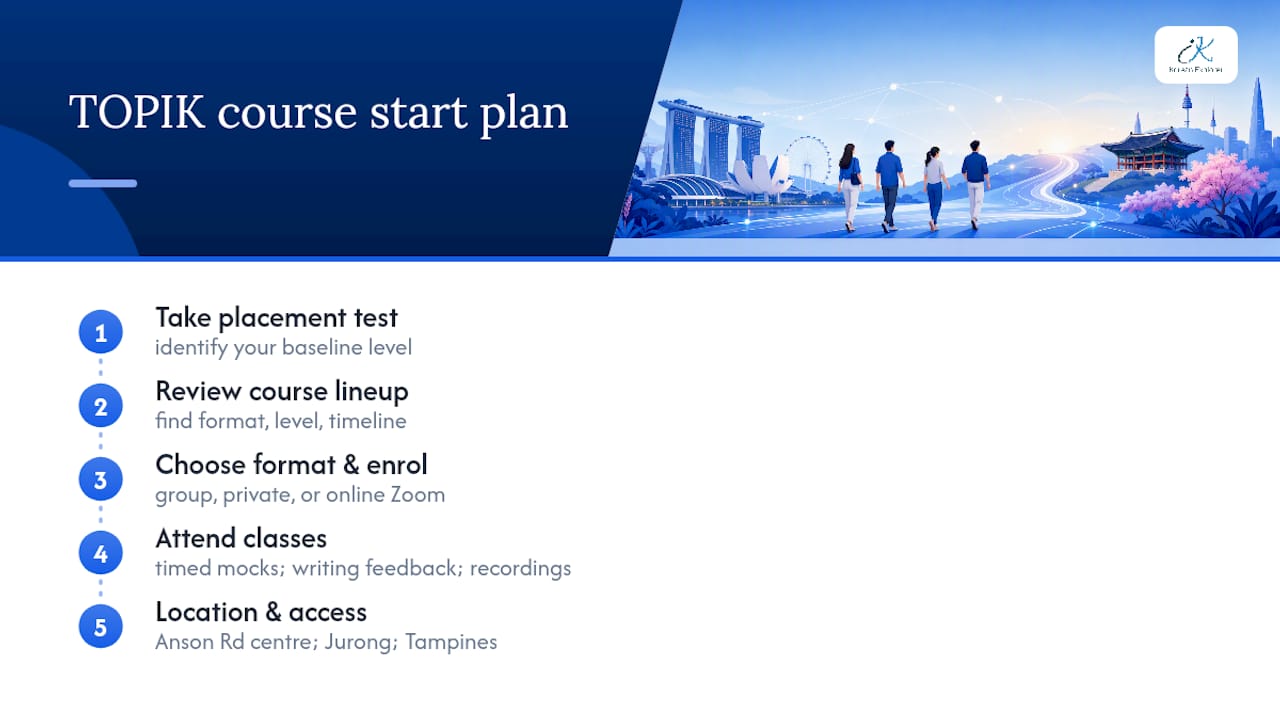
Courses run for both TOPIK I and TOPIK II preparation, with group, private, and online Zoom formats so you can match delivery to your schedule and budget. Every format includes timed mock testing, structured writing feedback on essay templates, and recorded lesson access, useful if you’re balancing prep around a full-time job. Classes run out of Korean Explorer’s central training centre at 10 Anson Road, Level 22, International Plaza, Singapore 079903, right above Tanjong Pagar MRT, alongside additional locations in Jurong and Tampines for learners who need a more convenient site.
Not sure where you currently stand? Start with a Korean placement test to identify your baseline level, then review the full course lineup to find the format and level that matches your target score and timeline.
Where to Verify Test Dates and Practice Materials
Always confirm official information directly before you commit to a study schedule. topik.go.kr publishes registration deadlines, official past papers, and exam specifications. Seoulstart’s TOPIK guide covers format differences and certificate validity in plain language, and Korea JoongAng Daily’s interviews with Level 6 scorers offer practical study advice worth reading before you build a plan.
Sources
- Test of Proficiency in Korean (TOPIK) official site
- Students who received a Topik Level 6 give advice on how to earn the highest score
- How to prepare for TOPIK: a repeatable study cycle | TOPIK Lab
FAQ
Can I self-study for TOPIK?
Yes, if you’re disciplined enough to run regular timed mock exams using official past papers and can get outside feedback on your writing. Most self-study plans break down on essay correction, since it’s hard to grade your own long essay objectively.
Is the TOPIK exam difficult?
Difficulty depends heavily on your target level and starting point. Reading and listening sections reward strong time management, while the writing section, especially the long essay, is consistently what high scorers say separates top bands from mid-range results.
How do I prepare for the TOPIK exam?
Run a repeatable cycle: take a full timed past paper, diagnose your weakest skill, drill that skill specifically, then repeat a comparable test to check improvement. This approach gives clearer signals than following a fixed generic schedule.
How hard is it to get TOPIK Level 4?
Level 4 is a realistic target for adult learners with consistent weekly study over several months, particularly with structured, test-focused preparation rather than general conversation practice alone. The biggest variable is usually writing consistency, not vocabulary size.