서울 is how the name Seoul is written in Korean, made of two syllable blocks: 서 (seo) and 울 (ul). Korean speakers pronounce it in two syllables, close to [sʰʌ̹uɭ] in narrow IPA, which is roughly “suh-ool” rather than the single-syllable English “soul.” The name is a native Korean word meaning “capital city,” not a term borrowed from Chinese, so it has no traditional Hanja spelling at all.
That last point trips up a lot of learners who assume every Korean place name has a Chinese-character equivalent hiding behind it.
- Hangul: 서울 (서 + 울)
- Narrow IPA: [sʰʌ̹uɭ]
- Plain phonetic guide: suh-ool
- Meaning: “capital city” (native Korean, no Hanja)
Seoul is one rare major world capital whose name in its own language is a plain, native word for “capital” rather than a place name with a separate meaning.
Key Takeaways
Seoul is written 서울 in Hangul, pronounced as two syllables close to [sʰʌ̹uɭ], and comes from a native Korean word for “capital” with no original Hanja form.
| Point | Details |
|---|---|
| Hangul spelling | 서울 breaks into two blocks, 서 (seo) and 울 (ul), each built from distinct consonant and vowel symbols. |
| Correct pronunciation | Say two syllables close to [sʰʌ̹uɭ], not the one-syllable English word “soul.” |
| No Hanja exists | Seoul is a native Korean word, not Sino-Korean, so it has no traditional Chinese-character spelling. |
| Name traces to Seorabeol | The modern name descended from Old Korean Seorabeol, Silla’s capital, through gradual sound change. |
| Official forms vary by context | Use 서울 casually, 서울시 for city administration, and 서울특별시 in formal official contexts. |
| Structured practice helps | Com’s adult conversational and business courses pair native instructors with recorded lessons to correct pronunciation habits like Korean’s final ㄹ. |
Table of Contents
- How Do You Say Seoul in Korean Language?
- How Is Seoul Written in Korean and Why Does English Spell It This Way?
- Where Does the Name Seoul Come From?
- What Do 서울시 and 서울특별시 Mean?
- How Can You Practice Saying 서울 Correctly?
- Why This One Word Teaches You So Much About Korean
- Ready to Move Beyond One Word?
- Sources
- FAQ
How Do You Say Seoul in Korean Language?
The single biggest mistake English speakers make with this word is treating it like the English noun “soul.” It isn’t. Say it as two distinct beats: 서 (seo) followed by 울 (ul). In fast, natural speech those two syllables blend together, but they never fully collapse into one the way English speakers tend to compress them.
The narrow phonetic transcription researchers use is sʰʌ̹uɭ, and breaking that down syllable by syllable makes it far less intimidating than it looks.
First syllable: 서 (seo)
The consonant is a light “s” sound, similar to English “s” but slightly softer. The vowel, ㅓ, is an open-mid unrounded vowel represented as [ʌ] in IPA. It’s not the “oh” sound Americans often substitute, and it’s not “uh” either. It sits somewhere between the vowel in “cup” and the vowel in “law,” produced with the mouth more relaxed than either.
Second syllable: 울 (ul)
This one gives most English speakers real trouble. The vowel ㅜ is a rounded “oo” sound, similar to the vowel in “boot.” The final consonant, ㄹ, is where the trouble starts. English speakers hear it and default to their own “l,” which is produced with the tongue tip pressed against the ridge behind the front teeth and the sides of the tongue lowered. Korean’s final ㄹ is different: the tongue makes brief contact further back and releases more like a light flap, closer to a Spanish tapped “r” than an English “l.” This single consonant difference is a large part of why “Seoul” sounds foreign even to native English speakers who think they’re saying it correctly.
Put those two syllables together and you get “suh” plus “ool,” said quickly enough that they nearly merge but never fully do.
Even when Korean syllables run together in casual speech, the underlying Hangul blocks stay separate units. A learner who hears “one long syllable” still has to reproduce two distinct vowels and a final consonant to get it right.
Why English speakers default to “soul”
English has a strong pull toward monosyllabic words that look like existing English words, and “Seoul” spelled in Latin letters looks exactly like “soul.” There’s no vowel-length cue in the spelling to warn English readers that two syllables are hiding in there. This is a spelling problem more than a hearing problem: readers see one written unit and their brain supplies the closest matching English word.
A second common error is “sool,” which fixes the syllable count but ignores the [ʌ] quality of the first vowel and often mangles the final consonant into a full English “l.”
Here’s a quick contrastive drill you can run out loud:
- Say “soul” (English word). Notice it’s one syllable with a diphthong.
- Now say “suh.” Then say “ool.” Say them back to back, slowly: suh. ool. suh ool.
- Speed it up gradually until the gap between the syllables shrinks but doesn’t vanish.
- Compare 서울 against a minimal pair like 소울 (a Korean transliteration of the English word “soul,” used for things like the Marvel character or the music genre) to hear how differently Koreans treat the two words.
That last drill is genuinely useful, because 소울 and 서울 sound similar to an untrained ear but rely on completely different vowels. Practicing the contrast trains your ear to stop hearing Seoul as an English cognate.
Pro Tip: Record yourself saying “seo” and “ul” as two fully separate words first, even if it feels exaggerated. Then gradually close the gap between them. Most learners jump straight to speed and end up baking the English one-syllable habit into their pronunciation permanently.
How Is Seoul Written in Korean and Why Does English Spell It This Way?
Hangul builds every syllable as a block, and 서울 is a clean example of how that system works. The first block, 서, combines the consonant ㅅ with the vowel ㅓ. The second block, 울, combines a placeholder consonant ㅇ, the vowel ㅜ, and the final consonant ㄹ. That opening ㅇ isn’t pronounced at all when a syllable starts with a vowel. It exists purely because Hangul requires every syllable block to start with a consonant symbol, so a silent placeholder fills the slot.
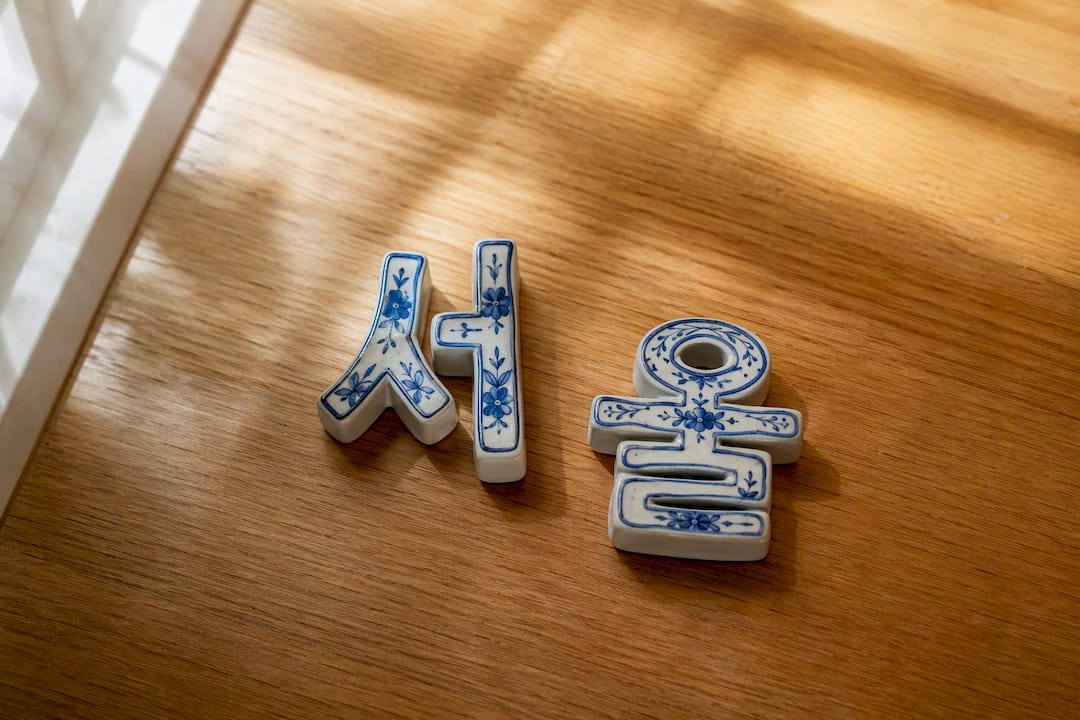
| Block | Components | Sound |
|---|---|---|
| 서 | ㅅ (s) + ㅓ (eo) | seo |
| 울 | ㅇ (silent) + ㅜ (u) + ㄹ (l) | ul |
Once you can see the two blocks as separate units, the two-syllable pronunciation stops being an abstract rule and starts making visual sense.
Where the English spelling actually comes from
“Seoul” as a Latin-alphabet spelling didn’t emerge from a modern, systematic romanization effort. It traces back to 19th-century French Catholic missionaries working in Korea, who transcribed the name in a way that reflected French spelling conventions rather than English phonetics, something closer to “Sé-oul.” That French-influenced spelling stuck, got passed down through decades of maps, treaties, and travel writing, and became the entrenched English form long before Korea had an official romanization standard.
By coincidence, when South Korea’s modern Revised Romanization system was formalized, it happened to render 서울 as “seoul” too, so the old missionary spelling and the newer official system landed on the same result. That’s a lucky accident of history, not proof that the spelling was ever phonetically obvious to English readers.
Other romanization systems render the name differently, and you’ll run into these if you read older scholarship or non-English-language Korean studies:
- Revised Romanization (current standard): seoul
- McCune-Reischauer (older academic standard): sŏul
- Yale Romanization (linguistics-focused system): sewul
Because 서울 is a native Korean word rather than a Sino-Korean one, it has no traditional Hanja form at all, which is unusual for a major Korean place name. This created a genuine headache for Chinese-language media and documents, which traditionally render Korean place names using their Hanja equivalents. For decades, Chinese sources used 汉城 (Hanseong), a leftover from the city’s Joseon-era name, even though Koreans had stopped calling it that. Seoul’s city government formally addressed the mismatch in 2005 by adopting 首爾 (Shǒu’ěr) as the standard Chinese-language rendering, a phonetic approximation rather than a translation. Japanese, by contrast, simply transliterates the sound as ソウル (Sōuru) using its own phonetic script.
If you’re mapping your own name into Hangul or want to see how romanization choices play out in practice, this guide to translating names into Korean walks through the same kind of sound-to-spelling decisions.
Where Does the Name Seoul Come From?
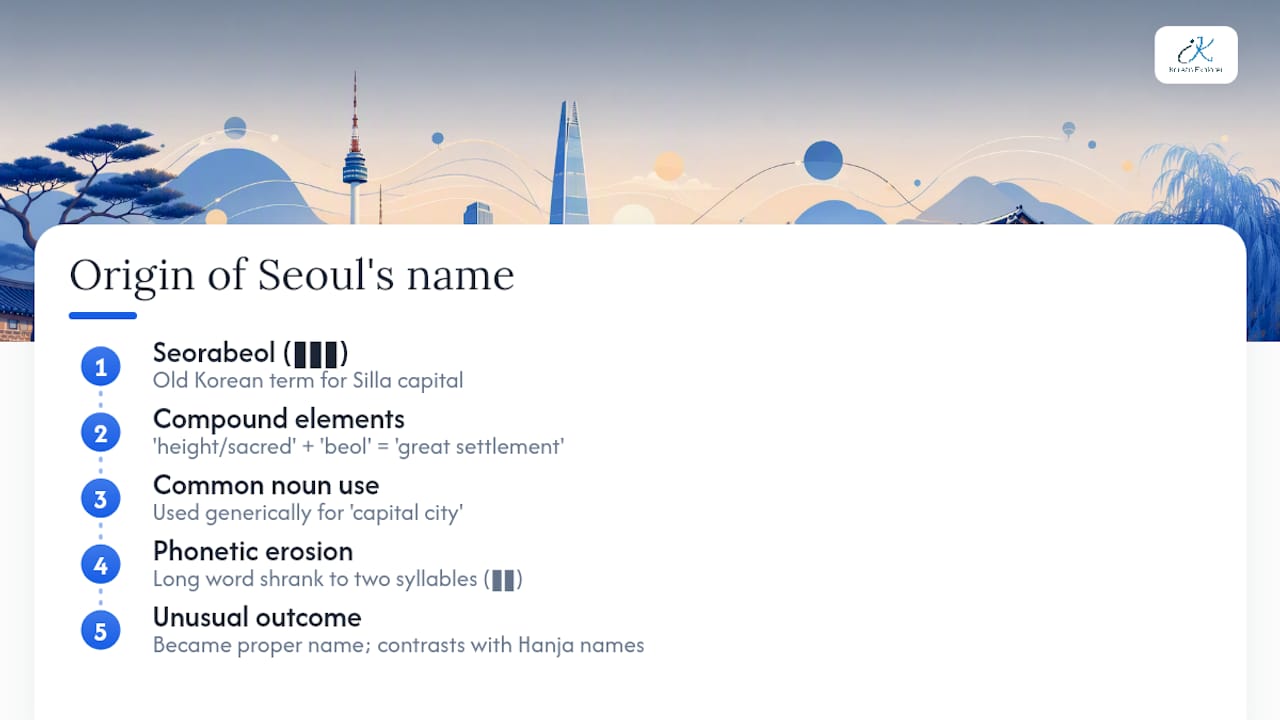
The most widely accepted explanation traces Seoul back to Old Korean Seorabeol (서라벌), a term used in the ancient kingdom of Silla. Seorabeol most likely referred to the Silla capital itself, and over centuries of sound change and regional variation, that longer word gradually wore down into the two syllables that became modern 서울. This isn’t a case of one word being replaced by an unrelated one. It’s the same core word shrinking through natural linguistic erosion, the way “cupboard” quietly lost a syllable in casual English speech over time.
The Korean cultural encyclopedia’s etymology breaks the older term down further, connecting the initial element to ideas of height or sacredness, and the second element (beol) to a broad open settlement or field. Put together, the compound described something like “the great settlement,” a fitting root for a word that eventually just meant “capital” in general.
What makes Seoul unusual is that it started life as a common noun, not a proper name. Korean speakers used a version of the word generically to mean “capital city,” and only later did it narrow into referring specifically to the capital of Korea.
That single fact explains why Seoul breaks the normal pattern of Korean place names. Most Korean cities carry Sino-Korean names built from Hanja characters with fixed, traceable meanings. Seoul instead carries a native word that functioned more like a job title than a proper noun, similar to how “the Capital” functions as a description before it hardens into an official name.
A quick timeline of names
- Silla era (roughly 1st century BCE to 10th century CE): the term Seorabeol is used for the Silla capital, the linguistic ancestor of Seoul.
- Joseon dynasty (1392 to 1897): the city is officially called Hanseong (漢城), a proper Sino-Korean name with Hanja, once the capital relocates to the site of modern Seoul.
- Japanese colonial period (1910 to 1945): the city is renamed Keijō (京城) in Japanese administrative use, the Japanese reading of the same Hanja concept.
- After 1945: newly independent Korea adopts Seoul as the official name, consciously choosing a native Korean word over a Sino-Korean or colonial-era alternative.
That postwar choice wasn’t incidental. Picking a plain native word instead of restoring a Hanja name was, functionally, a small act of linguistic independence.
If you’re curious about how the wider Korean language evolved through these same historical periods, the history of the Korean language covers the broader shifts that shaped words like this one.
What Do 서울시 and 서울특별시 Mean?
Once you know the base word, the variants you’ll see in real Korean text and speech are easy to sort out. Each one signals a slightly different register or context.
- 서울 — the plain name, used constantly in everyday speech (“서울에 가요” — “I’m going to Seoul”).
- 서울시 (Seoul-si) — the casual administrative form, commonly seen on government forms, news reports, and city documents.
- 서울특별시 (Seoul Teukbyeolsi) — the full official title, “Seoul Special City,” used in formal legal and administrative contexts.
- 수도 (sudo) — a generic Korean word for “capital,” not specific to Seoul; it’s used to describe any country’s capital city.
You’ll hear 서울특별시 read out on official broadcasts or printed on formal documents, while 서울시 shows up in more routine municipal contexts like transit announcements or city planning news. In casual conversation, Koreans almost never reach for anything beyond plain 서울.
One more thing worth flagging: English speakers keep the collapsed, single-syllable “soul” pronunciation even when speaking otherwise fluent Korean sentences, purely out of habit from the Latin spelling. Native Korean speakers never do this. The two-syllable pronunciation is automatic for them, which is exactly why it’s worth the deliberate practice for learners.
How Can You Practice Saying 서울 Correctly?
Getting comfortable with 서울 is less about memorizing IPA symbols and more about training your mouth through repetition. Here’s a practice sequence that works well for most learners:
- Read the Hangul blocks aloud slowly, pointing at 서 and then 울 as you say each one, keeping them fully separate at first.
- Isolate each vowel. Practice the ㅓ sound in 서 on its own for a few repetitions, then the ㅜ and final ㄹ in 울.
- Link the syllables gradually, speeding up bit by bit until they flow naturally without collapsing into one.
- Contrast against English “soul” out loud, back to back, so your ear learns to separate the two.
- Record yourself and compare against native audio, listening specifically for whether your first vowel sounds like [ʌ] rather than an English “oh.”
That decompose, link, and compare approach mirrors how phonetics researchers recommend learners approach syllable pairs with tricky final consonants like Korean’s ㄹ.
For structured audio and further explanation beyond this article, a few resources are worth bookmarking:
- The original Language Log analysis of Seoul’s pronunciation, which goes deep into the phonetics.
- Native Korean broadcast audio from Korean news outlets, useful for hearing 서울 used naturally at conversational speed.
- Practical pronunciation drills for building the habit beyond just this one word.
- A rundown of common pronunciation mistakes English speakers make with Korean sounds generally, since the ㄹ issue in Seoul shows up everywhere else in the language too.
If you’re the kind of learner who improves faster with a live person correcting you in real time rather than just comparing recordings on your own, working through this with a tutor or instructor cuts the guesswork down considerably, especially for a sound as unfamiliar as Korean’s final ㄹ.
Why This One Word Teaches You So Much About Korean
Teaching pronunciation, one pattern shows up constantly: students get Hangul reading down fairly fast, but they keep importing English vowel and consonant habits into words that look deceptively familiar in Latin letters. Seoul is the perfect example, because the spelling actively works against the correct pronunciation instead of helping it.
The fix isn’t complicated, just consistent. Spend two or three minutes a day on syllable separation drills like the ones above, applied not just to Seoul but to other Korean words that get flattened by English spelling habits. Small, repeated practice beats one long session every time, because pronunciation is muscle memory more than knowledge.
Pro Tip: If you only fix one habit from this article, fix the final ㄹ in 울. It’s the single sound most responsible for making fluent Korean speakers instantly recognize a foreign accent, and it’s also one of the fastest sounds to correct with focused practice.
Ready to Move Beyond One Word?
Getting 서울 right is a great warm-up, but real conversational confidence comes from working through Korean’s full sound system with someone who can hear your specific habits and correct them on the spot. Com’s adult courses are built around exactly that: conversational and business-focused Korean, taught by native instructors who explain pronunciation rules in plain English before drilling them into muscle memory.

Classes run in small groups, one-on-one, or fully online over Zoom, so you can fit structured practice around a work schedule instead of the other way around. Every class comes with access to recorded lessons, so tricky sounds like Korean’s final ㄹ don’t disappear the moment class ends. If you’d rather work through pronunciation with a tutor between sessions, Korean tutors through TUTOROO offer another option for focused one-on-one practice.
Course highlights include:
- Native Korean instructors fluent in English explanations
- Small group, private, and online Zoom formats
- Recorded lessons for review and repetition
- A curriculum built around real conversational and business use, not textbook drills
The training center sits right above Tanjong Pagar MRT at 10 Anson Road, with additional locations in Jurong and Tampines for learners closer to those areas. Check current Korean language course options to find a class format that fits your schedule.
Sources
FAQ
How do you say Seoul in Korean?
Say it as two syllables, close to [sʰʌ̹uɭ] in narrow IPA, roughly “suh-ool,” rather than the single-syllable English word “soul.”
What is Seoul called in Korean?
It’s called 서울 in everyday speech, 서울시 in casual administrative contexts, and 서울특별시 (Seoul Special City) in formal official use.
How do you write Seoul, Korea in Korean?
Write it as 서울, formed from two Hangul blocks: 서 (ㅅ + ㅓ) and 울 (ㅇ + ㅜ + ㄹ), with no accompanying Hanja since it’s a native Korean word.
What does Seoul mean in Korean?
Seoul is a native Korean word meaning “capital city,” descended from Old Korean Seorabeol, the name once used for the Silla dynasty’s capital.
Why doesn’t Seoul have a Hanja spelling like other Korean cities?
Most Korean place names come from Sino-Korean roots with fixed Hanja characters, but Seoul developed from a native Korean common noun, so it never had an original Hanja form to begin with.