TL;DR:
- Flexible class options give students meaningful control over when, where, and how they engage with learning without sacrificing rigor. They improve access, retention, and student satisfaction by removing logistical barriers and offering structured pacing and modality choices. Proper planning, design, and support ensure these options effectively serve diverse student needs and institutional goals.
Flexible class options expand access, improve completion rates, and preserve academic rigor when they are intentionally designed. That is the bottom line. Whether you are a student juggling a full-time job, an instructor rethinking your course structure, or an academic planner evaluating a new delivery model, the core question is the same: how do you give learners meaningful choices without letting the course fall apart?
Here is what flexible class options actually deliver:
- Where students engage: in-person, online, or both (hybrid/HyFlex)
- When they engage: synchronous live sessions, asynchronous recorded content, or a mix
- At what pace: standard semester, accelerated 8-week terms, or competency-based self-paced tracks
- How they are assessed: multi-day submission windows, varied formats, milestone-based assignments
- With what support: recorded sessions, captioned materials, mobile-friendly LMS resources
EDUCAUSE research shows 82% of students agreed every student should be able to participate in ways that work best for them. The strong agreement among students that flexibility in participation matters should anchor any institutional conversation about flexible delivery.
TL;DR for planners: (1) Survey your students’ scheduling constraints before designing anything. (2) Build in structured pacing guardrails alongside any flexibility you offer. (3) Pilot with one cohort, measure retention and satisfaction, then scale.
Table of Contents
- What “flexible class options” means and the formats you will actually encounter
- How flexible class options improve access, outcomes, and student experience
- Institutional and instructor impacts: enrollment, scheduling, and workloads
- Practical design and rollout steps for flexible class options
- Drawbacks to watch for and concrete mitigations
- What the research shows about impact
- U.S. institutions putting flexible delivery into practice
- How to measure success and realistic timelines
- A practical checklist for academic planners and instructors
- Key Takeaways
- Why structure is the thing most planners get wrong
- Korean Explorer: flexible Korean language learning for adult learners
- FAQ
What “flexible class options” means and the formats you will actually encounter
Flexible class options refer to deliberate course design choices that give students meaningful control over when, where, and how they engage with learning, without reducing the rigor or equivalency of outcomes. The concept sits at the intersection of access and equity: it removes arbitrary logistical barriers while keeping academic standards intact.
The formats in common use today break down like this:
- Online asynchronous: all content is pre-recorded or text-based; students complete work on their own schedule within weekly or module-level windows. No live attendance required.
- Online synchronous: live sessions via Zoom or similar platforms at scheduled times; attendance is expected but location is flexible.
- Hybrid: some sessions are in-person, others online; the split varies by course and institution.
- HyFlex: students choose, session by session, whether to attend in person, join live online, or engage asynchronously. The HyFlex model requires pedagogically equivalent materials across all three paths.
- Competency-based / self-paced: students advance when they demonstrate mastery, not when the calendar says so.
- Accelerated / short-session: 8-week or similar compressed terms that concentrate content and reduce the number of simultaneous courses a student carries.
- Evening, weekend, and early-morning scheduling: same content, shifted time slots to accommodate work schedules.
A concrete example: in a hybrid course, a nursing student who works weekend shifts can attend the Tuesday in-person lab and complete the Thursday lecture asynchronously. In a HyFlex course, that same student can switch modalities week to week depending on her shift schedule, as long as the online materials are genuinely equivalent to the in-person experience, not just a recording of someone else’s class.
Pro Tip: Before choosing a format, map your students’ actual constraints. A quick two-question survey at enrollment (Do you work more than 20 hours per week? Do you have caregiving responsibilities?) will tell you whether asynchronous or accelerated formats will serve your cohort better than a standard hybrid.
Classroom-level flexibility also matters at the face-to-face level. Edutopia practitioner examples show that flexible seating arrangements, where students can choose their workspace and grouping, improve collaboration and give learners a sense of agency even in fully in-person settings.
How flexible class options improve access, outcomes, and student experience
The most direct benefit is access. Online courses provide schedule flexibility and allow learners to reach courses not physically available at a single campus, which matters enormously for students in rural areas, students with disabilities, and students who cannot relocate or commute daily.

For working students and caregivers, the impact is even more concrete. A student working a 40-hour week cannot reliably attend a 2:00 PM Tuesday/Thursday class. Flexible scheduling does not lower the bar for that student; it removes a logistical wall that has nothing to do with her ability to learn.
The retention connection is well-established. According to Times Higher Education, designing for flexibility prevents the exclusion of students juggling work and caregiving duties. Students who can stay enrolled through a difficult semester are students who complete their degrees.
Personalization and pacing are the less-discussed benefits. Chunked microlearning units and milestone-based assessments let students re-enter after a life interruption (a medical issue, a family emergency, a job change) without losing momentum. That re-entry capability is what separates a well-designed flexible course from a course that simply has no deadlines.
Well-being is a real outcome, not a soft one. A Springer review of flexible course design strategies found that multi-day submission windows and clear assessment criteria reduce student anxiety and improve participation. A student who knows she has a 3-day window to submit an assignment can plan around a work shift; a student with a hard midnight deadline cannot.
Institutional and instructor impacts: enrollment, scheduling, and workloads
Flexible delivery expands the applicant pool in ways that standard semester scheduling cannot. Evening and online options attract working adults, career changers, and lifelong learners who would otherwise rule out a program entirely. For institutions facing enrollment pressure, that is not a minor consideration.

Operational benefits include more efficient use of physical space (fewer required classroom hours per course section), reusable digital materials that reduce prep time in subsequent semesters, and scalable asynchronous office hours via recorded Q&A or discussion boards. A well-built online module can serve 30 students this semester and 300 next year with minimal additional instructor time.
The instructor side is more complicated. Designing a genuinely flexible course takes more upfront time than adapting a traditional syllabus. Building pedagogically equivalent materials for multiple modalities, writing rubrics that work across varied submission formats, and managing asynchronous discussion boards all add to the design load. The payoff is that reusable content compounds over time: the recorded lecture you build this semester becomes a study resource, a makeup option, and a future course asset simultaneously.
- Enrollment gains: flexible scheduling and online options reach non-traditional students who cannot attend standard daytime classes.
- Space efficiency: asynchronous and hybrid models reduce peak-hour room demand.
- Reusable assets: recorded sessions, captioned videos, and digital rubrics reduce per-semester prep after the first build.
- Instructor workload risk: assessment management and modality-switching support can spike without proper systems.
Pro Tip: Assign a course design partner (an instructional designer or a senior TA) to the first flexible course build. The upfront investment in quality materials pays back across multiple semesters. Institutions that skip this step often find instructors rebuilding the same course from scratch each term.
Practical design and rollout steps for flexible class options
Good flexible course design follows four core principles drawn from the HyFlex framework: learner choice, equivalency, reusability, and accessibility. Every design decision should pass through those four filters before it goes into the syllabus.
Course structure
Build the course around weekly pathways, not open-ended modules. Each week should have a clear required core (a reading, a recorded lecture, a discussion post) and optional extension activities for students who want to go deeper. Chunked microlearning units of 10–15 minutes each are easier to complete around a work schedule than 90-minute recorded lectures.
Assessment design
Multi-day submission windows of 3–5 days give students scheduling flexibility without eliminating deadlines entirely. Segment major assignments into milestones: a proposal, a draft, a final submission. Authentic assessments tied to real-world competencies (a recorded presentation, a case analysis, a portfolio entry) are harder to game and more meaningful than timed multiple-choice tests.
Technology and support
Your minimum tech stack: a reliable LMS (Canvas, Blackboard, or Moodle), video hosting with closed captioning (Kaltura or Panopto), and a mobile-friendly course layout. All recorded sessions should be captioned. Run a student orientation session at the start of the term to walk through the tools, not just the syllabus.
Rollout steps
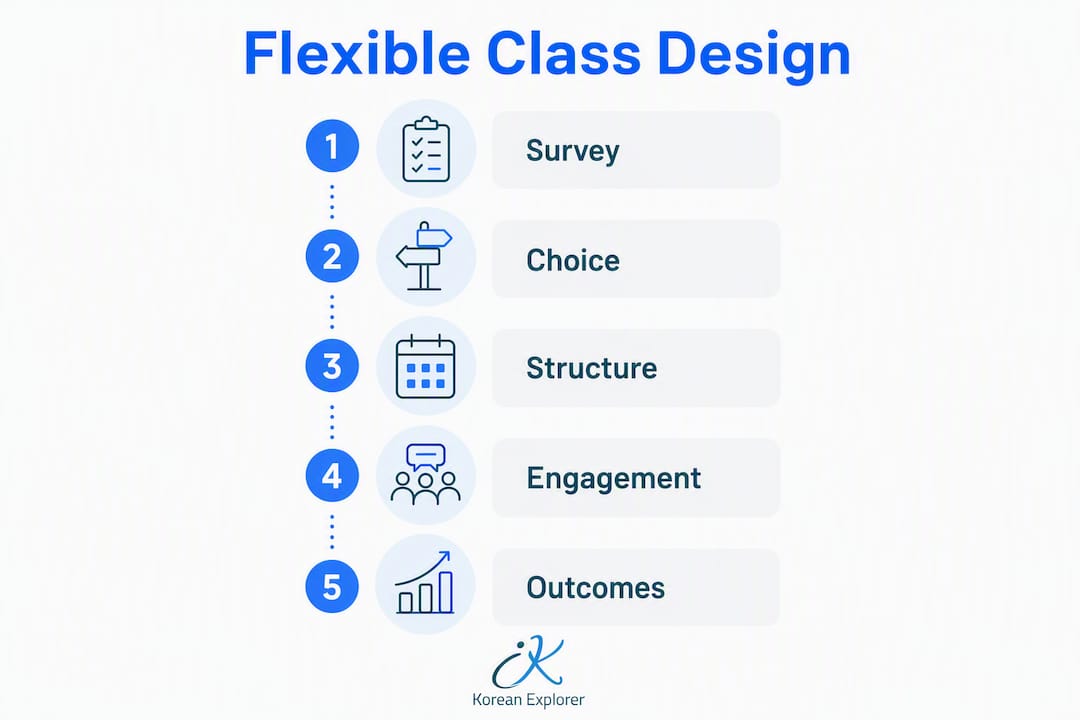
- Survey student needs and constraints before designing the course structure.
- Map learning outcomes and confirm equivalency across all modalities.
- Build and caption all core materials before the semester starts.
- Train instructors on asynchronous facilitation and LMS management.
- Pilot with one section or cohort; collect mid-semester feedback.
- Analyze retention, completion, and satisfaction data at semester end.
- Revise materials based on feedback before scaling to additional sections.
Weekly pathways and short structured sprints retain engagement better than fully open self-paced models. Structure is not the enemy of flexibility; it is what makes flexibility work.
Pro Tip: Post all materials at least 48 hours before they are due. Students with unpredictable schedules need lead time to plan. A Sunday-night post for a Monday-morning deadline defeats the purpose of a flexible course.
The table below summarizes the key design dimensions and what each one requires in practice.
| Design Dimension | What It Requires | Common Mistake to Avoid |
|---|---|---|
| Learner choice | At least two equivalent participation paths | Offering choice without equivalent materials |
| Equivalency | Same outcomes, different modalities | Treating the online path as a lesser option |
| Reusability | Captioned recordings, digital rubrics | Rebuilding materials from scratch each semester |
| Accessibility | Captions, mobile layout, screen-reader compatibility | Assuming all students have desktop access |
| Structured pacing | Weekly pathways, milestone deadlines | Fully open deadlines with no guardrails |
Drawbacks to watch for and concrete mitigations
Over-flexibility is a real risk. Fully open deadlines with no pacing guidance often cause student disengagement, not freedom. Students who thrive in structured environments can lose their footing when the course feels shapeless. The fix is not to remove flexibility but to add guardrails: rolling submission windows, weekly check-in prompts, and milestone checkpoints that keep students moving without locking them into a rigid schedule.
Community and engagement suffer in purely asynchronous courses. Without live interaction, students can feel isolated, and discussion boards can go quiet after week two. Strategies that help: require at least one synchronous touchpoint per module (even a 20-minute optional Zoom), use small-group discussion pods rather than whole-class forums, and build peer review into assessments so students are accountable to each other, not just to the instructor.
Academic integrity concerns are legitimate but often overstated. The most effective response is not surveillance; it is assessment design. Authentic tasks tied to a student’s specific context (a reflection on their own workplace, a project using local data) are far harder to outsource than a generic essay prompt. Open-book assessments with time limits and proctored windows for high-stakes exams cover the remaining risk.
Instructor workload spikes are predictable and manageable. Reusable rubrics, automated LMS feedback on low-stakes quizzes, and a clear policy on response time for asynchronous questions (24 hours on weekdays, 48 on weekends) prevent the “always-on” trap that burns out instructors in flexible courses.
Pro Tip: For time management challenges in flexible courses, share a sample weekly schedule with students in week one. Show them how a student with a 30-hour work week might block time for the course. Most students have never seen this modeled explicitly.
What the research shows about impact
The evidence base for flexible class options is strong enough to act on, with a few important caveats about context.
EDUCAUSE data shows that 55% of students reported being given a modality choice; among those students, satisfaction reached 70%, compared to 48% among students who had no choice. That 22-percentage-point gap is the clearest single argument for building choice into course design wherever it is logistically feasible.
The Springer review of flexible design strategies confirms that the HyFlex model’s four principles (learner choice, equivalency, reusability, accessibility) are the structural foundation for any flexible course that maintains rigor. The key investment is in the quality of materials and assessment design, not just in streaming technology.
Times Higher Education reporting frames flexibility as an equity measure, not a convenience feature. Students from underserved backgrounds, first-generation students, and students with caregiving responsibilities are disproportionately harmed by rigid scheduling. Designing for flexibility is designing for inclusion.
| Finding | Figure | Source |
|---|---|---|
| Students who agree all learners should be able to participate in ways that work for them | 82% | EDUCAUSE |
| Students given modality choice | 55% | EDUCAUSE |
| Satisfaction with modality choice | 70% | EDUCAUSE |
| Satisfaction without modality choice | 48% | EDUCAUSE |
One important limitation: most of the available research comes from higher education contexts in the United States and the United Kingdom. Outcomes in community college settings, professional training programs, and language schools may differ based on student demographics and course goals. Use these figures as directional evidence, not universal benchmarks.
U.S. institutions putting flexible delivery into practice
Three U.S. examples show what flexible class options look like when they move from policy to practice.
California State University flexible course delivery (Cal State’s flexible delivery initiative) represents one of the largest-scale commitments to multi-modal course design in U.S. public higher education. The system has invested in infrastructure for hybrid and online delivery across its 23 campuses, with an emphasis on ensuring that online sections meet the same learning outcomes as in-person ones. The operational lesson: equivalency requires institutional investment in instructional design support, not just faculty goodwill.
Northern Virginia Community College (NOVA) accelerated models: NOVA’s flexible learning options include 8-week accelerated terms designed specifically for working adults. Concentrating a semester’s content into eight weeks reduces the number of courses a student carries simultaneously and cuts scheduling conflicts with shift work. The tradeoff is intensity: students and advisors both need to be prepared for a faster pace, and advising support at enrollment is critical.
Edutopia-style classroom-level flexibility: At the face-to-face level, Edutopia practitioner examples document how flexible seating and student voice change the dynamics of a classroom. When students can choose where and how they sit, collaboration increases and the instructor gets real-time signals about engagement. This is not a technology investment; it is a pedagogical one.
One-line lessons from each case: Cal State shows that scale requires systems, not just intent. NOVA shows that compressed formats serve working adults when advising keeps pace. Edutopia shows that flexibility starts with the physical environment, not just the LMS.
How to measure success and realistic timelines
Knowing what to measure is as important as knowing what to change. The right KPIs for flexible course pilots are:
- Retention rate: are students staying enrolled through week 10 at the same or higher rate than in traditional sections?
- Course completion rate: are students finishing the course and receiving a grade?
- Grade distribution: are flexible-format students performing comparably to traditional-format peers?
- Student satisfaction scores: end-of-semester survey data, specifically questions about scheduling flexibility and perceived fairness.
- Modality choice uptake: in HyFlex or hybrid courses, which paths are students actually using?
- LMS engagement metrics: weekly login frequency, discussion post volume, video completion rates.
Realistic timeline for impact
- Semester 1 (pilot): establish baseline data from a comparable traditional section. Collect mid-semester feedback at week 5–6. Flag early-warning signals: students who have not logged in for 7+ days, students missing two consecutive milestones.
- End of semester 1: compare retention, completion, and satisfaction against baseline. Identify the top three design changes to make before the next term.
- Year 1 (two to three semesters): refine materials, train additional instructors, and expand to a second cohort or section. Look for patterns in which student groups benefit most.
- Years 2–3 (scale): if retention and satisfaction data support it, expand to additional courses or programs. Build institutional reporting to track flexible-format outcomes alongside traditional ones.
Data collection tip: run a brief needs survey at enrollment (three to five questions about work hours, caregiving, and tech access) and use it as your baseline for interpreting outcome data. A cohort of full-time workers will show different patterns than a cohort of traditional-age students, and your analysis should account for that.
A practical checklist for academic planners and instructors
Use this checklist to scope and launch a flexible class option pilot. Each item has a suggested owner.
Pre-launch questions
- Have you surveyed students on scheduling constraints, tech access, and caregiving responsibilities? (Instructor / advising team)
- Is your LMS configured for asynchronous content delivery, discussion boards, and mobile access? (IT / instructional design)
- Have you completed an accessibility audit of all planned materials (captions, alt text, screen-reader compatibility)? (Instructional designer)
- Do you have staffing support (TA, instructional designer) for the first build? (Department chair)
Design checkpoints
- Learning outcomes are identical across all modalities.
- Each major assignment has a 3–5 day submission window.
- A sample weekly schedule is ready to share with students at orientation.
- Rubrics are written to accommodate varied submission formats (video, written, audio).
- Communication templates are drafted for late submissions, tech issues, and modality switches.
Pilot execution checklist
- Train all instructors on asynchronous facilitation before the semester starts. (Instructional design team)
- Test all recordings and captions in the LMS before week one. (IT)
- Announce the flexible policy clearly in the syllabus and in the first week’s announcement. (Instructor)
- Collect mid-semester feedback at week 5–6 using a three-question survey. (Instructor)
- Review LMS engagement data weekly; contact students who have been inactive for 7+ days. (Instructor / advising)
Scale-up decision prompts
- Did retention in the pilot section match or exceed the comparable traditional section?
- Did student satisfaction scores meet your institution’s threshold?
- Can the course materials be reused next semester with less than 20% revision?
If yes to all three, the pilot is ready to scale. If not, identify the weakest point and fix it before expanding.
Key Takeaways
Flexible class options increase access and completion when they combine genuine learner choice with structured pacing guardrails, not when they simply remove deadlines.
| Point | Details |
|---|---|
| Choice drives satisfaction | EDUCAUSE data shows 70% satisfaction with modality choice vs. 48% without it. |
| Structure prevents drop-off | Multi-day submission windows and milestone checkpoints keep students on track without rigid deadlines. |
| Equity is the core argument | Flexibility removes logistical barriers for working students, caregivers, and underserved groups. |
| Measure before you scale | Track retention, completion, and satisfaction in a pilot cohort before expanding to additional sections. |
| Korean Explorer’s approach | Korean Explorer offers group, private, and online Korean classes with recorded sessions, giving adult learners real modality choice. |
Why structure is the thing most planners get wrong
The conventional wisdom on flexible learning tends to frame it as a spectrum: more flexibility is better, and the goal is to remove as many constraints as possible. That framing is wrong in practice, and the research is clear about why.
Fully open deadlines do not liberate students. They shift the cognitive burden of scheduling entirely onto the learner, which is exactly the burden that working students and caregivers are already carrying. A student who works unpredictable shifts does not need a course with no deadlines; she needs a course with deadlines she can actually plan around. That is a 3–5 day submission window, not an open calendar.
The planners who get the best outcomes from flexible delivery are the ones who treat structure and flexibility as partners, not opposites. They build weekly pathways that tell students exactly what is expected each week, then give students a window of days to complete it. They offer modality choice but make every path genuinely equivalent. They pilot with one cohort, collect real data, and revise before scaling.
The other thing that gets underestimated: instructor buy-in is not automatic. A faculty member who has taught the same Tuesday/Thursday lecture for 15 years will not become an effective asynchronous facilitator because the department sent a policy memo. Training, design support, and a realistic first-semester workload are the actual levers. Institutions that invest in those three things see the outcomes the research promises. Institutions that mandate flexible delivery without supporting it see the opposite.
Korean Explorer: flexible Korean language learning for adult learners
Adult learners who want to study Korean in Singapore face the same scheduling reality as any working student: evenings fill up, weekends disappear, and a fixed weekly class time can become a barrier faster than the language itself.
Korean Explorer addresses that directly. The school offers group classes, private lessons, and online Zoom classes taught by native Korean instructors who are fluent in both Korean and English. Recorded class videos are available for students who miss a session, which means a missed class does not mean lost ground. The curriculum is built on a Seoul National University framework, so the structure is there; the flexibility is in how and when you engage with it.
Whether you are starting from zero or picking up where you left off, Korean Explorer’s Korean courses are designed for adults with real schedules. The school is located at 10 Anson Road, Level 22, International Plaza, Singapore 079903, right above Tanjong Pagar MRT, with additional centers in Jurong and Tampines. Visit the course page to find the format and schedule that fits your week.
FAQ
What does a flexible class mean?
A flexible class gives students meaningful choices about when, where, or how they engage with course content, such as attending in person, joining online, or completing work asynchronously, while maintaining the same learning outcomes across all options.
What are the four principles of flexible learning?
The HyFlex model identifies four core principles: learner choice (students select their participation path), equivalency (all paths lead to the same outcomes), reusability (materials work across modalities and semesters), and accessibility (content is usable by all students regardless of device or ability).
What are the disadvantages of flexible programs?
The main risks are student time-management difficulties when deadlines are too loose, reduced peer community in fully asynchronous formats, and higher upfront design workload for instructors. Structured pacing guardrails, such as 3–5 day submission windows and milestone checkpoints, address most of these issues.
Why are flexible classroom spaces important?
Flexible physical spaces, such as moveable seating and varied work areas, give students agency over how they collaborate and focus. Edutopia practitioner examples show that this kind of classroom-level flexibility increases sharing behaviors and engagement even in fully in-person settings.
How does Korean Explorer support flexible learning?
Korean Explorer offers group, private, and online Zoom classes with recorded sessions, so adult learners in Singapore can choose the format and schedule that fits their work and personal commitments while following a structured, Seoul National University-based curriculum.