Read the name in Hangul if you can find it, say the family name first, and give every syllable roughly equal weight instead of stressing one like in English. A few fast fixes carry most of the weight: Lee is “Ee,” Kim is closer to “Gim” with a soft g, Park has no true English “r,” and Choi sounds like “Chwe,” not “Choy.” Get those five habits down and you’re already ahead of most English speakers guessing from the spelling.
TL;DR:
- Most Korean family names are one syllable, with “Kim,” “Lee,” “Park,” and “Choi” being the most common and often mispronounced by English speakers.
- Correct pronunciation hinges on understanding key vowel sounds like ㅓ (“uh”), ㅗ (“oh”), and ㅡ (“eu”), as well as differentiating aspirated and tense consonants, which have no direct English equivalent.
- Breaking names into Hangul syllable blocks and applying simple phonetic rules helps accurately read unfamiliar Korean names without memorization.
- Listening to native speaker recordings and practicing shadowing improves pronunciation consistency, especially for even syllable timing rather than English-style stress.
- Recognizing regional and dialectal variations is less critical for pronunciation, as standard Seoul-based rules reliably apply across South Korea and for most media.
Table of Contents
- Why Romanized Spellings Mislead You
- The Korean Sounds English Speakers Usually Get Wrong
- How to Sound Out a Korean Name Step by Step
- Common Korean Surnames and How They Actually Sound
- Where to Practice With Real Audio
- What Korean Explorer Instructors Correct Most in Class
- Why Korean Names Don’t Sound Sing-Song Like English
- Do North and South Korean Names Sound Different?
- Do Regional Dialects Change How Names Are Pronounced?
- Handling Uncommon or Unusual Korean Name Elements
- A Note on Getting Someone’s Name Right
- Get Real Feedback on Your Korean Pronunciation
- Sources
- FAQ
Why Romanized Spellings Mislead You
Romanization was never built to teach pronunciation. It was built to help Korean names function on English passports, business cards, and search engines, which means it borrows English spelling conventions for sounds that don’t actually exist in English. That mismatch is exactly why “Lee” gets read with a hard L sound that isn’t there in Korean, or why “Park” picks up an English “r” that Korean never had to begin with.
The fix starts with structure. Most Korean full names follow a simple pattern: one syllable for the family name, then two syllables for the given name. Kim Min-su breaks down as “Kim” (family) plus “Min-su” (given). Once you can read Hangul instead of leaning on the romanized version, most of the guesswork disappears.
A simple approach handles almost every name you’ll meet:
- Find the Hangul spelling, not just the English transliteration.
- Split the name into its syllable blocks: family name first, then given name.
- Map each block’s vowel sound before worrying about consonants.
- Apply the small set of sound rules covered below (batchim, tense consonants, ㄹ) to the whole name at once.
The Korean Sounds English Speakers Usually Get Wrong
A handful of sounds account for nearly every mispronounced Korean name, and they’re the same ones that trip up Korean learners generally, not just beginners with names. Hangul is a phonetic writing system, so once you can hear these sounds correctly, you can read almost any name accurately without memorizing exceptions.
Start with vowels, since they cause more damage than consonants:
- ㅓ sounds like “uh,” said with relaxed, slightly open lips. Not “oh,” not “aw.”
- ㅗ is a rounded “oh,” with your lips actually pushed forward.
- ㅡ is the vowel with no English equivalent: a flat, spread “eu” sound, made with a smile-shaped mouth and no lip rounding at all.
Confusing ㅓ and ㅗ is probably the single most common name pronunciation error among English speakers, since English doesn’t force a hard boundary between those two vowel qualities the way Korean does.
Pro Tip: Hold a piece of tissue paper an inch from your mouth and say the sounds “k,” “t,” and “p.” If the paper barely moves, you’re saying the plain consonant. If it flutters hard, that’s the aspirated version, and it’s a completely different sound in Korean, not just a stylistic variation.
Consonants bring their own three-way trap. Korean distinguishes plain, aspirated, and tense versions of sounds that English treats as one letter, and tense consonants (built by tightening your throat, not adding air) have no real English parallel at all. Then there’s ㄹ, which is neither an English “l” nor an English “r.” Between vowels it’s a quick tap, similar to the “tt” in the American pronunciation of “butter.” At the end of a syllable, it settles into something closer to an “l.” Finally, watch batchim, the final consonant of a syllable block: it gets clipped short, and when the next syllable starts with a vowel, the two link together (a pattern called liaison, or 연음) instead of staying separate.
How to Sound Out a Korean Name Step by Step
Once you know the trouble sounds, the actual process of reading a name is mechanical. It works the same way every time, regardless of how unfamiliar the name looks.
- Break the full name into its Hangul syllable blocks. Each block is one syllable. The first block is almost always the one-syllable family name.
- Inside each block, find three parts: the onset consonant, the vowel at the center, and the batchim (final consonant), if one exists.
- Apply the linking and clipping rules across the whole name. Final consonants get clipped short unless the next syllable opens with a vowel, in which case they link across. Keep every syllable close to the same length and loudness, since Korean doesn’t stress one syllable the way English does.
Try it on three real names:
- 김민수 → Gim Min-su (family name Gim, given name Min-su)
- 박지훈 → Bak Ji-hun (the ㅓ in 훈 stays a relaxed “uh,” not “on”)
- 이서연 → Ee Seo-yeon (no L sound anywhere in “Lee”)
Pro Tip: Say each syllable as its own beat, almost like counting: “Gim. Min. Su.” Then speed it up slightly until it flows. English speakers instinctively stress the first or last syllable, and that single habit is what makes a technically correct pronunciation still sound foreign.
If you ever need to spell your own name in Hangul to check how a name is built, a transliteration guide walks through how Korean handles consonant clusters that don’t exist in the language, which is useful context for why certain foreign names get an extra vowel inserted when written in Hangul.
Common Korean Surnames and How They Actually Sound
Four surnames cover a huge share of the Korean population, and they’re also the four most consistently mispronounced by English speakers:
- Kim (김) → “Gim,” with a soft, unaspirated g. Not a hard English “K.”
- Lee (이) → “Ee.” There’s no L sound in the Korean pronunciation at all, even though the romanization keeps one.
- Park (박) → “Bak,” with a plain b and no r sound whatsoever.
- Choi (최) → “Chwe,” roughly. Not “Choy,” which is the almost-universal English mispronunciation.
Try these full names aloud, checking your vowel quality against the guidance above: 이지은 (“Ee Ji-eun”), 최유진 (“Chwe Yu-jin”), 박서준 (“Bak Seo-jun”). The most common mistake with all three isn’t the surname itself, it’s flattening the given name’s rhythm into a single stressed syllable instead of keeping the syllables even.
Where to Practice With Real Audio
Reading the rules is step one. Hearing native speakers say the names is what actually rewires how you pronounce them, since your ear needs a real reference point before your mouth can match it. Crowdsourced pronunciation dictionaries collect native-speaker audio clips for names and words, and many entries carry more than one recording, which lets you compare how the same name sounds across different speakers. Forvo and Naver’s built-in dictionary audio work the same way. Treat machine-generated text-to-speech audio as a last resort; it tends to flatten exactly the vowel and stress distinctions you’re trying to learn.
A short drill routine works better than passive listening:
- Listen to the full name once, without trying to repeat it yet.
- Break it into syllables and listen again, syllable by syllable.
- Shadow it immediately, matching the recording as closely as you can.
- Record yourself and compare the two clips side by side.
Pick one family name and two given names per session rather than trying to drill a long list. You’ll retain the vowel corrections better with fewer names repeated more times.
What Korean Explorer Instructors Correct Most in Class
Teaching adults to pronounce Korean names, instructors run into the same three corrections over and over: vowel quality (especially ㅓ versus ㅗ), even syllable timing instead of English-style stress, and clean batchim handling at the end of a syllable block. Those three account for most of the gap between a technically readable name and one that actually sounds Korean.
The drills that move the needle fastest in a classroom setting are minimal-pair practice (saying pairs of words that differ only in the ㅓ/ㅗ vowel until the difference becomes automatic), the paper test for aspiration described earlier, and repeated shadowing of real name audio rather than isolated syllables. These are the same drills covered in Korean Explorer’s pronunciation guide, refined over years of correcting the same handful of habits in adult beginners.
Why Korean Names Don’t Sound Sing-Song Like English
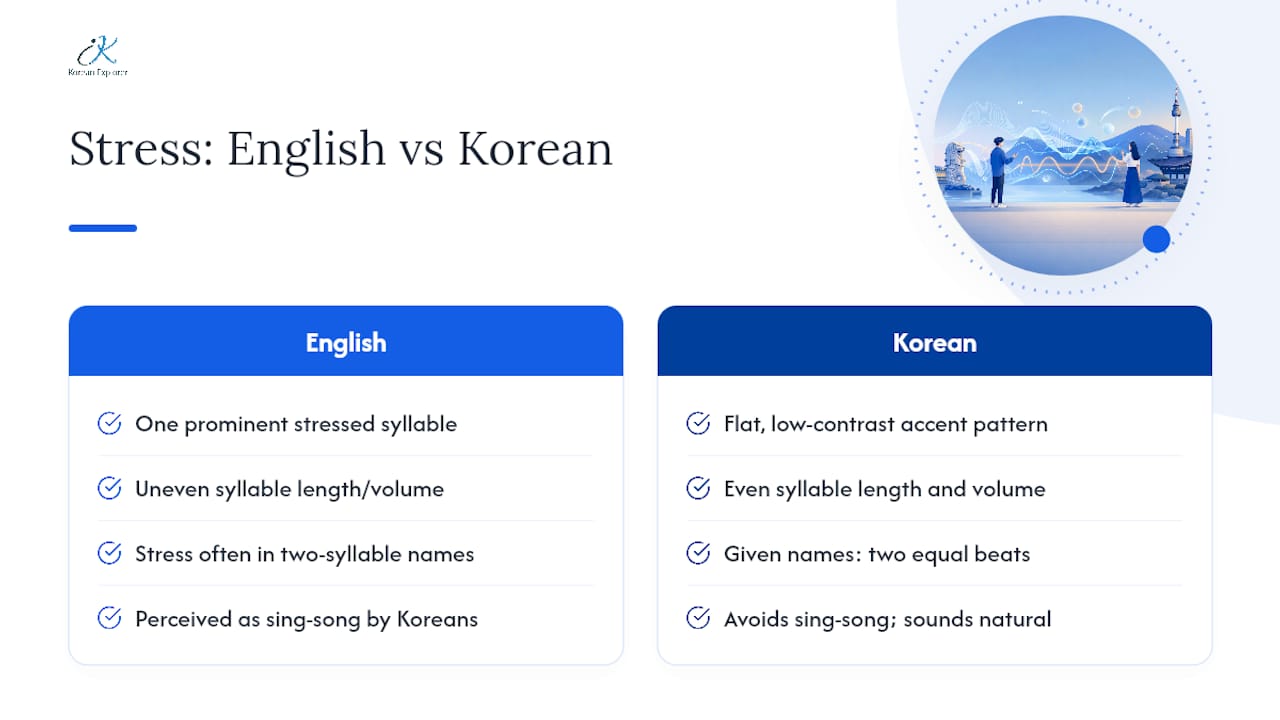
Korean doesn’t use word stress the way English does. English speakers instinctively lean on one syllable in a name (think “Michael” or “re-BEC-ca”), and that habit is the single biggest reason a technically correct Korean name pronunciation still sounds off to a native ear. Korean instead relies on keeping syllables close to even in length and volume, which research on Korean word accent describes as a much flatter stress pattern than English uses by default.
That doesn’t mean Korean has no rhythm at all. Intonation still rises and falls across a full sentence, and certain particles or endings carry a pitch shift. But within a single name, the rule of thumb holds: don’t punch one syllable harder than the others. Say “Min-su” as two roughly equal beats, not “MIN-su” or “min-SU.”
This matters more for given names than family names, since given names are almost always two syllables and that’s exactly where English speakers reach for a stress pattern out of habit. Practicing with a metronome or simply tapping your finger at a steady beat while saying a name out loud is a surprisingly effective way to break that instinct. It forces the syllables into equal time slots instead of letting your English ear pick a favorite.
Liaison adds another layer here. When a batchim consonant links into the next syllable’s vowel, the resulting sound can shift the rhythm slightly, but it still doesn’t create the stressed/unstressed contrast English speakers expect. The syllable count stays the same. The evenness stays the same. Only the specific consonant sound at the boundary changes.
Do North and South Korean Names Sound Different?
Yes, in noticeable but limited ways. The core phonetic inventory (the vowels and consonants themselves) is shared across both countries, since both trace back to the same language and writing system. What differs is mostly in pronunciation tendencies, some vocabulary, and a handful of consonant realizations that show up more in everyday speech than in name pronunciation specifically.
For names, the practical differences a learner is likely to encounter come down to two things. First, some family names that are common in the North are rare or unused in the South, and vice versa, simply due to decades of separate social history. Second, spelling conventions for certain surnames differ slightly between the two Koreas, most famously with the surname often romanized as “Lee” in the South, which historically appears as “Ri” or “Yi” in North Korean usage, reflecting an older pronunciation convention that South Korea simplified over time.
For a learner focused on speaking with South Korean speakers, whether in conversation classes, business settings, or casual meetings, the South Korean standard pronunciation covered throughout this guide is the one that matters. If you happen to encounter a name in North Korean spelling or media, the underlying sounds are close enough to the South Korean version that the same vowel and consonant rules still apply; you’re mainly adjusting for a different romanized spelling of a similar sound, not learning an entirely separate pronunciation system.
Do Regional Dialects Change How Names Are Pronounced?
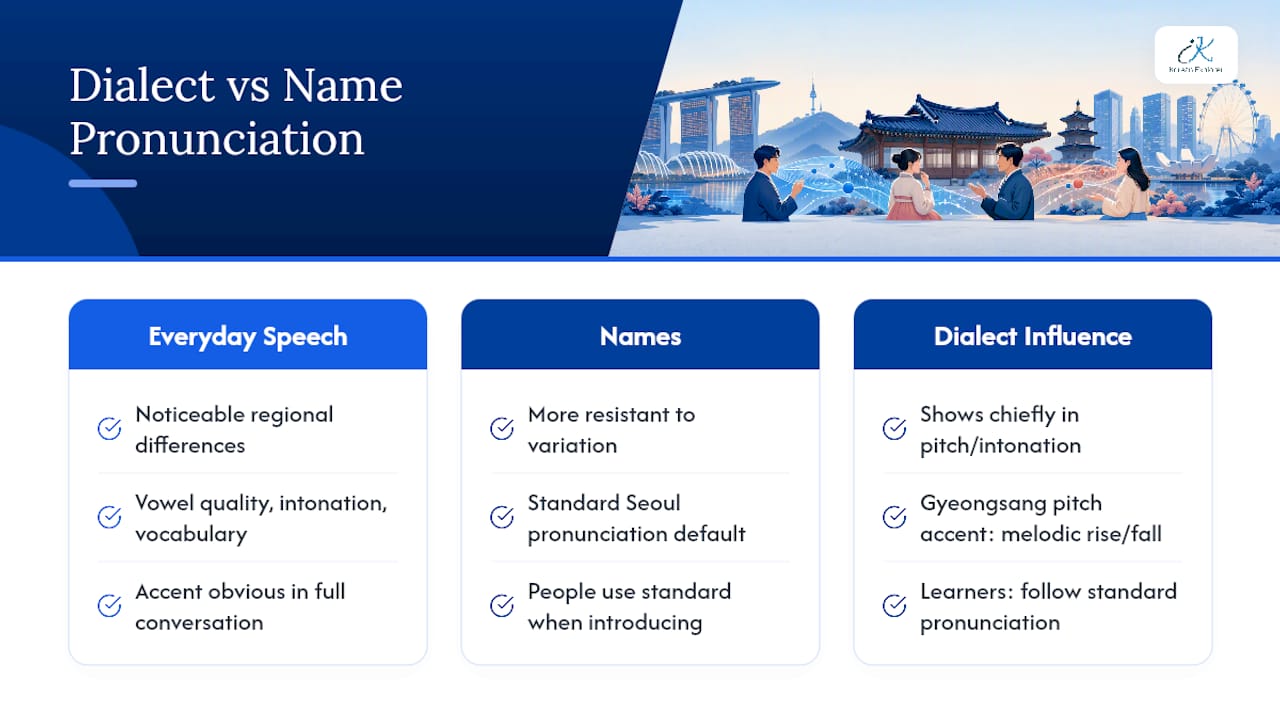
Somewhat, though less than you might expect for names specifically. Korean has several regional dialects, including Gyeongsang, Jeolla, and Jeju varieties, and they carry real differences in vowel quality, intonation, and vocabulary in everyday conversation. Someone from Busan and someone from Seoul will have noticeably different speech patterns if you listen to a full conversation.
Names are more resistant to this variation than ordinary speech, mainly because the standard pronunciation taught in schools and used in broadcast media (based on the Seoul dialect) is what nearly everyone defaults to when saying a name clearly, especially to someone new. A person from a Gyeongsang-speaking region will usually pronounce their own name close to the standard when introducing themselves formally, even if their everyday speech carries a distinct regional accent.
Where you’re more likely to notice dialect influence is in pitch and intonation rather than the actual vowel or consonant sounds. Gyeongsang dialect speakers, for instance, use pitch accent patterns that can make a name sound like it has more melodic rise and fall than the flatter, standard-accent version. That’s a coloring on top of the pronunciation, not a change to which sounds are used. For a learner, sticking with the standard pronunciation rules in this guide will get a name understood correctly anywhere in the country; the dialect variation is something you’ll notice as a listener long before you’d need to reproduce it yourself.
Handling Uncommon or Unusual Korean Name Elements
Most guides focus on the handful of surnames everyone meets, but Korea has hundreds of family names, and given names draw from an even wider pool of syllables, some genuinely rare. When you hit an unfamiliar syllable block, the same method from earlier still works. There’s no separate rulebook for uncommon names.
A few extra habits help when a name doesn’t look familiar. Check whether the syllable uses a double consonant onset (tense consonants like ㄲ, ㄸ, ㅃ, ㅆ, ㅉ), since these are easy to misread as their plain counterparts if you’re not looking closely at the Hangul. Also watch for less common batchim consonants; most learners get comfortable with ㄴ, ㅁ, and ㅇ endings quickly, but batchim like ㄺ or ㄼ (used in a small number of names and words) follow specific simplification rules where only one of the two consonants actually gets pronounced.
Given names occasionally use Hanja-based syllables that don’t show up often in everyday vocabulary, which means you won’t have a familiar word to anchor the pronunciation to. In that case, lean harder on the mechanical method: identify the onset, vowel, and batchim independently, apply the standard sound rules, and don’t assume an uncommon syllable is pronounced differently just because it looks unfamiliar. Hangul stays phonetically consistent even for rare combinations, which is one of its real advantages over English spelling.
A Note on Getting Someone’s Name Right
Taking the time to pronounce someone’s name correctly is a small thing that lands bigger than you’d expect. It signals you see the person, not just a name tag. If you’re not sure how someone prefers their name said, just ask, and offer your attempt first. Most people appreciate the effort far more than they mind correcting you once. A little practice before a meeting goes a long way toward a first impression you’d actually want to make.
— Paul
Get Real Feedback on Your Korean Pronunciation
Reading rules and listening to audio clips will get you most of the way there, but nothing replaces a native instructor hearing your specific mistakes in real time and correcting them on the spot. Adult Korean language courses focus on real-time correction from native instructors, suitable for travel, work, or personal interest.
For focused pronunciation work, private online classes give you one-to-one time with a native-speaking instructor who can catch a mispronounced batchim or a flattened ㅓ before it becomes a habit. If you’d rather practice in a conversational setting with other adult learners, the group and private online class packages run for 2 hours per session, and every class comes with recorded video you can rewatch to check your own pronunciation against your instructor’s. Sessions run over Zoom, so location isn’t a barrier, and the school’s central Singapore location sits at 10 Anson Road, Level 22, International Plaza, right above Tanjong Pagar MRT, for anyone who prefers in-person corporate or private training. Check current course dates and reserve a spot through the online classes page to get instructor feedback on your pronunciation directly.
Sources
For native-speaker audio, HowToPronounce’s Korean dictionary offers crowdsourced recordings. For sound rules and problem consonants, see the Korean pronunciation guide referenced throughout this piece.
- How to read Korean names: a beginner’s guide to structure, meaning and pronunciation
- Wordy
- Howtopronounce
FAQ
Why do Koreans pronounce Lee as “Ee”?
The Korean surname 이 has no L sound in its actual pronunciation; the initial consonant is silent when it starts a word, leaving just the vowel “ee.” The “L” in “Lee” comes entirely from an older romanization convention, not from how the name sounds in Korean speech.
Are Korean names pronounced family name first?
Yes. Korean names place the one-syllable family name before the two-syllable given name, the reverse of the Western first-name-then-surname order. Kim Min-su means the family name is Kim and the given name is Min-su, not the other way around.
How do you say “my name is” in Korean?
The common phrase is “제 이름은 [name]입니다” (jae ireumeun [name]imnida), which literally translates to “my name is [name].” A more casual version simply states the name followed by “입니다” (imnida) or “이에요/예요” (ieyo/yeyo) depending on politeness level.
How do you say “hi, my name is” in Korean?
You’d say “안녕하세요, 저는 [name]입니다” (annyeonghaseyo, jeoneun [name]imnida), which combines the standard greeting with a self-introduction. Practicing this phrase alongside your own name in Hangul is a good first step before trying to pronounce other people’s Korean names accurately, and it’s exactly the kind of phrase covered in Korean Explorer’s beginner pronunciation drills.