Korean Explorer’s published online private packages are S$1,280 for beginner study or S$1,480 from elementary through business Korean, each for 8 sessions of 2 hours, plus a S$50 registration fee. The tuition-only equivalents are S$80 and S$92.50 per teaching hour. These are particular school packages, not a market-wide tutor-rate range; obtain a separate quote for other tutors, formats or learner counts.
TL;DR:
- Published Korean Explorer online private examples: S$1,280 beginner or S$1,480 elementary through business for 16 teaching hours, plus S$50 registration. Compare each offer’s scope before comparing tuition per hour.
- Online delivery does not establish a fixed discount. Compare the actual package hours, learner count and full payable amount.
- Ask whether the package includes a syllabus, resources and progress discussions. Those inclusions do not prove that fewer hours will produce the same result.
- Cancelation policies and additional fees like registration or GST can significantly increase the total cost, so clarify these before committing.
- Discuss your starting point, available teaching hours and intended goals. A two-month calendar window does not establish a particular level of Korean.
Table of Contents
- How Much Does a Private Korean Tutor Cost in Singapore?
- What Drives the Price Differences Between Tutors?
- Package Pricing Examples: Doing the Per-Hour Math
- How to Choose Between Private Korean Tutors and Packages
- What Can You Realistically Learn in 2 Months vs. Longer Term?
- Where Korean Explorer Fits Into Your Budget
- Pay for Structure, Not the Lowest Number on the Page
- Ready to Turn a Budget Into a Booked Lesson?
- Sources
- FAQ
How Much Does a Private Korean Tutor Cost in Singapore?
Tutor listings, school packages and group courses are different offers. Request the price, session length, number of sessions and learner count for the option you want. This guide uses Korean Explorer’s published online package figures below; it does not claim a complete current survey of Singapore tutors.
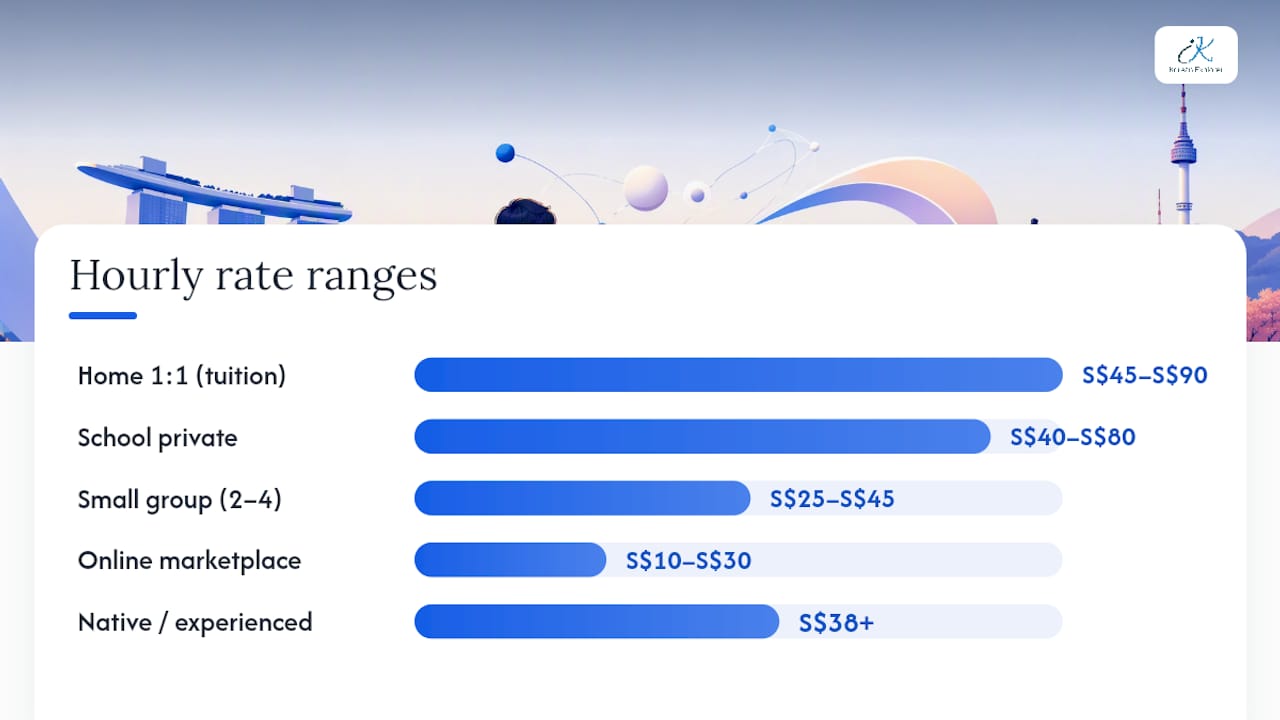
Before comparing two quotes, check whether each covers conversation practice, a defined course module or preparation for an examination. Ask what the teacher will cover and how progress is discussed; a higher price alone does not prove better results.
Here’s how the main formats typically break down in Singapore:
- Online private example: Korean Explorer publishes S$1,280 for a 16-hour beginner package or S$1,480 for elementary through business Korean, plus S$50 registration.
- For face-to-face private lessons, request a quote for the learner count, level, location and teaching hours. Do not assume the online package applies.
- For a shared private class, ask whether the price is for the whole class or per student. A paired package and a one-student package are distinct offers.
- Structured private packages (school-run, 8 sessions of 2 hours): S$80 to S$92.50 per hour once averaged out, based on Korean Explorer’s published beginner (S$1,280) and elementary-to-business (S$1,480) private packages
Korean Explorer publishes online private packages at S$1,280 for beginner study or S$1,480 from elementary through business Korean, each for 16 teaching hours. Dividing tuition by 16 gives S$80 or S$92.50 per teaching hour, before the listed S$50 registration fee. Its online group example is S$480 for 16 hours, or S$30 per teaching hour; its physical beginner group example is S$350 for 16 hours. Compare these as distinct school offers, not a complete tutor-market range.
Confirm the full payable amount in writing, including whether any applicable tax is already included. Do not add tax again to an inclusive amount. Korean Explorer’s public pages do not establish the GST treatment of every quote; no tax-adjusted total is asserted here. Its online private page separately lists a S$50 registration fee.
What Drives the Price Differences Between Tutors?
Use these questions to understand what each particular quote covers.
Tutor background: Ask about teaching experience, qualifications and the languages used for explanation. These details help you evaluate fit; this guide does not establish how much each credential changes the price or the learning outcome.
Format: Compare the actual online and face-to-face quotes, locations and teaching hours. Do not assume a fixed online discount or an in-person travel surcharge.
Curriculum depth separates hobbyists from serious learners. A tutor running you through a structured syllabus with progress checks and homework will price differently than someone offering unstructured conversation practice, even if the hourly number looks similar at first glance.
Scheduling flexibility has a real cost. Short-notice bookings, irregular timing, or frequent rescheduling often carry a premium or a cancellation fee, and this quietly inflates your effective hourly rate even when the advertised number stays flat.
- Ask which instructor teaches the class and what relevant teaching experience or qualifications they publish.
- Online format: compare the actual quote rather than assume a percentage saving.
- Ask which syllabus and resources are included in the specific quote.
- Obtain the actual cancellation and rescheduling terms before paying.
Pro Tip: Ask upfront whether the quoted hourly rate includes materials and whether cancellations within 24 hours are charged in full. This single question exposes more hidden cost than comparing three different tutors’ base rates.
Package Pricing Examples: Doing the Per-Hour Math
Package pricing looks attractive until you actually convert it to a per-hour figure, and that conversion is the single most useful skill in comparing quotes.
Term-based group courses. Some schools price a full term of 12 to 15 lessons at 1.5 hours each, billed as a single term fee. Divide the term fee by total hours to get a comparable per-hour number, then compare that against private rates to see the group discount in real terms.
Trial lessons: Korean Explorer publishes a S$45 trial lasting 120 minutes. Confirm the date, venue and format. It is a separate offer rather than proof of a universal trial-to-package price relationship.
Exam-focused private courses. Specialized courses, such as a TOPIK-focused program priced at S$1,480 plus a one-time S$50 registration fee and S$50 materials fee, carry a premium over general conversation packages because they demand targeted drilling and assessment tracking.
Ask each provider to list its syllabus, placement process, teaching hours and feedback arrangements. Marketplace listings are individual offers, not proof that all lower-priced tutors omit these elements or that a higher-priced course achieves better results.
How to Choose Between Private Korean Tutors and Packages
Start by matching your goal to the right lesson type. Someone prepping for a work trip needs different lessons than someone building long-term conversational fluency or targeting business Korean for a career move. Getting this wrong is the most common reason people feel they “wasted money” on tutoring.
Before committing, run through this checklist:
- Does the tutor provide a syllabus or lesson plan, or is it purely reactive conversation?
- What’s the instructor’s background: native speaker, bilingual, formal teaching experience?
- How is progress tracked between sessions?
- What’s the cancellation and refund policy in writing?
- Are materials, registration, or administrative fees separate from the quoted hourly rate?
Ask these questions during your first contact, ideally before or during a trial lesson: How many students has this tutor taught to a similar goal? What happens if I need to reschedule? Is there a placement test to confirm my starting level?
Watch for a few red flags. A tutor who can’t clearly explain their pricing structure, refuses to put cancellation terms in writing, or offers a rate that seems unusually low with no explanation is worth a second look. Structured private tutoring pages that map personalized paths to your specific learning goal tend to be more transparent about exactly this kind of detail upfront.
Pro Tip: If a quoted rate seems too good relative to the market range, ask directly what’s excluded. The answer usually reveals whether you’re comparing a real apples-to-apples price or a stripped-down version of what other providers include as standard.
What Can You Realistically Learn in 2 Months vs. Longer Term?
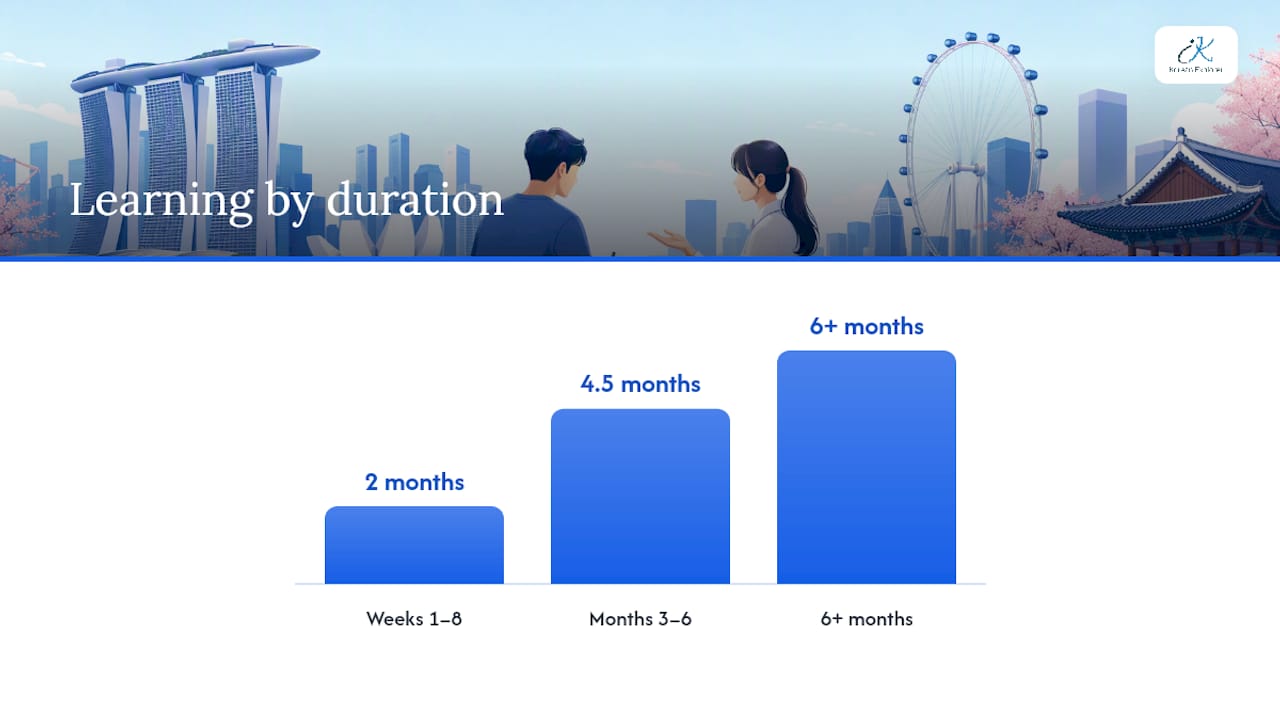
A two-month study window can be used to work on selected goals, but it does not guarantee Hangul literacy, a conversational level or a particular exam result. Ask what the proposed module covers, then plan your teaching hours and practice around your starting point.
Progress tends to map roughly to total hours and consistency, not calendar time alone:
- For an initial course block: ask whether it covers the writing system, greetings, sentence patterns or other topics you need. Confirm the teaching hours rather than infer the syllabus from elapsed weeks.
- After initial study: review which situations you can handle and identify the grammar, vocabulary or practice you need next. There is no guaranteed month-by-month progression.
- For business or more advanced goals: check the intended course outcomes and your starting level rather than assume that elapsed months establish proficiency.
Private lessons can allow individual lesson priorities, while group lessons involve a shared course outline. Ask which format covers your intended situations and actual timetable; this guide cannot establish that either format reaches fluency faster.
Where Korean Explorer Fits Into Your Budget
Some courses are based on a curriculum developed by Seoul National University and taught by native Korean instructors fluent in both Korean and English, which helps with clear grammar explanations and organized instruction.
Depending on your budget, a few formats line up directly with what’s covered above:
- Career or exam-driven goals: the TOPIK-focused private course at S$1,480, plus registration and materials fees
Training options are also available for teams needing business Korean on a schedule that fits work commitments. If you want to see how the teaching style and pacing feel before committing to a full package, a trial lesson is the lowest-risk way to check fit.
Pay for Structure, Not the Lowest Number on the Page
A low hourly rate is only one comparison point. Ask for the syllabus, teaching hours, learner count, included resources and feedback arrangements. This guide has no evidence that a structured course reaches the same outcome in half the time or necessarily costs less overall.
Spending more upfront makes the most sense when something concrete is riding on the outcome: a relocation, a client-facing role that needs business Korean, or an exam deadline. For general conversational goals without a hard deadline, a well-run online group course is a genuinely cost-effective way to build a foundation before deciding whether private lessons are worth the jump.
— Paul
Ready to Turn a Budget Into a Booked Lesson?
Once you know your rough budget, from a S$350 in-person group course (or S$480 online) to S$1,280 or S$1,480 for private courses depending on level, or S$1,480 plus materials for TOPIK preparation, the next real decision is picking a provider you can actually stick with for the long haul. Korean Explorer runs on a Seoul National University-developed curriculum with native, bilingual instructors, so you’re not choosing between “cheap and unstructured” or “expensive and hoping for the best.”
If your budget points toward serious, structured progress, the private class packages give you one-on-one attention with a real syllabus behind it. If cost matters more right now, the online group packages deliver the same curriculum at a fraction of the per-hour cost, all over Zoom, so location never gets in the way. Working toward a specific exam or certification timeline? The TOPIK preparation course is built around that exact goal.
Not sure which fits? Book a trial class first, or visit the centre at 10 Anson Road, Level 22, International Plaza, Singapore 079903, right above Tanjong Pagar MRT, to talk through your goals and budget in person before committing.
Sources
- Korean Language Course Singapore | Eduprime Singapore
- 2026 Private Korean Tutor Rates – How much do private Korean lessons cost? | AmazingTalker
FAQ
How much do Korean tutors cost in Singapore?
Korean Explorer’s online private beginner package is S$1,280 for 16 teaching hours, or S$80 per teaching hour. Its elementary-through-business private package is S$1,480 for 16 hours, or S$92.50 per teaching hour. The page also lists S$50 registration. These are published school examples; other tutors and formats require separate current quotes.
How much does it cost to learn Korean in Singapore overall?
Total cost depends heavily on format and duration. A beginner group course starts at S$350 for in-person or S$480 for online (each an 8-session package), while a full private tutoring path or exam-focused course can run S$1,280 to S$1,480 or more, before registration and materials fees.
What are the typical tutor rates in Singapore?
There is no single tutor rate established by this guide. Compare a current quote by teaching hours and learner count, then check registration, materials and any other applicable charges. A marketplace listing is an individual offer, not proof of an industry-wide price band.
Can I learn Korean in 2 months?
Two months is a study window, not a guaranteed proficiency result. Ask about the intended course content, total teaching hours and suitable practice for your starting point. Do not treat a calendar period as proof of conversational fluency.