Compare course formats against your goal: everyday conversation, travel, workplace communication or exam preparation. Ask what teacher feedback and practice activities are included. The amount of study completed and your starting skills matter; a format alone does not establish how quickly you will progress.
TL;DR:
- Regular live classes with native instructors provide structured speaking practice; how quickly you progress depends on total hours, practice between sessions and individual effort.
- Small group in-person or Zoom classes can offer more speaking time per student and immediate pronunciation feedback compared to larger or recorded sessions.
- Supplementing classes with daily practice tasks helps reinforce what you learn; track what you try, what corrections you receive and what to ask next.
- A course with a clear multi-level curriculum, native bilingual teachers and small class sizes helps you stay at the right level and avoid repeating material.
- Cultural immersion, such as local Korean eateries, events and media, can help reinforce vocabulary and contextual understanding beyond the classroom.
Table of Contents
- What Types of Korean Courses Are Available in Singapore?
- In-Person, Zoom, or Private: Which Class Format Fits You?
- How Do You Choose the Right Korean Course?
- How Long Does It Take, and What Does It Cost?
- Why Korean Explorer’s Model Fits Adult Conversational and Business Learners
- Where Else Can You Practice and Learn Korean in Singapore?
- What Cultural Immersion Options Exist in Singapore for Korean Learners?
- The Overlooked Part of Learning Korean as an Adult
- Ready to Start Speaking Korean With Real Feedback?
- Sources
- FAQ
What Types of Korean Courses Are Available in Singapore?
Check which beginner tasks a course covers, such as recognising Hangul, understanding a model dialogue or introducing yourself. Providers can organise these tasks differently. A specific published course listing is useful for checking that provider’s details; do not assume its price, schedule or funding terms apply to another course.
Conversation-focused courses can include beginner tasks as well as later-level practice. Ask about role-play, polite and casual forms, listening examples and everyday vocabulary. Check the actual course level and total package fee rather than assuming a particular teaching method produces faster progress.
For workplace Korean, identify a task you need, such as scheduling a meeting or drafting a short email. Ask whether the course includes relevant examples and teacher feedback for that task.
The four practical paths look like this:
- Beginner structured course — Hangul, basic grammar, simple conversation starters
- Conversational course — role-play, register practice, everyday vocabulary
- Business/workplace course — meetings, email phrasing, professional tone
- Multi-level pathway — each level builds on the last, which is why placement testing matters before you commit to a level
If you have studied Korean before, describe the materials you used and what you can currently read, understand and say. Ask how the provider recommends a starting level and whether an assessment is available.
In-Person, Zoom, or Private: Which Class Format Fits You?
For an in-person course, ask about the class cap, speaking activities and individual feedback. A course format or a small-group label alone does not establish your speaking time.
A live online lesson can include conversation and teacher feedback. Check the specific activities, class cap, equipment requirements and available support; do not assume every online course matches a classroom course.
Check the school’s online course page and confirm the applicable package, dates and terms.
Private lessons may allow a focus on particular tasks, while intensive options arrange teaching hours more closely together. Confirm the available schedule, content and fee. Compare group and one-to-one formats against your needs without assuming one guarantees faster learning.
- Small in-person classes: more speaking time, instant correction
- Live Zoom classes: same interaction if the group stays small, flexible scheduling
- Private/intensive packages: fastest progress, fully personalized
- Supplementary features to check: included notes and exercises, any recording access, and available corporate delivery options
Pro Tip: Ask how missed sessions are handled and whether recordings, materials or make-up options are included in the particular booking. Get the terms before paying.
How Do You Choose the Right Korean Course?
Start with the instructor, not the price. A native Korean instructor with genuine bilingual fluency in English can explain a grammar point two ways when the first explanation doesn’t land, which matters far more in week three than it does in week one.
Run through this checklist before you enroll:
- Does the instructor have native Korean fluency with clear English explanations?
- Is there a defined multi-level curriculum, or does the course just teach random topics each week?
- Does the school offer a placement test if you already know some Korean?
- How many students are in the class, and how much of the two hours will you personally speak?
- Does the schedule fit your week without constant rescheduling?
- Are fees, registration costs, and materials fees listed clearly upfront?
When you contact a provider, ask directly: “How many minutes will I speak per class?” “Is there a trial lesson?” “What happens if I need to transfer to a different time slot or level?” A school that can’t answer these without hedging is telling you something.
Watch for these red flags:
- No visible syllabus or level structure
- Class sizes so large that speaking time per student drops to a few minutes an hour
- Vague answers about who is actually teaching the class
- No clear explanation of how to assess the course level or teaching format before booking
A step-by-step beginner pathway should tell you exactly what level you start at and what the next one looks like. If a provider can’t show you that, keep looking.
How Long Does It Take, and What Does It Cost?
Choose a concrete task to practise and review it against a trusted model or teacher feedback. Recognising a script, completing a course package and holding a conversation are different outcomes. There is no universal timetable that establishes when an individual will reach them.
Compare the confirmed total fee, number of sessions and session length for the particular offer. Check any additional charges and booking terms directly with the provider.
More frequent practice generally helps. Whether that comes from additional class sessions, a private tutor, daily self-study, or a conversation app depends on your schedule and budget.
Why Korean Explorer’s Model Fits Adult Conversational and Business Learners
The checklist above (native instructors, multi-level curriculum, real speaking time) maps directly onto how Korean Explorer structures its program. The curriculum is structured around proficiency standards, giving each level a defined progression rather than a loosely themed set of weekly topics.
Korean Explorer lists group, private and live online study options. Ask about the instructor for the specific intake, the language used for explanations and the balance of conversation and other activities. Compare the actual available schedule with your needs.
- Curriculum built on a defined multi-level structure, not ad hoc topics
- Native Korean instructors with bilingual English support
- Interactive, conversation-focused class design
- Flexible group, private, and online Zoom formats
That combination directly answers the two questions that matter most when you’re comparing providers: who is teaching, and how much will I actually speak?
Where Else Can You Practice and Learn Korean in Singapore?
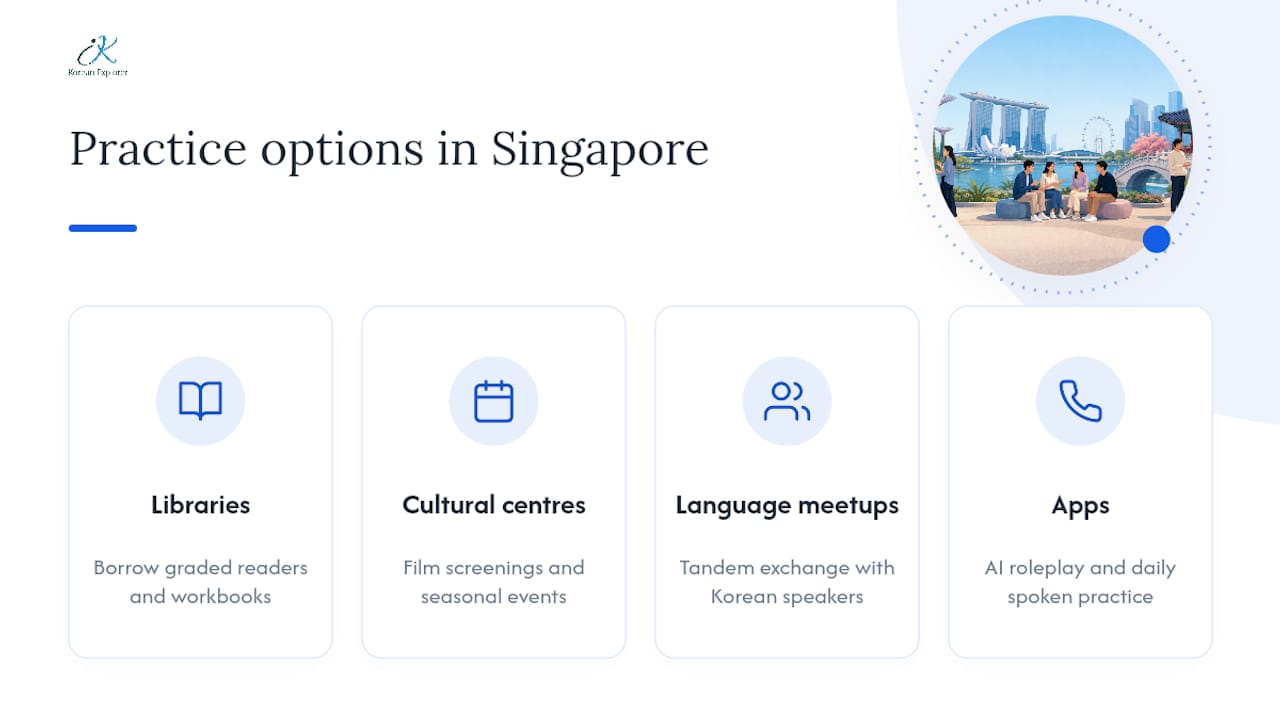
For additional reading or listening practice, check library catalogues and official learning resources. Confirm current access and borrowing conditions rather than assuming all materials are available without charge.
Cultural centers and organizations occasionally run Korean-language cultural programming, from film screenings to seasonal events, which gives you passive listening exposure even before you can follow a full conversation. Language exchange meetups, often organized informally through community groups or social apps, pair you with Korean speakers who want to practice English in return. These sessions rarely follow a curriculum, but they force you to use whatever vocabulary you already have under real conversational pressure, which is exactly the skill classroom drills can’t fully replicate.
Digital tools can provide optional rehearsal between lessons. Automated feedback is not an independent check of correctness; compare uncertain phrases with trusted materials or a teacher. You can review this conversation-practice tool and another practice option to see whether their current features suit a task you want to practise.
Choose a combination of resources that fits a specific task you want to practise. Review your attempts against suitable examples and feedback; enrolling in a course or using a particular tool does not by itself establish fluency.
What Cultural Immersion Options Exist in Singapore for Korean Learners?
Language and culture move together, and Singapore gives adult learners more immersion access than most people expect. Korean restaurants, cafes, and grocery stores concentrated in areas with a strong Korean community give you low-stakes chances to order, ask questions, and read menus in Korean without leaving the country.

Cultural events tied to Korean film, music, and food happen throughout the year, often organized by cultural associations or community groups, and they offer a reason to listen to native speech in a real setting rather than a classroom recording. Watching Korean variety shows or dramas with Korean subtitles, instead of English ones, turns passive entertainment into active listening practice once you’ve built enough vocabulary to catch fragments.
Some course providers build cultural context directly into lessons, covering etiquette, workplace hierarchy, and social norms alongside grammar, since a phrase that’s technically correct can still land wrong if you miss the cultural register behind it. That’s part of why a course with real cultural grounding beats pure vocabulary memorization: knowing when to use formal speech with a manager versus casual speech with a friend is a skill textbooks rarely teach well on their own.
As an optional activity, choose one expression from a drama, menu or cultural event, check its meaning and context, and compare it with a reliable example. Exposure alone does not establish retention or conversational proficiency.
The Overlooked Part of Learning Korean as an Adult
Most guidance on this topic obsesses over apps, grammar charts, and “hacks,” and almost none of it addresses the actual bottleneck: adult learners stall not from lack of vocabulary but from lack of low-stakes speaking reps. You can memorize five hundred words and still freeze the first time a native speaker asks you a real question, because recognition and production are different skills.
The conventional advice of “just practice daily” is practically useless without structure. One way to add structure is a simple self-check after each week: what task did I try (e.g. ordering in Korean, introducing myself)? What correction did I receive from my teacher or practice partner? What should I ask or try next? Keeping a short log helps you see actual progress rather than relying on a feeling.
Business Korean learners in particular benefit from courses that cover office register: meetings, emails, professional tone. A generic conversational course may not cover these. When comparing courses, ask about speaking time per student per session, not just the total class length or the price.
— Paul
Ready to Start Speaking Korean With Real Feedback?
Reading about course formats only gets you so far. Korean Explorer runs its programs specifically around the checklist covered above: native bilingual instructors, a multi-level curriculum, and class sizes small enough that you’re actually talking, not just listening.
Published package examples differ by format: physical Beginner 1 or Beginner 2 is S$350 each for 8 sessions of 2 hours; online group is S$480 for 8 sessions of 2 hours. The private online course page lists beginner packages at S$1,280 and elementary-through-business packages at S$1,480, each 16 teaching hours plus S$50 registration. TOPIK one-to-one preparation is S$1,480 for 8 sessions of 2 hours, plus S$50 registration and S$50 materials. Confirm the applicable package, calendar dates, availability and full fee before booking.
The published city address is 10 Anson Road, Level 22, International Plaza, Singapore 079903, above Tanjong Pagar MRT. Confirm the actual venue for your chosen batch or the joining details for live online study. Ask whether a trial class or observation is available and what it costs.
FAQ
How long does it realistically take to learn Korean?
There is no fixed learning period that applies to every learner. Choose a task, try it, compare it with a trusted model or teacher feedback, and record what you can do and what still needs practice. Completing teaching hours does not by itself establish conversational proficiency.
Can you learn Korean in 3 months?
You can use three months as a planning period, but it is not a guaranteed deadline for conversational ability. Define a specific task, such as introducing yourself or asking a simple question, and review your attempts with appropriate feedback.
What is the fastest way to learn Korean?
A structured course with regular live speaking practice, combined with daily self-study between sessions, generally produces more progress than either alone. Private lessons offer fully personalised feedback, while group classes provide peer interaction; the better choice depends on your learning style and budget.