The fastest way to improve your spoken Korean is short daily output paired with a repair-repeat loop: say something, get corrected on one target, repeat the fixed version three times. Do this now: record a 30-second voice message introducing yourself in Korean and send it to a partner or app for feedback. A daily short practice session, done consistently, produces steadier gains than occasional long study sessions.
TL;DR:
- Daily practice with short, targeted output and immediate correction significantly improves speaking ability, especially when combined with repetition of the fixed sentence.
- Focusing on fixing one specific mistake per session, such as sentence endings or batchim linking, accelerates mastery and prevents errors from recurring.
- Incorporating shadowing and voice messages helps develop rhythm, intonation, and listening comprehension without needing a live partner.
- A 10-minute routine emphasizing scenario-based speaking and correction is more effective than infrequent, lengthy study sessions.
- Combining solo drills, voice exchanges, and regular sessions with native instructors creates a comprehensive approach for steady fluency development.
Table of Contents
- Why Daily Speaking Practice Beats Passive Study
- Two Routines You Can Copy Today: 10 and 20 Minutes
- How Do You Practice Shadowing and Voice Messages?
- Which Korean Speaking Mistakes Should You Fix First?
- Which Tools Actually Give You Speaking Time?
- How Structured Classes Multiply Solo Practice
- How Do You Find a Korean Conversation Partner?
- Bringing Cultural Context Into Your Conversations
- How Should You Track Your Speaking Progress?
- How Can You Get Past Korean Speaking Anxiety?
- What the Research Actually Supports
- Ready to Turn Practice Into Real Conversation Skill?
- Sources
- FAQ
Why Daily Speaking Practice Beats Passive Study
Speaking forces your brain to retrieve words under pressure, not just recognize them. That retrieval effort is what separates people who can read Korean from people who can actually hold a conversation. Passive study, like watching dramas or reviewing flashcards, builds recognition. Production builds recall, and recall is what a real conversation demands.
The repair-repeat loop matters because correction without repetition rarely sticks. If a tutor fixes your sentence ending once and you move on, that error usually reappears the next session. Saying the corrected form aloud three or four times right after the correction locks it into muscle memory, the same way an athlete grooves a swing through repeated reps rather than a single verbal tip.
Several practice guides converge on this exact shape: produce, get corrected, repeat the corrected form aloud, then make it habitual. Low-pressure formats matter too. Learners speak more often, and more honestly, when the stakes feel small.
- Retrieval practice beats passive review for building usable speech.
- Correction sticks only when you repeat the fixed version immediately.
- Low-pressure formats (voice messages, solo drills) increase how often you actually speak.
A short, structured routine done daily produces consistent progress without a large time commitment, which is the real argument for showing up for ten minutes rather than saving it all for a weekend cram.
Two Routines You Can Copy Today: 10 and 20 Minutes
You do not need an hour to make progress. You need a structure you will actually repeat. Here is a 10-minute version for busy days and a 20-minute version for when you have more room.
The 10-minute routine:
- Pick one narrow scenario (ordering coffee, greeting a coworker, asking for the bathroom).
- Say two or three warm-up lines out loud, even alone, to get your mouth moving in Korean.
- Answer three short questions related to that scenario, speaking each one out loud.
- Choose exactly one mistake to fix. Don’t try to correct everything at once.
- Repeat the corrected sentence three times, slowly, then at normal speed.
- Save that one corrected line somewhere you’ll see it again tomorrow.
The 20-minute routine adds three layers on top of the 10-minute core: a short listening pass where you model a native clip before speaking, a variation round where you swap one word in your saved sentence to build flexibility, and a shadowing pass (covered below) followed by a two-minute mini role-play with yourself or a partner.
Good starter drills to build into either routine include polite ordering (“아메리카노 한 잔 주세요,” please give me one Americano), a 30-second self-introduction, and asking for directions using “어디예요?” (where is it?). Check that you’re using the polite ending consistently across all three. These small, repeatable scripts sit at the core of practical Korean speaking exercises that build toward longer conversations.
Pro Tip: Keep a running list titled “Lines I Can Actually Use.” Every time you fix a sentence, add it. Within a month you’ll have a personal phrasebook built entirely from your own mistakes, which sticks far better than a textbook list.
How Do You Practice Shadowing and Voice Messages?
Shadowing means listening to a short native clip and repeating it immediately, matching rhythm and intonation rather than just meaning. Pick clips between 30 seconds and two minutes, then run through them three to five times, speaking a half-beat behind the audio on the first pass and catching up by the last.
Self-recording works as a tighter, solo version of the same idea: speak for one minute on any topic, listen back once, write down exactly two things to fix, then re-record. Two fixes per round keeps the exercise from turning into a discouraging list of everything wrong.
Voice-message exchanges give you a native ear without scheduling a call. A simple opening script for your first three exchanges:
- Message one: a short self-introduction, then ask your partner to flag one pronunciation issue.
- Message two: describe your day in three sentences, then ask them to fix one grammar point.
- Message three: ask a question back and request they answer in Korean so you get listening reps too.
Live audio rooms and short-form voice posts (sometimes called “Moments” on language apps) work well for building the daily habit itself. Post something under a minute, most days, and treat any comments as free corrections rather than criticism.
Pro Tip: Don’t chase perfect audio clips for shadowing. A slightly noisy clip of natural speech trains your ear better than a slow, over-enunciated textbook recording.
Which Korean Speaking Mistakes Should You Fix First?
Trying to fix everything at once is the single biggest reason speaking practice stalls. Pick one target per session: speech level, a specific sentence ending, or a batchim (the consonant sound that closes a Korean syllable) that keeps tripping you up.
The repair routine stays the same regardless of target: hear or read the correct model, isolate just the sound or ending giving you trouble, repeat the corrected phrase three times out loud, then use it inside a full sentence so it doesn’t stay an isolated drill.
- Speech levels: mixing polite 요 endings with casual 어/아 endings mid-conversation confuses listeners about your relationship to them. Drill one level per practice session until it’s automatic.
- Sentence endings: the same idea can shift meaning entirely depending on ending. Say “먹어요” (I eat, polite) and “먹을까요?” (shall we eat?) back to back until the difference feels natural in your mouth.
- Batchim linking: a word like “먹었어요” (I ate) links its closing consonant into the next syllable when spoken quickly. Practice slow-to-fast passes on the same phrase until the linking happens without thinking.
Dedicated pronunciation drills built around these exact trouble spots tend to move the needle faster than general conversation practice, precisely because they isolate one problem at a time.
Which Tools Actually Give You Speaking Time?
Match the tool to what you actually need that week, not to whatever has the best reviews. Daily habit-building calls for something different than fixing a stubborn pronunciation error.
- Building a daily habit: short voice posts on a language exchange app, since the low stakes make it easy to show up even on tired days.
- Getting real correction: voice-message exchange apps or a partner who will actually flag mistakes rather than just being polite.
- Speaking faster under pressure: live audio rooms, which force real-time responses the way an actual conversation does.
- Practicing without embarrassment: AI conversation partners, useful for rehearsing before you try the same lines on a person.
When picking a platform, run through a short checklist: how specific is the feedback, is there a real native-speaker presence or mostly other learners, how much scheduling friction exists before you can actually talk, and what it costs. Live conversation platforms and dedicated listening-and-speaking apps both solve slightly different problems, so don’t expect one app to cover every need.
| Goal | Best-fit tool | What to check before starting |
|---|---|---|
| Build a daily habit | Voice-post/audio communities | Low pressure, easy to post in under a minute |
| Get corrected consistently | Voice-message exchange apps | Partner actually gives feedback, not just replies |
| Speak faster under pressure | Live audio rooms | Beginner-friendly rooms exist, not just advanced ones |
| Practice without judgment | AI conversation partners | Feels natural enough to transfer to real talk |
Our guide to Korean language apps breaks down specific options if you want a starting point today rather than researching for another week.
How Structured Classes Multiply Solo Practice
Solo drills build the habit, but a classroom or live online session adds something solo practice structurally cannot: a native instructor correcting you in real time, every session, on a schedule you can’t skip. That regularity compounds the same repair-repeat loop covered above, just with a person who catches errors you didn’t know you were making.
Group and private sessions taught by native Korean instructors give you scheduled speaking time, targeted correction, and often recorded class videos you can review the way you’d replay a self-recorded drill. For learners juggling work, online classes over Zoom remove the commute barrier without sacrificing live correction.
- Regular accountability: a set class time means you show up and speak even on days you’d otherwise skip solo practice.
- Faster error correction: a native instructor catches speech-level and batchim issues faster than self-review ever will.
- Workplace-relevant Korean: business and conversational courses focus on vocabulary and scenarios solo apps rarely cover.
The strongest combination is structural, not either-or: keep your 10-minute daily routine on non-class days, and let scheduled sessions handle the corrections that are hard to catch alone. Details on formats and class locations can help you decide whether group, private, or online fits your week better.
How Do You Find a Korean Conversation Partner?
The right partner depends on what stage you’re at. Complete beginners usually do better starting with a tutor or instructor who expects mistakes and corrects them without judgment. Once you can hold a basic exchange, a language exchange partner (someone learning your native language while you learn Korean) becomes genuinely useful, because the trade feels fair on both sides.
Language exchange apps are the most common starting point. Look for a partner whose stated goals match yours: someone practicing for travel wants different conversations than someone preparing for business Korean. Check activity level before committing. A profile that hasn’t posted in months usually means slow replies.
Tutors and instructors solve a different problem: consistency and correction quality. A language exchange partner might not know how to explain why a sentence is wrong, even if they know it sounds off. A trained instructor can name the exact grammar point and give you a drill for it. If your goal involves conversational or business Korean specifically, look for instructors with actual classroom experience rather than casual conversation partners alone, since business vocabulary and workplace speech levels rarely come up in casual exchange chats.
A few practical filters, once you’ve found a few candidates:
- Do they correct you, or just respond and move on?
- Is their schedule compatible with yours without constant renegotiation?
- Can they explain a grammar point in a sentence or two, not just fix it silently?
Mixing both, a tutor for structured correction and a peer partner for volume, tends to outperform relying on either one alone.
Bringing Cultural Context Into Your Conversations
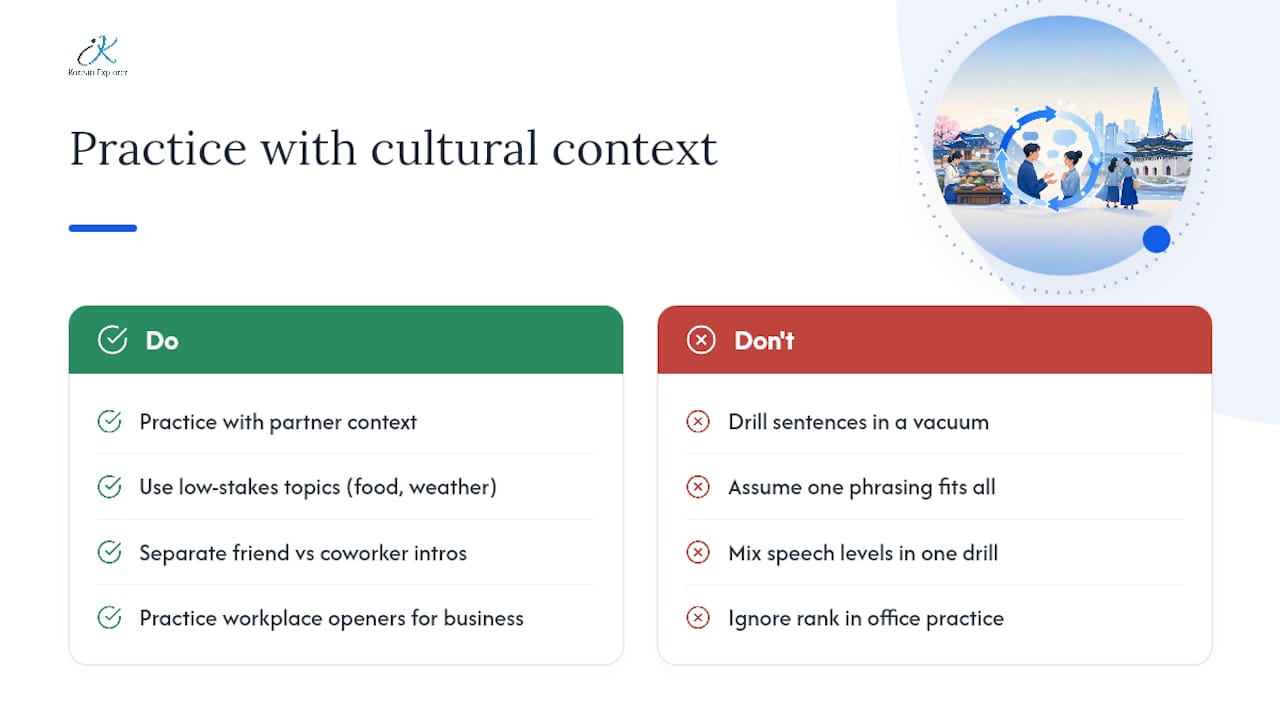
Korean conversation carries cultural rules that go beyond vocabulary. Speech level shifts depending on age, familiarity, and context, which means the “correct” sentence often depends on who you’re talking to, not just what you’re trying to say. Practicing scenarios with that context baked in, not just grammatically correct sentences in a vacuum, makes your speaking transfer better to real situations.
Common, low-stakes conversation topics give you a natural way to practice this. Talking about food is almost a cultural default in Korean small talk. Learning phrases like “같이 밥 먹을까요?” (shall we eat together?) or the common invitation “잘 먹었습니다” (said after a meal, roughly “I ate well”) gives you material that comes up constantly in real conversations, not just textbook drills.
Other reliably useful topics include weather, weekend plans, and workplace hierarchy small talk, since Korean office culture often opens conversations with rank-appropriate greetings before getting to business. If your goal is business Korean specifically, practicing these workplace openers matters as much as vocabulary drills.
Building this cultural layer into your routine of verbal exercises means your scenario bank should include not just “what to say” but “who you’re saying it to.” A self-introduction to a coworker and a self-introduction to a new friend genuinely use different endings, and practicing both separately avoids the confusion of trying to sort it out mid-conversation.
How Should You Track Your Speaking Progress?
Feedback only helps if you’re doing something with it. The single biggest mistake learners make is collecting corrections without ever revisiting them, which means the same mistake gets fixed over and over with no lasting change.
Keep a simple running log of corrected sentences, the same one suggested in the routines section above. Each entry should include the mistake, the fix, and the date. Reviewing that list weekly shows you patterns you’d never notice session to session, like consistently mixing up two similar-sounding endings.
Track frequency, not just accuracy. Counting how many days you spoke Korean out loud this week is a more honest progress signal early on than counting how many mistakes you made, since output volume is what most beginners actually lack. Once you’re speaking daily without much effort, shift the tracking toward accuracy on your chosen repair targets.
A few practical tracking habits:
- Log every corrected sentence with the date and the specific fix.
- Review that log once a week, not just when you make a new entry.
- Note which mistake types repeat across multiple sessions, that’s your next repair target.
- If you’re in classes, compare recorded sessions a month apart. Improvement is often clearer in a recording than it feels in the moment.
Progress in speaking is rarely a straight line. Some weeks feel stagnant even when you’re actually consolidating a grammar point that will click a few weeks later.
How Can You Get Past Korean Speaking Anxiety?
Speaking anxiety usually comes from a fear of sounding wrong in front of someone, and the honest fix is lowering the stakes until that fear stops being the loudest voice in the room. Talking to yourself out loud, a technique specifically recommended in official Korean language outreach, removes the audience entirely while still building the same speech muscles.
Asynchronous formats help too. Recording a voice message you can re-record before sending gives you a safety net live conversation doesn’t. That small buffer is often enough to get anxious learners speaking daily when live calls felt paralyzing.
Keeping voice posts short (around 30 seconds) also lowers the bar for showing up. A brief, imperfect recording that captures real spontaneous speech builds the habit faster than a longer, scripted one you agonize over, because it’s closer to how actual conversations feel: quick, unpolished, and forgiving of small mistakes.
Expect to sound imperfect for a while. That’s not a sign you’re doing it wrong. It’s a sign you’re producing enough output to actually improve.
What the Research Actually Supports
Most advice on learning Korean treats speaking practice as something you do after you’ve studied enough grammar and vocabulary. That order is backwards. Production is what turns passive knowledge into usable skill, and waiting until you feel “ready” to speak usually just delays the discomfort rather than avoiding it.
The conventional wisdom oversells app-only self-study and undersells structure. Apps and solo drills are genuinely good at building daily habit and giving you volume. What they’re weaker at is catching the specific, repeated errors that quietly become permanent, because most feedback is generic, not targeted to your actual patterns. That’s where a human instructor, whether a tutor or a class, earns its place, not as a replacement for daily practice, but as the layer that makes daily practice actually correct itself instead of drift.
If you take one thing from this, prioritize consistency over intensity. Ten honest minutes a day, with one repaired mistake, beats an occasional two-hour session every time. Pair that habit with periodic native correction, whether from a partner or an instructor, and the gap between “studying Korean” and “speaking Korean” closes faster than most learners expect.
— Paul
Ready to Turn Practice Into Real Conversation Skill?
Solo drills and voice-message exchanges build the habit, but they can’t replace a native instructor correcting you in real time, every session, on the exact mistakes you keep repeating. Conversation-focused adult Korean courses are available in group, private, or live online formats over Zoom, built around exactly the kind of daily speaking and targeted correction this article covers.
Classes come with recorded session videos, so you can review corrections the same way you’d replay a self-recorded drill, and native Korean instructors who explain the “why” behind a fix, not just the correction itself. Whether your goal is conversational fluency or business Korean for work, structured sessions handle the correction layer solo practice struggles to provide on its own. Our training center is located right above Tanjong Pagar MRT at 10 Anson Road, Level 22, International Plaza, Singapore 079903, easy to reach if you’d rather practice in person. Check current Korean course options and pick a class schedule that fits your week, then bring your daily 10-minute routine into the room with you.
Sources
- How to Practice Speaking Korean (even if you’re scared)
- How to Practice Speaking Korean Alone | Hanashi
- Korean Speaking Practice 2026: Methods That Get You Talking With Native Speakers – HelloTalk Blog
FAQ
How can I practice speaking Korean if I don’t have a partner yet?
Talk to yourself out loud using a scripted scenario, record a short voice message on a language app, or shadow a native audio clip immediately after listening to it. All three build speaking output without requiring a live partner.
How do Koreans say “let’s eat”?
A common way to say it is “같이 밥 먹을까요?” (shall we eat together?), and after finishing a meal, Koreans often say “잘 먹었습니다” as a polite closing phrase.
How do I improve my Korean speaking specifically, not just vocabulary?
Focus on daily spoken output rather than added vocabulary study, and use a repair-repeat loop: speak, get corrected on one target, then repeat the corrected sentence three times until it feels automatic.
How do you count 1 through 10 in Korean?
Korean has two counting systems. The native Korean numbers are 하나, 둘, 셋, 넷, 다섯, 여섯, 일곱, 여덟, 아홉, 열, and the Sino-Korean numbers are 일, 이, 삼, 사, 오, 육, 칠, 팔, 구, 십, used for different contexts like dates versus counting objects.
How much daily practice actually moves the needle?
A structured 10-minute routine done daily produces consistent progress, according to practical routine guides, and a 20-minute version that adds shadowing and role-play builds on that same core for faster gains.