Korean job applications require two separate documents: an 이력서 (structured resume) and a 자기소개서 (self-introduction essay). Foreign applicants need to include visa status and a passport-style photo sized to Korean standards. The single biggest technical step is to match the employer’s template exactly and submit in the file format the portal requests, usually .hwp or .docx.
TL;DR:
- Filling out the visa status and military service fields accurately, including “not applicable” where relevant, is crucial for passing automated screenings.
- Using the official Korean resume template and correct file format (.hwp or .docx) prevents rejection based on formatting errors.
- Listing education and work experience in reverse chronological order with explicit status labels and proper date formats enhances clarity for Korean HR staff.
- The 자기소개서 should address specific prompts with careful attention to formal language, spacing, and native proofreading to improve evaluation chances.
- Emphasizing a high TOPIK score with detailed certificate information can significantly improve competitiveness in Korean job applications.
Table of Contents
- What Is the Standard Korean Resume Format (이력서)?
- How Should Foreigners Fill Out the Personal Information Section?
- How Do You List Education and Work Experience Correctly?
- Why Does the Self-Introduction Essay Matter as Much as the Resume?
- What File Formats and Portal Habits Cause Applications to Get Rejected?
- What Should You Do Next to Strengthen Your Application?
- An Editorial Take on Korean Resume Formatting
- Sources
- FAQ
What Is the Standard Korean Resume Format (이력서)?
Korean recruiters read an 이력서 the way an accountant reads a balance sheet. They scan for facts, not personality. The layout is templated and table-like on purpose, because a hiring manager reviewing 200 applications needs to verify dates, degrees, and certifications in seconds, not minutes. That’s a different job than a Western resume, which sells a narrative. Treat the 이력서 as a verification document, not a pitch, and save the storytelling for the 자기소개서.
The canonical section order looks like this:
- Personal information (인적사항): name, photo, date of birth, contact details, address
- Education (학력): reverse chronological, with graduation status
- Work experience (경력): reverse chronological, employer and role details
- Certifications and licenses (자격증): name, issuing body, date obtained
- Skills (기술/능력): language ability, software, technical skills
- Awards or activities (수상/활동): optional, but useful for entry-level applicants
Three formatting rules matter more than they should. First, dates go in YYYY.MM format, not spelled out and not written as MM/DD/YYYY. Second, everything runs reverse chronological, most recent entry on top. Third, education and military entries carry status labels rather than plain dates: 졸업 (graduated), 재학 (currently enrolled), 휴학 (on leave), 중퇴 (withdrew without completing). Leaving a status label off an education entry is one of the fastest ways to make a resume look unfinished, even when the content is accurate.
University career centers frequently distribute official 이력서 templates and sample layouts, and starting from one of those is usually faster than building a layout from scratch.
How Should Foreigners Fill Out the Personal Information Section?
The 인적사항 block is where most foreign applications get filtered before a human ever reads them. Automated screening tools flag blank required fields, and a resume with a missing military service entry or an ambiguous name format often is rejected before review even starts.
A few fields deserve extra care:
- Photo: Korean resumes typically call for a passport-style photo at 35×45mm (3.5×4.5cm), plain background, professional attire. A passport-style photo, along with date of birth and military status, is close to universal on Korean templates, so budget for a proper photo session rather than a cropped selfie. If you don’t have one ready, hold a placeholder box but replace it before final submission.
- Name fields: list your legal name exactly as it appears on your passport, then add a Hangul transliteration if you can manage one accurately. This helps HR staff pronounce and file your name correctly, and it signals effort.
- Military service field: nearly every template includes this line, and leaving it blank looks like an oversight. Foreign nationals should write “해당 없음” (not applicable) rather than skip it, since blank military service fields are commonly caught by automated pre-screening before a recruiter even opens the file.
- Visa status: state your visa type, issue date, expiry date, and whether you’ll need sponsorship. This single field often decides whether HR moves your application forward at all, since it tells them immediately whether hiring you creates extra paperwork.
How Do You List Education and Work Experience Correctly?
Education and work history follow the same reverse chronological logic as the rest of the resume, but foreign degrees and job titles need a bit of translation work to land correctly.
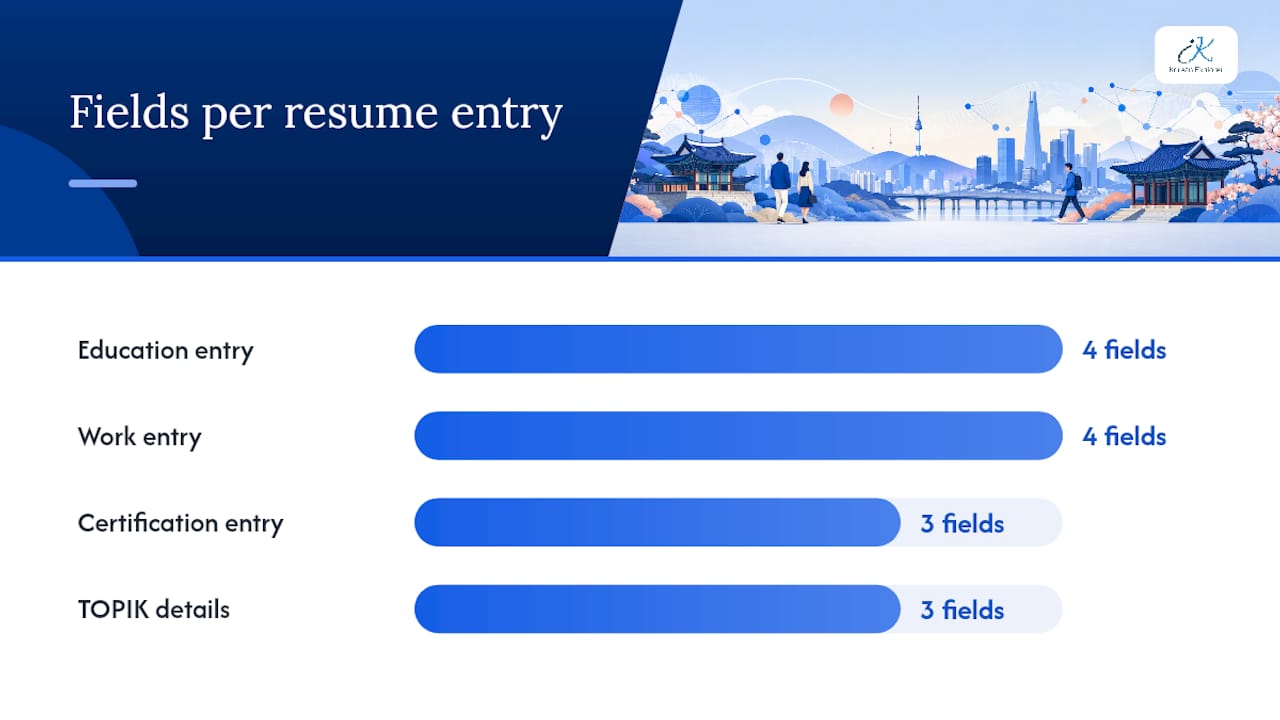
For education, list your most recent degree first, using YYYY.MM for start and end dates. State your status explicitly, even if it seems obvious: 졸업 for graduated, 재학 for currently enrolled. If your degree is from a university outside Korea, write the institution name in English, add a Hangul transliteration if you have one, and note the Korean degree equivalent (학사 for bachelor’s, 석사 for master’s, 박사 for doctorate) so a Korean reader can place it instantly.
Work entries need four things in order:
- Employer name, written clearly and consistently
- A Korean functional job title with your original English title in parentheses
- Employment period in YYYY.MM–YYYY.MM format
- A brief, factual description of your responsibilities, quantified only when the number is concise and verifiable
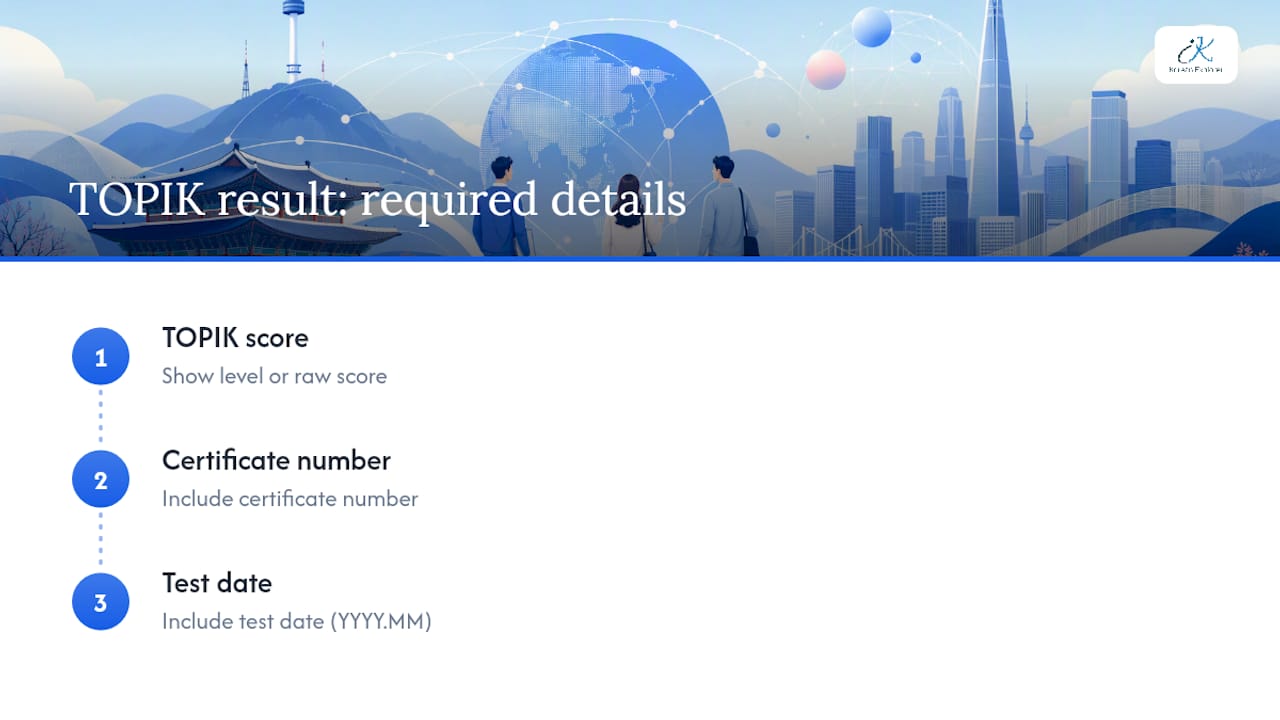
Certifications and language scores belong near the bottom of the 이력서. Reverse chronological order and explicit graduation status apply to certifications too. If you hold a TOPIK score, list the level, certificate number, and test date, since HR staff sometimes verify certificates directly against the registry.
Why Does the Self-Introduction Essay Matter as Much as the Resume?
The 자기소개서 is not a cover letter. A Western cover letter restates your resume in prose; a 자기소개서 answers specific prompts the company sets, and it’s graded almost like a short essay exam. Korean employers typically require both documents, and submitting only the 이력서 is one of the most common reasons foreign applications get rejected outright.
Most companies ask some version of these four prompts, often with limits between 500 and 1,000 Korean characters each:
- Growth background: how your upbringing or education shaped your values
- Strengths and weaknesses: a specific example, not a generic claim
- Motivation for applying: why this company, specifically, not just the industry
- Goals after joining: what you plan to contribute in the first one to three years
Register matters here more than most foreign applicants expect. Write in formal polite Korean (존댓말) throughout, and get the spacing (띄어쓰기) right, because sloppy spacing reads as careless regardless of content quality. A practical workflow: draft your ideas in English first to nail down the content, then translate carefully or hand it to a native speaker for proofreading. Register and spacing affect how essays are evaluated independently of the content itself, and a raw machine translation usually shows.
What File Formats and Portal Habits Cause Applications to Get Rejected?
Format mistakes sink otherwise strong applications constantly, and they’re avoidable.
- Use .hwp or .docx when a portal specifies one. Many Korean company portals only accept .hwp or .docx exports, and PDF is sometimes fine but not guaranteed, so check the posting before you assume.
- If the employer provides an application form (양식), fill that exact form. Using the supplied form matters more than resume polish, and uploading a free-form CV instead often gets deprioritized automatically.
- Watch for the usual filtering triggers: blank military or visa fields, wrong photo dimensions, exceeding the 자소서 character limit, inconsistent date formats, and missing certificate numbers for TOPIK scores.
Note that not every employer follows this format rigidly. Large multinational firms and some startups accept English-language CVs or treat the photo as optional, so checking the specific job posting before assuming Korean formatting rules apply saves wasted effort.
What Should You Do Next to Strengthen Your Application?
A strong 이력서 only gets you so far if the language behind it doesn’t hold up under scrutiny. A recognized TOPIK level materially improves how competitive a foreign candidate looks to Korean HR teams, and listing a score without a certificate number or test date can raise more questions than it answers, so check how to present TOPIK results with the right certificate details before you finalize that section.
Before committing to a study plan, it helps to know where you actually stand. Try Korean Explorer’s Korean placement test to get a clear read on your current level, then decide whether a short conversational course or more focused study makes sense.
Pro Tip: Before you submit anything, get a native Korean speaker to read your 자기소개서 out loud. Awkward spacing and stiff phrasing jump out instantly when read aloud, even to someone who isn’t a professional editor.
An Editorial Take on Korean Resume Formatting
Most advice on this topic treats the Korean resume format like a design problem: get the layout right, pick the correct photo size, and the rest follows. That’s backward. The format is easy to copy. What actually separates applications that get read from ones that get filtered is whether the applicant treated the visa status field and the military service line as seriously as the education section.
Recruiters aren’t scanning for polish first. They’re scanning for friction. A blank visa field or an omitted “해당 없음” tells an overworked HR screener that this application will need extra handling, and extra handling is exactly what gets deprioritized in a pile of 150 resumes. The self-introduction essay gets more attention in most guides than it deserves relative to the resume’s factual fields, because a beautifully written 자기소개서 attached to an incomplete 이력서 never gets opened in the first place.
If you’re a foreign applicant with limited time, fix the boring fields first: visa status, military service line, photo dimensions, date formats, and consider getting brutally honest AI resume feedback to improve clarity and scannability. Polish the essay second. The order most people apply effort in is the reverse of what actually clears the first screening.
— Paul
Sources
- How to write a Korean resume | Seoulstart
- Resume guide south korea | SIRA
- Korean Resume Sample & Guideline | SUNY Korea
FAQ
Do Foreigners Need to Include a Photo on a Korean Resume?
Most Korean employers still expect a passport-style photo sized to Korean standards, though some multinational firms and startups treat it as optional, so check the specific job posting first.
What Does 해당 없음 Mean on a Korean Resume?
It means “not applicable” and is what foreign nationals should write in the military service field instead of leaving it blank, since blank fields often get caught by automated screening.
Is a 자기소개서 the Same as a Cover Letter?
No. A 자기소개서 answers specific company prompts, often 500 to 1,000 Korean characters each, covering growth background, strengths and weaknesses, motivation, and post-hire goals, while a Western cover letter simply restates the resume in prose.
Should I Submit My Korean Resume as a PDF?
Use .hwp or .docx whenever the job portal specifies a format, since PDF acceptance varies by employer, and confirm the requirement on the individual posting before submitting.
How Should I List a TOPIK Score on a Korean Resume?
Include the level, certificate number, and test date, since HR staff sometimes verify certificates directly, and a higher level generally strengthens a foreign candidate’s competitiveness at Korean firms.