The top Korean pronunciation mistakes are predictable and fixable. Most come down to several repeatable errors that give non-native speakers away immediately. Here they are, with a one-line fix for each:
- Three-way consonant contrast (ㄱ/ㅋ/ㄲ): You’re treating them like voiced/voiceless pairs. Fix: drill aspiration vs. tension separately — hold a tissue in front of your mouth and feel the air difference.
- ㅓ vs. ㅗ confusion: Both sound “oh-ish” to English ears. Fix: round your lips fully for ㅗ; for ㅓ, keep them relaxed and open.
- Releasing final consonants (batchim): English speakers pop the final ㄱ in 국, making it sound like “kook.” Fix: stop the sound, hold it, release nothing.
- Skipping or mispronouncing ㅢ: This vowel shifts depending on position. Fix: learn its three pronunciations (/ui/, /e/, /i/) by position before drilling it.
- ㄹ substitution: Swapping in an English r or l. Fix: touch the tip of your tongue lightly to the ridge behind your upper teeth — it’s a flap, not a full r or l.
- Adding English vowels to consonants: Saying “beu” for ㅂ or “geu” for ㄱ. Fix: practice consonants in syllable blocks only, never in isolation with a vowel attached.
- English-style /h/ for ㅎ: English /h/ is too breathy. Fix: soften it — ㅎ is lighter and almost disappears between vowels.
- Incorrect liaison: Reading syllable by syllable instead of linking. Fix: when a syllable ends in a consonant and the next starts with ㅇ, the consonant moves forward — 음악 sounds like [으막], not [음악].
Check which of these match your own speech. Two or three will stand out immediately.
Key Takeaways
Fixing Korean pronunciation mistakes requires identifying your specific errors first, then drilling the phonological contrasts that cause them with a structured weekly plan.
| Point | Details |
|---|---|
| Eight common errors | Three-way consonant contrast, batchim release, vowel confusion, and liaison are the most frequent mistakes. |
| Seven final consonants | Korean allows only ㄱ, ㄴ, ㄷ, ㄹ, ㅁ, ㅂ, ㅇ in final position; all others neutralize to one of these. |
| Five phonological processes | Liaison, nasalization, tensification, aspiration, and palatalization explain most writing-to-speech mismatches. |
| 4-week practice plan | Three to five sessions per week, 10–25 minutes each, with progressive focus from ear training to mixed conversation. |
| Korean Explorer | Private, group, and online courses with native instructors provide the targeted feedback self-study can’t replicate. |
Table of Contents
- Why spoken Korean sounds so different from the written block
- What are the five phonological processes causing most errors?
- How do you drill consonants, vowels, and batchim effectively?
- What does a 4-week pronunciation practice plan look like?
- When does personalized feedback actually make a difference?
- Why adults struggle more than they expect to
- Korean Explorer’s pronunciation coaching for adult learners
- Sources
- FAQ
Why spoken Korean sounds so different from the written block
Hangul looks phonetic, and it is — but only at the level of individual syllables. The moment you string syllables together in natural speech, a set of predictable rules reshapes the sounds. Relying on the written block alone is one of the most common challenges when learning Korean, and understanding why it happens is the fastest way past it.
Standard Korean allows only seven final consonant sounds: ㄱ, ㄴ, ㄷ, ㄹ, ㅁ, ㅂ, and ㅇ. Every other consonant that appears in final position collapses into one of these seven. So ㅅ, ㅆ, ㅈ, ㅊ, ㅌ, and ㅎ all neutralize to the ㄷ sound at the end of a syllable. That alone explains why reading aloud block by block produces the wrong sounds.
Then there’s re-syllabification. When a syllable ending in a consonant is followed by one beginning with ㅇ (a placeholder vowel), the final consonant moves forward and becomes the onset of the next syllable. Written 음악 becomes spoken [으막]. Written 한국어 becomes [한구거]. The words look nothing like they sound.
- Written: 음악 → Spoken: [으막]
- Written: 한국어 → Spoken: [한구거]
- Written: 같이 → Spoken: [가치] (palatalization)
- Written: 십만 → Spoken: [심만] (nasal assimilation)
Pro Tip: Train your ear before you train your mouth. Shadow native audio of a sentence three times before you attempt to produce it yourself. Trying to fix mouth mechanics before your ear knows what “correct” sounds like slows everything down.
What are the five phonological processes causing most errors?
These five processes, identified across Korean phonology resources, explain the bulk of what makes spoken Korean sound different from written Korean to a learner’s ear.
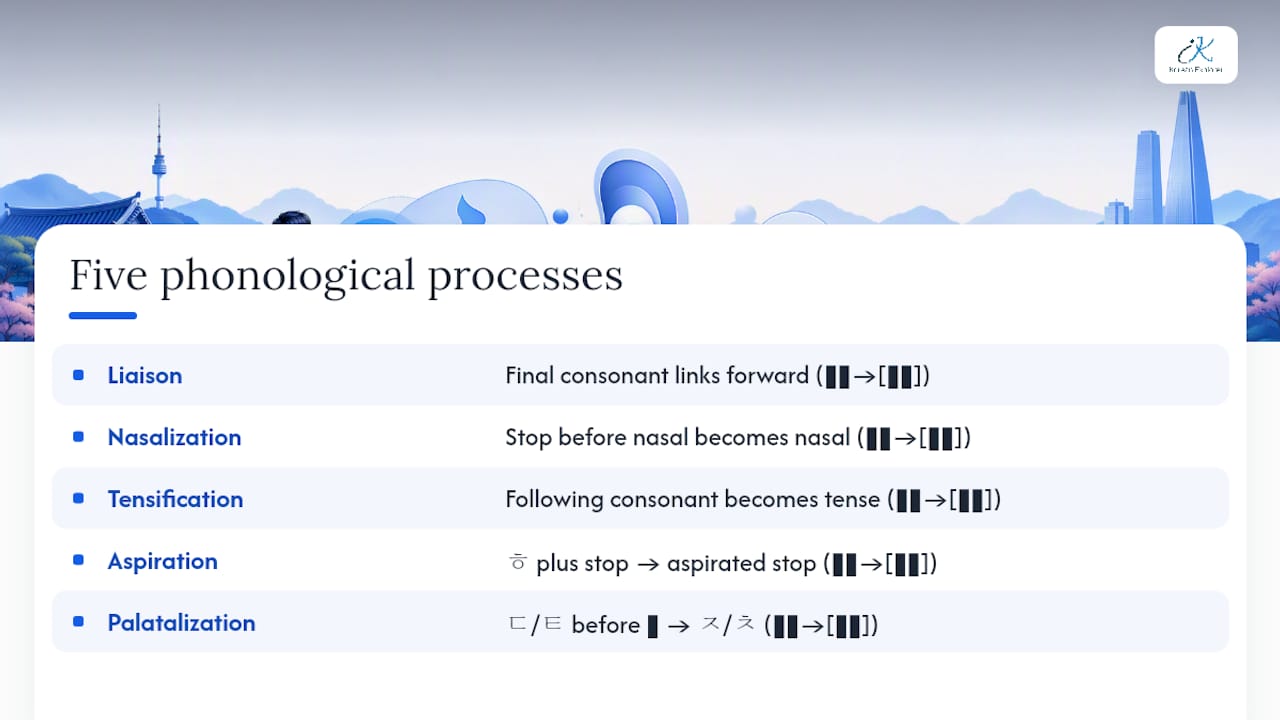
1. Liaison (연음화 — linking)
When a syllable-final consonant precedes a syllable beginning with ㅇ, the consonant shifts forward. 음악 → [으막]. The batchim liaison rules can chain across multiple syllables, which is why a short phrase can sound completely unrecognizable. Drill: say 음악이에요 slowly, then speed up until the linking feels automatic.
2. Nasalization
A stop consonant (ㄱ, ㄷ, ㅂ) before a nasal (ㄴ, ㅁ) becomes nasal itself. 십만 → [심만]; 국민 → [궁민]. Listening target: the ㄱ in 국 disappears into an ㅇ sound before ㅁ. Drill: minimal pair — 국물 [궁물] vs. 국밥 [국빱] — say each five times, focusing on the nasal shift.
3. Tensification
A plain consonant following certain final consonants becomes tense (doubled). 학교 → [학꾜]; 식당 → [식땅]. Tense consonants are shorter and tighter — adding air turns them into aspirated sounds instead, which changes the word entirely. Drill: say 학교 and feel that the ㄱ in 꾜 has no puff of air.
4. Aspiration
When ㅎ meets a stop consonant (or vice versa), they merge into an aspirated consonant. 북한 → [부칸]; 좋다 → [조타]. Listening target: the ㅎ vanishes and the adjacent consonant gains a strong breath. Drill: contrast 북한 [부칸] with 부간 — the aspiration is the only difference.
5. Palatalization
ㄷ or ㅌ before 이 becomes ㅈ or ㅊ. 같이 → [가치]; 굳이 → [구지]. Listening target: any word ending in ㄷ followed by 이 will sound like a ㅈ or ㅊ. Drill: say 같이 ten times until [가치] feels natural, then contrast with 가지 (branch) to hear the difference.
How do you drill consonants, vowels, and batchim effectively?
The fastest gains come from focused daily work on 2–3 targeted contrasts rather than trying to fix everything at once. Minimal pairs are the most efficient tool for this because they isolate the single contrast that changes meaning.
Three-way consonant contrast drills
| Mistake | Example words | Production cue |
|---|---|---|
| ㄱ vs. ㅋ vs. ㄲ | 가다 / 카드 / 까다 | ㄱ: no air; ㅋ: strong puff; ㄲ: tense, no air |
| ㅂ vs. ㅍ vs. ㅃ | 바다 / 파다 / 빠다 | Same air pattern as above |
| ㄷ vs. ㅌ vs. ㄸ | 다리 / 타다 / 딸기 | ㄸ: tongue pressed harder, no release air |
Vowel contrast drills
The vowel pairs that trip learners most are ㅓ vs. ㅗ, ㅡ vs. ㅜ, and ㅐ vs. ㅔ.
- ㅓ vs. ㅗ: Stand in front of a mirror. For ㅗ, round your lips into a tight circle. For ㅓ, drop your jaw slightly and relax the lip rounding. Practice: 버 / 보, 먹다 / 목.
- ㅡ vs. ㅜ: ㅜ requires rounded lips; ㅡ is flat and unrounded. Practice: 그 / 구, 으 / 우.
- ㅐ vs. ㅔ: These have merged in most modern Seoul speech, but in formal or exam contexts the distinction matters. Practice them as near-identical and focus on surrounding consonants for context.
Batchim (final consonant) drills
- Say 국 and stop completely before any air escapes — the ㄱ is held, not released.
- Hold the position for one second, then move to the next syllable.
- Practice stop-hold sequences: 먹, 박, 낙 — each one a held stop with zero release.
- Record yourself and compare to a native speaker’s audio. Released batchim sounds noticeably “popped” on playback.
Pro Tip: Use Korean tongue twisters for palatalization and tensification practice — they force rapid consonant transitions that expose exactly where your motor memory breaks down.
What does a 4-week pronunciation practice plan look like?
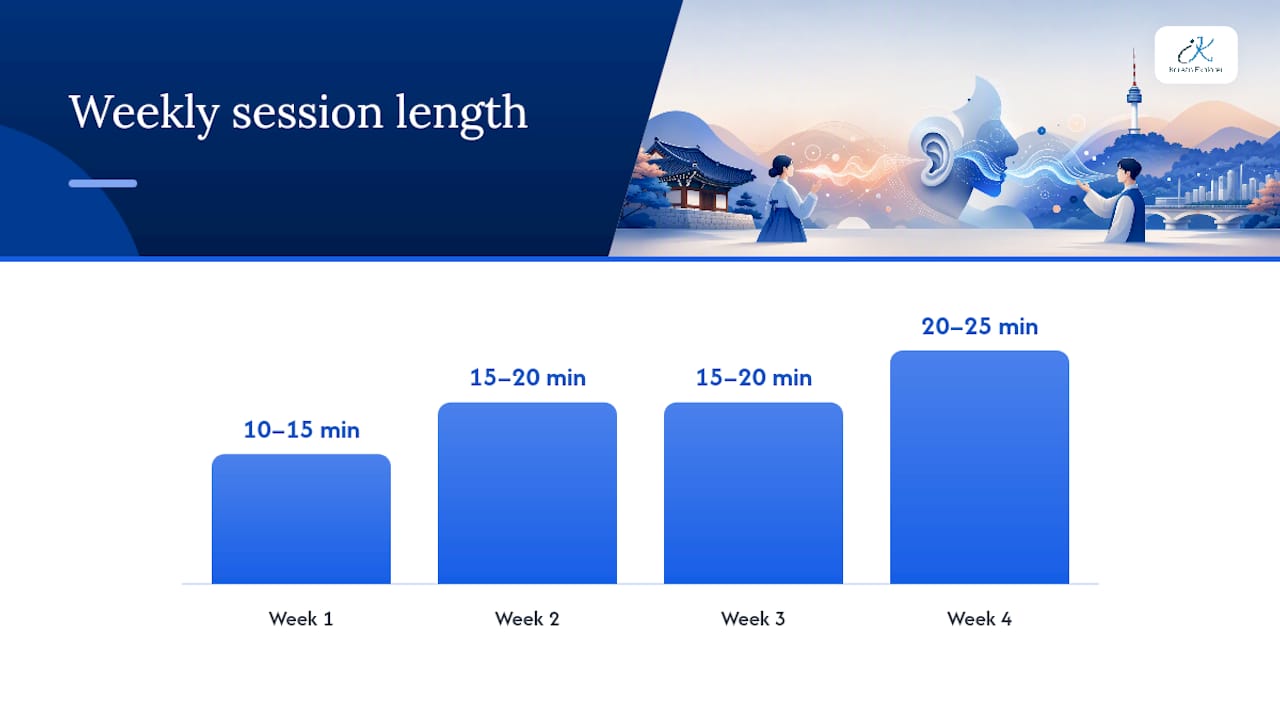
Follow this routine at 3–5 sessions per week, 10–25 minutes each, and you’ll hear measurable improvement in both production and listening comprehension by week four.
Week 1: Ear training and consonant contrast (10–15 min/session)
- Warm-up: listen to 2 minutes of native Korean audio (drama, podcast) without reading.
- Shadowing: pick one sentence, shadow it three times matching rhythm and linking.
- Three-way consonant drill: 5 minutes on one contrast pair (ㄱ/ㅋ/ㄲ).
- Record yourself saying five target words. Play back and compare.
Week 2: Vowel contrasts and batchim (15–20 min/session)
- Warm-up: shadow one short dialogue.
- Mirror drill: ㅓ vs. ㅗ for 3 minutes, watching lip shape.
- Batchim stop-hold drill: 10 words with final ㄱ, ㅂ, ㄷ.
- Record and note which batchim you’re still releasing.
Week 3: Linking and fluency (15–20 min/session)
- Warm-up: read a short paragraph aloud, then shadow the native version.
- Liaison focus: practice 연음화 across 5 phrase pairs (written vs. spoken).
- Nasalization and tensification: drill 학교, 식당, 국민 until the sound changes feel automatic.
- Record a short monologue (30 seconds). Listen for choppy syllable breaks.
Week 4: Mixed practice and simulated conversation (20–25 min/session)
- Warm-up: shadow a 1-minute native audio clip.
- Mixed minimal-pair drill: pull from all three categories (consonants, vowels, batchim).
- Simulate a short conversation or business exchange — record it.
- Self-assessment checklist review (below).
Self-assessment checklist — bring your top 3 to a tutor:
- [ ] I still release final consonants (batchim)
- [ ] I confuse ㅓ and ㅗ in natural speech
- [ ] Liaison sounds unnatural or choppy
- [ ] I’m using English /h/ instead of Korean ㅎ
- [ ] My three-way consonant contrast is inconsistent
When does personalized feedback actually make a difference?
Self-practice has a ceiling. Seek personalized feedback when you can’t reliably hear your own errors, or when progress stalls after 2–4 weeks of focused drilling. The problem is that your brain fills in what it expects to hear — a native instructor catches what you can’t.
Concrete benefits of native-instructor feedback include:
- Accurate tensification diagnosis: most learners can’t feel the difference between a tense and aspirated consonant until someone demonstrates it in real time.
- Vowel quality correction: ㅓ vs. ㅗ errors are subtle on a recording but obvious to a trained ear.
- Immediate corrective cues: a tutor can adjust your tongue placement or lip rounding on the spot.
- Progress accountability: weekly recording reviews with a tutor surface persistent errors that self-review misses.
For adult learners, the format matters. Small-group classes work well for listening exposure and peer comparison. Private sessions are faster for targeted error correction. Online classes via Zoom suit busy professionals who can’t commit to a fixed location. Corporate training formats address the specific pronunciation demands of business Korean, where mispronouncing a formal register word carries real professional weight.
Korean Explorer’s courses are built on a Seoul National University-aligned curriculum, taught by native Korean instructors who are also fluent in English. That bilingual fluency matters: an instructor who can explain why 학교 becomes [학꾜] in English, not just demonstrate it, cuts the learning curve significantly. You can find tips on making your Korean sound more native on the Korean Explorer blog.
Why adults struggle more than they expect to
Adults learning Korean tend to over-rely on Hangul as a visual anchor. They read the block, they produce the block, and may be surprised when a native speaker doesn’t recognize the word. The issue isn’t effort — it’s sequence. Reading comes before listening, which is backwards.
The fix that works fastest in a classroom setting: take a sentence the student has been mispronouncing, play the native audio without showing the text, and ask them to shadow it three times. Then show the text. The gap between what they expected and what they heard is usually the exact error they’ve been making for weeks. One student who had been saying 같이 as [같이] (block by block) heard [가치] for the first time and corrected it in a single session. The ear just needed the input.
For busy professionals, the most practical micro-habit is a 5-minute commute drill: pick one phonological process per week, find three example words, and shadow them on repeat. Pair that with a weekly 10-minute recording review with a tutor, and you have a feedback loop that actually closes.
Pro Tip: For accent improvement on a tight schedule, three focused accent tips practiced consistently beat an hour of unfocused study every time.
Korean Explorer’s pronunciation coaching for adult learners
Korean Explorer offers pronunciation-focused instruction in small-group, private, and online formats, all designed for adult learners working toward conversational fluency, business Korean, or exam preparation.
Private 1:1 sessions are the fastest route for targeted error correction — a native instructor diagnoses your specific consonant and vowel errors in the first session and builds corrective drills around them. Intermediate group courses include dedicated pronunciation modules covering the five phonological processes. Online Zoom classes deliver the same native-instructor feedback for learners who prefer remote study. Corporate training programs address the pronunciation demands of professional Korean, from formal speech registers to business meeting contexts.
Korean Explorer is located at 10 Anson Road, Level 22, International Plaza, Singapore 079903, right above Tanjong Pagar MRT. To get started, browse available Korean courses or book a private Korean class for one-on-one pronunciation coaching.
Sources
- My Korean 1 — Unit 02 (audio enabled) — Talking to Koreans
- Korean Pronunciation Mistakes English Speakers Make | Kaiwa Blog
- Why You Can Read Korean but Can’t Understand It | Conversa Blog
- Korean Pronunciation Guide (2026): Speak Clearly
- Korean minimal pairs – master pronunciation and listening
FAQ
What are the most common Korean pronunciation mistakes for English speakers?
The eight most frequent errors are: missing the three-way consonant contrast, confusing ㅓ and ㅗ, releasing final consonants (batchim), mispronouncing ㅢ, substituting English r/l for ㄹ, adding English vowels to consonants, using an English-style /h/ for ㅎ, and incorrect liaison.
Why does spoken Korean sound so different from written Hangul?
Five phonological processes reshape sounds in natural speech: liaison, nasalization, tensification, aspiration, and palatalization. Korean also allows only seven final consonant sounds, so many written consonants neutralize in speech.
How long does it take to fix Korean pronunciation mistakes?
With 3–5 focused sessions per week of 10–25 minutes each, most learners notice measurable improvement in both production and listening comprehension within four weeks of targeted drilling.
When should I get a native instructor instead of practicing alone?
Seek personalized feedback when you can’t reliably hear your own errors or when progress stalls after 2–4 weeks of self-practice. A native instructor diagnoses tensification and vowel quality errors that recordings alone won’t reveal.
Does Korean Explorer offer pronunciation-focused classes for adults?
Yes. Korean Explorer offers private 1:1 corrective sessions, pronunciation modules in intermediate group courses, and online Zoom classes, all taught by native Korean instructors fluent in English. View course options here.