Accurate Korean pronunciation is learnable, and the fastest path runs through Hangul, not romanization. Start by learning the actual sound values behind each letter, then drill the three consonant types (plain, aspirated, tense) alongside the ㅓ, ㅗ, and ㅡ vowels using native audio. Get those two things right and most other pronunciation problems start correcting themselves.
TL;DR:
- Learning Hangul and native audio is essential for mastering Korean pronunciation, as romanization often provides misleading cues about sounds.
- Proper distinction between plain, aspirated, and tense consonants requires exaggerating air release and tension to develop accurate muscle memory.
- Short, flat vowels like ㅓ, ㅗ, and ㅡ must be practiced slowly and held steady to avoid natural English diphthong glides.
- Connected speech patterns such as liaison, nasalization, and assimilation occur frequently and must be trained through shadowing native audio at increasing speeds.
- Regular recording and instructor feedback accelerate correction of subtle errors in vowel length, consonant tension, and connected speech, making self-guided practice more effective.
Table of Contents
- How Hangul Maps to Sounds (and Why Romanization Misleads You)
- Producing Plain, Aspirated, and Tense Consonants
- Mastering ㅓ, ㅗ, and ㅡ: The Vowels English Speakers Get Wrong
- Batchim and the Sound-Change Rules That Reshape Syllables
- Connected Speech: How Korean Words Change When Spoken Together
- Daily Practice Routines and How to Check Your Progress
- Common Mistakes and Two-Minute Fixes
- Pitch Accent and Intonation Patterns in Korean
- Pronunciation Differences Between Dialects
- A Teaching Perspective on Realistic Progress
- Where Guided Feedback Speeds Things Up
- Sources
- FAQ
How Hangul Maps to Sounds (and Why Romanization Misleads You)
Every Korean syllable block follows the same architecture: an initial consonant, a medial vowel, and an optional final consonant, stacked into one visual unit. That structure isn’t decorative. It changes how a consonant sounds depending on where it sits in the block, which is exactly why reading Korean through English letters causes so much trouble.
Take the letter ㄱ. Romanized as “g” or “k” depending on the source, it actually shifts between a soft, almost unaspirated “g” sound at the start of a word and a slightly harder sound elsewhere, with no consistent English letter that captures it. Romanization forces a choice, and that choice is often wrong for the context. Hangul itself never asks you to choose. It gives you one symbol and one set of contextual rules, which is a big part of why the system is considered phonetic and learnable in a way that romanization actively obscures.
Here’s the corrective rule worth memorizing early: treat every Romanized spelling you see as a rough sketch, never the final answer. The Hangul letter is the source of truth; the Roman letters are a guess made for people who can’t read Hangul yet.
A few sound-mapping habits worth building from day one:
- Read the syllable block as a unit, not as separate letters stacked randomly.
- Say the sound out loud immediately after reading it, before checking any romanized version.
- Notice how the same consonant sounds different at the start of a word versus between vowels.
- Never let an English “equivalent” letter override what you hear in native audio.
Try this now: pull up three simple syllable blocks, such as 가, 나, and 다, and listen to a native recording of each. Compare what you hear against the romanization you’d expect (“ga,” “na,” “da”). You’ll likely notice the vowels are shorter and cleaner than the English versions suggest, and that’s the first ear adjustment most learners need to make. Repeat with three more blocks daily for a week and the gap between what you read and what you hear starts closing fast.
Producing Plain, Aspirated, and Tense Consonants
This is the single biggest pronunciation hurdle for English speakers, because English doesn’t organize its consonants this way. Korean splits consonants like ㄱ, ㅋ, and ㄲ into three distinct categories: plain, aspirated, and tense. Aspirated consonants (ㅋ, ㅌ, ㅊ, ㅍ) come out with a strong burst of air, while tense consonants (ㄲ, ㄸ, ㅉ, ㅆ, ㅃ) are produced with tighter, stiffer vocal tract tension and almost no air release at all, according to a detailed breakdown of Korean’s essential pronunciation rules.
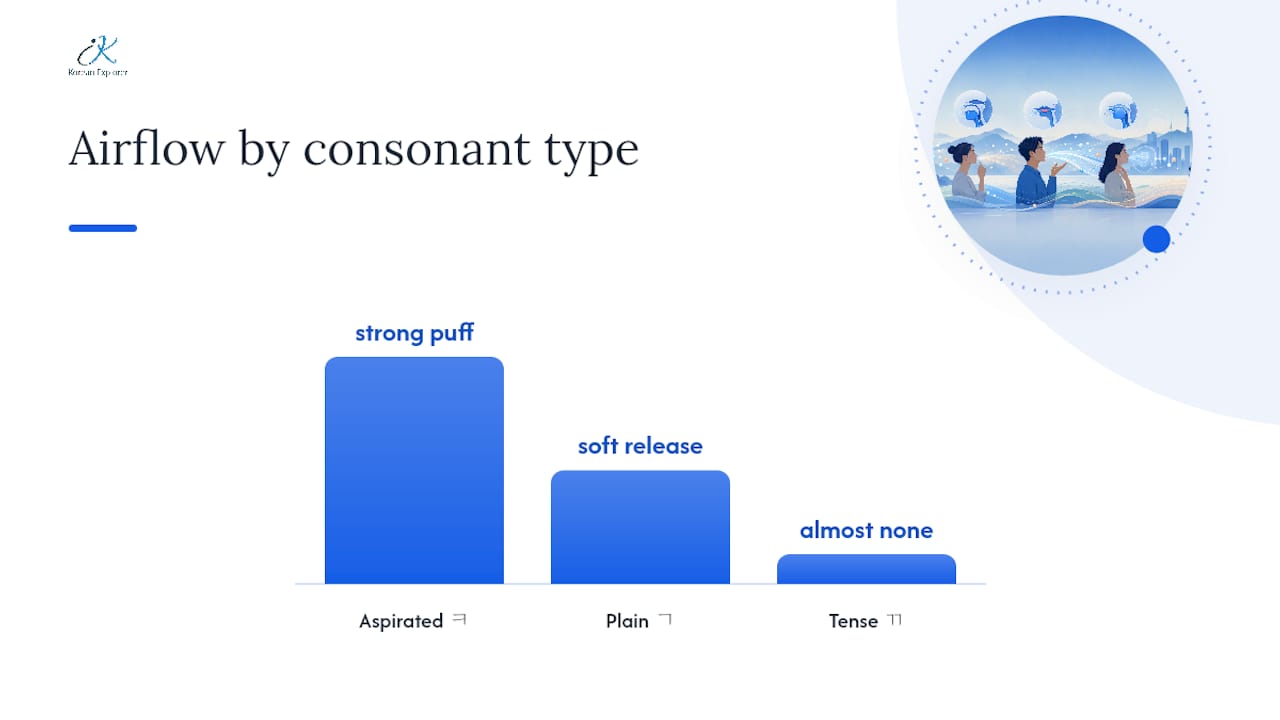
Plain consonants sit in the middle. They’re softer than the aspirated version but looser than the tense one, closer to what English speakers default to naturally.
Here’s how to actually feel the difference:
- Hold your hand an inch from your mouth and say “카” (aspirated). You should feel a clear puff of air hit your palm.
- Say “까” (tense) the same way. If you feel air, you’re doing it wrong. Tense consonants should produce almost none.
- Say “가” (plain) last. It should land somewhere between the two, with a soft, quick release.
- Repeat the sequence 가, 카, 까 five times, exaggerating the air difference until it feels automatic.
The tense sound is the hardest for English speakers because it requires coordinating your diaphragm, tongue, and glottis in a way English never asks for. Isolating the glottal tension specifically, almost like the catch in your throat before a cough, speeds up how fast that coordination becomes automatic.
Two minimal-pair drills to run daily:
- 불 (fire) vs 뿔 (horn): say both ten times, alternating, and record yourself.
- 달 (moon) vs 딸 (daughter): same drill, then play both recordings back and check which pair sounds identical. If they do, you’re collapsing the contrast.
Pro Tip: Learners who skip straight to sentences before nailing the tense/aspirated split usually bake the confusion into their accent permanently. Spend two focused weeks on minimal pairs before moving to full conversation drills, and the fix sticks far better than trying to correct it later.
Prioritizing contrastive pairs that actually change meaning, like 서 versus 소, or 가다 versus 까다, gives you far more return than drilling random syllables. A small, well-chosen set of minimal pairs does more for your accent than hours of unfocused listening.
Mastering ㅓ, ㅗ, and ㅡ: The Vowels English Speakers Get Wrong
English speakers glide almost every vowel into a diphthong without realizing it. Say the word “go” slowly and you’ll hear it curl from “oh” into something closer to “ow.” Korean vowels don’t do that. They’re short, flat, and held at one consistent mouth position for their entire duration, which is exactly why ㅗ sounds clipped and unfamiliar the first hundred times you hear it.
Three vowels cause the most trouble:
- ㅓ: Round your lips slightly less than for ㅗ, and drop your jaw a bit more. It sits between the English “uh” in “duh” and the “aw” in “law,” but shorter and flatter than either.
- ㅗ: Round your lips fully and keep the sound pure, resisting any urge to glide it toward “oh” or “ow.” Think of a clipped, held “o” with zero drift.
- ㅡ: Keep your lips completely flat and unrounded, almost smiling slightly, while pushing the sound from the back of your throat. There’s no real English equivalent, which is exactly why it needs isolated practice.
The fix isn’t complicated, but it does require slowing down. Start by holding each vowel for a full two seconds without letting your mouth shift position. Once you can hold it flat, practice minimal pairs that isolate the contrast: 어 versus 오, then 어 versus 으. Say each pair slowly five times, then speed up gradually until you can say them at natural conversational tempo without your mouth reverting to the English glide.
Recording yourself here matters more than almost anywhere else in pronunciation practice, because vowel drift is nearly impossible to hear in your own head while you’re speaking. Play it back immediately and listen specifically for any curl at the end of the vowel sound.
Batchim and the Sound-Change Rules That Reshape Syllables
Korean writes 27 different final consonants in the batchim (받침) position, but only seven distinct sounds actually come out at the end of a syllable, regardless of which letter is written there. That single fact explains most of the confusion learners feel when a word looks complicated on paper but sounds simple out loud.
The seven landing sounds are: ㄱ, ㄴ, ㄷ, ㄹ, ㅁ, ㅂ, and ㅇ. Letters like ㅋ, ㄲ, and ㅍ all collapse into one of these seven when they appear in final position, usually as unreleased stops with no burst of air at all.
Two sound-change rules explain almost everything else you’ll hear in connected speech:
- Liaison (연음): when a syllable ending in a consonant is followed by a syllable starting with ㅇ, the final consonant slides forward and becomes the initial sound of the next syllable. 한국어 (Korean language) becomes something closer to “han gu gaw” rather than three separate blocks.
- Nasalization: stop consonants (ㅂ, ㄷ, ㄱ) turn into nasal sounds (ㅁ, ㄴ, ㅇ) when they land next to a nasal consonant. 입니다 (a common sentence ending) comes out as “im-ni-da,” not “ip-ni-da,” because the ㅂ shifts to ㅁ before the nasal ㄴ.
Practice both with short sentence drills. Say “한국어 배워요” (I’m learning Korean) slowly, then speed it up while listening for the liaison sliding the final consonant forward. Then try “처음입니다” (it’s the first time) and listen for the nasalized shift at 입니다. A useful drill for internalizing liaison specifically is treating the final consonant as unreleased and practicing the transition into the next vowel as one motion rather than two separate sounds.
Connected Speech: How Korean Words Change When Spoken Together
Isolated syllables rarely sound the way they do inside a real sentence, and three more assimilation patterns explain most of that gap.
Palatalization turns ㄷ and ㅌ into ㅈ and ㅊ sounds when they’re immediately followed by ㅣ. 굳이 (deliberately) shifts from a hard “d” sound to something closer to “j,” which trips up almost every learner the first time they hear it in natural speech.
Aspiration shifts happen when ㅎ sits next to another consonant. The two combine into an aspirated version of that consonant, so 좋다 (to be good) comes out closer to “jota” rather than “jot-da,” with the ㅎ essentially vanishing into the aspiration.
Tensification kicks in when certain consonants collide across syllable boundaries, hardening a plain consonant into its tense counterpart even though nothing on the page signals it. This is one of the most common reasons native speech sounds “faster” or “harder” than textbook audio, even at identical speed.
A few habits that build these patterns into your ear faster:
- Shadow short native audio clips, repeating immediately after the speaker rather than waiting until the clip ends.
- Practice the same three or four phrases daily until the assimilated sound stops feeling foreign.
- Slow the audio down first, then gradually return to full speed once you can hear the shift clearly.
- Compare your own recording against the native clip specifically at the assimilation point, not the whole sentence.
Shadowing works because it trains your mouth and ear together instead of separately, which is closer to how connected speech actually gets processed in real conversation.
Daily Practice Routines and How to Check Your Progress
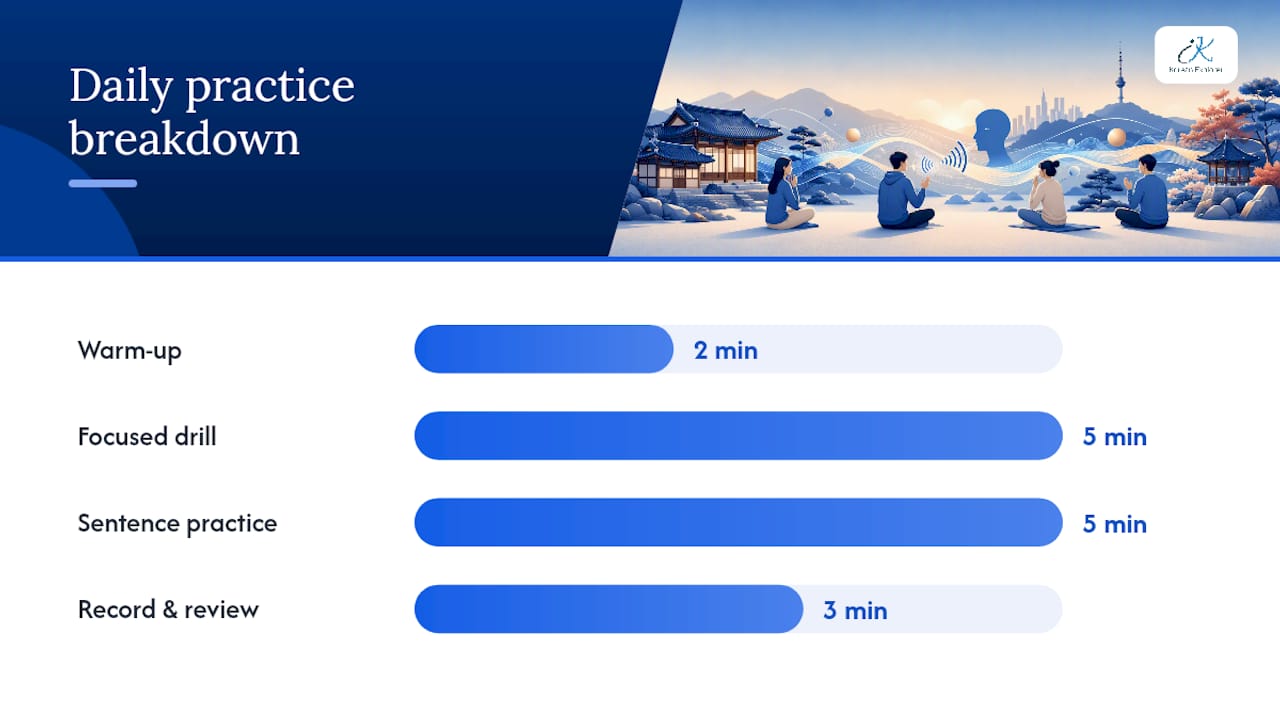
Structure beats intensity here. A focused fifteen-minute daily routine will outperform an unfocused hour, and the routine barely needs to change once you’ve built it.
A workable daily structure looks like this:
- Warm-up (2 minutes): read five syllable blocks aloud, focusing purely on clean articulation, no meaning required.
- Focused drill (5 minutes): run one minimal-pair set, either consonant contrast or vowel contrast, ten repetitions each.
- Sentence practice (5 minutes): pick two or three short sentences containing your target sound and repeat them at increasing speed.
- Record and review (3 minutes): record the sentence set, play it against a native version, and note one specific fix for tomorrow.
That last step is the one most learners skip, and it’s the one that actually moves the needle. Recording yourself and directly comparing against native audio turns vague self-assessment (“that sounded off”) into a specific, fixable target (“my ㅗ still glides at the end”).
For tools, a few options cover different needs:
- Native-recording repositories like Forvo let you hear real speakers pronounce individual words in context, which is useful when a textbook’s audio doesn’t match what you hear on the street.
- Pronunciation dictionaries help you check specific words before you commit a wrong pronunciation to memory.
- AI conversation partners give you low-pressure repetition practice and can flag obvious errors, though they’re a supplement rather than a full substitute for human feedback.
- Guided tutor sessions catch the errors you genuinely cannot hear in your own speech, since structured feedback from another person eliminates persistent mistakes faster than solo practice alone.
If you want to make practice sessions measurable rather than vague, pick one target sound per week, log ten repetitions daily, and keep every recording in a folder labeled by date. Listening back after seven days makes small improvements obvious in a way that daily self-assessment never quite catches. Some advanced learners even run recordings through free spectrogram software to visually compare vowel length and formant shape against native samples, though that level of detail is optional for most speaking goals.
Pro Tip: Keep your first month of recordings even after you’ve moved past them. Nothing motivates a plateaued learner faster than hearing exactly how far their vowels have come since week one.
For a broader set of app-based options that layer onto this routine, a rundown of pronunciation apps built for adult learners is worth a look, alongside more general listening-skill exercises that pair naturally with the drills above.
Common Mistakes and Two-Minute Fixes
Four errors show up in almost every English-speaking learner’s early pronunciation: leaning on romanization instead of Hangul, blurring the tense/aspirated contrast, gliding vowels the way English does, and mangling ㄹ into an English “r” or “l.”
Quick fixes that work in under two minutes each:
- Cover the romanization and reread the Hangul three times before checking meaning.
- Run the hand-in-front-of-mouth aspiration test on any word with ㄱ, ㄷ, ㅂ, or ㅈ before saying it aloud.
- Hold each vowel for two full seconds to kill the glide reflex.
- Say ㄹ with your tongue tapping once against the roof of your mouth, closer to a Spanish flick than an English “l.”
If any of these persist after two weeks of daily drilling, that’s the signal to bring in outside feedback rather than keep repeating the same practice. A deeper look at the most common pronunciation mistakes covers more examples worth checking against your own speech.
Pitch Accent and Intonation Patterns in Korean
Korean isn’t a tonal language the way Mandarin is, but it isn’t flat either. Standard Seoul Korean relies mainly on sentence-level intonation rather than pitch changes on individual syllables to carry meaning, which is good news for English speakers: you don’t need to learn a tone system from scratch.
That said, intonation still does real work. Questions typically rise at the end, statements fall, and certain sentence endings carry a distinct pitch contour that signals politeness level or emotional tone as much as the words themselves do. A flat, monotone delivery, common among early learners who focus purely on individual sounds, often reads as unnatural or even blunt to native listeners, even when every consonant and vowel is technically correct.
Some linguists also describe a mild pitch accent pattern in certain regional varieties of Korean, where the pitch of the first syllable in a word can shift meaning slightly, though this plays a much smaller role in standard Seoul speech than in genuinely tonal languages. For most adult learners focused on conversational and business Korean, the practical priority is intonation contour at the sentence level rather than syllable-level pitch, since that’s what native listeners notice first in unfamiliar speech.
Practicing intonation works best paired with shadowing: mimic not just the sounds but the rise and fall of a native speaker’s full sentence, exaggerating the contour slightly at first until it feels natural.
Pronunciation Differences Between Dialects
Seoul Korean is the standard most textbooks, apps, and courses teach, and it’s the version most useful for conversational and business contexts. But regional variation is real, and Busan Korean is the one learners run into most often once they start watching unscripted Korean media or talking with speakers from outside the capital.
Busan and the broader Gyeongsang dialect region carry noticeably more pitch variation than standard Seoul speech, with some linguists describing it as closer to a genuine pitch-accent system than Seoul Korean’s mostly flat, intonation-driven pattern. Sentence endings also shift: where Seoul speech softens and elongates certain endings, Gyeongsang speech tends to clip them shorter and land with more emphasis on the final syllable.
Vowel quality shifts slightly too, and some consonant contrasts that Seoul speakers keep sharply distinct blur more in casual regional speech. None of this should worry a learner focused on core competence. Building a solid Seoul-standard foundation first makes regional variation easy to recognize and adapt to later, rather than confusing from the start. Think of it the way a new English speaker benefits from learning standard American or British English before tackling a strong regional accent. The rules stay the same; only the delivery shifts.
A Teaching Perspective on Realistic Progress
Hangul-first, conversation-focused practice consistently produces faster real-world gains than romanization-based shortcuts, because learners stop translating sounds through a broken intermediary. Most committed adult learners notice a real shift in the tense/aspirated contrast and core vowels within four to six weeks of focused daily drilling, though full comfort with connected-speech patterns like liaison and tensification tends to take longer. Instructor feedback matters most exactly where self-checking breaks down: the errors you genuinely cannot hear in your own voice.
— Paul
Where Guided Feedback Speeds Things Up
Self-checking with recordings and native audio gets you far, but a second set of trained ears catches the errors that all the shadowing in the world won’t reveal on your own. Korean Explorer’s online Korean classes build pronunciation correction directly into the curriculum, whether that’s a private online class package or a conversation-focused group class, with native-instructor feedback on the exact sounds you’re struggling with, plus recorded lessons you can replay and compare against your own speech later.
For learners who want fully individualized correction rather than a group pace, private Korean classes focus entirely on your specific pronunciation gaps, whether that’s the tense consonant series, the ㅓ/ㅗ/ㅡ vowel cluster, or connected-speech patterns like nasalization. Classes run over Zoom for anyone learning outside Singapore’s central area, and in person at Korean Explorer’s training center at 10 Anson Road, Level 22, International Plaza, Singapore 079903, right above Tanjong Pagar MRT, for those who prefer face-to-face correction. If you’re ready to move past self-guided drills, get in touch through the online classes page to explore practice plans built around the specific sounds you’re missing.
Sources
- Korean Pronunciation Guide for English Speakers (CrushOnKorean)
- Korean/Essential Pronunciation Rules — Wikibooks
- Pronunciation guide — Practice Korean
- Forvo Korean pronunciations
FAQ
How Do You Pronounce Basic Korean Words?
Read the word in Hangul rather than romanization, break it into its syllable blocks, and say each block as a single unit rather than separate letters. Focus first on getting the consonant type right (plain, aspirated, or tense) and the vowel quality clean, since those two elements cause most mispronunciations in basic vocabulary.
Why Do Koreans Say “Imnida” So Often?
입니다 (imnida) is a common polite sentence ending attached to nouns, roughly equivalent to “it is” in formal speech. The pronunciation shift from a written ㅂ to a spoken “m” sound happens because of nasalization, where the stop consonant becomes nasal before the following ㄴ sound.
How Do You Pronounce Korean Words Using English Sounds?
You can’t do this accurately, and that’s the core problem with romanization: English letters don’t have equivalents for Korean’s tense consonants or its pure, unglided vowels. The reliable approach is learning Hangul directly and pairing it with native audio rather than trying to force Korean sounds into an English alphabet.
How Do I Check My Korean Pronunciation?
Record yourself saying a word or sentence, then play it directly against a native recording of the same phrase and listen for specific differences in vowel length or consonant tension. For errors you can’t identify on your own, structured feedback from an instructor, such as through Korean Explorer’s online Korean classes, catches mistakes that self-checking consistently misses.