Korean particles are short markers attached to the end of nouns that show grammatical role and speaker attitude, not word position. Master the core six first: 은/는 (topic), 이/가 (subject), 을/를 (object), then 에/에서/(으)로 (location and direction), 의/도/만 and 에게/한테 (possession, addition, limitation, recipient), plus conjunction particles like 와/과/랑/하고. Every particle choice depends on context and one spelling rule tied to whether the syllable before it ends in a consonant, called batchim.
TL;DR:
- Mastering the batchim rule is crucial, as mistaking particles like 을 or 를 based on final consonant can lead to common errors.
- Choosing between 에, 에서, and (으)로 depends on whether you’re indicating location, action, origin, or direction, with specific distinctions for each.
- Casual speech often omits particles like 을/를 or 이/가, but accurate recognition and use improve clarity and comprehension in formal contexts.
- Using correct particles such as 은/는 versus 이/가 depends on whether you’re introducing a topic or emphasizing a subject, impacting the sentence’s nuance.
- Guided practice with native instructors accelerates mastery by providing real-time corrections and helps overcome persistent mistakes and hesitation.
Table of Contents
- Topic vs Subject: 은/는 and 이/가, How to Tell Them Apart
- Object Particle 을/를: Marking the Direct Object and Common Traps
- Location and Direction Particles: Choosing Between 에, 에서, and (으)로
- Other Common Particles Worth Memorizing (의, 도, 만, 에게/한테, 와/과/랑/하고)
- Combining Particles and Knowing When You Can Skip Them
- Practice Drills: Three Short Activities to Internalize Particle Usage
- Why Guided Practice Speeds Up Particle Mastery
- Where Korean Particles Actually Came From
- How Korean Particles Compare to Grammar Markers in Other Languages
- Quoting Others: ~고 and ~라고 for Reported Speech
- Cause, Reason, and Contrast Beyond 은/는
- Particles, Honorifics, and Speech Levels
- The Learning Curve Nobody Warns You About
- Get Corrective Feedback on Particles from Native Instructors
- Curated Primary Sources for Further Study
- Sources
- FAQ
Topic vs Subject: 은/는 and 이/가, How to Tell Them Apart
Most learners get stuck here first, and for good reason: English doesn’t have a topic marker, so there’s no direct translation to lean on. 은/는 marks the topic of a sentence, often with a contrast or “as for” feeling. 이/가 marks the grammatical subject and tends to put a spotlight on new or emphasized information.
Compare these two sentences. “저는 학생이에요” (“As for me, I’m a student”) introduces yourself as a topic, calm and neutral. “제가 학생이에요” (“I am the student,” emphasis on I) answers a question like “Who’s the student?” The particle swap changes nothing about the grammar, but it completely changes what the sentence is doing.
A simple test works almost every time: if you can mentally insert “as for” before the noun, use 은/는. If the sentence is answering an implicit “who?” or “what?” question, or introducing brand-new information, reach for 이/가. The core beginner pairs also follow the batchim rule: nouns ending in a vowel take 는 or 가, nouns ending in a consonant take 은 or 이.
A few more contrast pairs worth drilling:
- 날씨가 좋아요 (The weather is nice, plain observation) vs. 날씨는 좋은데 사람이 많아요 (The weather’s nice, but it’s crowded, setting up contrast).
- 저는 커피를 좋아해요 (As for me, I like coffee) vs. 제가 커피를 좋아해요 (I’m the one who likes coffee, correcting an assumption).
Pro Tip: Watch Korean dialogue with subtitles and pause every time you hear 는 or 가 attached to a subject. Say out loud whether the speaker is introducing a topic or pointing at someone specific. After a week of this, the distinction stops feeling abstract.
Object Particle 을/를: Marking the Direct Object and Common Traps
을/를 attaches to the noun receiving the action of a transitive verb. The batchim rule applies again: a noun ending in a consonant takes 을 (책을 읽어요, “reads a book”), and a noun ending in a vowel takes 를 (사과를 먹어요, “eats an apple”).
The trap most learners fall into is attaching 을/를 to an intransitive verb, one that doesn’t take a direct object at all. “가다” (to go) and “오다” (to come) don’t need an object marker on the destination. Saying “학교를 가요” sounds off to native ears; the natural form is “학교에 가요,” using the location particle instead.
Common mistakes to watch for:
- Adding 을/를 after a destination noun when 에 is correct (학교를 가요 → 학교에 가요).
- Forgetting the batchim rule and defaulting to 를 for every noun, even consonant endings.
- Dropping the object marker entirely in written Korean, where omission reads as sloppy rather than casual.
Try this substitution drill: take five nouns of your own (연필, 책상, 커피, 영화, 음악) and attach the correct object particle to each, checking the final syllable before deciding.
Location and Direction Particles: Choosing Between 에, 에서, and (으)로
These three trip up even intermediate learners because English “at,” “in,” and “to” don’t map cleanly onto them. 에 marks existence, a point in time, or a destination. 에서 marks the place where an action happens, or means “from” when paired with movement. (으)로 marks direction or the means by which something is done.
The quickest test: ask whether the action physically happens at that location. If yes, use 에서. “도서관에서 공부해요” (I study at the library) describes an action happening there. “도서관에 가요” (I go to the library) treats the library as a destination, not a site of ongoing action.
- 집에 있어요 (I’m at home, existence) vs. 집에서 자요 (I sleep at home, action happening there).
- 학교에 가요 (I go to school, destination) vs. 학교에서 와요 (I come from school, origin point).
- 지하철로 가요 (I go by subway, means) vs. 오른쪽으로 가요 (I go to the right, direction).
부터 and 까지 extend this system for ranges: “9시부터 6시까지 일해요” means “I work from 9 to 6.” The Migaku guide on Korean particles points out that pairing textbook rules with authentic listening practice, catching these particles in real dialogue, cements the difference faster than drilling sentences alone.
Other Common Particles Worth Memorizing (의, 도, 만, 에게/한테, 와/과/랑/하고)
Beyond the core set, a handful of particles show up constantly in everyday speech. Learn these six and you’ll recognize most of what you hear.
- 의: possession, “of.” 친구의 책 (my friend’s book). Often dropped in casual speech.
- 도: “also/too.” 저도 가요 (I’m going too).
- 만: “only.” 물만 마셔요 (I only drink water).
- 에게/한테: “to/for” a recipient. 친구에게 선물을 줘요 (I give a gift to my friend). 한테 is more casual than 에게.
- 와/과: “and/with,” more formal in writing. 친구와 영화를 봐요 (I watch a movie with a friend).
- 하고/랑: “and/with,” casual spoken equivalents of 와/과. 랑 is the most informal.
| Particle | Meaning | Formality Note |
|---|---|---|
| 의 | possession (“of”) | neutral, often omitted in speech |
| 도 | “also / too” | neutral |
| 만 | “only” | neutral |
| 에게 | “to” (recipient) | more formal than 한테 |
| 한테 | “to” (recipient) | casual, spoken |
| 와/과 | “and / with” | formal, common in writing |
| 하고/랑 | “and / with” | casual, spoken; 랑 most informal |
Print this table and tape it near your desk. Recognition speeds up dramatically once the shapes become familiar rather than foreign.
Combining Particles and Knowing When You Can Skip Them
Particles stack to add nuance. “여기에서는 조용히 해요” combines 에서 (place of action) with 는 (topic/contrast), producing something like “here specifically, be quiet” as opposed to other places. That layered meaning disappears if you use only one particle.

Native speakers often drop particles in casual speech, especially 을/를 and sometimes 이/가, when context makes the role obvious. “나 밥 먹어” skips 을 entirely and still means “I’m eating rice.” Omission is common but risky for learners, because leaving out the wrong particle in the wrong context can make a sentence ambiguous rather than casual.
Top mistakes to self-check:
- Batchim errors: attaching 는 after a consonant-ending noun, or 을 after a vowel-ending one. Batchim mismatches are the single most common beginner slip.
- Confusing 에 and 에서: using 에 for an action that clearly happens at a location, or vice versa.
- Overusing 은/는: defaulting to the topic marker everywhere, even when 이/가 would sound more natural for new information.
Run a quick self-check after any conversation: pick three sentences you said, isolate each particle, and ask whether the batchim rule and the function actually matched.
Practice Drills: Three Short Activities to Internalize Particle Usage
Reading rules doesn’t build instinct. Doing something with them does. Three drills, done consistently, move particles from “memorized” to “automatic” faster than passive review.
- Substitution drill: Take a sentence like “친구가 밥을 먹어요” and swap 가 for 는, or 을 for 이, noting exactly how the meaning shifts each time. Do this with five sentences a day.
- Listening scavenger hunt: Pick a two-minute clip from a K-drama or a song and write down every particle you hear attached to a noun. This trains your ear to catch particles in fast, natural speech rather than slow textbook audio.
- Production exercise: Write three sentences about your day, then say them out loud, forcing yourself to choose a particle for every noun rather than skipping the hard ones.
Schedule this in ten-minute blocks rather than long study sessions; particle recognition improves through frequency, not duration. Track progress by revisiting a drill from two weeks earlier. If your speed answering has doubled, the practice is working.
Pro Tip: Keep a small notebook of “particle swap” sentences you get wrong. Reviewing your own mistakes, rather than generic textbook examples, tends to stick longer because the error is tied to something you actually said.
Why Guided Practice Speeds Up Particle Mastery
Self-study gets you the rules. It rarely catches the small errors that become habits. Conversation-focused classes with native instructors give you contextualized repetition. Someone corrects you the moment you drop 을 where it mattered, and that immediate feedback loop is difficult to replicate alone.
Korean Explorer’s courses follow a curriculum developed by Seoul National University, taught by native Korean instructors fluent in English, so explanations of tricky grammar points like particle nuance land clearly. Classes run in group, private, and online Zoom formats.
- Corrective feedback catches particle errors before they harden into habits.
- Curriculum structure sequences particles in a logical order rather than randomly.
- Flexible formats fit around work schedules, including evening and online options.
Where Korean Particles Actually Came From
Korean particles didn’t appear as a modern grammatical convenience. They trace back through Middle Korean, documented from around the 15th century onward following the creation of Hangul, and further back into Old Korean forms reconstructed from historical records and inscriptions. Linguists studying the language’s structure note that Korean belongs to the agglutinative family, where grammatical meaning is built by attaching particles and endings onto a root rather than relying on separate function words or strict word order.
That structural choice has deep roots. Because particles mark role directly on the noun, Korean sentences can reorder their nouns without losing meaning. “친구가 나를 만나요” and “나를 친구가 만나요” both mean “My friend meets me,” just with different emphasis, because the particles, not the position, carry the grammatical weight. English lost most of this flexibility centuries ago when its case endings eroded, forcing word order to do the job instead.
The particle system also evolved alongside honorific speech, one of the more distinctive features of Korean compared to many neighboring languages. Historical linguists trace shifts in how topic and subject markers interacted with formality levels over centuries of court and literary Korean, eventually settling into the modern system taught today. Understanding this history isn’t just trivia. It explains why Korean grammar feels so different from English at a structural level: the two languages solved the same communication problem, marking who did what to whom, in fundamentally different ways.
How Korean Particles Compare to Grammar Markers in Other Languages
Korean isn’t alone in using attached markers to show grammatical role. Japanese runs on a strikingly similar system, with particles like は (topic), が (subject), and を (object) mapping almost directly onto 은/는, 이/가, and 을/를. Learners who know one language often find the other’s particle logic familiar, even though the vocabulary shares little common ground.
Languages with case systems achieve something similar through word endings rather than separate particles. Latin, German, and Russian mark nominative, accusative, and dative case directly on the noun or its article, which is functionally close to what 이/가, 을/를, and 에게/한테 do in Korean. The difference is mechanical: Korean’s particles are separate, attachable units, while case endings fuse into the word itself.
English handles the same jobs almost entirely through word order and prepositions. “The dog bites the man” and “The man bites the dog” mean opposite things because English lost most of its case marking centuries ago and now relies on position to show who’s doing what. That’s precisely why English speakers tend to underestimate how much work Korean particles are doing: there’s no equivalent instinct to transfer over. A useful way to think about it: prepositions in English point forward at a noun (“to the store”), while Korean particles point backward, attaching after the noun they describe. Once that mental flip clicks, particle placement stops feeling backward and starts feeling logical.
Quoting Others: ~고 and ~라고 for Reported Speech
Reporting what someone said or thought requires its own particle logic. ~고 attaches to a verb ending to introduce reported speech or quoted content, roughly matching English “that” in indirect speech. “친구가 온다고 했어요” means “My friend said that he’s coming.”
~라고 works similarly but typically follows a direct quotation or a noun-based statement, often paired with 하다 (to say) or 말하다 (to speak). “그 사람이 ‘안녕하세요’라고 했어요” translates as “That person said, ‘Hello.’” The distinction between ~고 and ~라고 often comes down to whether the report is indirect (paraphrased) or feels closer to a direct quote, though in casual speech Koreans blend the two more freely than textbooks suggest.
A related pattern, ~다고 하다, extends this system for reporting statements in plain form: “비가 온다고 해요” means “They say it’s raining.” Swap the verb ending and the quoting particle adjusts: questions take ~냐고, commands take ~라고 or ~으라고, and suggestions take ~자고. Each variant signals exactly what kind of speech act is being reported, something English handles with an entire clause (“she asked whether,” “he suggested that”) rather than a single attached marker.
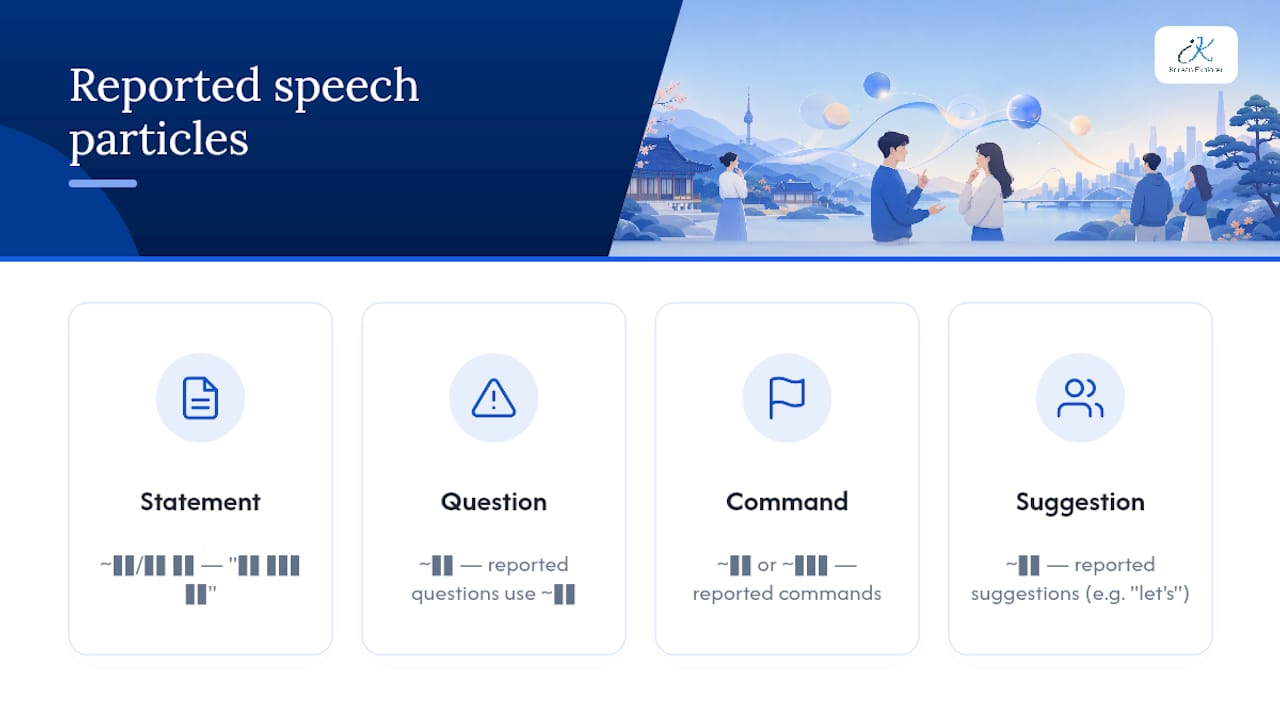
Learning this cluster pays off fast, because reported speech shows up constantly in casual conversation, gossip, news retelling, and even quoting your own past thoughts (“I thought that…”).
Cause, Reason, and Contrast Beyond 은/는
Topic and subject particles aren’t the only tools for framing a sentence’s logic. Korean uses several connective endings to show cause, reason, and contrast, and these function much like particles even though they attach to verb stems rather than nouns.
~니까 marks a reason the speaker considers obvious or urgent, often setting up a command or suggestion that follows. “비가 오니까 우산을 가져가세요” means “Since it’s raining, take an umbrella.” Compare that with ~아서/어서, which marks a more neutral cause and effect: “비가 와서 우산을 가져가요” (Because it’s raining, I’m bringing an umbrella) sounds more like a simple explanation than a nudge toward action.
~지만 marks contrast within a single sentence, roughly matching English “but.” “한국어는 어렵지만 재미있어요” means “Korean is difficult, but it’s fun.” This differs from using 은/는 for contrast across separate sentences or clauses; ~지만 keeps the contrast tight and internal to one thought.
Getting the reason markers right matters more than learners expect, because ~니까 can sound pushy or overly direct if used where ~아서/어서 would be gentler. Save ~니까 for situations where the reason genuinely justifies an instruction or a sense of urgency, and default to ~아서/어서 for plain cause and effect.
Particles, Honorifics, and Speech Levels
Particles themselves mostly stay fixed regardless of formality: 이/가, 을/를, and 에서 don’t change shape based on who you’re speaking to. What shifts is which particle variant you reach for and how the surrounding verb endings signal respect.
The clearest example is the recipient particle. 에게 appears in more formal or written contexts, while 한테 feels casual and conversational, both meaning “to” a person. Similarly, 와/과 shows up in formal writing and announcements, while 하고 and especially 랑 dominate casual speech among friends. Choosing the formal variant in a text message to a close friend can sound stiff or oddly distant, while using 랑 with a client or professor in a business setting reads as careless.
Subject and topic particles interact with honorific verb endings rather than changing form themselves. “선생님이 오세요” (The teacher is coming) pairs 이 with the honorific verb ending 세요, showing respect through the verb, not the particle. This is why Korean speakers often say “imnida” (입니다) frequently in formal settings. It’s the formal declarative verb ending, not a particle, but it works alongside particle choices like 에게 over 한테 to build a consistently respectful register across an entire sentence.
Getting this layering right takes longer than memorizing particle shapes, because it requires reading social context, not just grammar. Corporate and professional Korean, in particular, leans on 에게 and 와/과 far more than casual speech does, which matters directly for anyone using Korean at work.
The Learning Curve Nobody Warns You About
Particles feel backward at first because English simply doesn’t ask you to think this way. You’re used to word order carrying meaning, so attaching a tiny syllable to the end of a noun and having it change everything can feel arbitrary, even after someone explains the rule clearly.
It stops feeling arbitrary once you’ve drilled enough minimal pairs that your brain starts predicting which particle fits before you’ve consciously worked it out. That shift usually takes weeks of consistent, short practice, not months of occasional cramming. Pairing passive input, K-dramas, songs, podcasts, with active production, writing and speaking your own sentences, closes the gap faster than either approach alone.
Expect plateaus. Expect moments where 에 and 에서 blur together again after you thought you’d nailed them. That’s normal, and it’s not a sign the method is failing.
— Paul
Get Corrective Feedback on Particles from Native Instructors
Grammar guides can only take you so far. The moment you need someone to catch a misplaced 을 in real time, self-study runs out of road. Korean courses, built on a curriculum developed by Seoul National University and taught by native instructors fluent in English, give you exactly that: live correction in group, private, or online Zoom classes, with recorded sessions to review afterward.

This fits best if you’ve read this guide, tried the drills, and still catch yourself hesitating over 은/는 or fumbling 에 versus 에서 mid conversation. That hesitation is normal, and it’s precisely what structured, conversation-focused practice is designed to smooth out through repetition and real-time correction rather than more solo reading.
Classes run at a central training center in International Plaza, with additional locations in Jurong and Tampines for learners who prefer a location closer to home. If you want a next step beyond this article, check the Korean language courses page to see current class formats and get started with a lesson built around exactly this kind of particle practice.
Curated Primary Sources for Further Study
- Particles Overview (조사) from Practice Korean breaks down grammatical role and discourse function in plain terms.
- The Wikipedia entry on Korean particles is a solid reference for the batchim rule and core particle pairs.
- Migaku’s guide explains why pairing authentic input with drills beats rule memorization alone.
- Batchim’s particle guide covers the spelling rule in detail with clear examples.
Sources
- Particles Overview (조사) | Korean Grammar Documentation | Practice Korean
- Korean particles — Wikipedia
- Complete Guide to Korean Particles for Korean Learners — Migaku
- Korean Particles Guide: 은/는, 이/가, 을/를 Finally Explained | Batchim
FAQ
How do I know when to use 은 or 는?
Use 는 after a noun ending in a vowel and 은 after a noun ending in a consonant (batchim); the choice of which particle, topic versus subject, depends on context, not spelling.
Why do Koreans say “imnida” so often?
입니다 (imnida) is the formal declarative verb ending, not a particle, and it shows up frequently in formal or professional speech to signal a respectful, polished register.
How do I know when to use 이 or 가?
이 follows a noun ending in a consonant and 가 follows a noun ending in a vowel; both mark the subject, typically used when introducing new information or emphasizing who or what is doing the action.
How many Korean particles are there?
Korean has dozens of particles covering case, location, and discourse function, but a focused set of roughly six to eight covers most everyday spoken sentences, which is why this guide prioritizes them first.
What’s the fastest way to stop confusing 에 and 에서?
Ask whether the action physically happens at that location: if yes, use 에서; if the noun is simply a destination, existence point, or time, use 에.