Learning Korean for career purposes pays off when the study plan targets workplace registers and live conversation, not textbook grammar alone. Academic research links higher Korean proficiency to measurable wage premiums, and professional-track courses now exist specifically to build those skills fast. The move that matters most: start speaking practice now and evaluate a course built for the workplace, not the classroom.
TL;DR:
- Korean workplace communication relies heavily on formal polite speech and honorifics, which are essential for credibility and social hierarchy.
- Achieving job-ready skills typically requires 3 to 6 months of consistent weekly practice, focusing on speaking, listening, and industry-specific vocabulary.
- Practicing real conversation and mastering formal greetings, progress reports, and email phrases is more effective than textbook grammar for workplace clarity.
- A professional curriculum incorporating sector-specific language and native instructor feedback accelerates proficiency faster than self-study or casual courses.
- Demonstrating actual speaking ability and familiarity with workplace scenarios on resumes and in interviews holds more value than vague claims or standardized test scores.
Table of Contents
- What Employers Actually Need: Workplace Korean Skills and Registers
- A Realistic 3 to 6 Month Study Plan for Working Professionals
- How Language Proficiency Maps to Hiring and Promotion
- How to Choose a Career-Focused Korean Course
- How to Show Korean Proficiency on Resumes and in Interviews
- Industry Vocabulary That Actually Comes Up at Work
- Cultural Competence Matters as Much as Grammar
- Do You Need a Proficiency Test Score for Job Applications?
- How Korean Explorer Helps Working Professionals Get Job Ready
- What I’ve Seen Teaching Professionals This Skill
- Sources
- FAQ
What Employers Actually Need: Workplace Korean Skills and Registers
Most new learners waste months on grammar that never shows up at work. Korean offices run on a specific register, and missing it costs you credibility faster than a small vocabulary gap ever will.
The default is 합니다체, the formal polite speech level. It shows up in meetings, emails, phone calls, and pretty much every interaction with a manager or client. Casual speech (반말) has no place in a status update, and using it by accident reads as a real misstep, not a charming mistake. Layered on top of that is the honorific system: verbs get the -(으)시- marker when you talk about someone senior, certain nouns swap for honorific versions, and you switch to humble forms when referring to your own actions in front of that same senior person. Get the honorific right but forget the humble form in the same sentence, and the whole thing sounds off to a native ear.
The formal and written register that governs business Korean isn’t optional vocabulary. It’s a system that has to be learned in sequence, because skipping a layer creates habits that are hard to unlearn later.
Job-ready skills worth prioritizing, in rough order of how often you’ll use them:
- Formal self-introductions and small talk openers for meetings
- Status update phrases (“진행 중입니다”, “완료했습니다”) for reporting progress
- Polite refusal and pushback language for disagreeing without offending
- Email openings, closings, and request phrasing for written communication
- Phone scripts for scheduling and follow-up calls
- Presentation transition phrases for structuring a talk
Pro Tip: Record yourself giving a two-minute status update in 합니다체 every week. Listening back exposes tense slips and honorific mismatches faster than any workbook exercise.
Get listening comprehension and formal endings solid first. Honorific verbs come next, since they change how every sentence about a colleague or boss is built. Business writing and presentation phrasing can wait until the spoken foundation holds up under pressure. A business Korean guide focused on workplace scenarios walks through these email and meeting conventions in more depth.
A Realistic 3 to 6 Month Study Plan for Working Professionals
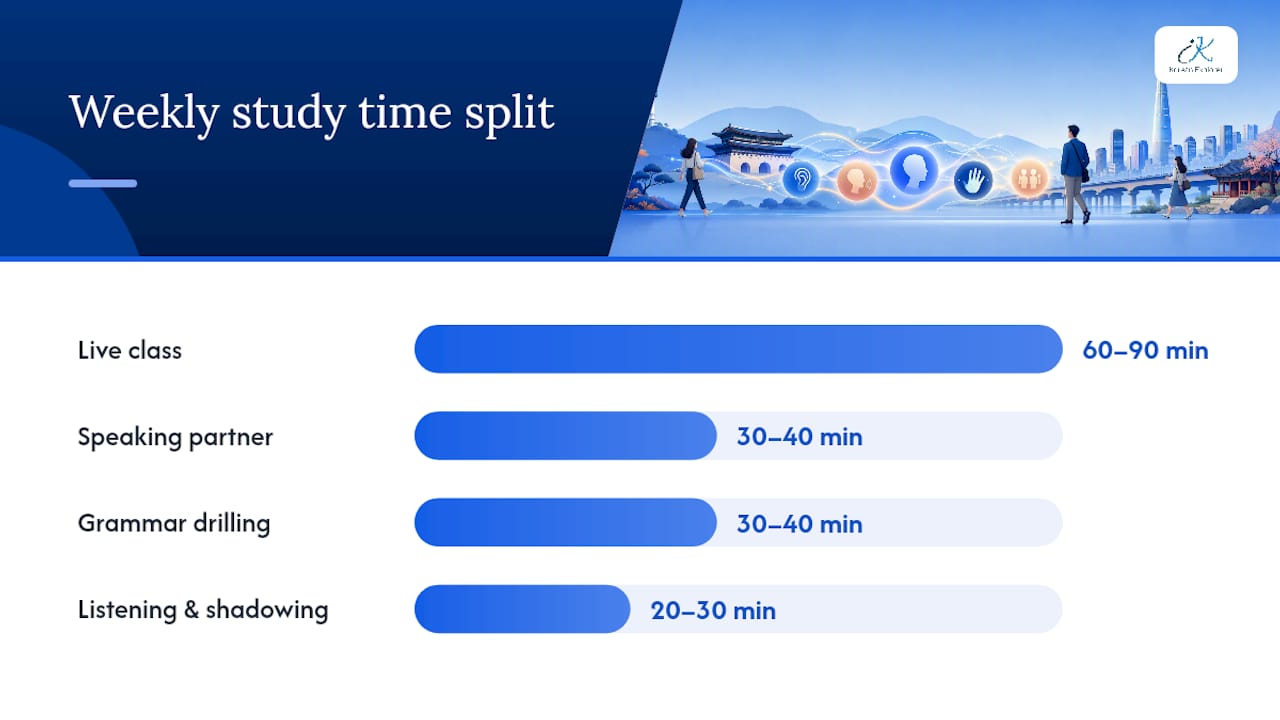
You don’t need to quit your job to get functional at business Korean. You need a plan that survives a bad week at the office, which most self-study schedules don’t.
A workable weekly split for someone working full time:
- One live class (group or private), 60 to 90 minutes, focused on speaking and correction
- One session with a speaking partner or tutor for unscripted conversation
- 30 to 40 minutes of focused grammar drilling, tied to whatever register you’re building that month
- 20 to 30 minutes of listening and shadowing, using recorded lessons or Korean workplace audio
- A short review pass over any recorded class videos from the week
Group classes work well for building the formal register and honorific patterns, since you get exposure to how classmates make the same mistakes you do. Private lessons earn their higher cost when you need to drill a specific skill fast, like presentation phrases before a client visit. Online Zoom sessions solve the scheduling problem entirely for anyone traveling or working irregular hours, and they let you keep a consistent routine even during a busy quarter. A comparison of group versus one-to-one Korean classes breaks down which format fits which goal.
Monthly checkpoints keep the plan honest:
- Month 1: You can introduce yourself formally, understand basic meeting instructions, and produce simple 합니다체 sentences without hesitating.
- Months 2 to 3: You can give a short status update, write a basic email request, and follow most of a meeting conducted in Korean.
- Months 4 to 6: You can handle an unscripted phone call, use honorific and humble forms correctly in the same conversation, and contribute in a client-facing meeting.
Keep a running “work phrase” notebook. Every time you hear a useful phrase in a real meeting, write it down that day. Set a micro-goal before every performance review or interview, like using three new honorific verbs correctly in the conversation. If you’re job hunting alongside your study plan, pairing language progress with optimized LinkedIn job alerts keeps you moving on both fronts at once.
How Language Proficiency Maps to Hiring and Promotion
The wage data on this is more specific than most people expect. A semi-parametric analysis of Korean proficiency found that wage premiums appear from mid-level proficiency upward, with returns that grow nonlinearly rather than in a flat, steady climb. The strongest gains showed up early in a career and among bachelor’s degree holders, which suggests proficiency compensates for thin work experience rather than replacing it entirely.
Language proficiency often functions as a signaling mechanism early on. It can offset a short resume, and it tends to become a real differentiator when someone is being considered for a management role at a Korean-headquartered company.
Employer signals to watch for: job postings that list Korean as required versus preferred, interviews conducted partly or fully in Korean, and internal promotion patterns where bilingual staff move into client-facing or leadership roles faster. Foreign employees who use Korean on the job, even imperfectly, tend to get pulled into more meetings and considered for advancement sooner than colleagues who stay in English-only mode.
Gains concentrate among early-career hires, client-facing staff, and anyone working inside a Korean-headquartered firm. In English-first startups and specialist technical roles, Korean matters less at hiring but still shapes how far you climb later. Language study pairs best with real domain expertise. Fluency without a skill set to back it up rarely moves a senior hiring decision.
How to Choose a Career-Focused Korean Course
Not every Korean class is built for the office. A conversation club or general-interest course might get you through a vacation, but it won’t prepare you to draft an email to a client or handle an honorific slip in a meeting.
Look for these criteria when evaluating a provider:
- Native instructors with genuine bilingual support, so nuance gets explained clearly in both languages
- A curriculum that covers workplace scenarios directly, not just travel and daily-life vocabulary
- Conversation-first teaching, where you’re producing spoken Korean every session instead of just filling in worksheets
- Scheduling flexibility, including online options for people traveling or working odd hours
- A corporate training track, if you’re trying to build a team’s skills rather than just your own
- Some way to measure progress, whether through recorded lessons, instructor feedback, or milestone check-ins
Ask providers directly: Who designs the curriculum? Do instructors give individual feedback on business writing, or just group correction? Can you switch between group and private formats as your schedule changes?
Pro Tip: Ask to sit in on a class before committing. A conversation-focused lesson feels noticeably different from a lecture-style one within the first ten minutes.
A managed curriculum with workplace materials and consistent instructor feedback moves faster than piecing together apps and YouTube videos on your own. Korean Explorer’s professional courses are built around a curriculum with Seoul National University input, taught by native instructors who work in both Korean and English, with a dedicated professional track and flexible online scheduling that fits a working adult’s calendar.
How to Show Korean Proficiency on Resumes and in Interviews
Vague claims like “conversational Korean” tell a hiring manager almost nothing. Specificity does the work instead.
On a resume, describe what you can actually do: “Conducted client status updates in Korean,” or “Drafted business emails in formal Korean register.” If you’ve completed a structured course, name it and note the focus, such as business communication or workplace Korean, rather than just listing hours studied. Avoid overstating your level. An interviewer switching into Korean mid-conversation will find the gap immediately, and that’s worse than an honest, modest claim.
In the interview itself, prepare a short self-introduction in 합니다체 you can deliver without stumbling, since this often comes up even in roles that are technically English-first. Practice answering one or two behavioral questions in Korean, focused on teamwork or handling a problem, since these show real communicative range beyond memorized phrases. If the role is client-facing, ask if part of the interview will be conducted in Korean. Volunteering to do a portion in Korean, when you’re genuinely ready, signals confidence that a resume line can’t capture.
A career language guide for professionals covers more interview-specific phrasing if you want to build a deeper practice bank before your next application round.
Industry Vocabulary That Actually Comes Up at Work
General textbooks rarely teach the words that show up in your actual meetings. Sector-specific vocabulary is where most professional learners feel the biggest gap.
In finance and business operations, you’ll run into terms like 매출 (revenue), 손익 (profit and loss), and 계약서 (contract), along with formal phrasing for discussing budgets and forecasts. Tech and manufacturing environments lean on words like 개발 (development), 품질 관리 (quality control), and 일정 (schedule or timeline), often mixed with English loanwords that get pronounced in Korean phonetics. Retail and client-facing roles need service-register phrases for handling requests, complaints, and follow-ups, which tend to use even more layered honorifics than internal office talk.
Marketing and creative teams use a different set entirely, with terms like 브랜드 전략 (brand strategy) and 캠페인 (campaign) showing up constantly in planning meetings. HR and administrative contexts bring their own formal vocabulary around 채용 (recruitment), 평가 (evaluation), and 휴가 (leave).
The fastest way to build this vocabulary isn’t a generic word list. It’s collecting terms directly from your own industry’s meetings, emails, and reports, then drilling them in the same formal register you’re already practicing. A course with a genuine professional curriculum will usually fold sector vocabulary into role-play scenarios rather than isolated flashcards, which makes the words stick because you’re using them the way you’ll actually need them.
Cultural Competence Matters as Much as Grammar
Perfect grammar with poor workplace etiquette still lands badly. Korean corporate culture runs on hierarchy signals that have nothing to do with vocabulary.
Seniority shapes almost everything: who speaks first in a meeting, how you receive a business card, and how you pour a drink at a company dinner. Age and title both matter, and getting either wrong reads as a real gap, not a minor slip. Group meals and after-work gatherings (회식) still function as genuine relationship-building events in many companies, and showing up, even briefly, signals respect for the team.

Directness also works differently than in many Western workplaces. Disagreement often gets softened or delayed rather than stated outright in a meeting, and picking up on that indirect pushback is its own skill separate from vocabulary. Email etiquette follows similar rules: greetings and closings carry more formal weight than in English business writing, and skipping them can come across as abrupt even when the content is fine.
None of this replaces language study, but ignoring it undercuts language study that’s otherwise solid. A learner with modest Korean and strong cultural awareness often reads as more competent in a meeting than a fluent speaker who misses the social cues entirely.
Do You Need a Proficiency Test Score for Job Applications?
A standardized proficiency score can strengthen an application, particularly for roles where a company wants a quick, comparable benchmark across candidates. It’s one input among several employers weigh, not a substitute for demonstrated speaking ability in an interview.
Job postings that name a specific proficiency requirement usually do so because the role involves regular Korean-language work: client communication, internal reporting, or coordination with a Korean headquarters. In those cases, a documented score gives a hiring manager a number to point to internally, which can matter in larger organizations with formal hiring criteria. In smaller companies or specialist technical roles, interview performance tends to carry more weight than any certificate.
Treat a proficiency score as a supplement to spoken skill, not a replacement for it. An interviewer will notice quickly if a strong test score doesn’t match actual conversational ability, and that mismatch does more damage than having no score at all. Build the speaking and writing skills first, through consistent workplace-focused practice, and let a test result confirm progress you can already demonstrate live.
How Korean Explorer Helps Working Professionals Get Job Ready
You’ve seen what actually moves the needle: formal register, honorific accuracy, and real conversation practice under workplace pressure. Getting there faster usually means training with people who’ve built a curriculum around exactly that, instead of assembling it yourself from scattered resources.
Korean Explorer’s courses draw on a curriculum shaped with Seoul National University input, taught by native instructors who explain nuance clearly in both Korean and English. Classes are conversation-focused from day one, with a dedicated professional track for learners building business Korean specifically, plus corporate training options for teams. Flexible online Zoom classes and in-person sessions both fit around a full work schedule, and recorded lesson access means a missed week doesn’t set you back. The what is workplace Korean guide breaks down exactly what a professional track covers, from status updates to email conventions.
If you’re ready to move past general phrasebook Korean and start building the skills a hiring manager or client will actually notice, check current course options and enrollment details to find a format that fits your schedule. Classes run at 10 Anson Road, Level 22, International Plaza, Singapore 079903, right above Tanjong Pagar MRT, alongside the online options for anyone who can’t make it in person.
What I’ve Seen Teaching Professionals This Skill
Paul here, working with Korean Explorer’s professional learners. The pattern I notice most: people who practice speaking weekly, even imperfectly, outpace those chasing grammar perfection by a wide margin. Career gains tend to show up quietly first, in being asked to join a meeting, before they show up on a payslip. Start speaking now. The formal register gets easier the moment you stop avoiding it.
— Paul
Sources
FAQ
How long does it take to reach workplace-ready Korean?
Most working professionals reach basic workplace functionality, formal introductions, simple status updates, and meeting comprehension, within 3 to 6 months of consistent weekly study.
Is group or private tuition better for business Korean?
Group classes work well for building formal register and honorific patterns through shared practice, while private lessons help most when you need to drill a specific skill quickly, like presentation phrasing before a client visit.
Does Korean fluency guarantee a promotion at a Korean company?
No. Research shows proficiency correlates with wage premiums, especially early in a career, but the biggest returns come from pairing language skill with real domain expertise, not language alone.
What’s the single most important skill to learn first?
Formal polite endings (합니다체) come first, since nearly every workplace interaction, from emails to meetings, runs through that register before anything else matters.
Can I learn business Korean entirely online?
Yes. Online Zoom classes cover the same conversation-focused, workplace-aligned curriculum as in-person sessions, which makes them a practical option for professionals with irregular schedules or frequent travel.