Korean honorifics (높임말, nopimmal, or 경어, gyeongeo) are a grammatical system that marks social relationships through verb forms, particles, special vocabulary, and sentence endings. The single rule every learner must internalize: default to the informal-polite -요 (-yo) ending with everyone you do not know well, add -(으)시- to verbs when the subject deserves respect, and never apply honorific forms to yourself. Get those three habits right and you will avoid the most embarrassing mistakes from day one.
Quick-start checklist for your next conversation:
- Use -요 endings (해요체) with strangers, acquaintances, and colleagues until explicitly invited to speak casually.
- Add -(으)시- to the verb when talking about or to a respected person (your boss, a professor, an elder).
- Switch to humble first-person forms (저 instead of 나, 저희 instead of 우리) whenever you are being polite.
Pro Tip: Think of Korean honorifics as a dial, not a switch. You are not choosing between “polite” and “rude” — you are calibrating respect up or down based on who is in the room.
Key Takeaways
Mastering Korean honorifics requires three habits: defaulting to 해요체 with strangers, applying -(으)시- to respected subjects (never to yourself), and replacing second-person pronouns with names, titles, or omission.
| Point | Details |
|---|---|
| Default to 해요체 | Use informal-polite -요 endings with anyone you do not know well; switch only when invited. |
| -(으)시- raises the subject | Add this infix to verbs when the subject deserves respect; never attach it to 저 (yourself). |
| Suppletive verbs matter | Memorize 계시다, 드시다, 드리다, and 뵙다 early — they cover most formal daily situations. |
| Avoid second-person pronouns | Replace “you” with the person’s title, name + -씨, or omit the pronoun entirely. |
| Register shifts are social signals | Moving from 합니다체 to 해요체 relaxes a conversation; the reverse can sound sarcastic. |
Table of Contents
- Korean honorifics explained: the three speech levels you actually need
- How honorific suffixes and particles attach to names and verbs
- How verbs change: -(으)시-, honorific verbs, and humble forms
- How to address people naturally: titles, kinship terms, and -nim
- Why Koreans often avoid saying “you” — and what to use instead
- How sentence endings mark respect: -습니다, -요, and conjugation patterns
- Age, seniority, and the common mistakes learners make
- Short dialogues that show honorific levels in action
- Practical exercises and resources to build the habit
- What realistic progress actually looks like
- Ready to practice with native instructors?
- Sources
- FAQ
Korean honorifics explained: the three speech levels you actually need
Korean honorifics form a system that touches every part of a sentence, but for practical conversation, three levels cover nearly every situation an adult learner will face.
The three everyday levels:
- 합니다체 (habnidache) — formal-polite. Endings: -습니다 / -습니까. Used in business presentations, news broadcasts, military settings, and formal public speech.
- 해요체 (haeyoche) — informal-polite. Endings: -아요 / -어요 / -여요. The everyday default for most adult interactions: meeting someone new, shopping, talking to a colleague you are not close with.
- 해체 / 반말 (banmal) — casual. Endings: -아 / -어. Used with close friends of the same age or younger people you have permission to speak casually with.
The three-factor decision is straightforward. Ask yourself: How old is this person relative to me? What is their rank or seniority? How close are we? Age, seniority, and closeness are the three practical levers, and age is usually the deciding one when the other two are unclear.
Practical decision guide:
- Elderly stranger or anyone clearly older → 합니다체 or 해요체; never banmal.
- Boss or senior colleague → 합니다체 in formal meetings; 해요체 in daily office chat.
- Colleague of similar age and rank → 해요체 until you both agree to drop it.
- Close friend of the same age → 반말, but only after mutual agreement.
- Someone younger → You may use 반말, but wait until the relationship is established.
When in doubt, informal-polite 해요체 is the safe default for most interactions, while formal-polite 합니다체 is reserved for official business or public announcements.
Pro Tip: Koreans will often invite you to use banmal by saying “말 놓아도 돼요” (mal noado dwaeyo — “you can speak casually”). Wait for that invitation rather than assuming.
How honorific suffixes and particles attach to names and verbs
Honorific suffixes and particles are the building blocks of respectful Korean. Each one has a specific attachment rule, and mixing them up signals either disrespect or awkward over-formality.
The key suffixes and particles:
- -님 (-nim): Attached to titles or names to show deep respect. 선생님 (seonsaengnim, “teacher”), 사장님 (sajangnim, “company president”). Never attach -님 to your own title.
- -씨 (-ssi): Attached to a full name or first name to show polite but not elevated respect. 김지수씨 (Kim Jisu-ssi). Attaching -씨 to a surname alone (김씨) implies the speaker is of higher status — avoid it with people you respect.
- -아 / -야 (-a / -ya): Vocative suffixes for calling someone by name casually. -아 follows a consonant-final name (민준아, Minjun-a); -야 follows a vowel-final name (지수야, Jisu-ya). Using these with elders or superiors is rude.
- 께서 (kkeseo): Honorific subject particle replacing 이/가. Signals that the subject deserves respect. 선생님께서 오셨어요 (The teacher came).
- 께 (kke): Honorific dative particle replacing 에게/한테. 선생님께 드렸어요 (I gave it to the teacher).
The honorific particles 께서 and 께 pair naturally with -(으)시- verbs to create a fully honorific clause. Using 께서 with a plain verb (without -시-) sounds inconsistent and jarring.
Key rule: 께서 and 께 raise the subject or recipient of the action. -(으)시- raises the verb. A fully respectful sentence uses both together: 할머니께서 오셨어요 (Halmeoni kkeseo osyeoyo — “Grandmother came”).
How verbs change: -(으)시-, honorific verbs, and humble forms
This is where Korean politeness forms get genuinely interesting. The language does not just add a polite ending — it can replace the entire verb with a different word depending on who is doing the action and who is receiving it.
The -(으)시- infix
The infix -(으)시- raises the grammatical subject of the verb. Its form depends on the stem ending:
- Vowel-final stem: add -시- directly. 가다 → 가시다 (gasida, “to go [honorific]”)
- Consonant-final stem: add -으시-. 읽다 → 읽으시다 (ilgeusida, “to read [honorific]”)
- ㄹ-final stem: drop ㄹ, then add -시-. 살다 → 사시다 (sasida, “to live [honorific]”)
Suppletive honorific and humble verbs
Some verbs are replaced entirely rather than modified with an infix. These suppletive forms are among the most important vocabulary items for learners to memorize.
Humble verbs (겸양어, gyeomyangeo) lower the speaker’s action when addressing a respected person. You use 드리다 when you give something to someone senior; you use 드시다 when they eat. Mixing these up is one of the most common learner errors.
Pro Tip: A quick memory hook: 드시다 = “they dine” (honorific, subject is respected); 드리다 = “I deliver” (humble, speaker lowers themselves). The direction of respect is opposite.
One critical warning: never attach -(으)시- to yourself. 저는 먹으시겠어요 is wrong and sounds absurd. The infix raises the subject, so applying it to 저 (I) self-honorifies, which violates the core logic of the system.
How to address people naturally: titles, kinship terms, and -nim
Korean address terms are not just polite add-ons. They often replace pronouns entirely, which is why learning them is inseparable from understanding Korean honorifics.
Kinship-based address terms
These terms are used not just for family but for anyone in a similar social relationship:
- 오빠 (oppa): Used by a woman to address an older male she is close to (brother, older male friend, boyfriend).
- 언니 (unni): Used by a woman to address an older female she is close to.
- 형 (hyung): Used by a man to address an older male he is close to.
- 누나 (noona): Used by a man to address an older female he is close to.
These terms are relational, not biological. A woman calling a male friend 오빠 signals closeness and a recognized age gap, not a family relationship.
Academic and workplace terms
- 선배 (seonbae): Senior (in school or at work). Shows respect for experience.
- 후배 (hubae): Junior. The junior uses 선배 to address the senior; the senior may use 후배 or the person’s name.
- -님 (-nim): Attached to a professional title for deep respect. 팀장님 (team leader), 교수님 (professor).
Common address terms at a glance
| Term | Who uses it | To whom | Key tip |
|---|---|---|---|
| 오빠 (oppa) | Younger woman | Older male (close) | Don’t use with strangers |
| 형 (hyung) | Younger man | Older male (close) | Signals closeness, not just age |
| 선생님 (seonsaengnim) | Anyone | Teacher / instructor | Safe default for educators |
| -씨 (-ssi) | Polite equals | Full name or first name | Never on surname alone |
| -님 (-nim) | Anyone | Title holder | Attach to title, not to 저 |
| 선배님 (seonbaenim) | Junior | Senior (formal) | -님 adds extra formality |
Pro Tip: When you do not know someone’s name or title, 저기요 (jeogiyo, “excuse me”) is the universal polite attention-getter. It sidesteps the address-term problem entirely.
Why Koreans often avoid saying “you” — and what to use instead
Second-person pronouns are one of the trickiest parts of Korean politeness forms for English speakers, because the instinct to say “you” is almost always wrong in polite Korean.
First-person forms:
- 나 (na): Plain “I.” Used in casual speech (banmal contexts).
- 저 (jeo): Humble “I.” Used in all polite contexts. Default whenever you are speaking to someone you respect.
- 우리 (uri): Plain “we / our.” Also used for “my” in casual speech (우리 집, “my house”).
- 저희 (jeohui): Humble “we / our.” Used in polite contexts instead of 우리.
Second-person avoidance in practice:
Second-person pronouns are normally avoided in polite Korean. 너 (neo, “you”) is casual and can sound blunt or even rude in formal contexts. 당신 (dangsin) exists but is used almost exclusively between married couples or in poetic/ironic registers — using it with a stranger or boss sounds strange.
What to say instead of “you”: Use the person’s name + -씨, their title + -님, or simply omit the pronoun. Korean grammar allows subject omission freely, so “Did you eat?” becomes 밥 먹었어요? (Bap meogeosseoyo?) — no “you” needed at all.
Short examples:
- ✗ 당신은 어디 가요? (Dangsineun eodi gayo?) — Sounds odd or confrontational.
- ✓ 어디 가세요? (Eodi gaseyo?) — “Where are you going?” with subject omitted and -(으)시- marking respect.
- ✓ 팀장님은 어디 가세요? (Timjangnimeun eodi gaseyo?) — Using the title instead of a pronoun.
Pro Tip: When addressing a group, 여러분 (yeoreobun, “everyone / ladies and gentlemen”) is the polite second-person plural. You will hear it in presentations, classes, and announcements.
How sentence endings mark respect: -습니다, -요, and conjugation patterns
The sentence ending is the most visible marker of speech level. Getting the ending right signals immediately that you understand Korean social hierarchy, even if your vocabulary is still developing.
Core paradigms
Note that 해요체 uses the same form for statements and questions — only intonation differs. 합니다체 uses -습니다 for statements and -습니까 for questions.
How -(으)시- combines with endings
When you add -(으)시- to a verb, the combination with polite endings follows a predictable pattern:
- Vowel-final stem + 시 + 어요 → contracts to -세요 (e.g., 가세요, gaseyo).
- Consonant-final stem + 으시 + 어요 → -으세요 (e.g., 읽으세요, ilgeuseyo).
- With formal ending: stem + 시 + ㅂ니다 → -십니다 (e.g., 가십니다, gasimnida).
Register shifts mid-conversation
Switching from 합니다체 to 해요체 mid-meeting is normal and signals that the conversation is becoming less formal. The reverse — suddenly shifting to 합니다체 in a casual chat — can sound sarcastic or passive-aggressive. Korean honorifics at work follow a clear pattern: open formally, relax as rapport builds, but never drop below 해요체 with a superior.
Pro Tip: The -세요 ending does double duty: it is both a polite statement (“Please go,” 가세요) and a polite question (“Are you going?”). Context and intonation tell them apart.
Age, seniority, and the common mistakes learners make
Korean social hierarchy is not just about grammar — it is a calculation. The concept of 압존법 (apjonbeop), or relative honorifics, means that when you talk about a third person in front of someone even more senior, you may need to lower the honorifics for the third person. A classic example: when speaking to your company president about your team leader, you would not use -(으)시- for the team leader, because the president outranks them.
Frequent learner errors
- Using banmal too early. Dropping to casual speech before being invited is the single most common social mistake. It signals either ignorance or disrespect.
- Applying -(으)시- to yourself. 저는 먹으시겠어요 is grammatically wrong and socially bizarre. -(으)시- is for others, never for 저.
- Confusing 드시다 and 드리다. 드시다 = the respected person eats; 드리다 = you humbly give. Saying 제가 드시겠습니다 when you mean “I will eat” is wrong on two levels.
- Attaching -씨 to a surname alone. 김씨 implies you are of higher status than the person named. With someone you respect, use their full name + -씨, or their title + -님.
- Forgetting humble forms when speaking about yourself. Using 나 and 우리 in a formal meeting instead of 저 and 저희 sounds careless.
Self-audit checklist
- Am I using 저 (not 나) in polite contexts?
- Is -(으)시- on the verb when the subject is someone I respect?
- Am I using 드리다 (not 주다) when I give something to a senior?
- Have I avoided -씨 on a bare surname?
- Am I waiting for an invitation before switching to banmal?
Pro Tip: Teaching honorifics alongside cultural notes — why Koreans ask your age, when titles replace names — reduces social mistakes faster than grammar drills alone.
Short dialogues that show honorific levels in action
These four dialogues model the most common real-life register situations. Each line includes Hangul, standard romanization, and a literal English translation.
Dialogue 1: Meeting a professor
Student: 교수님, 안녕하세요. 저는 김민준이라고 합니다.
Gyosunim, annyeonghaseyo. Jeoneun Kim Minjunirago hamnida.
“Professor, hello. I am called Kim Minjun.”
Professor: 반갑습니다. 어느 수업 듣고 있어요?
Bangapseumnida. Eoneu sueop deutgo isseoyo?
“Nice to meet you. Which class are you taking?”
What to notice: The student uses 합니다체 (-합니다) and 교수님 (title + -님). The professor responds in 해요체 (-어요), which is natural for a senior speaking to a junior.
Dialogue 2: Talking about a grandparent with a friend
Friend: 할머니 요즘 어떠세요?
Halmeoni yojeum eotteoSeyo?
“How is your grandmother these days?”
You: 잘 지내세요. 요즘 운동도 하시더라고요.
Jal jinaeseyo. Yojeum undongdo hasideorago yo.
“She is doing well. She has even been exercising lately.”
What to notice: Both speakers use -(으)시- when referring to the grandmother, even though she is not present. Honorifics follow the subject, not the listener.
Dialogue 3: Workplace exchange with a boss
You: 팀장님, 보고서 검토해 주실 수 있으세요?
Timjangnim, bogoseo geomtohae jusil su isseuseoyo?
“Team leader, would you be able to review the report?”
Boss: 네, 오후에 볼게요.
Ne, ohue bolgeyo.
“Yes, I will look at it in the afternoon.”
What to notice: You use 팀장님 (title + -님) and -(으)시- in the request. The boss replies in 해요체, which is normal for a senior speaking down.
Dialogue 4: Friendly invite with a register shift
Friend A: 오늘 저녁에 뭐 해요?
Oneul jeonyeoge mwo haeyo?
“What are you doing this evening?” (해요체 — still getting comfortable)
Friend B: 별로 없어. 왜?
Byeollo eopseo. Wae?
“Nothing much. Why?” (반말 — already close)
Friend A: 같이 밥 먹을래?
Gachi bap meogeullae?
“Want to eat together?” (shifts to 반말 following the friend’s lead)
What to notice: Friend A starts in 해요체, then mirrors Friend B’s banmal once the register is established. This mirroring is natural and socially smooth.
Practice prompts: After each dialogue, try substituting a different title or verb. In Dialogue 3, replace 팀장님 with 부장님 (department head) and adjust the verb ending. In Dialogue 4, practice keeping 해요체 throughout and notice how the tone changes.
Practical exercises and resources to build the habit
Understanding honorifics is one thing; using them without thinking is another. Experienced instructors recommend focused drills because selection — choosing the right form — is harder than conjugation for most learners.
Daily micro-practice checklist:
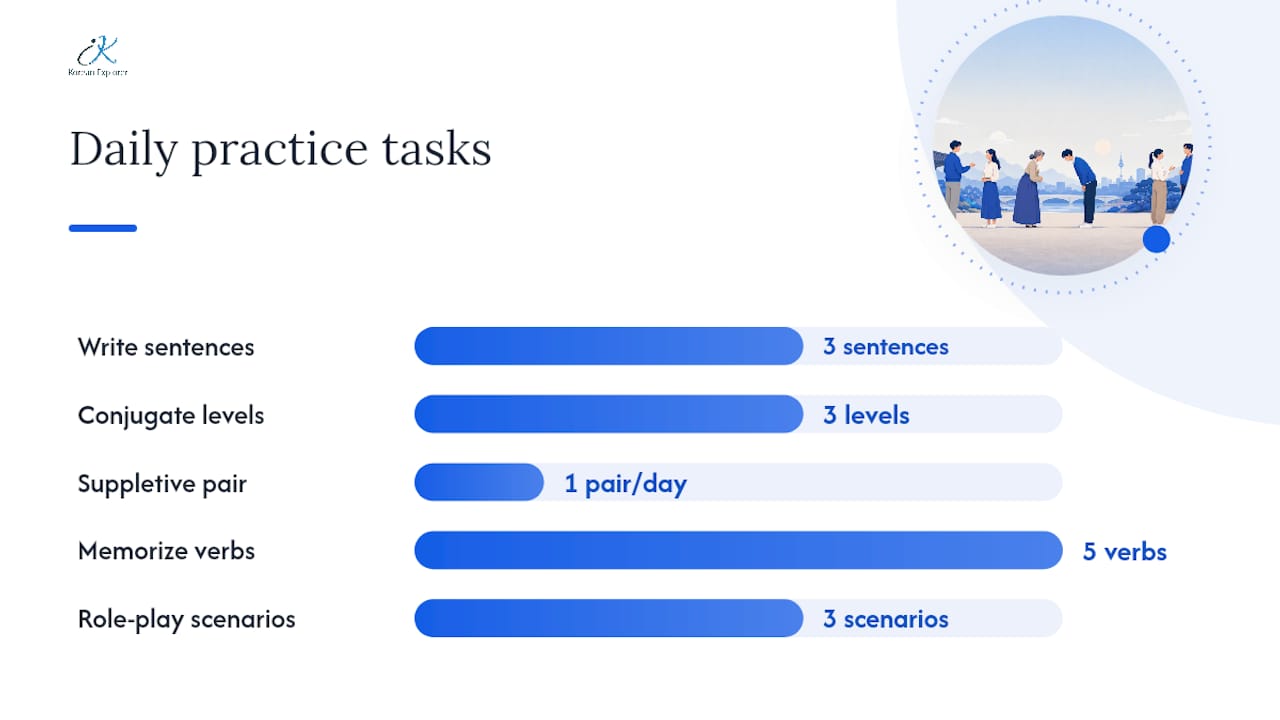
- Write three sentences about what you did today using 저 and 해요체 endings.
- Pick one verb (e.g., 먹다) and conjugate it across all three levels: 먹습니다 / 먹어요 / 먹어.
- Practice one suppletive pair daily: today, 드시다 vs. 드리다. Tomorrow, 계시다 vs. 있어요.
- Shadow one short Korean video clip (a drama scene or news segment) and note every -(으)시- you hear.
Structured learning steps:
- Secure 해요체 first. Get comfortable forming present, past, and question forms before adding complexity.
- Add -(으)시- with non-self subjects. Drill sentences like “My mother eats” → 어머니가 드세요 until it is automatic.
- Memorize five suppletive verbs. 계시다, 드시다, 주무시다, 드리다, 뵙다. These five cover most daily situations.
- Practice title-based role plays. Simulate a meeting with a 팀장님, a visit to a 교수님, and a call to a 선배. Switch roles.
- Use a translation tool like Lara Translate to check whether your honorific phrasing in written Korean reads naturally before sending a formal email or message.
- Take a Korean placement test to identify exactly which level you are at before deciding which grammar points to drill next.
For learners who want structured feedback, group or private lessons with native instructors accelerate correct usage far faster than self-study alone. A teacher can catch self-honorification errors and register mismatches in real time — the kind of feedback a textbook cannot give.
Pro Tip: Shadowing works best when you already know what you are listening for. Pick a drama scene where a character speaks to their boss, and count every -(으)시- and -님. Then replay and shadow the respectful speaker’s lines only.
What realistic progress actually looks like
Most learners expect honorifics to click after a few lessons. They do not — and that is fine.
The realistic progression looks like this: you get 해요체 solid in the first few weeks, which covers the vast majority of daily interactions. Then you start noticing -(으)시- in speech and adding it deliberately. Humble verbs like 드리다 and 뵙다 come later, usually when you have a real situation that demands them — a job interview, a formal email, meeting a partner’s parents.
The part that takes longest is not grammar. It is the social reading: knowing when to shift registers, when to hold formal speech even if the other person has relaxed, and when dropping to banmal would actually build rapport rather than offend. That judgment comes from exposure and from making mistakes in low-stakes environments — which is exactly what a classroom is for.

If you are learning for business use, prioritize 합니다체 and honorific address terms early. A Korean colleague will forgive a foreigner’s imperfect banmal; they will notice and appreciate a foreigner who uses 팀장님 correctly and does not self-honorify.
Ready to practice with native instructors?
Korean Explorer offers adult Korean courses in Singapore designed specifically for conversational and business use, taught by native Korean instructors who are fluent in both Korean and English. Whether you prefer in-person classes at 10 Anson Road, Level 22, International Plaza (right above Tanjong Pagar MRT), or live online sessions via Zoom, the structured curriculum takes you from 해요체 basics through honorific verbs and business register at a pace that fits working adults.
Explore Korean language courses or browse group and private class options to find the right fit for your level and schedule.
Sources
These references are worth bookmarking as you build your honorific fluency:
- Korean honorifics
- Elon
- Honorific System Overview | Korean Grammar Documentation | Practice Korean
- Korean honorific terms guide | Indiana University (Korean language resources)
FAQ
Why do Koreans say “imnida” after everything?
이다 (ida, “to be”) conjugated in 합니다체 becomes 입니다 (imnida). It is the formal-polite copula ending, used in presentations, introductions, and official speech to signal that the speaker is being maximally respectful or formal.
Why do Koreans say -씨 after a name?
-씨 is a polite name suffix equivalent to “Mr.” or “Ms.” attached to a full name or first name. It signals respectful equality — neither elevated nor casual. Attaching it to a bare surname (e.g., 김씨) implies superiority over the named person, so use the full name instead.
Is it oppa or hyung?
Both mean “older brother” in a social sense, but the speaker’s gender determines which to use. A woman uses 오빠 (oppa) for an older male she is close to; a man uses 형 (hyung) for an older male he is close to.
Can a guy call his boyfriend hyung?
Yes. 형 (hyung) is used by a man toward any older male he is close to, regardless of the relationship type. If one partner is older, the younger man may naturally use 형 as a term of closeness and affection.