You only need a handful of polite phrases, plus one grammar trick, to handle most travel situations in Korea. The trick is adding -요 or 주세요 to almost anything you say. Master that, memorize eight phrases, and you can order food, catch a taxi, check into a hotel, and ask for help without ever feeling lost. Everything below expands that kit by situation, so you can copy, screenshot, or practice before your flight.
TL;DR:
- Memorizing eight to ten essential Korean phrases with polite endings is more effective than trying to learn dozens for travel situations.
- The core phrases include greetings, requesting items, asking prices, and directions, which cover almost all day-to-day interactions for travelers.
- Adding -요 at the end of sentences is crucial for politeness, and mastering this grammar pattern ensures smoother, more respectful communication.
- Carrying a written or photo reference of destination and key phrases in Hangul simplifies communication, especially with taxi drivers and in emergencies.
- Learning basic Hangul reading skills enhances navigation and reduces confusion, making interactions faster and less stressful during your trip.
Table of Contents
- Learning Korean for Travel: What You Actually Need to Know
- Traveler’s Quick Phrase Kit: 8 Essential Phrases
- How Do You Ask a Taxi Driver to Take You Somewhere?
- Ordering Food and Dining Phrases for Travelers
- Shopping and Money Phrases: Understanding Korean Prices
- Accommodation and Hotel Check-In Phrases
- Emergency Phrases and Numbers Every Traveler Should Know
- Pronunciation and Politeness: The Grammar That Ties It All Together
- Why Learning Conversational Travel Korean Helps
- Asking for Directions and Understanding the Answer
- Cultural Etiquette Around Language Use While Traveling
- Making Friends: Korean Phrases Beyond Transactions
- Reading Signs and Notices While Traveling in Korea
- What This Guide Gets Right That Others Miss
- Ready to Move Beyond the Phrase Kit?
- Sources
- FAQ
Learning Korean for Travel: What You Actually Need to Know
Most guides throw fifty phrases at you and hope something sticks. That is backwards. Five specific phrases can handle the majority of daily interactions in South Korea, which means the goal isn’t memorizing a phrasebook. It’s picking the right eight or ten and drilling them until they’re automatic.
The standard industry term for this kind of language is “survival Korean,” a stripped-down, situational vocabulary set built for short-term visitors rather than long-term learners. It skips grammar theory and gets straight to what you’ll say at a counter, in a cab, or at a restaurant table. Basic Korean for tourists works because it leans on one repeated pattern: attach -요 to the end of a sentence, and you sound polite. Drop it, and you risk sounding blunt or rude, even by accident. Outside major tourist areas, English service is limited, so a small kit of Korean travel phrases changes how smoothly your trip runs, not just whether you’re understood.
Traveler’s Quick Phrase Kit: 8 Essential Phrases
Save this list as a screenshot before you land. These eight cover greetings, requests, ordering, payment, and getting help, which is nearly everything a traveler needs day to day.
- 안녕하세요 (annyeonghaseyo) — Hello. Works any time of day, with anyone.
- 주세요 (juseyo) — Please give me. Add it after any noun: “물 주세요” means “Water, please.”
- 감사합니다 (gamsahamnida) — Thank you. The safe, polite default in any interaction.
- 죄송합니다 (joesonghamnida) — I’m sorry. Use it for bumping into someone or asking for a repeat.
- 이거 주세요 (igeo juseyo) — I’ll have this. Point at a menu item or product while saying it.
- 얼마예요? (eolmayeyo) — How much is it? Essential for shops, markets, and taxis.
- 화장실 어디예요? (hwajangsil eodiyeyo) — Where’s the restroom? You’ll use this more than you expect.
- 여기서 세워주세요 (yeogiseo sewojuseyo) — Please stop here. Useful in taxis when your stop is coming up.
A quick pronunciation note: Korean vowels are short and consistent, unlike English. “Yeo” sounds like “yuh,” not “yee-oh.” Say each phrase slowly first, then speed up once it feels natural.
Pro Tip: Screenshot this list and keep it in your phone’s photo gallery, not buried in notes. When you’re standing at a counter, you want it one swipe away, not three taps deep.
For a longer reference before your trip, Korean Explorer has a full rundown of key Korean phrases for beginners worth bookmarking alongside this kit.
How Do You Ask a Taxi Driver to Take You Somewhere?
Taxis are where basic Korean for travel pays off fastest, because drivers rarely speak English and GPS pins get lost in translation. The fix is simple: name your destination, then add 가주세요 (gajuseyo), meaning “please take me to.”
- “Myeongdong 가주세요” — Please take me to Myeongdong.
- “여기서 세워주세요” — Please stop here (when you’ve arrived or want to get out early).
- “기사님” (gisanim) — A respectful way to address the driver, similar to “sir” or “driver.”
Adding the destination name directly before “가주세요” is the standard, clearly understood way to direct a driver, and addressing the driver as 기사님 signals respect that Korean speakers notice immediately.
Subways and buses work a little differently since you’re often reading signs rather than speaking. A useful line for double-checking a stop is “이 버스 [destination]에 가요?” (Does this bus go to [destination]?). Station names are usually posted in English underneath the Hangul, but bus routes often aren’t, so this question earns its keep.
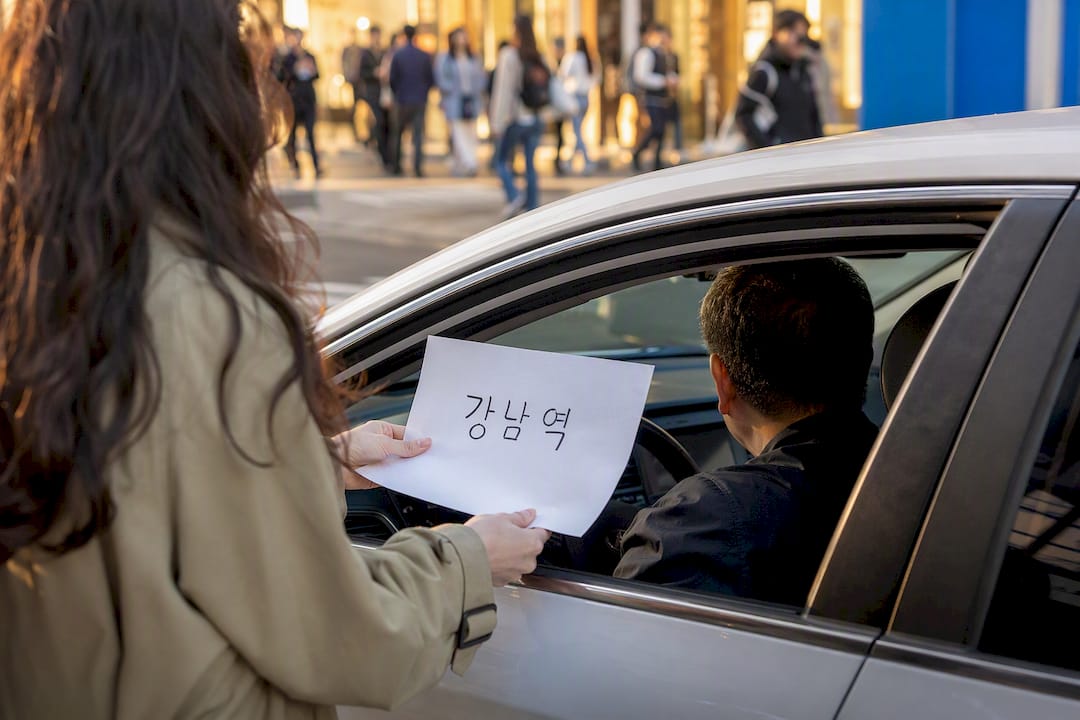
Pro Tip: Always carry your destination written in Hangul, either on paper or saved as a photo. If a driver looks confused, show the map pin on your phone. It’s faster than any phrase and eliminates guesswork entirely.
Ordering Food and Dining Phrases for Travelers
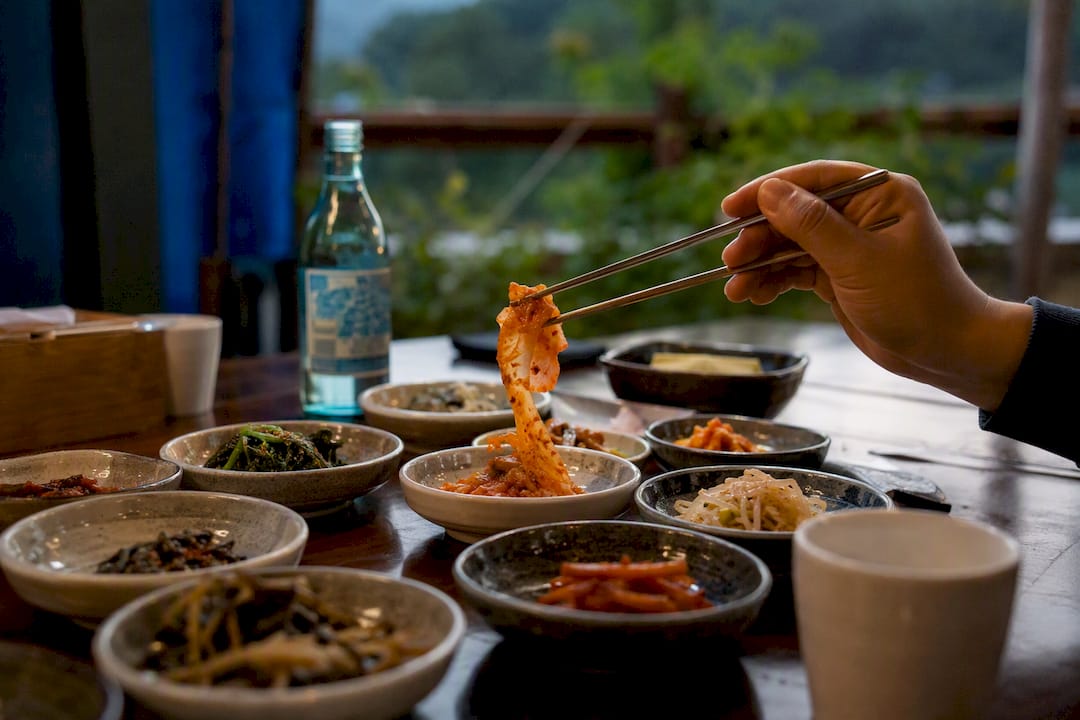
Dining in Korea has a rhythm: you call staff over, point and order, then pay. Once you know the pattern, every restaurant and café interaction follows the same steps.
- 여기요! (yeogiyo) or 저기요! (jeogiyo) — Excuse me! (to call a server over)
- 메뉴 주세요 (menyu juseyo) — Menu, please.
- 이거 주세요 (igeo juseyo) — I’ll have this (point at the menu or a neighboring table’s dish).
- 맵지 않게 해주세요 (maepji anke haejuseyo) — Please make it not spicy.
- 계산해 주세요 (gyesanhae juseyo) — Check, please.
Calling staff with “여기요” or “저기요,” then ordering by pointing and saying “이거 주세요,” is the standard flow in most Korean restaurants, and it works whether you’re in a street stall or a sit-down spot.
One cultural note worth knowing: dropping the polite ending and using a bare verb stem is the most common mistake travelers make, and it can come across as curt even when you don’t mean it that way. Sticking to -요 and 주세요 endings keeps every request sounding courteous. Also expect shared side dishes, called banchan, at most Korean meals. They’re refillable and free, so no need to ask permission before digging in.
Shopping and Money Phrases: Understanding Korean Prices
Shopping conversations hinge on one question: 얼마예요? (eolmayeyo), meaning “How much is it?” This phrase is essential for shopping and services, and Korea uses Sino-Korean numbers for all currency amounts, which trips up a lot of first-time visitors.
Sino-Korean numbers are the counting system borrowed from Chinese, and they’re the ones you’ll see on price tags and hear at checkout. For example, 15,000 won is written and spoken as “만오천 원” (man-ocheon won), not with the native Korean number set you’d use to count objects or tell your age. Mixing the two systems up is the single most common numbers mistake travelers make, since Korean actually runs two separate counting systems depending on context.
- 얼마예요? — How much is it?
- 더 싸게 해주세요 (deo ssage haejuseyo) — Please make it a bit cheaper (small markets only, not department stores).
- 카드 되나요? (kadeu doenayo) — Can I pay by card?
At traditional markets, don’t be surprised if a vendor points to a calculator or writes the number on paper instead of saying it aloud. That’s normal and actually easier for most travelers than parsing spoken numbers on the spot.
Accommodation and Hotel Check-In Phrases
Hotel interactions are short and predictable, which makes them easy to prepare for. A handful of lines cover check-in, requests, and problems.
- 체크인 해주세요 (chekeu-in haejuseyo) — I’d like to check in, please.
- 와이파이 비밀번호가 뭐예요? (waipai bimilbeonhoga mwoyeyo) — What’s the Wi-Fi password?
- 짐 맡길 수 있나요? (jim matgil su innayo) — Can I leave my luggage here?
- 모닝콜 해주세요 (moningkol haejuseyo) — Please give me a wake-up call.
- 에어컨이 안 돼요 (eeokeoni an dwaeyo) — The air conditioner isn’t working.
Reading these aloud slowly is usually enough, but if pronunciation feels shaky in the moment, showing the phrase on your phone screen works just as well. Front desk staff at most hotels are used to guests doing exactly that.
Emergency Phrases and Numbers Every Traveler Should Know
Emergencies are rare, but the language for them needs to be automatic, not something you look up while panicking. Three phrases cover most urgent situations:
- 도와주세요! (dowajuseyo) — Help me!
- 경찰 불러주세요 (gyeongchal bulleojuseyo) — Please call the police.
- 병원 어디예요? (byeongwon eodiyeyo) — Where’s the hospital?
For numbers, dial 112 for police, 119 for fire and medical emergencies, and 1330 for the tourist hotline, which offers multilingual support around the clock. Wikivoyage’s phrasebook lists these numbers alongside its emergency phrase section, grouping them with transport and dining phrases the same way this guide does.
Save your hotel’s address in Hangul as a photo before you leave each day. If something goes wrong, showing that image to a driver, police officer, or bystander gets you home faster than trying to explain in English.
Pronunciation and Politeness: The Grammar That Ties It All Together
Two grammar patterns do almost all the heavy lifting in survival Korean: -(으)세요 and -아/어 주세요. These are the two most useful patterns for travelers making polite requests, and once you notice them, you’ll see they’re baked into nearly every phrase in this guide, from 주세요 to 해주세요.
Here’s the number split that trips people up: money uses Sino-Korean numbers (일, 이, 삼 for 1, 2, 3), but telling time and counting objects uses native Korean numbers (하나, 둘, 셋). Confusing the two won’t just sound wrong. It can cause real confusion during a transaction.
Three quick pronunciation fixes for English speakers:
- Korean vowels stay short and flat. Don’t drag them out the way English speakers naturally do.
- The consonant ㄹ sits between an English “l” and “r.” Don’t commit fully to either sound.
- Stress falls evenly across syllables in Korean, unlike English, which leans hard on one syllable per word.
Spending even thirty minutes learning Hangul before your trip changes everything, since reading menus, station names, and street signs directly cuts down on stress and guesswork in a way that romanization alone never quite manages.
Pro Tip: Practice saying phrases out loud, not just reading them silently. Korean rhythm is different enough from English that your mouth needs the repetition as much as your memory does. For structured pronunciation drills, Korean Explorer’s guide on improving pronunciation of Korean phrases breaks this down further, and pronunciation coaching techniques built for other contexts, like interview prep, use similar drilling methods worth borrowing.
Why Learning Conversational Travel Korean Helps
Paul, who writes on language learning for Korean Explorer, points out that survival phrases only take you so far without the confidence to use them out loud. Short, conversation-focused courses taught by native instructors help learners apply phrases naturally in real interactions, rather than freezing up when a cashier responds faster than expected.
Korean Explorer’s curriculum draws on coursework developed by Seoul National University, and classes are led by native Korean instructors fluent in English, which matters most in the first few sessions when explanations need to go both directions. A traveler who spends even a few sessions on conversational basics tends to walk into a restaurant or taxi with noticeably less hesitation than someone relying on a phrase list alone. Guided practice catches small pronunciation habits, like flattening vowels or stressing the wrong syllable, that are hard to self-correct from a book.
Asking for Directions and Understanding the Answer
Asking for directions is easy. Understanding the answer is where most travelers get stuck. The question side is short: “이거 어디예요?” (Where is this?) while pointing at a written address or landmark name works in nearly any situation. You can also ask “화장실이 어디예요?” for restrooms or swap in any destination.
The harder part is the response, since Koreans often answer with a string of directions rather than a single word. Listen for a few anchor words rather than trying to catch every syllable: 오른쪽 (oreunjjok) means right, 왼쪽 (oenjjok) means left, 직진 (jikjin) means straight ahead, and 여기 (yeogi) means here. If someone points while saying 저기 (jeogi, meaning “over there”), follow their hand, not just their words.
A useful backup: ask “얼마나 걸려요?” (eolmana geollyeoyo), meaning “How long does it take?” The answer usually comes as a number of minutes, which is far easier to parse than a full sentence of directions. If you’re still unsure, repeating the destination name back with a questioning tone, like “Myeongdong… 이쪽?” (this way?), often prompts a simpler nod or point in response.
Combining a few anchor words with body language gets you further than trying to translate every word in real time. Koreans giving directions to a visibly lost tourist tend to slow down and simplify once they realize you’re following along, even partially.
Cultural Etiquette Around Language Use While Traveling
Politeness in Korean isn’t just about word choice. It shapes how people respond to you. Using polite speech, known as jondaetmal, builds immediate rapport with service staff and locals, often shifting a transactional interaction into a noticeably warmer one.
A few etiquette habits make a real difference. Slight bows, even a small nod of the head, pair naturally with greetings and thank-yous. Volume matters too: raising your voice to call a server, rather than saying 여기요 at a normal conversational level, can come across as impatient even if that’s not your intent. Handing over cash or a card with both hands, or your right hand supported by your left, is a small gesture that Korean speakers notice and appreciate, particularly with older staff or shop owners.
Age and hierarchy shape Korean speech more than most travelers expect. You’re not expected to navigate this perfectly as a visitor, but leaning on -요 endings by default is the safest choice in any interaction, since it signals baseline respect regardless of who you’re speaking to. Dropping into overly casual speech (banmal) with someone you’ve just met, even unintentionally, can read as presumptuous.
None of this requires fluency. A polite tone, a slight bow, and a consistent -요 ending communicate more goodwill than a grammatically perfect sentence delivered bluntly.
Making Friends: Korean Phrases Beyond Transactions
Not every conversation in Korea is transactional. Travelers who spend time in hostels, cafés, or group tours often want language for something less scripted: meeting people. A few phrases open that door.
- 이름이 뭐예요? (ireumi mwoyeyo) — What’s your name?
- 어디에서 왔어요? (eodieseo wasseoyo) — Where are you from?
- 한국 처음이에요 (hanguk cheoeumieyo) — This is my first time in Korea.
- 친구 하고 싶어요 (chingu hago sipeoyo) — I’d like to be friends. (Casual, best for peer settings like hostels.)
- 연락처 줄 수 있어요? (yeollakcheo jul su isseoyo) — Can you give me your contact info?
These phrases work best with younger Koreans or in social settings where casual conversation is expected, like a hostel common room or a language exchange meetup. In more formal settings, sticking to polite forms and simple small talk (commenting on food, weather, or a shared activity) tends to land better than jumping straight into personal questions.
A genuine attempt at Korean, even a clumsy one, tends to get a warmer response than sticking to English by default. Koreans meeting a traveler who has clearly put in some effort often switch into a mix of English and Korean to meet you halfway, which turns into some of the more memorable exchanges of a trip.
Reading Signs and Notices While Traveling in Korea
Spoken phrases only cover half the picture. The other half is reading what’s around you: subway signs, store notices, and warning labels. A little bit of sign literacy prevents a lot of confusion.
A handful of characters and words show up constantly. 입구 (ipgu) means entrance, 출구 (chulgu) means exit, and 화장실 (hwajangsil) marks restrooms, usually with a recognizable icon alongside the text. 영업중 (yeongeopjung) means “open,” while 영업종료 (yeongeop jongryo) means “closed,” both common on shop doors. On public transit, 환승 (hwanseung) means transfer, which you’ll see constantly on subway platform signs.
Price tags and menus almost always use Arabic numerals rather than Korean numerals, so the numbers themselves are usually readable even before you’ve learned any vocabulary. What trips people up more is unit labels, like 원 (won) after a price, or 개 (gae) as a counter for items.
This is exactly where a little Hangul knowledge pays for itself. Once you can sound out the alphabet, even without understanding every word, unfamiliar signs stop being a wall of shapes and start being something you can at least partially decode. That shift alone removes a lot of the low-level anxiety that comes with navigating a country where you can’t read the default script.
What This Guide Gets Right That Others Miss
Most Korean travel phrase guides drown you in fifty or sixty phrases and call it thorough. That approach backfires. Nobody memorizes fifty phrases under travel stress, and trying to leads to hesitation exactly when you need to speak up.
The better approach, and the one this guide is built around, is prioritizing a small set of high-frequency phrases and one grammar pattern over breadth. Five to eight phrases, drilled until automatic, beat fifty phrases half-remembered. That’s not a shortcut. It reflects how people actually retain language under pressure.
Where conventional advice really falls short is treating politeness as optional flavor rather than the backbone of the whole system. Adding -요 isn’t a nice-to-have layer on top of “real” Korean. For a traveler, it often is the real Korean that matters, since it’s the difference between sounding respectful and sounding curt with the exact same vocabulary.
If you take one thing from this guide, make it this: learn the polite ending before you learn extra words. A traveler who knows five phrases with consistent -요 endings will have smoother interactions than one who knows twenty phrases delivered bluntly. Vocabulary breadth is overrated. Politeness consistency is not.
— Paul
Ready to Move Beyond the Phrase Kit?
A phrase list gets you through a trip. Actual conversational ability changes how you experience one. Korean Explorer offers adult-focused courses built specifically for conversational and business use, including small group classes, private lessons, and online sessions over Zoom, so you can prepare for a trip without rearranging your entire schedule around a classroom.
Private lessons are worth considering if your trip is close and you want fast, targeted practice on pronunciation and real dialogue rather than a full curriculum. If you’d rather study at your own pace before departure, the online Korean classes run over Zoom with native instructors who teach in both Korean and English, so nothing gets lost in translation during your early sessions.
Classes run out of Korean Explorer’s location right above Tanjong Pagar MRT, at 10 Anson Road, Level 22, International Plaza, Singapore 079903, alongside additional centers in Jurong and Tampines for learners who want a location closer to home. If you’re planning a trip and want more than a screenshot of phrases to rely on, check out the conversational Korean course options and see which format, group, private, or online, fits your timeline before you fly.
Sources
- Useful Korean Phrases for Travelers (2026) — A Local’s Complete Guide
- Korean phrases: riding taxis — Sweet & Tasty TV
FAQ
How Do You Say “Travel” in Korean?
“Travel” translates to 여행 (yeohaeng). “I’m traveling” is 여행하고 있어요 (yeohaenghago isseoyo), and “trip” or “journey” uses the same root word.
Why Do Koreans Say “Imnida” a Lot?
입니다 (imnida) is a formal sentence ending used in polite, often business or public-facing speech, similar in function to -요 but more formal. You’ll hear it from announcers, staff in upscale settings, and anyone speaking in a professional context, and it signals the same underlying respect that -요 endings do in everyday conversation.
How Do You Say “Tourist” in Korean?
“Tourist” is 관광객 (gwangwanggaek). You might hear it used by staff at attractions or hotels, as in “관광객이세요?” (Are you a tourist?).
What Are the Most Useful Korean Phrases for Travel?
The core set covers greetings, requests, and directions: 안녕하세요 (hello), 주세요 (please give me), 감사합니다 (thank you), 얼마예요 (how much), and 화장실 어디예요 (where’s the restroom). These five, combined with the -요 polite ending, handle the majority of situations most travelers encounter.
Do I Need to Learn Hangul Before Visiting Korea?
You don’t need fluency, but even thirty minutes learning the Hangul alphabet makes reading menus, signs, and station names significantly easier and reduces day-to-day confusion. Structured courses, like those offered through Korean Explorer’s beginner phrase guide, can build this foundation faster than self-study alone.