TL;DR:
- Verified platforms like ArriveKorea and Soul Korea provide trusted guidance for expats and travelers in Korea. AI-based tools such as K-Travel Mate and TravelGen assist with transit planning and day-trip routes. For language learning, Talk To Me In Korean and Korean Explorer offer structured lessons, with the latter providing live instruction in Singapore.
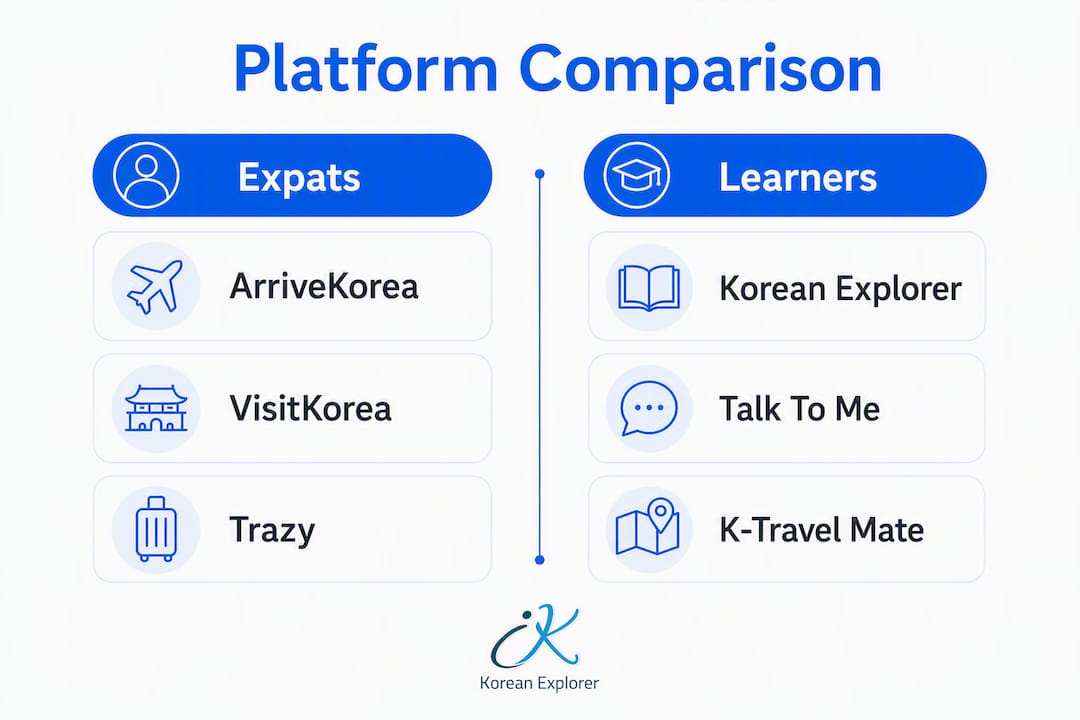
The top alternatives to inmykorea.com, ranked by what you actually need: ArriveKorea for expat living logistics, K-Travel Mate for transit-first trip planning, MyGuideKorea and Soul Korea for curated local discovery, VisitKorea for official tourism data, Talk To Me In Korean (TTMIK) for self-study language resources, and Korean Explorer for structured courses in Singapore. InMyKorea is a solid personal travel blog, but it was built around one writer’s experience. When you need verified expat checklists, AI-assisted route planning, or a real classroom curriculum, you need something built for that job.
Quick shortlist:
- ArriveKorea — verified expat checklists covering visas, healthcare, and cost of living
- K-Travel Mate — AI itineraries and transit-hub routing for short trips
- MyGuideKorea — curated local services, clinics, and events for international visitors
- Soul Korea — Korea Tourism Organization (KTO) data with AI trip planning
- Talk To Me In Korean — structured self-study lessons, podcasts, and reference materials
- Korean Explorer — in-person and online Korean courses for adult learners in Singapore
Table of Contents
- What are the best inmykorea.com alternatives?
- How do you choose the right Korea website alternative?
- What does each Korea website alternative actually offer?
- Which alternative fits your specific goal?
- How to use these platforms together
- Key Takeaways
- Why verified platforms beat personal blogs for serious learners
- Korean Explorer: structured Korean for adult learners in Singapore
- Useful sources
- FAQ
What are the best inmykorea.com alternatives?
| Alternative | Best for | Core focus | Interactivity / features | Content sourcing | Access & cost | Up-to-dateness |
|---|---|---|---|---|---|---|
| ArriveKorea | Expat living guidance | Visa, healthcare, cost of living | Checklists, guides | Editor-curated, verified | Free | Date-stamped guides |
| K-Travel Mate | Transit-first trip planning | Route planning, AI itineraries | AI routes, maps, local Q&A | Curated + AI | Free / freemium | Regularly updated |
| MyGuideKorea | Curated local discovery | Events, clinics, local services | Service directory, listings | Editor-verified | Free | Ongoing updates |
| Soul Korea | Official tourism + AI planning | Attractions, food, festivals | AI trip planner, maps | KTO official data | Free | KTO-sourced |
| TravelGen | AI-driven Korea search | Festivals, accessibility, maps | AI search, travel map | KTO-linked | Free | AI-refreshed |
| Trazy | Niche experiences, bookings | Tours, specialty activities | Booking platform | Curated listings | Free to browse, paid to book | Listing-dependent |
| Talk To Me In Korean | Self-study language resources | Lessons, podcasts, references | Audio, video, workbooks | Editorial team | Free + paid tiers | Ongoing |
| Korean Explorer | Structured courses, Singapore | Conversational and business Korean | In-person, Zoom, corporate | Native instructors, SNU curriculum | Paid enrollment | Live instruction |
One-line verdicts:
- ArriveKorea is the first stop for anyone relocating, not just visiting.
- K-Travel Mate earns its place the moment you need to plan a day around subway stops.
- MyGuideKorea fills the gap between “what’s here” and “can I trust this clinic listing.”
- Soul Korea is the most authoritative free starting point for general trip discovery.
- TTMIK works best as a self-study companion, not a replacement for structured learning.
- Korean Explorer is the right call when you want a curriculum, not just content.
How do you choose the right Korea website alternative?
Match your primary goal to the platform built for it: verified legal and expat info points to ArriveKorea, transit-aware planning points to K-Travel Mate, curated local services point to MyGuideKorea or Soul Korea, and structured language learning points to Korean Explorer.
Decision criteria to check:
- Sourcing: Does the site pull from KTO or official government pages, or is it one person’s opinion?
- Last-reviewed dates: Expat content without a clear review date is a liability, especially for visa and banking steps.
- Contributor credentials: Look for named editors, local experts, or institutional data partners.
- Route and transit tools: Static maps are not the same as transit-hub itineraries.
- Language resources: Free content and structured curricula serve different needs; know which one you’re after.
- Community responsiveness: Active Q&A forums or customer support matter when you hit an edge case.
- Pricing transparency: Freemium platforms should disclose what’s behind the paywall before you invest time.
Red flags to avoid: undated posts on legal or visa topics, heavy affiliate booking links with no editorial context, no named contributors or local experts, and route tools that don’t account for public transit.
Pro Tip: To verify freshness fast, search the site’s name in Google with “site:” and sort by date. Any expat or visa guide older than 18 months without a visible review date should be cross-checked against official Korean government sources before you act on it.
What does each Korea website alternative actually offer?

ArriveKorea
ArriveKorea is built specifically for people moving to or living in Korea, not just visiting. Its checklists cover visa pathways, healthcare registration, phone and bank setup, and cost-of-living comparisons in a step-by-step format that general travel blogs rarely match.
- Verified, practical relocation checklists
- Healthcare and banking setup guides
- Cost-of-living tools for budgeting
Limitation: Light on day-trip itineraries and tourist discovery content.
MyGuideKorea
MyGuideKorea positions itself as a discovery platform for international visitors, aggregating verified local services including medical clinics, events, and specialty businesses. The editor-verified listings make it more reliable than crowd-sourced directories for clinic searches.
- Verified clinic and medical service listings
- Local events calendar for international visitors
- Service directory with editorial oversight
Limitation: Less useful for transit routing or language learning.
Soul Korea
Soul Korea runs on Korea Tourism Organization data, which is about as authoritative as a free platform gets. It covers attractions, food, festivals, heritage sites, and pet-friendly places, with an AI trip planner layered on top.
- KTO-sourced attraction and event data
- AI trip planning with map integration
- Strong coverage of festivals and heritage
Limitation: Stronger on discovery than on expat living logistics.
Trazy
Trazy is a curated booking platform that surfaces niche tours, specialty activities, and local experiences for foreign visitors. It’s less of an information resource and more of a marketplace, which means the editorial depth is thinner.
- Curated niche tours and specialty experiences
- Booking platform with English-language support
- Good for K-beauty, food tours, and day trips
Limitation: Content depth depends on vendor listings, not editorial curation.
VisitKorea
VisitKorea is the official Korea Tourism Organization portal. For national event calendars, accessibility data, and tourism advisories, it’s the primary source. Every other platform on this list either pulls from it or should be cross-checked against it.
- Official KTO event calendars and advisories
- Accessibility and regional tourism data
- Authoritative sourcing for trip planning
Limitation: Interface is functional but not built for interactive route planning.
K-Travel Mate and TravelGen
K-Travel Mate focuses on transit-hub routing and AI-assisted itineraries, making it the strongest pick for day trips built around subway stops. TravelGen complements this with an AI search layer that handles festival queries and accessibility lookups.
- Transit-aware multi-stop route planning
- AI itinerary generation
- Local Q&A features
Limitation: Neither replaces expat-specific legal or healthcare guides.
Talk To Me In Korean
TTMIK is the most widely used self-study Korean resource in English, offering structured lessons, podcasts, and printed workbooks across all levels. It works well as a supplement to classroom learning but doesn’t replicate the feedback loop of live instruction.
- Structured lesson series from beginner to advanced
- Podcasts and audio content for listening practice
- Workbooks and reference materials
Limitation: No live instruction, no feedback on speaking accuracy.
Korean Explorer
Korean Explorer offers structured in-person and online Korean courses for adult learners in Singapore, with a curriculum developed alongside Seoul National University materials and taught by native Korean instructors. Classes cover conversational and business Korean, with flexible group, private, and Zoom options.
- Curriculum aligned with Seoul National University materials
- Native Korean instructors with bilingual support
- In-person classes at Tanjong Pagar, plus online Zoom options
Limitation: A paid structured course, not a free self-study resource. That’s the point.
Which alternative fits your specific goal?
- Expat paperwork and relocation logistics: ArriveKorea, for its step-by-step visa and banking checklists.
- Transit-first day trips: K-Travel Mate, which maps attractions around subway hubs.
- Clinic or medical service search: MyGuideKorea, for editor-verified listings.
- Curated local experiences and events: Soul Korea or Trazy, depending on whether you want discovery or booking.
- Self-study language resources: Talk To Me In Korean, paired with a study routine at home.
- Structured conversational or business Korean in Singapore: Korean Explorer, for live instruction with a real curriculum.
How to use these platforms together
A. Short transit-first trip (3–5 days)
- Start with VisitKorea for official event dates and any travel advisories.
- Use Soul Korea to shortlist attractions, food spots, and festivals.
- Build your daily routes in K-Travel Mate around transit hubs.
- Cross-check clinic or service needs on MyGuideKorea.
B. Long-term relocation checklist
- Begin with ArriveKorea’s visa and housing guides before anything else.
- Use VisitKorea for regional context and official resources.
- Supplement with MyGuideKorea for local services once you arrive.
C. Blended language learning (self-study + structured classes)
- Use TTMIK for listening and vocabulary building between classes.
- Enroll in a structured course at Korean Explorer for live feedback and curriculum progression.
- Reference the online study guide for Singapore learners to build a consistent weekly routine.
Pro Tip: When using K-Travel Mate or any AI itinerary tool, always cross-check transit times against the Naver Map or Kakao Map apps on the day of travel. AI-generated routes use published schedules, but real-time disruptions won’t show up until you’re in the app.
Key Takeaways
Curated, verified platforms consistently outperform solo travel blogs for expat logistics, transit planning, and structured language learning because they draw on official KTO data, named contributors, and date-stamped content.
| Point | Details |
|---|---|
| Match platform to goal | ArriveKorea for expat logistics, K-Travel Mate for transit routing, Soul Korea for general discovery. |
| Verify sourcing and dates | Prioritize platforms pulling KTO data or with visible last-reviewed dates, especially for visa and legal content. |
| Self-study has limits | TTMIK is a strong supplement, but live instruction with feedback accelerates speaking accuracy. |
| Use platforms in sequence | Start with VisitKorea for official checks, then layer in curated and interactive tools. |
| Korean Explorer for Singapore | Structured in-person and Zoom courses with native instructors and an SNU-aligned curriculum. |
Why verified platforms beat personal blogs for serious learners
Personal travel blogs like InMyKorea have real value: they’re readable, personal, and often surface details that official sources miss. But there’s a ceiling. When you need to know whether a visa category changed last quarter, or whether a clinic accepts international patients, or whether your Korean is good enough for a job interview, you need sources built around verification, not storytelling.
The same logic applies to language learning. Free content scattered across YouTube, blogs, and apps can get you to a conversational baseline. Getting past that baseline, to the point where Korean actually works for you professionally, usually requires a structured curriculum, live correction, and a teacher who knows where you’re stuck. That’s not a knock on free resources. It’s just an honest read of where they stop being enough.
Korean Explorer: structured Korean for adult learners in Singapore
If your goal is conversational fluency or business Korean and you’re based in Singapore, the websites above are useful research tools. But they’re not a classroom.
Korean Explorer offers structured adult Korean courses in Singapore with a curriculum developed alongside Seoul National University materials. Classes run in-person at International Plaza (above Tanjong Pagar MRT) and online via Zoom, taught by native Korean instructors with bilingual support.
- Conversation-first teaching: every class builds toward real-life and professional use
- Flexible formats: group classes, private lessons, and corporate training available
- Online Zoom options: full curriculum access without commuting
Browse course options and schedules and enroll directly online.
Useful sources
- VisitKorea — official KTO event calendars, accessibility data, and national tourism advisories; check the “last updated” timestamp on any regulatory or event page.
- ArriveKorea — expat relocation checklists for visas, healthcare, and banking; look for date-stamped guide headers.
- Soul Korea — KTO-sourced attraction and festival discovery with AI trip planning.
- K-Travel Mate — transit-hub itineraries and AI route planning for short trips.
- MyGuideKorea — editor-verified local services, clinics, and events for international visitors.
- TravelGen — AI-powered Korea tourism search with festival and accessibility filters.
- Korean Explorer: where to learn Korean in Singapore — local course listings and enrollment options for adult learners.
- Korean for professionals — career-focused Korean learning guide for working professionals in Singapore.
FAQ
What is the best free alternative to inmykorea.com for trip planning?
Soul Korea is the strongest free option for general trip discovery, drawing on official Korea Tourism Organization data with an AI trip planner built in. K-Travel Mate adds transit-aware routing for day trips built around subway stops.
Which site is best for expats moving to Korea?
ArriveKorea is the most practical choice, with step-by-step checklists covering visa pathways, healthcare registration, phone setup, and cost-of-living tools, all in a date-stamped format.
Can I learn Korean from these websites?
Talk To Me In Korean offers structured self-study lessons, podcasts, and workbooks useful for independent learners. For live instruction with feedback and a formal curriculum, Korean Explorer provides in-person and online Zoom courses for adult learners in Singapore.
How do I know if a Korea website’s information is up to date?
Look for visible last-reviewed dates on individual guides, named contributors or editorial teams, and sourcing from official bodies like the Korea Tourism Organization. Undated posts on visa or legal topics should always be cross-checked against primary government sources.
Is Korean Explorer available online for Singapore learners?
Yes. Korean Explorer runs a full curriculum via Zoom in addition to in-person classes at International Plaza, above Tanjong Pagar MRT, covering conversational Korean, business Korean, and corporate training for adult learners.