Conversational Korean classes deliver four measurable gains: faster speaking confidence, real-time pronunciation correction, everyday vocabulary you can use immediately, and sharper listening comprehension. They work faster than solo study because a live instructor catches your mistakes the moment you make them, and a classroom forces you to produce language instead of just recognizing it. That combination is why learners who add class time to their routine tend to overtake app-only learners in usable speaking ability.
TL;DR:
- Conversational Korean classes accelerate pronunciation correction and speaking confidence because instructors provide immediate, targeted feedback during real-time practice.
- Learners in classes achieve practical vocabulary for everyday situations faster by focusing on useful phrases for travel, shopping, and small talk rather than just written tests.
- Structured classes lead to measurable improvements in speaking self-efficacy, with progress tracked through milestones like self-introductions and sustained two-minute conversations.
- Response speed and initiation of exchanges are clearer signs of progress than vocabulary size, typically improving significantly within an eight to twelve-week intensive course.
- Choosing the right format depends on goals, with group classes suited for beginners and social practice, while private sessions suit learners needing to fix specific gaps quickly.
Table of Contents
- What are the practical benefits of conversational Korean classes?
- What outcomes should you expect from conversational Korean classes?
- How do conversational classes actually produce these results?
- Who should take conversational classes, and which format fits?
- How long does it take to become conversational in Korean?
- What should you look for when choosing a class?
- Does the research actually back this up?
- Why conversational classes are the smarter bet for practical goals
- Ready to build real conversational skills?
- Sources
- FAQ
What are the practical benefits of conversational Korean classes?
Speaking confidence is the benefit learners notice first, and it usually shows up before grammar accuracy does. Once you have said “안녕하세요” out loud to a real person and survived the awkward pause, the second attempt gets easier. Confidence builds from repetition in a low-stakes setting, which is exactly what a conversation class is designed to provide.
Pronunciation improves faster with a native instructor correcting you in the moment than it ever does from an app’s audio playback. A teacher can hear the difference between your 어 and 오, tell you where your tongue should sit, and have you repeat it until the sound clicks. That kind of targeted correction is nearly impossible to get from self-study.
Vocabulary acquisition in a conversational course skews toward what you will actually say out loud, not what shows up on a written test. Courses built around everyday interaction typically front-load phrases for greetings, shopping, and asking directions, because those are the situations learners hit first when they try to use the language outside class.
Listening comprehension improves simply from exposure to different voices, speeds, and accents. An app gives you one speaker. A classroom gives you an instructor, classmates with different learning speeds, and often recorded dialogue that mimics how Koreans actually talk, including the contractions and dropped syllables textbooks skip.
Cultural and pragmatic knowledge rounds out the practical list. Knowing which honorific level to use with a stranger versus a friend, or when a phrase that translates fine on paper would sound stiff or rude in person, only comes from someone explaining the social context behind the words.
Here is the full practical benefit set in one place:
- Speaking confidence: less hesitation before starting a sentence, faster recovery from mistakes
- Pronunciation accuracy: real-time correction on sounds an app cannot hear you make
- Usable vocabulary: phrases for travel, dining, shopping, and small talk you can deploy the same week
- Listening comprehension: exposure to natural speech rhythm and multiple speakers
- Cultural fluency: correct honorific use and situational appropriateness
- Accountability: a scheduled class prevents the slow drift into “I’ll study tomorrow”
That last point matters more than it sounds. Learners moving from app-based solo study into live classes routinely point to structured progression and live feedback as the reason their speaking finally started improving, after months of app streaks that never translated into a real conversation.
What outcomes should you expect from conversational Korean classes?
Progress in a conversation class is easiest to track through milestones, not test scores. Here is a realistic sequence most learners move through:
- Self-introduction: name, nationality, occupation, and a few personal details, delivered without reading from notes
- Transactional exchanges: ordering food, asking a price, or requesting directions with a natural back-and-forth
- Small talk: weather, weekend plans, and simple opinions, held for a short stretch without switching to English
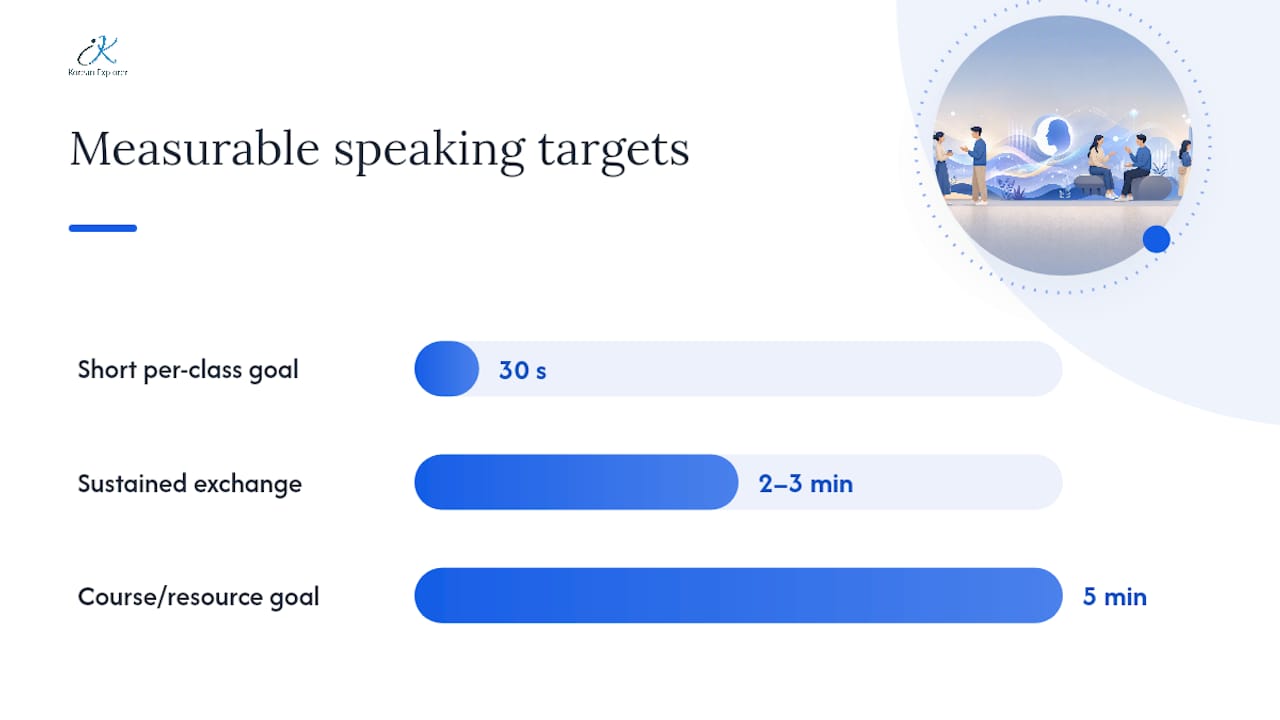
- Sustained exchange: a two to three minute conversation on a familiar topic with only occasional translation
- Reduced reliance on translation: responding in Korean first and only reaching for English when genuinely stuck
Each session should move you a small step along that sequence rather than dumping new grammar with no speaking practice attached. A realistic short-term goal per class might be holding a thirty-second exchange on that day’s topic without freezing. Language resources built around measurable goals, such as ordering at a restaurant or holding a five-minute conversation, consistently recommend tracking progress against specific speaking tasks rather than vague fluency targets.
Over an eight to twelve week block, most learners taking weekly conversational classes go from needing constant prompting to initiating exchanges on their own. The clearest sign of real progress is not vocabulary size. It is response speed. A beginner searches for every word. A learner four months in answers a simple question almost immediately, even if the grammar is not perfect yet.
How do conversational classes actually produce these results?
The results above come from specific teaching techniques, not just “practice.” Task-based speaking is the backbone: instructors set up a scenario, like buying a bus ticket or checking into a hotel, and you work through it out loud rather than filling in a worksheet. That mirrors what actually happens when you land in Seoul or run into a Korean-speaking colleague.
Intercultural activities push this further by adding the social layer. A controlled classroom study on intercultural speaking methods found that learners using this approach recorded measurable gains in speaking self-efficacy, with reported scores rising from 2.87 to 3.46 over the study period. Practicing a phrase is one thing. Understanding why a Korean coworker phrases a request more indirectly than you would in English is what makes the phrase land correctly.
Instructor feedback cycles matter just as much as the activities themselves:
- Recasts: the instructor repeats your sentence back correctly without interrupting your flow
- Targeted drills: short, repeated practice on the one sound or pattern tripping you up
- Pronunciation focus: isolated attention on vowel sounds or batchim endings that English speakers commonly flatten
Modality changes how much of this feedback you get. A private lesson maximizes speaking time and correction per minute. A group class gives you more social practice and a wider range of conversation partners, but less individual airtime. Online classes over Zoom now replicate most of the in-person feedback loop, provided the instructor still runs live speaking drills rather than lecturing at a screen.
Pro Tip: Record yourself answering the same three questions at the start and end of an eight-week block. The improvement is often more obvious in playback than it feels in the moment.
Who should take conversational classes, and which format fits?
Conversational classes suit a wide range of goals, but the right format depends on what you are optimizing for.
- Absolute beginners: group classes work well here because everyone is building the same basic vocabulary together, and the pace stays manageable.
- Returning learners with rusty basics: private lessons make sense if you need to quickly identify and fix specific gaps rather than relearning everything from scratch.
- Travelers on a deadline: an intensive private or small-group course focused on transactional phrases gets you functional fastest.
- Working professionals: online evening or weekend classes fit around a work schedule without sacrificing live feedback, and corporate-style sessions can focus on workplace-relevant scenarios.
Group classes cost less per session and add social practice with peers at a similar level. Private lessons cost more but concentrate correction and speaking time entirely on you. Online formats trade a small amount of in-room energy for scheduling flexibility, which matters if your week does not allow for a fixed commute to a physical classroom.
How long does it take to become conversational in Korean?
Timelines vary with intensity, but two common tracks give a useful benchmark.
- Intensive track (8 to 12 weeks): several sessions a week, heavy speaking practice each class, and daily out-of-class review. Learners following this pace often reach basic conversational competence, meaning they can handle travel and daily-life scenarios, by the end of the block.
- Weekly track (12 to 24 weeks): one class a week with lighter homework. Progress is real but slower, since spaced-out sessions mean more forgetting between lessons.
- Self-paced supplement track: any class frequency, combined with 20 to 30 minutes of daily speaking or listening practice outside class. This is the single biggest lever for speeding up either track above.
Prior language background affects pace too. Someone who already speaks Japanese or Mandarin often picks up Korean sentence structure faster because of shared grammatical logic or vocabulary borrowed from Chinese characters. Someone starting from only English will need more repetition on basic sentence order before speaking feels natural.
Immersion outside class compounds everything. Watching Korean shows with subtitles off for short stretches, or finding a conversation partner for even fifteen minutes a week, tends to move learners through the milestone sequence noticeably faster than class time alone.
What should you look for when choosing a class?
Not every conversational class is built the same way, and a bad fit wastes both time and money. Run through this checklist before enrolling:
- Instructor background: is the teacher a native speaker with actual teaching experience, not just a fluent volunteer?
- Syllabus progression: does the course build logically from greetings to transactional phrases to small talk, or does it jump around?
- Class size: smaller groups mean more speaking time per person; ask directly how many minutes you will talk per session.
- Demo lesson or sample materials: a school confident in its teaching should let you sit in or preview a lesson before committing.
- Progress checks: does the instructor track your milestones, or is it the same generic lesson plan regardless of how you are doing?
Red flags include a syllabus that is entirely grammar drills with no speaking component, a class size so large you would get under a minute of talk time per hour, or a school that cannot describe its own teaching approach beyond “we follow the textbook.”
Does the research actually back this up?
Yes, and the evidence is more specific than most learners assume. A classroom implementation using task-based and intercultural speaking methods measured a real jump in learners’ speaking self-efficacy, moving from an average score of 2.87 to 3.46 across the study period, using structured intercultural speaking activities. That is not a vague satisfaction survey. It is a measured before-and-after on learners’ own confidence in speaking.
Structured classes give learners systematic curriculum progression, immediate feedback from qualified native instructors, and the social accountability that keeps them from quietly dropping out the way isolated self-study learners often do.
That pattern lines up with broader guidance on language class effectiveness, which points to structured progression and native-instructor feedback as the two factors that most reliably separate learners who reach real conversational ability from those who stall out after a few months of app use.
Why conversational classes are the smarter bet for practical goals
Self-study apps are fine for building initial vocabulary, but they cannot correct your pronunciation or push you to speak under mild social pressure. If your goal is ordering food, making small talk, or handling a work meeting in Korean, a structured class with native instructors and a clear syllabus gets you there faster than any app streak. Save the app for grammar review between sessions, not as your main method.
— Paul
Ready to build real conversational skills?
If you have read this far, you already know the gap between knowing Korean words and actually using them in a conversation. Korean Explorer closes that gap with adult-focused conversational and business Korean classes, taught by native instructors, in group, private, and live online Zoom formats. Classes follow a structured syllabus that moves you through the same milestone sequence covered above, and every session is recorded so you can review your own progress instead of guessing at it.
Corporate teams get the same structure adapted to workplace scenarios, useful for professionals who need Korean for client calls or on-site work rather than travel. Classes run at the school’s central Singapore location at 10 Anson Road, Level 22, International Plaza, right above Tanjong Pagar MRT, with online options for learners who prefer to join from anywhere. If you want to see what a structured conversational course actually covers session by session, check the full course listings and pick the format that fits your schedule.
Sources
- Korea
- A Case Study of Korean Speaking Classes Using Intercultural Approach — MSES (2024)
- Everyday Korean Conversations for Beginners — ITE
FAQ
What are the main benefits of learning to speak Korean?
The biggest practical gains are speaking confidence, corrected pronunciation, usable everyday vocabulary, and better listening comprehension, all of which come faster with live instructor feedback than solo study.
How long does it take to become conversational in Korean?
Learners on an intensive eight to twelve week track with heavy speaking practice often reach basic conversational competence by the end of the block, while a weekly class over twelve to twenty four weeks gets there more gradually.
Can I become conversational in Korean in three months?
It is possible with an intensive schedule, daily practice outside class, and consistent live speaking feedback, though most learners need closer to four to six months for comfortable daily conversation.
Is it better to learn Chinese or Korean?
That depends entirely on your goals and existing language background rather than one language being objectively easier; Korean’s writing system, Hangul, is widely considered faster to learn than Chinese characters, but grammar difficulty varies by learner.
Why do conversational classes work better than apps alone?
Apps cannot correct your pronunciation in real time or hold you accountable to a schedule, while a structured class combines native-instructor feedback with social accountability that keeps learners consistent.