TL;DR:
- Korean uses Subject-Object-Verb order and relies on particles to indicate grammar roles.
- Verb endings attach as suffixes in an agglutinative system, adding tense, mood, and respect levels.
- Mastering particles, honorifics, and Hangul is essential through active practice and immersive learning.
Korean grammar doesn’t follow the rules you learned in school. If you grew up speaking English, you’re wired to expect a sentence to flow as Subject-Verb-Object, where the action sits in the middle. Korean flips this entirely. As an agglutinative SOV language, Korean places the verb at the end, uses particles instead of word order to signal meaning, and layers honorifics directly into verb endings. For Singaporeans aiming to use Korean in K-culture, academic, or professional contexts, understanding these structural building blocks early isn’t optional. It’s the difference between guessing and actually communicating.
Table of Contents
- The backbone: Word order and sentence construction
- Agglutinative morphology: How meaning stacks in Korean
- Particles and honorifics: The keys to context and respect
- Hangul, pronunciation, and practical strategies for mastery
- A practical perspective: What most guides miss about learning Korean structure
- Ready to build your Korean foundation?
- Frequently asked questions
Key Takeaways
| Point | Details |
|---|---|
| SOV Word Order | Korean sentences organize ideas as subject-object-verb, not subject-verb-object like English. |
| Agglutinative Structure | Meaning is added by stacking suffixes and endings onto words, especially verbs. |
| Importance of Particles | Particles indicate grammatical roles and often cause confusion but are crucial for clarity. |
| Honorifics and Context | Politeness and social context shape sentence forms through honorifics and verb endings. |
| Master Hangul Early | Learning Hangul’s logic quickly unlocks reading and pronunciation for all learners. |
The backbone: Word order and sentence construction
The first thing that surprises most new Korean learners is where the verb lands. In English, you say “I eat rice.” In Korean, you say the equivalent of “I rice eat.” That’s the Subject-Object-Verb structure at work, and it runs through every sentence you’ll ever build in the language.
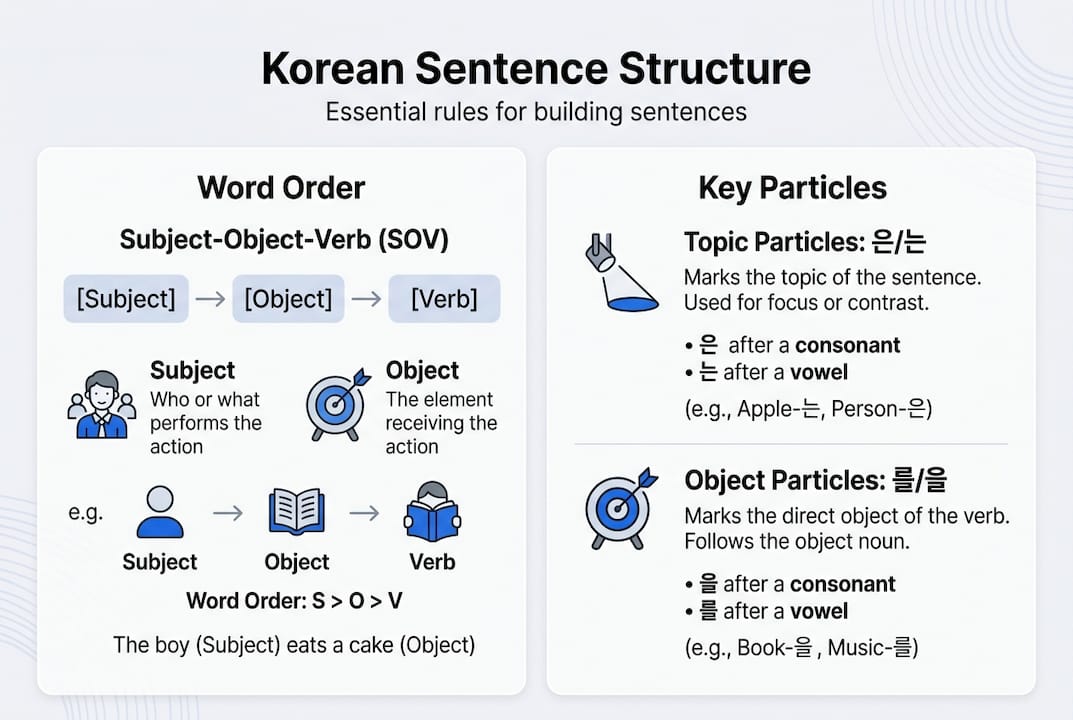
But here’s where Korean gets even more interesting: word order is actually more flexible than English, because particles carry the grammatical load. Particles are small suffixes attached directly to nouns. They tell you whether a noun is the subject, the object, the topic, or something else entirely. You could shuffle the words in a Korean sentence and still be understood, as long as the particles are correct.
For comparison, look at this side-by-side structure:
| Language | Structure | Example |
|---|---|---|
| English | Subject-Verb-Object | I eat rice |
| Korean | Subject-Object-Verb | 나는 밥을 먹어요 (I rice eat) |
The particles in the Korean example are 는 (topic marker on 나, meaning “I”) and 을 (object marker on 밥, meaning “rice”). Remove those particles and the sentence loses precision. Reorder the words but keep the particles? Still perfectly clear.
Here are the core particles every beginner needs to know:
- 이/가 marks the grammatical subject
- 을/를 marks the direct object
- 은/는 marks the topic of the sentence
- 에 marks location or direction
- 에서 marks where an action takes place
For Singaporeans, a practical early sentence to practice is 저는 한국어를 공부해요, meaning “I study Korean.” Notice how 는 follows 저 (I/me in formal speech) and 를 follows 한국어 (Korean language). The verb 공부해요 (study) sits at the end. Understanding how the English vs Korean grammar systems diverge here will save you significant confusion in the early stages.
“Korean is an agglutinative language with Subject-Object-Verb word order, and particles signal grammatical function rather than position.”
Once this clicks, sentence construction starts to feel logical rather than alien.
Agglutinative morphology: How meaning stacks in Korean
Once you grasp the core sentence structure, it’s critical to understand how Korean builds meaning through its unique morphology. “Agglutinative” sounds intimidating, but the concept is straightforward. Think of a Korean verb stem as a train engine, and every suffix you attach is an additional car. Each car adds a specific meaning, such as tense, politeness level, or honorific status, and they stack in a precise order.
Take the verb stem 먹 (to eat). Add endings and it transforms:
- 먹어요 (eat, polite present)
- 먹었어요 (ate, polite past)
- 먹으세요 (please eat, honorific request)
- 드셨어요? (Did you eat? highest honorific)
Each new ending changes the meaning precisely and predictably. This is agglutinative morphology in action: suffixes stack on verb stems to express tense, politeness, and honorifics through seven recognized speech levels.
Here’s a comparison of how endings function:
| Ending | Function | Example |
|---|---|---|
| -아요/어요 | Polite present | 먹어요 (eat) |
| -았어요/었어요 | Polite past | 먹었어요 (ate) |
| -시- (infix) | Honorific marker | 드세요 (please eat, respectful) |
| -겠어요 | Future/intention | 먹겠어요 (will eat) |
Korean is primarily agglutinative but hybrid, meaning some endings fuse and undergo phonological changes rather than stacking cleanly. The ending 었어요 is a classic example where past tense and polite endings merge into a single, blended form.
For Singaporeans learning Korean, understanding these local learning tips around verb endings can dramatically shorten the learning curve.
Pro Tip: Don’t try to learn all seven speech levels at once. Focus on the standard polite form (아요/어요 endings) first. Once that feels natural, layer in the formal and honorific levels. This mirrors how Koreans themselves learn to speak in different social settings, and it’s also how you’ll make your Korean sound native faster.
Particles and honorifics: The keys to context and respect
Beyond building sentences, true fluency depends on grasping the subtle particles and honorifics that communicate meaning and respect. This is where many learners hit a wall, and for good reason.
Particles in Korean aren’t just grammar tools. They carry social and contextual meaning. The difference between 이/가 (subject marker) and 은/는 (topic marker) is one of the most nuanced distinctions in the entire language. 이/가 introduces new or emphasized information. 은/는 signals what the sentence is about in a broader conversational context. Native speakers switch between them instinctively. New learners need time and exposure to internalize this.
Here’s why particles matter more than most beginners expect:
- They replace the need for fixed word order
- They signal new vs. known information in conversation
- They indicate contrast and emphasis without adding extra words
- They are essential for politeness when combined with honorific speech
Honorific language is equally important, especially in Singapore where many Korean learners are pursuing business connections or academic partnerships with Korean institutions. Using casual speech with someone older or in a senior position is considered genuinely rude in Korean culture, not just a grammatical error.
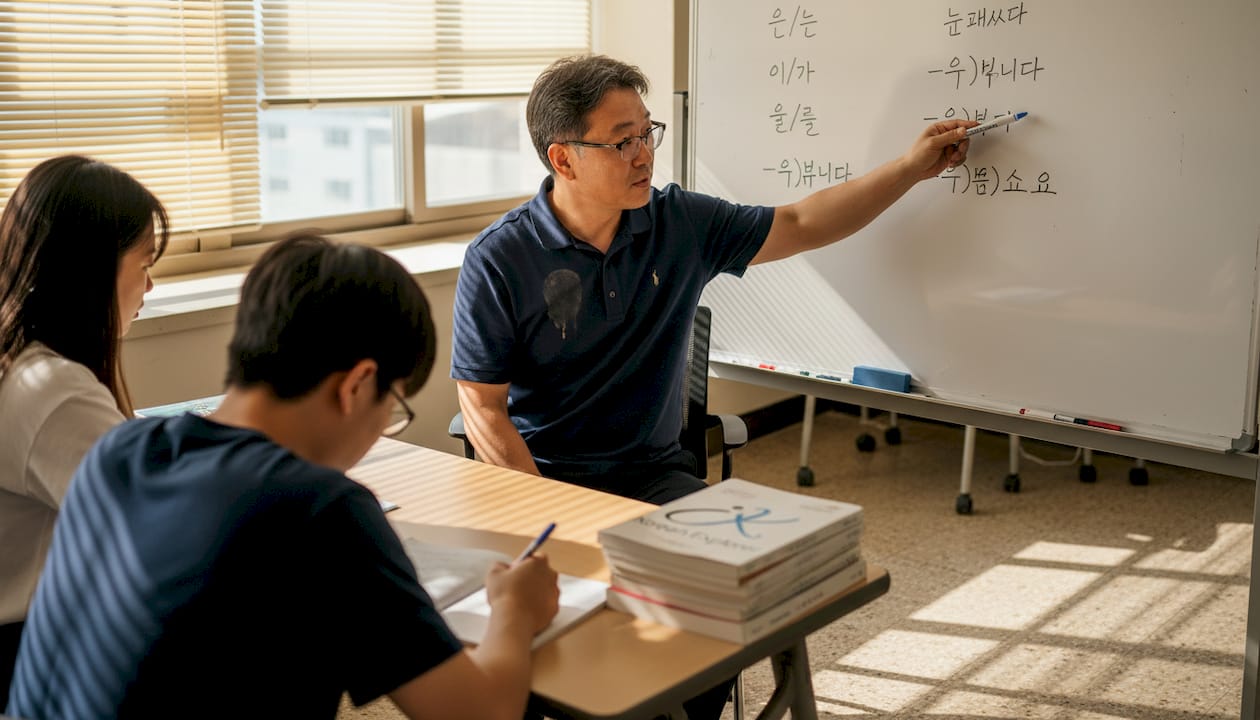
According to KICE 2023 data, 80% of foreign Korean learners find particles and honorifics the hardest aspects of the language to master. That’s a striking number, but it also validates what most learners already feel.
Pro Tip: Instead of memorizing particle rules in isolation, study them through real conversation snippets. Pull lines from a K-drama or a Korean text message exchange and identify each particle’s function. Context is what makes the distinction between 이/가 and 은/는 finally click. Pair this with the tips for Korean particles from experienced instructors and your retention improves dramatically.
For deeper practice, explore resources on mastering Korean particles that go beyond textbook drills.
Hangul, pronunciation, and practical strategies for mastery
To support sentence and grammar mastery, let’s focus on how Korean is written, pronounced, and effectively studied. Hangul, Korea’s writing system, is often called one of the most logical scripts in the world, and that reputation is well earned.
Each Hangul character is a syllable block built on a specific pattern. Syllable blocks follow a ©V© structure: an initial consonant (or the silent ㅇ if the syllable starts with a vowel), a vowel, and an optional final consonant called a batchim. The batchim matters more than many beginners realize. It affects pronunciation of the following syllable through a process called consonant assimilation, and sometimes changes the entire sound of a word.
Here’s a quick breakdown of Hangul block structure:
| Component | Role | Example |
|---|---|---|
| Initial consonant | Starts the syllable | ㅂ in 밥 (bap) |
| Vowel | Core sound | ㅏ in 밥 |
| Batchim (final) | Closes the syllable | ㅂ in 밥 |
For practical mastery, here are the most effective study strategies:
- Learn Hangul first, not last. Most learners can cover Hangul’s syllable blocks within a few hours using structured drills.
- Use spaced repetition for verb endings. Apps like Anki work well for ingraining patterns.
- Watch K-dramas with Korean subtitles. Research on learning from K-dramas confirms that immersive listening accelerates recognition of grammar patterns.
- Practice speaking out loud daily. Even five minutes of shadowing a native speaker trains your ear and mouth simultaneously.
Pro Tip: For pronunciation, focus on the batchim rules early. Many learners skip this and then struggle with natural-sounding speech later. Work through the Korean pronunciation tips that target these specific sound transitions so your Korean doesn’t sound robotic.
A practical perspective: What most guides miss about learning Korean structure
With core structures and strategies in mind, it’s important to address what truly works and what doesn’t in mastering Korean structure.
Most study guides focus heavily on rule memorization. Learn the particles. Memorize the endings. Drill the exceptions. And while that has value, it creates a specific type of learner: one who can pass a written quiz but freezes in a real conversation.
What we’ve seen consistently with Singaporean learners is that fluency comes from active use in authentic situations, not passive rule recall. A student who practices honorifics while navigating a real Korean workplace scenario or chatting in a K-culture fan group builds intuition that no grammar table can replicate. This practical local learning experience is what separates learners who plateau from those who keep progressing.
Korean structure isn’t a fixed rulebook. It’s a living, context-driven system. Particles shift in meaning depending on what came before them in the conversation. Honorific choices depend on reading social cues correctly. The best learners we’ve worked with treat structure as a framework for communication, not a set of constraints to memorize.
Our advice: pair structured learning with immersive learning methods that force you to use what you know under real conditions. That’s when grammar becomes instinct.
Ready to build your Korean foundation?
If you’re serious about mastering Korean structure and want guidance tailored for Singaporean learners, here’s how to accelerate your progress.
Structured learning makes an enormous difference when you’re dealing with a language as nuanced as Korean. At Korean Explorer, our Korean language courses follow a curriculum developed by Seoul National University, aligned with TOPIK standards, and taught by native Korean instructors who explain complex grammar in clear, relatable English.
Singaporeans can also tap into SkillsFuture-supported Korean classes to make structured learning more accessible financially. Whether you’re a complete beginner or looking to level up, our placement process ensures you start at exactly the right point. Find out why we’re considered one of the best places to learn Korean in Singapore and take the first step toward real fluency.
Frequently asked questions
Why is Korean SOV word order hard for English speakers?
Korean sentences end with the verb, which is the opposite of English’s Subject-Verb-Object flow, so English speakers must rewire their instinct for where the action appears. The SOV structure means you often need to hear or read the full sentence before grasping its core meaning.
How fast can I learn Hangul?
Most learners can read and write Hangul within a few hours because its syllable block system is highly logical and consistent, unlike many other writing systems.
What are the main particles I should master first?
Start with the subject markers 이/가, topic markers 은/는, and object markers 을/를. These three cover the majority of sentences you’ll encounter and are the foundation for understanding particle nuances later.
Is memorizing verb endings enough to speak politely in Korean?
No. Polite and honorific speech depends on reading social context correctly, not just applying the right ending. Honorific suffixes must be paired with an understanding of the relationship between speakers to be used appropriately.
How can I practice Korean sentence structure effectively?
Break down real sentences from K-dramas or Korean text conversations, identify each particle and verb ending, and then try rebuilding the sentence in your own words. Active reconstruction beats passive reading every time.