The fastest practical route is a structured multi-level course that pairs weekly live speaking practice with a native instructor, not a self-study app or a one-off workshop. Most adult learners see basic conversational ability within two to three months of consistent weekly classes, whether in a small group, a private online Zoom package, or a hybrid of both. The right format depends on your schedule and your goal: casual conversation, travel, or workplace Korean. Everything below breaks down how to pick.
TL;DR:
- Most adult learners can achieve basic conversational skills within two to three months through weekly live classes with native instructors.
- Small group in-person or Zoom classes offer more speaking time and immediate pronunciation feedback compared to larger or recorded sessions.
- Prioritizing speaking practice during classes and supplementing with daily practice tools significantly accelerates progress.
- Selecting a course with a clear multi-level curriculum, native bilingual teachers, and small class sizes ensures efficient learning and avoids boredom or confusion.
- Cultural immersion, such as local Korean eateries, events, and media, enhances retention and contextual understanding beyond classroom learning.
Table of Contents
- What Types of Korean Courses Are Available in Singapore?
- In-Person, Zoom, or Private: Which Class Format Fits You?
- How Do You Choose the Right Korean Course?
- How Long Does It Take, and What Does It Cost?
- Why Korean Explorer’s Model Fits Adult Conversational and Business Learners
- Where Else Can You Practice and Learn Korean in Singapore?
- What Cultural Immersion Options Exist in Singapore for Korean Learners?
- The Overlooked Part of Learning Korean as an Adult
- Ready to Start Speaking Korean With Real Feedback?
- Sources
- FAQ
What Types of Korean Courses Are Available in Singapore?
Not every course teaches the same skill, and picking the wrong type wastes months. A beginner structured course builds Hangul literacy, basic grammar, and simple reading and writing before it asks you to hold a conversation. Short beginner classroom courses typically run over a few weeks with modest fees, and course listings show fees around S$150 for a short beginner course covering evening sessions.
Conversational classes sit one rung higher. They lean on role-play, register control (polite versus casual speech), and vocabulary you would actually use at a café or with a Korean friend. Some conversational beginner courses use K-drama clips and pop-culture material to make everyday phrases stick faster, with fees around S$280 for a multi-week block.
Business and workplace Korean is its own category entirely. These courses drill office scenarios: explaining a delay, scheduling a meeting, writing a short email. Workplace-focused courses use scenario role-play specifically because rehearsing a typical office exchange in advance cuts down the anxiety of doing it live.
The four practical paths look like this:
- Beginner structured course — Hangul, basic grammar, simple conversation starters
- Conversational course — role-play, register practice, everyday vocabulary
- Business/workplace course — meetings, email phrasing, professional tone
- Multi-level pathway — each level builds on the last, which is why placement testing matters before you commit to a level
Skipping placement testing is the single most common reason adult learners end up bored in a class that is too easy, or lost in one that is too hard.
In-Person, Zoom, or Private: Which Class Format Fits You?
Format changes how much you actually speak, and speaking time is the entire point of a conversation-focused course. A small in-person class gives you more turns per hour and lets the instructor correct your pronunciation on the spot, which matters enormously for a language with sounds English speakers rarely make.
Live Zoom classes match that interaction level as long as the group stays small. You trade a commute for a screen, but a well-run online Zoom group still gives you real back-and-forth with a native instructor, not a recorded lecture. You just need a stable connection and a headset that doesn’t clip your consonants.
Private lessons and intensive packages sit at the top for speed. One-to-one feedback means no waiting for your turn, and progress compounds faster because every minute is about you. It’s worth comparing group versus one-to-one formats directly before choosing, since the trade-off is cost against personalized pace.
- Small in-person classes: more speaking time, instant correction
- Live Zoom classes: same interaction if the group stays small, flexible scheduling
- Private/intensive packages: fastest progress, fully personalized
- Supplementary features: recorded class access, structured materials, corporate delivery options
Pro Tip: Ask whether missed classes come with recorded video access. A single missed session in a fast-moving beginner course can set you back a full week if you have nothing to review.
How Do You Choose the Right Korean Course?
Start with the instructor, not the price. A native Korean instructor with genuine bilingual fluency in English can explain a grammar point two ways when the first explanation doesn’t land, which matters far more in week three than it does in week one.
Run through this checklist before you enroll:
- Does the instructor have native Korean fluency with clear English explanations?
- Is there a defined multi-level curriculum, or does the course just teach random topics each week?
- Does the school offer a placement test if you already know some Korean?
- How many students are in the class, and how much of the two hours will you personally speak?
- Does the schedule fit your week without constant rescheduling?
- Are fees, registration costs, and materials fees listed clearly upfront?
When you contact a provider, ask directly: “How many minutes will I speak per class?” “Is there a trial lesson?” “What happens if I need to transfer to a different time slot or level?” A school that can’t answer these without hedging is telling you something.
Watch for these red flags:
- No visible syllabus or level structure
- Class sizes so large that speaking time per student drops to a few minutes an hour
- Vague answers about who is actually teaching the class
- No trial lesson and no placement test before you pay in full
A step-by-step beginner pathway should tell you exactly what level you start at and what the next one looks like. If a provider can’t show you that, keep looking.
How Long Does It Take, and What Does It Cost?
Hangul basics take about one to four weeks of regular classes to read and sound out comfortably. Basic conversational competence, enough to order food, introduce yourself, and handle small talk, typically arrives after two to three months of consistent weekly classes. Functional conversational fluency, the kind that lets you follow a casual conversation without constant translation in your head, generally takes six to twelve months of steady practice.
Short beginner classroom courses list fees around S$150 for Hangul basics, while conversational beginner blocks run closer to S$280. Private packages and multi-week group courses typically run several hundred dollars higher, plus a modest one-time registration fee and a materials fee.
Frequency shortens the timeline more than anything else. Daily low-friction speaking practice, whether through a private tutor or a short live call, compounds faster than a single weekly class ever will.
Why Korean Explorer’s Model Fits Adult Conversational and Business Learners
The checklist above (native instructors, multi-level curriculum, real speaking time) maps directly onto how Korean Explorer structures its program. The curriculum is developed with Seoul National University, giving each level a defined progression rather than a loosely themed set of weekly topics.
Instructors are native Korean speakers who are also fluent in English, which matters when a grammar point needs a second explanation in your own language. Classes emphasize interactive, conversation-first teaching over textbook recitation, and the school runs group, private, and online Zoom formats so the delivery model bends to your schedule instead of the reverse.
- Curriculum built on a defined multi-level structure, not ad hoc topics
- Native Korean instructors with bilingual English support
- Interactive, conversation-focused class design
- Flexible group, private, and online Zoom formats
That combination directly answers the two questions that matter most when you’re comparing providers: who is teaching, and how much will I actually speak?
Where Else Can You Practice and Learn Korean in Singapore?
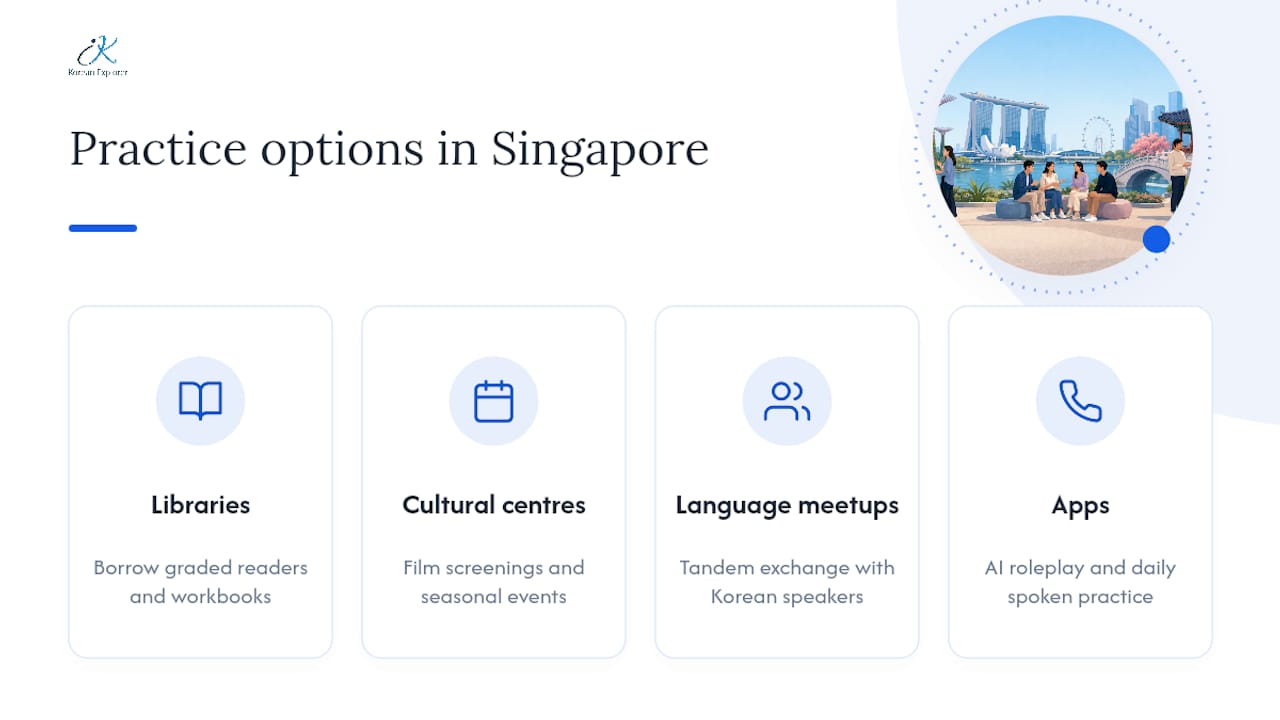
Structured classes give you the foundation, but resources outside the classroom fill the gaps between sessions. Public libraries carry Korean language learning collections, including graded readers and workbooks you can borrow to reinforce Hangul and vocabulary between lessons at no cost.
Cultural centers and organizations occasionally run Korean-language cultural programming, from film screenings to seasonal events, which gives you passive listening exposure even before you can follow a full conversation. Language exchange meetups, often organized informally through community groups or social apps, pair you with Korean speakers who want to practice English in return. These sessions rarely follow a curriculum, but they force you to use whatever vocabulary you already have under real conversational pressure, which is exactly the skill classroom drills can’t fully replicate.
Digital conversation-practice tools have also become a genuine supplement rather than a gimmick. Apps offering AI-based Korean roleplay chat practice let you rehearse scenarios daily without scheduling a human tutor, and similar platforms provide daily spoken practice with instant correction. Neither replaces a live instructor, but stacking five minutes of daily app practice on top of a weekly class measurably speeds up the plateau-breaking stage most learners hit around month two.
None of these resources alone will get you to conversational fluency. Combined with a structured course, they close the gap between the Korean you learn in class and the Korean you actually need to use.
What Cultural Immersion Options Exist in Singapore for Korean Learners?
Language and culture move together, and Singapore gives adult learners more immersion access than most people expect. Korean restaurants, cafes, and grocery stores concentrated in areas with a strong Korean community give you low-stakes chances to order, ask questions, and read menus in Korean without leaving the country.

Cultural events tied to Korean film, music, and food happen throughout the year, often organized by cultural associations or community groups, and they offer a reason to listen to native speech in a real setting rather than a classroom recording. Watching Korean variety shows or dramas with Korean subtitles, instead of English ones, turns passive entertainment into active listening practice once you’ve built enough vocabulary to catch fragments.
Some course providers build cultural context directly into lessons, covering etiquette, workplace hierarchy, and social norms alongside grammar, since a phrase that’s technically correct can still land wrong if you miss the cultural register behind it. That’s part of why a course with real cultural grounding beats pure vocabulary memorization: knowing when to use formal speech with a manager versus casual speech with a friend is a skill textbooks rarely teach well on their own.
Combining classroom study with even modest cultural exposure, a Korean drama night, a grocery run, a community event, gives your brain more contexts to anchor new vocabulary to, which is a big part of why immersion accelerates retention.
The Overlooked Part of Learning Korean as an Adult
Most guidance on this topic obsesses over apps, grammar charts, and “hacks,” and almost none of it addresses the actual bottleneck: adult learners stall not from lack of vocabulary but from lack of low-stakes speaking reps. You can memorize five hundred words and still freeze the first time a native speaker asks you a real question, because recognition and production are different skills.
The conventional advice of “just practice daily” is technically true and practically useless without structure. What works is pairing a class that forces you to speak out loud every session with something that fills the gaps between classes, whether that’s a private tutor, a language exchange, or a daily practice app. Business Korean learners in particular get shortchanged by generic courses that never touch office register, and they end up fluent in casual speech but stiff in a meeting.
If you take one thing from this: prioritize speaking time per class over almost every other factor, including price. A cheaper course where you talk for four minutes an hour is a worse deal than a pricier one where you talk for twenty.
— Paul
Ready to Start Speaking Korean With Real Feedback?
Reading about course formats only gets you so far. Korean Explorer runs its programs specifically around the checklist covered above: native bilingual instructors, a multi-level curriculum, and class sizes small enough that you’re actually talking, not just listening.
If you’re starting from zero, the Conversational Korean Beginner 1 Group Class covers Hangul and everyday conversation for S$350 per person. If your schedule doesn’t allow for a fixed weekly slot, the Private Online Class package gives you eight two-hour sessions over Zoom for S$1,280 to S$1,480 per person, with a one-time S$50 registration fee. Prefer group energy without leaving home? The Group Online Class package runs eight two-hour sessions for S$480 per person. Learners planning to sit a proficiency exam can look at the TOPIK Prep Course for S$1,480, plus a S$50 registration fee and S$50 material fee.
Classes run in person at 10 Anson Road, Level 22, International Plaza, Singapore 079903, right above Tanjong Pagar MRT, alongside the Zoom-based options above. Book a trial class to sit in on a real session before you commit to a full package.
FAQ
How long does it realistically take to learn Korean?
Hangul basics take one to four weeks of regular classes, and basic conversational ability generally follows within two to three months of consistent weekly practice. Functional conversational fluency for everyday and workplace use usually takes six to twelve months of steady, ongoing practice.
Can you learn Korean in 3 months?
You can reach basic conversational competence, greetings, simple questions, everyday small talk, in about two to three months with regular weekly classes and some daily review. Full fluency in three months isn’t realistic for most adult learners, but a solid speaking foundation is.
What is the fastest way to learn Korean?
The fastest combination is a structured course with frequent live speaking practice, backed by daily low-friction practice between sessions, whether through a private tutor, a language exchange, or a conversation-practice app. Private lessons accelerate progress further because every minute of feedback is personalized rather than shared across a group.