Korean sentence endings are the small set of verb endings that simultaneously tell you how polite you must be, what kind of sentence you’re making, and how the listener is supposed to treat the information. Master the speech-level grid first, then move to the discourse endings that mark whether information is new, shared, or overheard. This guide covers both, with formation rules, common mistakes, and drills you can start using today.
TL;DR:
- Korean sentence endings encode both politeness levels and sentence types, making mastery of the speech-level grid crucial for correct usage.
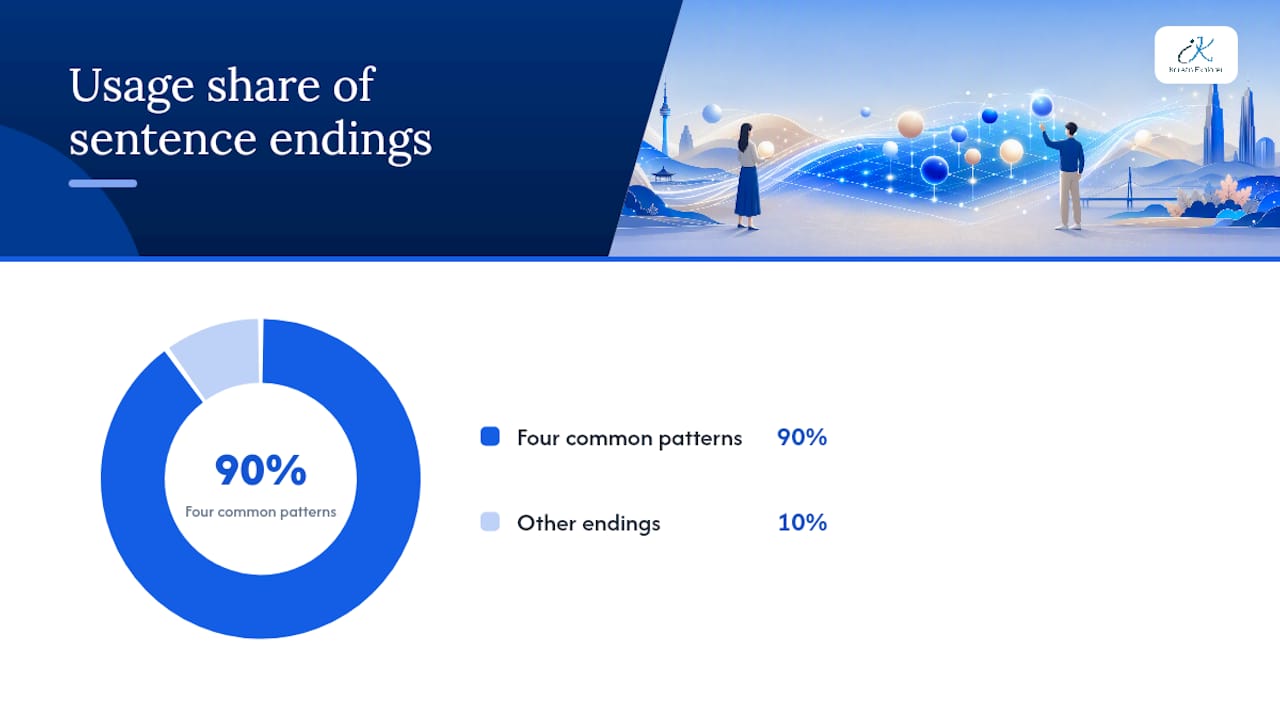
- The most common endings for beginners are -아/어요, -ㅂ니다/습니다, and their plain counterparts, which cover over 90% of daily interactions.
- Discourse endings like -네요 and -거든요 mark whether the information is new, observed firsthand, hearsay, or shared, affecting social nuances.
- Tense markers like -았/었- and future -겠- attach before the final ending, with irregular stems, such as 하다 or ㄹ stems, requiring specific conjugation patterns.
- Avoid common mistakes like dropping -요 with strangers or confusing -거든요 and -잖아요, and practice with native feedback to develop natural, appropriate speech.
Table of Contents
- What Is the Speech-Level and Sentence-Type Grid in Korean Sentence Endings?
- What Are the Most Common Korean Sentence Endings for Beginners?
- Why Do Discourse Endings Like -네요 and -거든요 Matter So Much?
- How Do Tense and Irregular Verbs Affect Korean Sentence Endings?
- What Mistakes Do Learners Make With Korean Sentence Endings?
- How Can You Practice Korean Sentence Endings Effectively?
- A Classroom Note on Teaching Korean Sentence Endings
- Where to Practice Korean Sentence Endings With Guided Feedback
- Sources
- FAQ
What Is the Speech-Level and Sentence-Type Grid in Korean Sentence Endings?
Every Korean sentence ending does two jobs at once. It sets the politeness register, and it marks whether you’re making a statement, asking a question, giving a command, or proposing an action together. Miss either piece, and the sentence sounds off even if the vocabulary is perfect.
Korean has four speech levels that show up constantly in real conversation: 합니다체 (formal polite), 해요체 (informal polite), 해체 (intimate/casual), and 한다체 (plain, used in writing and narration). Each level crosses with four sentence types: declarative, interrogative, imperative, and propositive. A Elon lays out all sixteen combinations for a single verb, and that grid is the fastest way to stop guessing which ending fits a situation.
Take the verb 가다 (to go). In 합니다체, “I go” becomes 갑니다, while “Do you go?” becomes 갑니까? Switch to 해요체 and both become 가요, distinguished only by rising intonation on the question. In 해체, you get 가, again context dependent. In 한다체, used in books, news, and diaries, “goes” is written 간다.
Try 먹다 (to eat) the same way: 먹습니다 (formal statement), 먹어요 (informal polite statement or question), 먹어 (intimate), 먹는다 (plain narrative). And 하다 (to do): 합니다, 해요, 해, 한다. Notice the pattern: 해요체 collapses statement, question, and even suggestion into one shape, which is efficient for speakers but genuinely confusing for learners at first.
A few things to keep in mind as you build this mental grid:
- 해요체 covers roughly the same territory English handles with intonation and tag questions. One form, multiple jobs, and context plus pitch tells you which.
- The honorific marker -(으)시- inserts before most endings when you’re talking about someone senior or unfamiliar, turning 가요 into 가세요. Our guide to Korean honorifics breaks down exactly where this attaches.
- 한다체 rarely comes up in spoken conversation; you’ll meet it mostly in newspapers, novels, and formal writing, so don’t over-practice it for speaking drills.
Once this grid clicks, everything else in Korean sentence structure becomes a matter of plugging verbs into slots you already recognize.
What Are the Most Common Korean Sentence Endings for Beginners?
The endings you’ll use in 90 percent of daily conversation are -아/어요, -ㅂ니다/습니다, and their plainer counterparts. Get these four patterns solid before touching anything more nuanced.
-아/어요 (해요체) is the default polite form for daily life, work with peers, and most service interactions. Formation depends on the final vowel of the verb stem: stems ending in ㅏ or ㅗ take -아요 (가다 → 가요, 오다 → 와요), while everything else takes -어요 (먹다 → 먹어요, 읽다 → 읽어요). This single ending covers statements, questions, and even soft suggestions, so learners have to lean on intonation. A rising pitch turns 가요 (I’m going) into 가요? (Are you going?).
-ㅂ니다/습니다 (합니다체) is the formal register for presentations, news broadcasts, military contexts, and first meetings with someone significantly senior. Verb stems ending in a vowel take -ㅂ니다 (가다 → 갑니다), while stems ending in a consonant take -습니다 (먹다 → 먹습니다). You’ll hear this constantly in customer service announcements and formal business settings.
Plain and intimate forms matter for reading and for close relationships. -ㄴ다/는다 marks plain narrative style in books and diaries: 가다 → 간다, 먹다 → 먹는다. The intimate 해체 form drops -요 entirely: 가 instead of 가요, 먹어 instead of 먹어요. Reserve 해체 for close friends, younger family members, or people who have explicitly invited casual speech. Using it with a stranger or an elder is one of the fastest ways to sound rude by accident.
A quick reference for the four verbs learners see most often:
| Verb | 해요체 | 합니다체 | 해체 |
|---|---|---|---|
| 가다 (go) | 가요 | 갑니다 | 가 |
| 먹다 (eat) | 먹어요 | 먹습니다 | 먹어 |
| 하다 (do) | 해요 | 합니다 | 해 |
| 오다 (come) | 와요 | 옵니다 | 와 |
Pro Tip: When a verb stem ends in a consonant (called a “batchim” in Korean), Korean often needs a buffer vowel 으 before certain endings so the syllable is pronounceable. That’s why 먹다 needs 먹습니다 rather than a direct consonant clash, and it’s the same mechanical reason 읽다 becomes 읽어요 rather than something unpronounceable.
Vowel harmony explains why 가다 takes -아요 while 먹다 takes -어요: Korean groups vowels into “bright” (ㅏ, ㅗ) and “dark” (everything else) categories, and the ending has to harmonize with the stem’s final vowel. Once you internalize this split, conjugation stops feeling like memorization and starts feeling like pattern matching.
Why Do Discourse Endings Like -네요 and -거든요 Matter So Much?
These endings exist to tell your listener something English handles with tone of voice: whether the information is brand new to you, something you personally witnessed, secondhand gossip, or a shared fact both of you already know. Discourse-specific sentence-final endings grammaticalize the listener’s knowledge state, and research on Korean discourse markers treats them as central to sounding like a fluent speaker rather than a textbook one.
English speakers tend to miss this system entirely because English signals the same distinctions through intonation, hedges, and tag questions rather than a bound grammatical ending. Korean instead builds the distinction directly into the verb.
Here’s the family, with the core meaning of each:
- -네요 marks fresh realization, something you’re noticing or reacting to right now. “이 커피 맛있네요” (Oh, this coffee is good!) signals you just discovered that.
- -더라고요 reports something you personally witnessed or recalled firsthand, often from the past. “그 영화 재미있더라고요” (I found that movie was fun, from my own experience watching it).
- -대요/래요 marks hearsay, information you heard from someone else rather than experienced directly. “내일 비 온대요” (I heard it’s going to rain tomorrow).
- -지요/죠 seeks agreement or confirms something you assume the listener already believes. “덥지요?” (It’s hot, isn’t it?).
- -거든요 supplies a reason the listener probably doesn’t already have, often explaining yourself. “저는 오늘 못 가요, 시험이 있거든요” (I can’t go today. I have a test, you see).
- -잖아요 appeals to something the listener already knows or should remember. “오늘 제 생일이잖아요” (It’s my birthday today, remember?).
The -거든요 versus -잖아요 contrast is the single most useful pair to nail early, because swapping them creates real social friction. Use -거든요 when you’re handing the listener new information as a reason or explanation. Use -잖아요 only when you’re both already aware of the fact, since using it for genuinely new information sounds presumptuous or mildly condescending, as if you’re scolding someone for not knowing something they had no way of knowing.
Pro Tip: Before choosing between -거든요 and -잖아요, ask yourself one question: would the listener already know this? If yes, -잖아요. If no, -거든요. That single test resolves most mix-ups.
Dropping the -요 on any of these endings shifts you straight into intimate speech, appropriate only with close friends or younger family. Doing it by accident with a coworker or someone you just met is one of the more common ways learners unintentionally sound blunt.
How Do Tense and Irregular Verbs Affect Korean Sentence Endings?
Tense and aspect markers slot in before the final ending, not after, and that fixed order is the backbone of Korean verb morphology. Syntactic research on Korean describes final endings as encoding mood and speech level while pre-final morphemes handle tense and aspect, sitting in a strict sequence: stem, then tense/aspect marker, then the final ending.
Past tense uses -았/었- inserted right before the ending. 가다 in past tense polite form becomes 갔어요 (went), not some awkward stacking of separate past and present pieces. 먹다 becomes 먹었어요 (ate). The future/intention marker -겠- works the same way structurally: 가겠어요 (I will go / I intend to go) or 먹겠습니다 (I will eat, formal).
The buffer vowel 으 shows up specifically to prevent unpronounceable consonant clusters. Stems ending in a consonant (a batchim) need 으 before certain endings, while vowel-ending stems skip it entirely:
- 먹다 (consonant-ending stem) + 습니다 → 먹습니다, no buffer needed here because -습니다 already starts with a consonant that pairs fine.
- 가다 (vowel-ending stem) + ㅂ니다 → 갑니다, the ㅂ attaches directly since the stem already ends in a vowel.
- 살다 (consonant stem, ends in ㄹ) + (으)세요 → 사세요, where the ㄹ actually drops rather than taking a buffer, one of several irregular patterns tied to ㄹ-final stems.
A short list of the irregular patterns worth memorizing early:
- 하다 verbs (하다, 공부하다, 사랑하다) conjugate to 해요/합니다/해, not a predictable -아요/어요 pattern. This irregularity affects hundreds of common verbs since 하다 attaches to so many nouns.
- ㄹ-irregular stems (살다, 만들다, 알다) drop the ㄹ before endings starting with ㄴ, ㅂ, or ㅅ: 살다 → 삽니다, not 살ㅂ니다.
- ㅂ-irregular stems (덥다, 어렵다) change ㅂ to 우 before a vowel-initial ending: 덥다 → 더워요, not 덥어요.
Our verb conjugation guide walks through additional irregular categories with more worked examples if you want a deeper reference beyond these core patterns.
What Mistakes Do Learners Make With Korean Sentence Endings?
Most register mistakes come from a handful of predictable habits, and every one of them is fixable with a quick mental check before you speak.
- Dropping -요 with people you don’t know well. Intimate 해체 forms feel efficient once you’re comfortable, but using them with a stranger, a boss, or an elder reads as disrespectful even when your grammar is otherwise flawless. Default to -아요/어요 until someone signals it’s fine to drop the honorific tone.
- Confusing -거든요 and -잖아요. Run the “would they already know this?” test every time. New information and a reason: -거든요. Shared knowledge and a reminder: -잖아요.
- Treating dictionary -다 as a spoken casual form. The -다 ending you see in dictionaries and headlines is the plain written form, not something people say aloud in casual conversation. Spoken casual Korean uses 해체 (가, 먹어, 해), never the dictionary form.
- Ignoring intonation on 해요체. Since the same 가요 can be a statement or a question, flat delivery on a question makes you sound like you’re mumbling a fact rather than asking one. Practice exaggerating the rising pitch until it becomes automatic.
Pro Tip: Record yourself saying the same 해요체 sentence three ways, as a statement, a question, and a suggestion, then listen back. Most learners are surprised at how flat their “questions” sound until they hear the recording.
How Can You Practice Korean Sentence Endings Effectively?
Classroom-tested drills move learners from recognizing endings on paper to producing them without hesitation in conversation, which is a different skill entirely. Here are two structured drills plus role-play prompts worth running weekly.
- Speech-level conversion drill. Take six simple sentences (2-3 verbs, mixed tenses) and rewrite each across all four speech levels: 합니다체, 해요체, 해체, and 한다체. Time yourself; aim to cut your conversion time in half over two weeks.
- Knowledge-state swap drill. Take five sentences using -네요, -더라고요, -대요, -거든요, or -잖아요, then swap each for a different ending in the family and explain out loud how the meaning shifts. This forces you to articulate the pragmatic difference rather than just recognize it.
- Role-play: giving an excuse. Practice declining an invitation using -거든요 to explain a genuine reason, then practice the same scenario using -잖아요 to remind a friend of something you’ve already told them. Notice how the second version only works if the information is truly shared.
- Role-play: reacting to news. Have a partner tell you something surprising, and practice responding with -네요 for fresh reactions versus -더라고요 for something you’re recalling having seen yourself.
Teachers generally correct sentence-type errors first (declarative versus question, for instance) before touching register mistakes, since sentence type affects comprehension more directly than politeness level. Short, timed practice sessions, five to ten minutes with a strict clock, tend to build more automatic recall than open-ended study. For more structured speaking practice, our collection of verbal exercises and conversation phrase list both give you material to run these drills against real vocabulary.
A Classroom Note on Teaching Korean Sentence Endings
The errors that show up most often in class aren’t about memorizing which ending goes with which verb. They’re about register. A student will nail the grammar of -거든요 on a worksheet and then use it to explain something the listener obviously already knew, and the sentence comes out sounding oddly defensive. That gap between knowing the rule and reading the room is where real correction has to happen.
The fix isn’t more grammar drilling. It’s more conversation where a mistake actually lands and gets noticed in real time, because that’s when the “would they already know this?” instinct starts to form. Once it clicks, the payoff is immediate: fewer awkward pauses, fewer accidental slights, and speech that finally sounds like it belongs to a person instead of a worksheet. If you want that correction happening in real time rather than after the fact, guided practice with a native speaker closes the gap faster than solo study ever will.
— Paul
Where to Practice Korean Sentence Endings With Guided Feedback
Reading about -거든요 versus -잖아요 only gets you so far. The gap closes fastest when a native speaker catches your register slip the moment it happens and tells you why it landed wrong, not three chapters later in a workbook.
Language classes are offered with two paths built specifically for this kind of practice. The Conversational Korean Beginner 1 Group Class puts you in live conversation with classmates and a native instructor, so you’re testing 해요체 intonation and basic endings against real reactions, not silence. For faster correction on discourse endings and register nuance, the Private Online Class package gives you eight two-hour sessions of one-on-one feedback over Zoom, where an instructor can catch a -거든요/-잖아요 mix-up the instant it happens and walk you through the fix on the spot. Both formats include recorded class videos, allowing review of corrections. Contact the team for placement recommendations and to start the class that fits your level.
Sources
The discourse-ending analysis in this guide draws on academic research into how Korean sentence-final endings encode listener knowledge state, alongside the speech-level and sentence-type reference grid at Elon.io and its companion piece on managing shared knowledge through discourse endings. For the morphotactic ordering behind tense markers and buffers, see the published research on Korean syntax. For guided, structured practice, browse Com’s Korean sentence order and verb conjugation resources.
- Sentence-Final Endings and Discourse (University of Hawai’i repository)
- Elon
- Korean syntax and morphotactics (published article PDF)
FAQ
Why Do Koreans Say “-mnida” So Often?
“-mnida,” from -ㅂ니다/습니다, is the formal 합니다체 ending used in news broadcasts, workplaces, presentations, and first meetings with someone senior. Koreans reach for it whenever the setting calls for distance and respect rather than casual warmth, and it applies regardless of what’s being said.
What Does “Gaja Gaja Gaja” Mean?
“가자” is the propositive form of 가다 (to go) in intimate 해체 speech, meaning “let’s go.” Repeating it three times in a row (“가자 가자 가자”) is simply emphatic urging among close friends, roughly equivalent to shouting “let’s go, let’s go, let’s go!” in English.
How Do Koreans Say “Let’s Eat”?
The propositive form of 먹다 (to eat) is 먹자 in casual 해체 speech among close friends, or 먹어요 with rising, suggestion-toned intonation in polite 해요체 company. The more formal option, 먹읍시다, appears in group settings like meetings or family gatherings where a slightly more respectful tone is expected.
How Do I Know When to Use 이 or 가?
이 and 가 are subject markers, not sentence endings, but they trip up the same learners because both attach to nouns right before the verb. 가 follows nouns ending in a vowel (친구가 왔어요, my friend came), while 이 follows nouns ending in a consonant (선생님이 오셨어요, the teacher came), a pattern driven by the same batchim logic that governs buffer insertion in verb endings.
What’s the Difference Between -거든요 and -잖아요?
-거든요 introduces a reason or explanation the listener doesn’t already have, while -잖아요 appeals to something you both already know. Using -잖아요 for genuinely new information tends to sound presumptuous, since it implies the listener should have already known it.