Intensive learners can reach conversational Korean relatively quickly studying most days; steady daily learners take longer; casual learners often need significantly more time. The gap between those numbers comes down to hours per week, how early you start speaking out loud, and whether you’ve studied another language before. “Conversational” here means handling everyday interactions with about 1,000 active words and holding a 5 to 10 minute spoken exchange. Timelines shift fast depending on input quality and how much actual talking you do, not just studying.
TL;DR:
- Most learners master Hangul in 1 to 3 days, emphasizing immediate reading ability before moving on to vocabulary or grammar.
- Achieving conversational competence typically takes several months of consistent practice, with at least 2 to 3 weekly speaking sessions.
- Early speaking is crucial, and scheduling brief daily conversations from week one drastically shortens the overall timeline.
- Using spaced repetition and shadowing outperforms passive input alone, especially when paired with live classes or AI practice platforms.
- Mistakes like delaying speaking until feeling “ready” or relying on romanization can add months to progress, so early correction and direct practice are essential.
Table of Contents
- Conversational Korean Timeline: Phase by Phase
- What Does a Weekly Korean Study Schedule Actually Look Like?
- Which Study Methods Actually Speed Up Speaking Ability?
- The Mistakes That Add Months to Your Timeline
- How Do You Know You’ve Reached Conversational Korean?
- Why This Timeline Holds Up
- An Instructor’s Honest Take on Timelines
- Ready to Turn This Timeline Into Real Progress?
- Sources
- FAQ
Conversational Korean Timeline: Phase by Phase
Every realistic conversational Korean timeline breaks into four phases, and skipping the order rarely works. You can’t shortcut Hangul, and you can’t talk your way through beginner grammar you haven’t touched. What varies by study intensity is how fast you move through each phase, not the sequence itself.
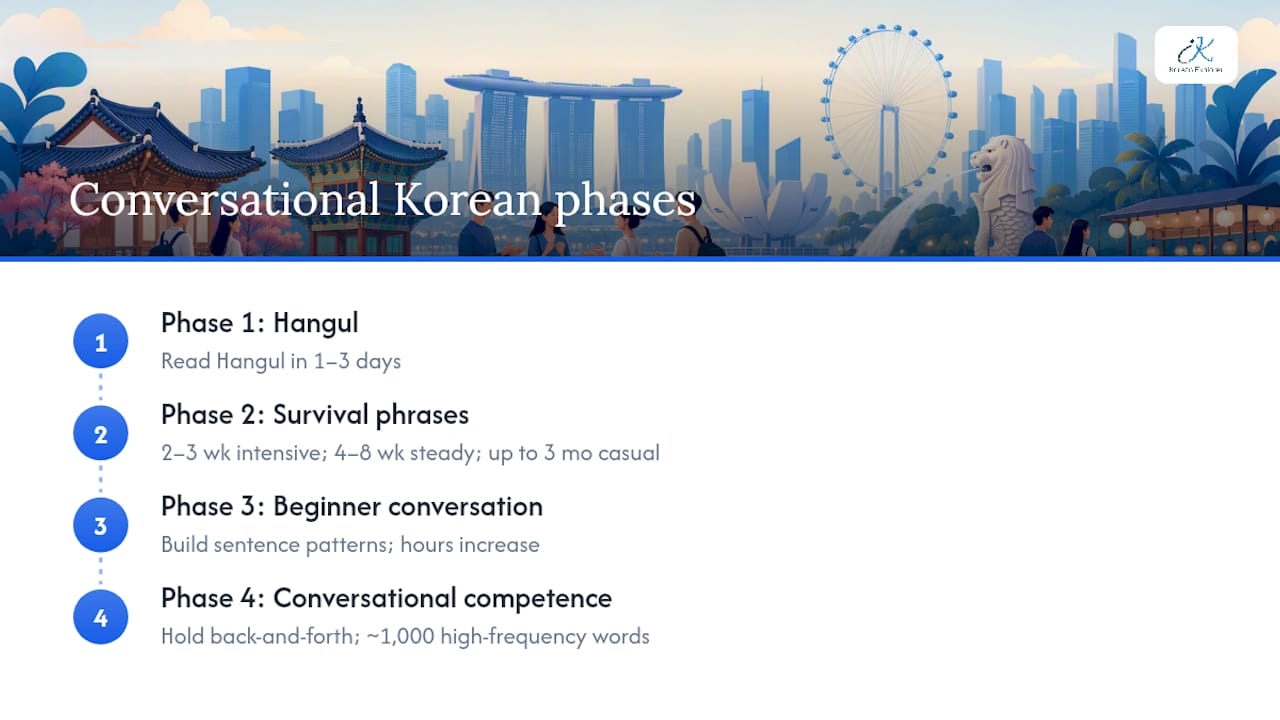
Phase 1: Hangul and pronunciation. Most learners read Hangul within 1 to 3 days of focused practice, since it’s a phonetic alphabet built to be learned quickly, unlike character-based writing systems. This phase is about decoding syllable blocks and matching sounds to letters, not memorizing vocabulary yet.
Phase 2: Survival phrases. This covers greetings, numbers, basic questions, and enough vocabulary to order food or ask directions. Intensive learners clear this in 2 to 3 weeks; steady learners take 4 to 8 weeks; casual learners might stretch it across 3 months.
Phase 3: Beginner conversation. Here you start building sentence patterns, the polite informal speech level, and enough vocabulary to describe your day, your job, and your plans. This is where hour totals climb fast, since grammar patterns need repetition in actual speech, not just recognition on flashcards.
Phase 4: Conversational competence. You can hold a real back and forth conversation, understand most natural speed audio on familiar topics, and recover when you don’t understand something instead of freezing. About 1,000 high-frequency words cover most daily conversational needs, according to TryKaiwa’s Korean learning timeline research.
One detail people underestimate: listening speed lags behind speaking ability for almost everyone. You’ll likely produce simple sentences before you can comfortably follow a native speaker talking at full speed, and that’s normal, not a sign you’re behind schedule.
What Does a Weekly Korean Study Schedule Actually Look Like?
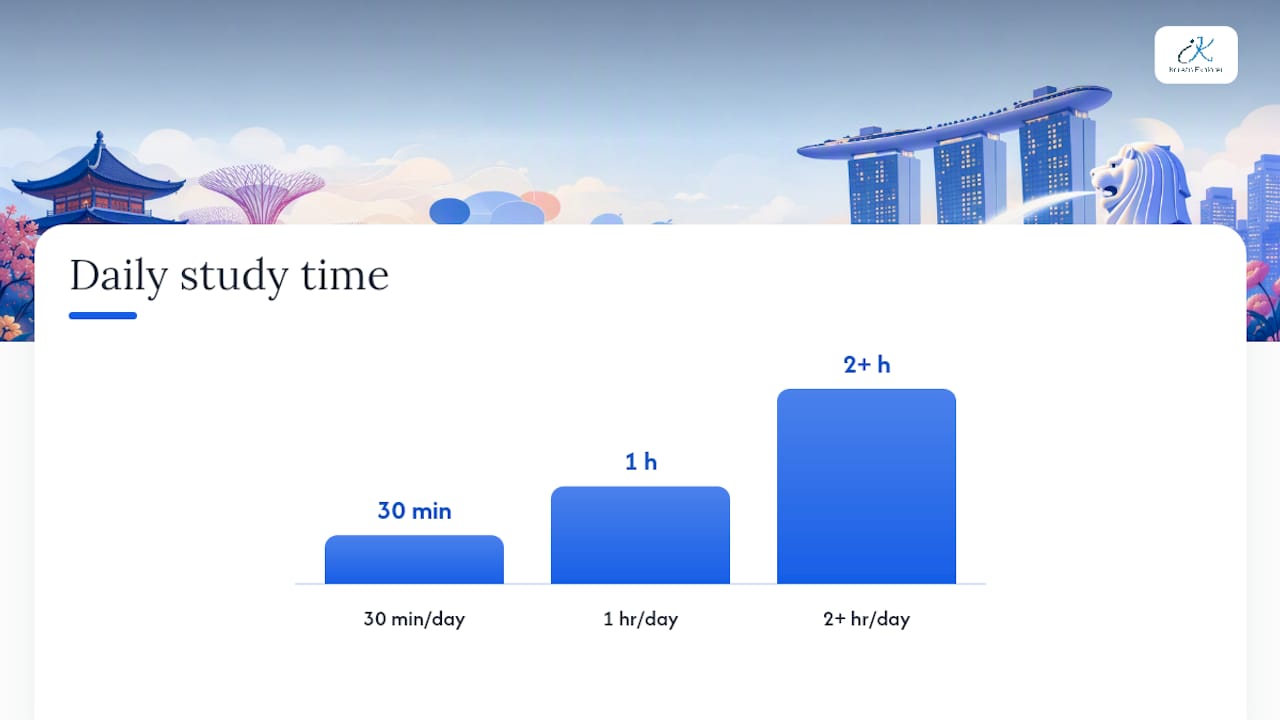
A workable Korean study schedule scales with your available time, but the components stay the same at every intensity: daily vocabulary review, regular speaking practice, and periodic checkpoints to confirm you’re actually progressing.
- 30 minutes a day: 10 minutes of spaced repetition vocabulary review, 10 minutes of shadowing a short audio clip, 10 minutes writing or speaking three sentences about your day.
- 1 hour a day: 15 minutes of SRS review, 20 minutes of grammar-focused input (a lesson or article), 15 minutes of shadowing, and 10 minutes of unscripted speaking practice, even if it’s just talking to yourself.
- 2+ hours a day: Split into two sessions. Morning: SRS review plus new grammar input. Evening: a real conversation (with a partner, tutor, or structured speaking drill), followed by review of what tripped you up.
On a weekly basis, aim for at least 2 to 3 active speaking sessions regardless of intensity level, plus one dedicated listening session using unscripted, natural speed content. A 12-week progression gives you natural checkpoints: by week 4, you should manage basic self-introductions and simple questions; by week 8, short exchanges about daily routines; by week 12, a loose 5-minute conversation on a familiar topic, even with mistakes.
Pro Tip: Pair every new vocabulary word you add to your spaced repetition deck with one spoken sentence using it that same day. Recognition and production are different skills, and reviewing a word silently doesn’t guarantee you can produce it under pressure.
For more structured week-by-week ideas, see this breakdown of Korean study schedules built for real fluency.
Which Study Methods Actually Speed Up Speaking Ability?
Production-first learning beats input-only study for conversational speed. Watching hours of dramas builds comprehension, but comprehension and speaking are separate skills that need separate practice. Language-teaching research on the input hypothesis supports combining comprehensible input with regular output, not choosing one over the other.
- Spaced repetition (SRS): Apps like Anki outperform simple flashcard review for long-term vocabulary retention, especially when decks prioritize high-frequency verbs and question frames over obscure nouns.
- Shadowing: Repeating audio out loud immediately after hearing it, matched to natural native speed, trains your mouth and ear together rather than separately.
- AI conversation practice: Platforms like LinguaLive fill the gap when a live partner isn’t available, giving on-demand roleplay and immediate correction.
- Live classes: Structured conversation classes catch fossilized errors and pragmatic mistakes (wrong politeness level, awkward phrasing) that self-study alone rarely flags, according to the Korean American Center.
Most learners read Hangul in 1 to 3 days, and around 1,000 words cover the bulk of daily conversation needs, per TryKaiwa’s research. That single data point explains why so many learners underestimate their own progress. The early phase moves fast; the plateau in beginner conversation is where most people quit, right before things get easier.
The Mistakes That Add Months to Your Timeline
- Waiting to speak until you feel “ready.” Fix: schedule short speaking practice from week one, even if it’s just narrating your own actions out loud.
- Leaning on romanization instead of Hangul. Fix: commit to reading Hangul directly within the first week. Romanization slows pronunciation and creates habits you’ll have to unlearn later.
- Drilling grammar exercises without speaking them. Fix: add one short unscripted conversation daily, even 5 minutes, to convert recognition into production.
- Misjudging speech levels. Fix: learn the polite informal (-요) form first, since it covers the vast majority of everyday adult conversations before you touch formal or intimate registers.
Small corrections like these, made early, often save months compared to discovering them after building bad habits. For more on where speaking practice tends to break down, this guide on Korean speaking practice covers common repair strategies.
How Do You Know You’ve Reached Conversational Korean?
Measuring progress beats guessing at “fluency,” which is a vague finish line nobody agrees on. Use concrete checkpoints instead.
- Can you read a restaurant menu and place an order without switching to English?
- Can you introduce yourself, your job, and your general interests in under a minute?
- Can you hold a 5 to 10 minute conversation on a familiar topic, asking follow-up questions?
- Can you understand most of a native speed conversation on a topic you already know?
Self-tests help here: record a 1-minute monologue about your week and listen back for gaps, time an actual conversation with a partner, or test comprehension against unscripted native audio. If you’re consistently stalling in the same spot, that’s the signal to change intensity or bring in structured feedback rather than pushing the same routine harder. Some targeted speaking exercises can help isolate exactly where the breakdown happens.
Why This Timeline Holds Up
This timeline draws on classroom experience teaching adult learners under a curriculum aligned with Seoul National University’s Korean language program, alongside established second language acquisition concepts like the input hypothesis and spaced repetition. The pedagogical emphasis throughout favors early production over passive review.
An Instructor’s Honest Take on Timelines
Every learner’s timeline looks different, but the ones who progress fastest aren’t the most talented. They’re the ones who speak daily, even badly. Small, consistent wins beat sporadic long study sessions every time.
— Paul
Ready to Turn This Timeline Into Real Progress?
Reading a timeline is one thing. Actually hitting each checkpoint on schedule is another, and that’s where structured feedback closes the gap self-study can’t. Group classes, private lessons, and online Zoom sessions are available specifically for adult learners working toward conversational or business-level Korean, with native instructors who catch the small errors that quietly slow you down for months if left uncorrected.
Classes run at 10 Anson Road, Level 22, International Plaza, Singapore 079903, right above Tanjong Pagar MRT, with additional locations in Jurong and Tampines for learners who want a location closer to home. If you’re not sure where you’d slot into a class, book a Korean placement test first, or browse the full course list for adult learners to see which format, group, private, or online, fits your schedule best.
Sources
- How Long Does It Take to Learn Korean? Realistic 2026 | TryKaiwa
- Anki — powerful, intelligent flashcards
- Duolingo is just the start — here’s why serious Korean learners are joining real classes | Korean American Center
- LinguaLive — Korean speaking practice with AI
FAQ
How Long Does It Realistically Take to Learn Korean?
Intensive daily study enables many learners to reach conversational ability in a few months; steady daily practice takes longer, and casual, sporadic study often requires a significantly longer period.
Can You Speak Korean Conversationally in 3 Months?
Only with intensive daily practice combining speaking, listening, and spaced repetition review, and even then expect basic conversational ability rather than deep fluency.
How Long Does It Take to Learn Hangul?
Most learners read Hangul within 1 to 3 days of focused practice, since it’s a phonetic alphabet designed for fast learning rather than a system requiring years of character memorization.
Is There a Set Timeline of Milestones for Learning Korean?
Yes, a practical timeline moves through four phases: Hangul in days, survival phrases in weeks, beginner conversation over a few months, and conversational competence over several months depending on study intensity.
How Did Some Learners Reach Fluency So Quickly?
Learners who progress fastest usually combine early speaking practice with spaced repetition and consistent daily exposure rather than relying on passive watching or listening alone, a pattern echoed in most structured conversation practice research.