Use this standard sequence and the formal 합니다체: Subject, then Address and Greeting, Self-Intro, Purpose, Body, Request, Closing, and Signature. That order isn’t optional in Korean business correspondence, and skipping the self-introduction or softening a request into a direct command is the fastest way to look inexperienced to a Korean reader.
TL;DR:
- Proper self-introduction and the use of formal, 존댓말 register are essential, with the standard structure including subject, greeting, purpose, body, request, closing, and signature.
- Addressing recipients correctly with their title, name, and appropriate suffixes shows hierarchy awareness and should follow set patterns, especially when unsure of titles.
- Using 해요체 or 반말 within a formal email signals carelessness, as 한국 business emails require consistency in formal speech levels, particularly the 합니다체.
- Clear, specific subject lines with brackets and purpose indicators significantly increase the chances of your email being opened and responded to promptly.
- Including CCs when appropriate and referencing attachments politely are crucial to maintaining professionalism and clarity in Korean workplace communication.
Table of Contents
- Korean Email Format: The Structure You Should Follow Every Time
- Getting Names and Titles Right in a Korean Email
- Formal Register: Why 합니다체 Is Non-Negotiable
- Subject Lines That Actually Get Opened
- Phrases and Templates Worth Memorizing
- CC, BCC, and Attachments: The Etiquette Nobody Explains
- Closing Lines and Signature Format
- A Full Annotated Example You Can Copy
- Why This Guide Reflects Real Classroom Practice
- What Actually Matters Here (And What Doesn’t)
- Sources
- FAQ
Korean Email Format: The Structure You Should Follow Every Time
A professional Korean email runs through seven parts in a fixed order: subject line (제목), greeting (인사말), introduction and purpose (도입), main content (본문), action items or requests (요청사항), closing (맺음말), and signature (서명). This seven-part structure is what Korean readers expect, and deviating from it, say, burying your request in the middle of a paragraph, makes the email harder to act on.
Here’s how each piece works in practice:
- Subject: state the purpose plainly, often with a bracketed prefix like [확인 요청] (confirmation requested).
- Address line: name the recipient with their title and 님, followed by 께 (“to”).
- Self-intro: open the body with “[회사명] [부서명] [이름]입니다” (“This is [Name] from [Department], [Company]”).
- Body order: context first, then the actual matter, then what you need from the reader.
- Request closers: end with 부탁드립니다 or 감사하겠습니다 rather than a flat command.
Readers skim top to bottom looking for the ask, so front load context and put the request in its own short paragraph near the end.
Getting Names and Titles Right in a Korean Email
Korean workplace culture runs on hierarchy, and how you address someone signals whether you understand it. Getting a title wrong, or omitting one you should have used, changes how the whole message reads.
Three patterns cover most situations:
- Title only (팀장님, “Team Lead”): use when the relationship is formal and the title alone is respectful enough.
- Name plus title (김민수 팀장님): use when clarity matters, especially in group threads or first contact.
- Name plus 님 (김민수 님): use for peers or when no clear title applies, such as freelancers or external partners.
For institutional correspondence, especially a formal notice or 공문, use 귀하 after the name, a more distant and formal equivalent of “님” reserved for official letters. If you’re unsure whether someone is 과장님 or 부장님, default to 담당자님 (“person in charge”) rather than guessing wrong. The address line itself follows a set pattern: name plus title plus 님께, then the greeting on its own line. When writing to someone senior outside your own company, pair that address line with 안녕하십니까 as your opening greeting, immediately followed by your self-introduction, before you get into the matter at hand.
Pro Tip: If you truly don’t know the recipient’s title, 담당자님 is a safe universal fallback. It reads as respectful without risking a factual error on rank.
Formal Register: Why 합니다체 Is Non-Negotiable
합니다체, the formal declarative speech level, is the baseline register for Korean business email. It signals distance and respect regardless of how well you know the recipient, and switching out of it mid-email is one of the more noticeable mistakes a non-native writer can make.
Two grammar tools do most of the work here. The honorific infix -(으)시- raises the recipient, as in 확인하시기 바랍니다 (“please confirm,” literally elevating the person doing the confirming). Humble verbs like 드리다 lower the sender instead, as in 연락드리다 (“to contact,” used when you’re the one reaching out to someone above you). Formal written notices go a step further, using 귀하 and -고자 하다 constructions that don’t appear in spoken Korean at all.
Turning a command into a request is simple once you know the pattern:
- Direct: 확인해 주세요 → Polite: 확인 부탁드립니다.
- Direct: 보내 주세요 → Polite: 보내주시면 감사하겠습니다.
Mixing 해요체 or 반말 into an otherwise formal email is one of the more common register slips, and it reads as careless rather than casual. One inconsistent sentence can undercut an otherwise well-written message.
Subject Lines That Actually Get Opened
Korean inboxes get triaged fast, and subject lines carry the load. The convention is company or sender name plus a specific purpose, often flagged with a bracketed prefix that tells the reader exactly what kind of response you need. Subject lines that include the company name and a clear purpose get read faster than vague ones, and the bracket prefix does a lot of that work on its own.
- [확인 요청] 3월 회의록 검토 부탁드립니다 (“Confirmation requested: please review the March meeting minutes”) flags that you need a check, not just an FYI.
- [회신 요청] 견적서 관련 문의 (“Reply requested: inquiry about the quotation”) tells the reader a response is expected, not optional.
- [긴급] 계약서 서명 필요 (“Urgent: contract signature needed”) reserves urgency markers for things that are actually urgent, so the tag keeps its weight.
Vague subjects like “문의드립니다” (“I have an inquiry”) get buried. Specificity is what gets your email opened first.
Phrases and Templates Worth Memorizing
A handful of set phrases cover most business situations, and knowing them cold saves you from improvising register mid-sentence.
| Korean phrase | Literal gloss | When to use it |
|---|---|---|
| 확인 부탁드립니다 | “Confirmation, please request” | Asking someone to check or verify something |
| 회신 부탁드립니다 | “Reply, please request” | Asking for a response by a certain point |
| 빠른 회신 부탁드립니다 | “Fast reply, please request” | Signals urgency, but can read as pressure if overused |
| 회신 주시면 감사하겠습니다 | “If you give a reply, I will be thankful” | Softer alternative when urgency isn’t the point |
| 첨부파일 확인 부탁드립니다 | “Attached file, confirmation please request” | Referencing an attachment politely |
| 바쁘신 중에 죄송하지만 | “Sorry in the midst of your busy schedule, but” | Softener before making a request |
Three short templates cover the situations you’ll hit most often:
- Inquiry: Address line → 안녕하십니까 → self-intro → “[제품/서비스]에 대해 문의드립니다” (I’m inquiring about [product/service]) → specific question → 확인 부탁드립니다 → closing.
- Meeting request: Address line → greeting → self-intro → proposed date and purpose → “가능하신 시간을 알려주시면 감사하겠습니다” (please let me know a time that works) → closing.
- Follow-up: Address line → greeting → brief reference to prior contact → “회신 부탁드립니다” → closing.
CC, BCC, and Attachments: The Etiquette Nobody Explains
CC in Korean workplace email isn’t just informational. It’s often a deliberate move to document a decision and put a supervisor on record as aware of it. Leaving a relevant manager off CC when they’d normally expect to be included can read as an oversight, even if the omission was accidental.
A few practical rules:
- CC your manager or the relevant team lead whenever a decision, deadline, or commitment is being made.
- BCC is reserved for cases needing confidentiality, like a mass notice where recipients shouldn’t see each other’s addresses.
- Name attachments clearly and reference them in the body: “첨부파일로 견적서를 보내드립니다” (“I’m sending the quotation as an attachment”).
- If you’re unsure whether to CC someone, err on the side of including them. Under-including reads worse than over-including.
Closing Lines and Signature Format
감사합니다 (“thank you”) works for most everyday emails. 감사드립니다 is slightly more formal and fits when writing to someone senior or outside your organization. For sign-offs, 드림 (“respectfully, from”) is common for peer-to-peer or standard business correspondence, while 올림 carries more deference and suits writing to someone clearly above you in rank or age.
A clean signature block includes:
- Name, title, and department
- Company name
- Phone number and email
- Company address, if relevant to external correspondence
Avoid 수고하세요 (“good work” or “take it easy”) when writing to a senior. It’s a peer-level phrase that sounds presumptuous going up the hierarchy. 감사합니다 또는 좋은 하루 되세요 (“thank you, and have a good day”) is a safer universal closer. If the recipient may not read Korean fluently, adding a short English line beneath your Korean signature is common practice and not seen as unprofessional.
A Full Annotated Example You Can Copy
Here’s a short, real business email with a line-by-line gloss:
제목: [확인 요청] 계약서 초안 검토
김민수 팀장님께,
안녕하십니까. ABC컴퍼니 영업팀 이지은입니다.
지난주 논의드린 계약서 초안을 첨부파일로 보내드립니다. 검토 후 의견 주시면 감사하겠습니다.
확인 부탁드립니다.
감사합니다.
이지은 드림
- 제목 (“Subject”): the bracketed prefix flags exactly what’s needed, confirmation.
- 김민수 팀장님께 (“To Team Lead Kim Min-su”): title plus 님 plus 께, the standard address format.
- 안녕하십니까 / ABC컴퍼니 영업팀 이지은입니다: formal greeting immediately followed by self-introduction, company and department first.
- 보내드립니다 / 감사하겠습니다: humble verb forms lowering the sender, raising the reader.
- 확인 부탁드립니다: the actual request, isolated in its own short line so it can’t be missed.
- 이지은 드림: standard peer-to-senior sign-off.
For a stricter style variant, swap 팀장님께 for 귀하 and open with “귀사와의 협력에 감사드리며” (“thanking your company for the cooperation”). For a peer-level version, 안녕하세요 replaces 안녕하십니까 and 올림 becomes 드림 or even just a name. Whatever you do, avoid dropping into 해요체 partway through. One casual verb ending in an otherwise formal email undoes the whole tone.
Why This Guide Reflects Real Classroom Practice
This guide is written by Paul, drawing on classroom patterns taught at Korean Explorer, a Korean language school built around a curriculum from Seoul National University. The focus stays on conversational and business Korean for working adults, not on exam prep or younger learners.
- Classes run in-person and online over Zoom, so location isn’t a barrier to practicing this kind of formal register.
- Instructors are native Korean speakers who teach bilingually, which matters when explaining nuances like 드리다 versus 주다 that don’t translate cleanly.
- Corporate training options exist for teams that need consistent email etiquette across a whole department.
- The Anson Road center sits directly above Tanjong Pagar MRT, making in-person practice sessions easy to fit around a workday.
Written correspondence is one of the harder skills to self-teach because mistakes are silent. Nobody corrects your register in real time the way a conversation partner would.
What Actually Matters Here (And What Doesn’t)
Most guides to Korean email etiquette spend too much time on vocabulary lists and not enough on the one thing that actually trips people up: register consistency. You can know every polite phrase in this article and still write a bad email if you slip from 합니다체 into 해요체 halfway through, because Korean readers notice that shift immediately, even when they can’t articulate why the email suddenly feels off.
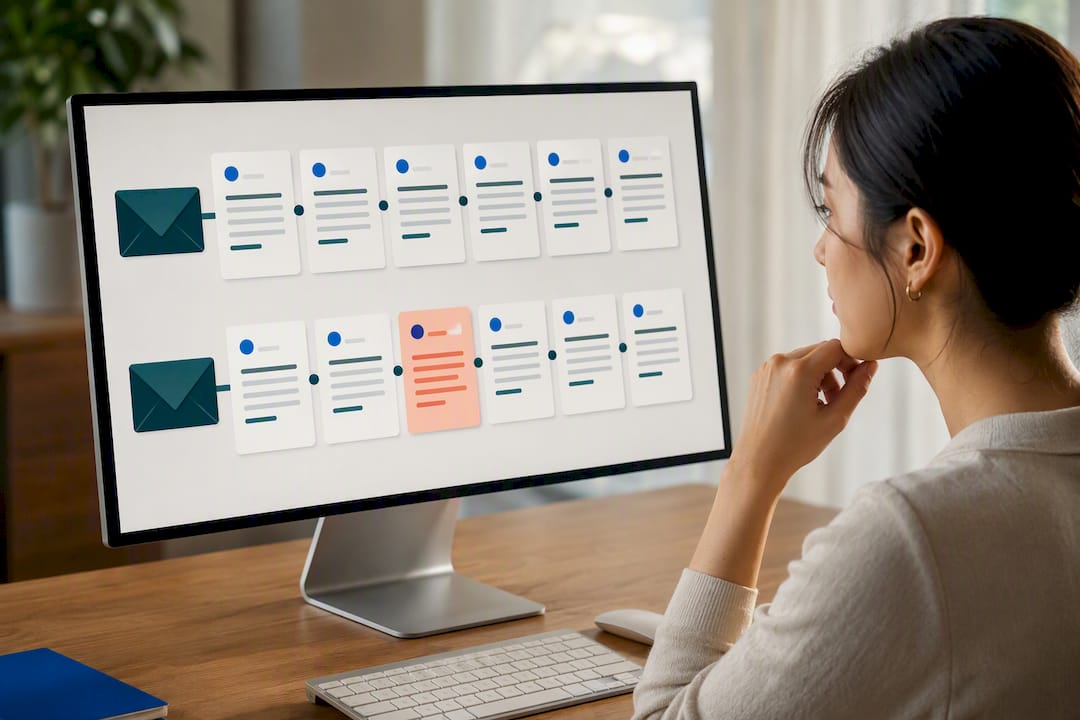
The conventional advice treats honorifics like vocabulary to memorize. They’re not. They’re a system, and -(으)시- and 드리다 only work correctly when the whole email commits to the same level of formality from address line to signature. A single casual verb ending undoes four lines of careful honorific work.
If you’re going to prioritize one thing, prioritize the self-introduction line. “[Company] [Department] [Name]입니다” seems like a formality, but it’s the sentence that tells a Korean reader you understand how workplace hierarchy operates before you’ve asked them for anything. Everything else, the subject prefix, the CC list, the closing line, matters less than getting that one sentence right. Learning it properly, alongside the honorific grammar behind it, usually goes faster with structured business Korean instruction than with phrase lists alone, since the grammar behind 님 and -시- is easier to internalize through guided practice than memorization.
— Paul
Sources
FAQ
How do you write a Korean mailing address in an email signature?
Korean addresses in formal signatures typically go the largest unit to smallest in English-language business contexts, but when written in Korean, they follow the reverse: province or city, then district, then street and building number, ending with the postal code.
Is Naver a Korean email service?
Naver Mail is a widely used Korean email service tied to the Naver portal, similar in function to Gmail, and it’s common to see Korean business contacts using a Naver address alongside their corporate one.
How do Koreans typically end a business email?
Most business emails close with 감사합니다 or the more formal 감사드립니다, followed by a sign-off like 드림 (peer to standard business use) or 올림 (more deferential, for senior recipients).
How do I address a Korean name correctly in an email?
Use the surname and title together when known (김민수 팀장님), title alone if that’s the standard practice (팀장님), or name plus 님 for peers; when title is uncertain, 담당자님 is a safe fallback.