Manage your time with 10-question time boxes, use skip-and-return, and train the Evidence Line Drill. These three moves deliver the biggest score gains for TOPIK II reading. Everything else, from passage schemas to a 2-week intensive plan, exists to make that combination stick under real exam pressure.
TL;DR:
- Master time boxes dividing questions into five blocks of ten, with strict cutoffs, to ensure steady pacing throughout the exam.
- Practice skipping questions that stall after 30 seconds and returning to them later, using clear markers to save valuable time.
- Focus on passage type identification and matching reading strategies to passage schemas to improve efficiency and accuracy.
- Use evidence line drills to attach answers to specific proof sentences, reducing pattern-matching errors and increasing answer confidence.
- During test day, follow a disciplined routine with answer marking, quick decision-making, and time management to maximize scoring potential.
Table of Contents
- Topik ii reading strategies at a glance: your top 6 tactics
- How should you split 70 minutes across 50 reading questions?
- What reading schemas work for each TOPIK II passage type?
- How do you train evidence-based answer selection?
- What’s a realistic 2-week intensive study plan for reading?
- What should you practice differently for the digital TOPIK exam?
- What should your test-day routine look like?
- Why structured feedback shortens your improvement loop
- What actually moved my score the most
- How Korean Explorer can help you apply these strategies
- Sources
- FAQ
Topik ii reading strategies at a glance: your top 6 tactics
Before the deep dives, here’s the shortlist. If you only remember one section from this article, make it this one.
- Time boxes: Split the 50 questions into five blocks of 10 and give each block a hard cutoff, so you always know if you’re behind schedule.
- Skip and return: If a question stalls you for more than 30 seconds without progress, circle it, move on, and come back after finishing the block.
- Reverse strategy for IBT: Read the question and answer choices before the passage, then scan only for the section that answers it.
- Passage schema matching: Identify the passage type in the first three seconds (announcement, graph, argument, narrative) and switch your reading pattern to match it.
- Evidence line marking: Underline or mentally flag the exact sentence that proves your answer choice before selecting it.
- Mock test routine: Run at least one full timed mock every week, then log your errors by category, not just by score.
None of these strategies stands alone. A candidate who masters passage schemas but ignores time boxes still runs out of minutes on the last ten questions. A candidate who is fast but skips evidence-checking makes confident wrong guesses on argument passages. The combination is what moves your score, not any single trick in isolation.
Pro Tip: Print this list, or save it as a photo on your phone, and glance at it during your last practice mock before test day. Treat it as your test-day cheat card, not just reading material.
Notice that “skip and return” only works if you actually mark the question clearly. Circle the number in your test booklet or use the digital flag tool on IBT, then physically note which block you’re in so you don’t lose track of unanswered items when you circle back. A messy return pass costs more time than the skip saved.
How should you split 70 minutes across 50 reading questions?
TOPIK II PBT gives you 50 questions in 70 minutes, which averages out to 84 seconds per question. That average is misleading, though, because questions are not evenly difficult. Early items (1 to 20) are usually short and formulaic. Middle items (21 to 40) demand more inference. Late items (41 to 50) are long passages that eat time fast if you read them start to finish without a plan.
A sample time-box split that works for most intermediate to advanced test-takers looks like this:
- Questions 1 to 10: 12 minutes
- Questions 11 to 20: 13 minutes
- Questions 21 to 30: 15 minutes
- Questions 31 to 40: 15 minutes
- Questions 41 to 50: 15 minutes
That leaves a small buffer for skip-and-return passes. One successful candidate who adopted this exact structure, paired with disciplined skipping, reported saving 15 minutes across the section while improving accuracy. That margin matters more than it sounds. Fifteen extra minutes on a 70-minute clock is a 21% time recovery, and TOPIK II candidates often reinvest saved reading time into the writing section, where planning time is scarce and directly affects score.
The 30-second rule is simple: if you read a question and its options and still don’t see a clear path to the answer within 30 seconds, stop. Circle it, note the block you’re in, and move to the next question. Returning with fresh eyes after finishing nine other questions in that block almost always beats grinding on one item for two minutes straight.
Setting your own time targets requires actual data, not guesswork. Run three full mock reading tests and log your per-block times honestly, using a phone timer or a simple stopwatch app. If you consistently finish Q1 to Q10 in 9 minutes but Q41 to Q50 takes 18, you know exactly where to trim. A tool like TESTUNO’s reading speed test can also give you a baseline reading pace outside the exam context, which helps you separate “I read Korean slowly” from “I get stuck on TOPIK-specific question formats.”
One counterintuitive tactic worth testing in your mocks: some high scorers tackle the hardest question cluster (usually 42 to 50, the long dual-question passages) before the easier early items, while their focus is sharpest. Fatigue builds over 70 minutes, and if your accuracy on long passages drops noticeably after minute 50 in practice, front-loading them can raise your overall score even though it feels backwards.
What reading schemas work for each TOPIK II passage type?
Every passage type in TOPIK II reading rewards a different search pattern. Reading blind, start to finish, wastes time you don’t have. Matching your approach to the passage type is what separates a 70-minute finish from a 55-minute one.
Announcements and notices (typically early questions): These hide the answer in specific details like dates, locations, or conditions. Skim for bolded terms, numbers, and negation words (“cannot”, “except”) first, since wrong answers usually flip one small detail.
Graphs and statistics passages: Follow a fixed order: read the title, check the axis labels, spot the highest and lowest points, note the overall direction, then look for anomalies. Descriptive phrases like “more than half” or “a steady increase” are common traps. Always cross-check the wording against the actual numbers in the chart before trusting a summary statement, because test writers deliberately mismatch loose language against precise data.
Argument and opinion passages: The real thesis often sits right after a contrast marker like “하지만” (however) or “그러나” (but). Underline the sentence immediately following any contrast conjunction. Writers bury the main claim there specifically because careless readers stop at the first opinion stated.
Expository and informational texts: These reward paragraph-level skimming. Read the first and last sentence of each paragraph before diving into detail questions, since topic sentences usually carry the answer to “main idea” questions.
Sentence-order and insertion tasks: These hinge on connector words and repeated referents. If a sentence starts with “이것” (this) or “그것” (that), it almost always follows the sentence that introduced the noun it replaces. Training yourself to spot these left-right joins between sentences cuts down the trial-and-error of testing every possible order.
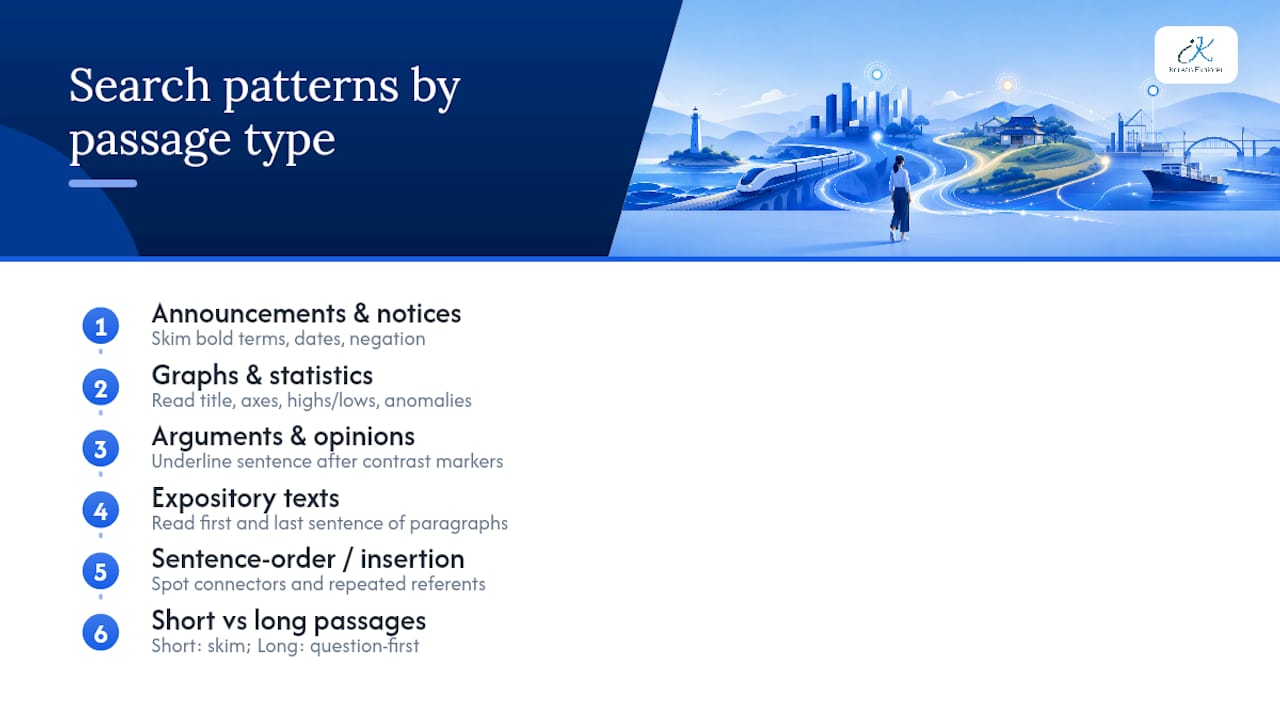
On the question of reading the question first versus skimming the passage first: for short passages (under 100 words), skim first, since you’ll finish reading before you’d even finish parsing the question stem. For long passages (dual-question sets, argument pieces), read the question and options first, then hunt the passage for the specific proof. This is the same logic behind the reverse strategy IBT candidates rely on, just applied to paper as well.
Pro Tip: Mark passage type in the margin the instant you recognize it, even before reading a single sentence of body text. A one-second habit like writing “그래프” or “논쟁” next to the passage number keeps your brain in the right mode and prevents you from defaulting to slow, linear reading.
How do you train evidence-based answer selection?
Guessing based on a “vibe” is the single most common source of preventable errors on TOPIK II reading. The fix is what’s often called the Evidence Line Drill: for every answer you select, you must be able to point to the exact sentence in the passage that proves it. If you can’t point to a line, you haven’t actually solved the question, you’ve pattern-matched, and pattern-matching fails on trap questions designed specifically to punish it.
Training evidence-finding means drilling three specific sub-skills:
- Referent tracking: Words like 이것 (this), 그것 (that), and 그 (that/the) almost always point back to the immediately preceding sentence or noun phrase. Practice isolating what each referent points to before you even look at the answer choices.
- Conjunction mapping: Words like 따라서 (therefore), 왜냐하면 (because), and 반면에 (on the other hand) flag the sentence carrying the passage’s main content. Train yourself to circle every conjunction on a first pass through unfamiliar text.
- Paraphrase spotting: The correct answer choice rarely repeats the passage’s exact wording. It restates the same idea in different vocabulary. Practice rewriting passage sentences in your own words, then compare your paraphrase against the answer options to see how test writers disguise correct answers.
A useful micro-drill format: pull 10 to 20 questions from past papers, but instead of just answering them, write the evidence sentence number next to each answer before checking the key. This forces accountability. When you review, sort your mistakes into categories rather than lumping them together.
| Error type | What it looks like | Fix |
|---|---|---|
| Referent confusion | Picked wrong antecedent for 이것/그것 | Redo referent-only drills on 5 passages |
| Missed conjunction signal | Overlooked 하지만/따라서 marking main idea | Circle all conjunctions before reading answers |
| Paraphrase mismatch | Chose literal repeat instead of correct restatement | Practice paraphrasing 3 sentences daily |
| Chart misread | Trusted descriptive phrase over actual numbers | Redo graph-specific drills, verify against axis |
| Time pressure guess | No evidence line, answered from memory of similar question | Slow down, redo under no time limit first |
This error taxonomy matters more than your raw practice score. A learner who scores 70% but can’t explain why answers were right is far more fragile on test day than a learner who scores 65% but can point to the evidence line for every single answer, including the wrong ones.
What’s a realistic 2-week intensive study plan for reading?
Two weeks is enough time to meaningfully shift your reading speed and accuracy, provided the plan mixes targeted drills with full mock exams rather than relying on unguided extensive reading. A structured plan that alternates isolated skill work with timed practice consistently outperforms simply reading more Korean text without a target.
Here’s a day-by-day breakdown for the first week, focused on building individual skills before combining them under time pressure:
| Day | Focus | Activity |
|---|---|---|
| 1 | Diagnostic | Full mock test, log time per block and error type |
| 2 | Referent drills | 20 questions isolating 이것/그것/그 tracking only |
| 3 | Conjunction drills | 20 questions isolating connector-word signals |
| 4 | Graph schema | 15 chart/statistics questions, verify every number |
| 5 | Argument schema | 15 opinion passages, underline post-contrast sentences |
| 6 | Sentence order | 15 insertion/ordering questions, timed |
| 7 | Rest or light review | Review error notebook, no new drills |
The second week shifts toward combining skills under realistic time pressure:
- Day 8: Timed block practice, Q1 to Q20 only, using full time-box rules.
- Day 9: Timed block practice, Q21 to Q40, focus on evidence-line accountability.
- Day 10: Timed block practice, Q41 to Q50, the long dual-question passages.
- Day 11: Full mock test under exact exam conditions, no pauses.
- Day 12: Deep error review, redo every missed question without a timer.
- Day 13: Second full mock test, compare time-per-block against Day 1.
- Day 14: Light review only. Read your error notebook, rest your eyes, sleep well.
After the intensive two weeks, shift to a maintenance rhythm: one full mock per week, three short skill drills spread across other days, and ongoing vocabulary building through varied reading. Track two numbers religiously: time per 10-question block and accuracy percentage per block.
Choose past papers and practice sets that match your registered exam format specifically. Our guide on TOPIK preparation tips that actually move the needle breaks down where to source reliable practice materials for both formats.
What should you practice differently for the digital TOPIK exam?
TOPIK II IBT is not just a screen version of the paper test. The question count and interface differ meaningfully from PBT, so practice on the wrong format wastes hours building habits that don’t transfer.
- Question count differs by format: PBT reading runs 50 questions in 70 minutes, while IBT sections use a different count and timing structure tied to the digital interface. Confirm which format you’re registered for before choosing practice materials.
- Practice reverse reading: Since full passages aren’t always visible on one screen, read the question and answer choices first, then scroll to find the specific proof rather than reading top to bottom first.
- Get comfortable scrolling under pressure: Scrolling costs seconds you don’t get back. Practice mock IBT sets specifically to build muscle memory for scrolling efficiently instead of re-reading from the top each time.
- Use the digital highlight and memo tools: Most IBT interfaces let you highlight text or jot short notes on screen. Practice using these during mocks so they become automatic rather than something you fumble with mid-exam.
- Manage eye fatigue: Screen reading for 70 minutes straight strains your eyes differently than paper. Set your practice monitor brightness and font size exactly as you’d expect on test day, and take short blink breaks between time-box blocks during mock sessions.
If you’re unsure which format suits your situation, our breakdown of how TOPIK works and its full exam format covers the practical differences in more depth.
What should your test-day routine look like?
A clean routine on test day prevents the kind of avoidable mistakes that cost half a level on your final score. Build this checklist into your last few mock sessions so it feels automatic, not new, when you walk into the actual exam.
Before the test starts:
- Confirm your watch or timer is allowed and working, since phones are typically restricted.
- Check your seating and materials layout so nothing feels unfamiliar during the tutorial.
- Do a light 5-minute warm-up read of Korean text, nothing new, just to activate reading mode.
During the test:
- Read the question and options first for longer passages, then hunt for the evidence line.
- Mark and move on the instant you hit the 30-second stall point on any single question.
- Star genuinely uncertain answers, even ones you filled in, so you know exactly what to revisit.
In the final 5 minutes:
Skip trying to solve anything new. Instead, confirm every question has an answer marked, even a guess, since blank answers guarantee zero points while guesses have a chance. Recheck starred items only if you have time left after that.
Pro Tip: If panic hits mid-test, stop reading for five seconds, exhale, and restart on the next question rather than the one that stalled you. Losing 30 seconds to breathe is far cheaper than losing three minutes to spiraling.
Why structured feedback shortens your improvement loop
Self-study drills work, but they have a ceiling. You can spot that you got a referent-tracking question wrong, but diagnosing why your mental model of Korean connectors is off, and fixing it before it recurs across ten more passages, is where a second set of trained eyes changes the timeline.
Korean Explorer builds its curriculum around the standards used to assess proficiency across Korean language levels, with native Korean instructors who are fluent in both Korean and English guiding that error-diagnosis process directly. That combination matters specifically for the Evidence Line Drill: an instructor who reviews your marked evidence sentences can immediately tell you whether you’re missing a conjunction pattern, misreading a referent, or falling for a paraphrase trap, rather than you guessing at the pattern across dozens of practice sets alone.
Structured instruction speeds up the loop in a few concrete ways:
- Faster error diagnosis, since an instructor spots a recurring referent-tracking mistake in one session rather than you noticing it after twenty missed questions.
- Corrected schema habits, since feedback on your passage-type recognition happens in real time, not after a full mock’s worth of wrong turns.
- Structured accountability through mock tests and recorded lessons, so gaps get addressed before they calcify into bad habits.
…
What actually moved my score the most
Of everything covered here, time-boxing produced the fastest visible gain for me. Evidence-line training took longer to pay off but built the durable accuracy the timing alone couldn’t. If you do nothing else today, run one 10-question set under a hard 12-minute cutoff and see where you actually stand.
— Paul
How Korean Explorer can help you apply these strategies
Reading about time boxes and evidence lines is one thing. Getting a native instructor to watch you apply them in real time, under a clock, is what actually closes the gap between knowing a strategy and using it reflexively on exam day.
Korean Explorer’s intermediate-level classes build mock reading tests directly into the course structure, so instructors can review your marked evidence sentences and flag exactly which schema you’re missing, whether that’s referent tracking, conjunction mapping, or graph verification. Every session gets recorded, so you can rewatch the feedback on a missed passage instead of relying on memory alone. Classes run in-person at our centre above Tanjong Pagar MRT or online over Zoom, so the drill-and-feedback loop fits your schedule whether you’re studying before work or on a weekend. If you’re ready to turn this article’s tactics into a routine with actual instructor feedback attached, check out our intermediate Korean course and book a session that maps directly to the drills above.
Sources
- TOPIK Reading: Stop Running Out of Time! A Successful Candidate’s 15-Minute Shortcut | HaniSeoul TOPIK
- TOPIK Reading: Number of Questions, Texts and Question Types — TOPIK Lab Info
- Glossa journal article (practitioner guidance on chart interpretation)
FAQ
How much time should you spend on TOPIK II reading?
TOPIK II PBT gives you 50 questions in 70 minutes, which averages to about 84 seconds per question, though a 10-question time-box split with hard cutoffs works better than an even average across all 50 items.
What are five active reading strategies for TOPIK II?
Time-boxing your sections, skip-and-return marking, passage schema matching, evidence line verification, and reverse reading for digital formats form the five most effective active strategies for TOPIK II reading.
Is TOPIK II reading difficult?
TOPIK II reading is demanding mainly because of time pressure, not vocabulary alone. Candidates who manage the clock with time boxes and verify answers against evidence lines report meaningful accuracy gains over those who read straight through without a plan.
What reading strategies help students improve fastest?
Micro-drills that isolate one skill at a time, such as referent tracking, conjunction mapping, or graph verification, tend to produce faster improvement than broad, unfocused reading, since each drill targets a specific, correctable error pattern.
Should I read the question or the passage first?
For short passages, skim the text first since it’s faster than parsing the question stem separately; for long or dual-question passages, especially on IBT, read the question and options first, then scan the passage for the specific evidence line.