For handwriting practice, the Korean Hangul Writing Practice Workbook from Tuttle Publishing is the strongest pick, thanks to its guided stroke drills and free audio. If you want one comprehensive book that also teaches vocabulary, go with Learn Korean: The Language Workbook for Beginners by Jennie Lee, which packs more than a hundred pages of drills and flashcards. Struggling to read someone’s actual handwriting instead of textbook font? Hangeul Master from Talk To Me In Korean is built for exactly that problem. Learners who want a structured, classroom-style progression should pair the Yonsei Korean Workbook 1-2 with an Active Korean workbook. And if you want to test the waters before spending a dollar, KoreanClass101’s free Hangul PDFs are the best no-cost starting point.
Here’s the short version of who each one suits:
- Tuttle’s workbook — best for daily handwriting reps and pronunciation practice.
- Jennie Lee’s workbook — best single book for absolute beginners who want stroke order plus vocabulary.
- Hangeul Master — best for decoding real-world Korean handwriting and fonts.
- Yonsei + Active Korean — best academic pairing for learners who want depth.
- KoreanClass101 PDFs — best free option to try before buying anything.
Key Takeaways
The right Hangul workbook depends on your goal: handwriting drills, comprehensive beginner coverage, decoding real handwriting, structured academic depth, or a free trial run before spending money.
| Point | Details |
|---|---|
| Match the book to the goal | Choose Tuttle for handwriting, Jennie Lee’s workbook for all-around beginner coverage, and Hangeul Master for reading real handwriting. |
| Try free PDFs first | KoreanClass101’s free Hangul PDFs let you test handwriting practice before buying a physical workbook. |
| Follow a structured schedule | Move through tracing, guided writing, free writing, and timed reading over four weeks rather than skipping stages. |
| Pair writing with sound | Workbooks with audio or QR support, or a companion pronunciation resource, close the gap between writing and speaking. |
| Add guided feedback when stuck | A native instructor can correct stroke order and pronunciation errors that self-study alone tends to miss. |
Table of Contents
- Best Hangul Workbooks Worth Buying or Downloading
- How to Choose the Best Hangul Workbook for Your Goals
- How to Use a Hangul Workbook Effectively
- Free Hangul PDFs and Printable Practice Sheets
- When Guided Lessons Make Workbook Practice Go Further
- An Editorial Take on Picking a Hangul Workbook
- Sources
- FAQ
Best Hangul Workbooks Worth Buying or Downloading
Picking the right workbook comes down to matching the format to how you actually study. Some of these are physical books you order and wait for. Others are PDFs you can print tonight. Here’s the rundown.
1. Korean Hangul Writing Practice Workbook (Tuttle Publishing)
This is the workbook to reach for if your main goal is legible, confident handwriting. It provides guided writing exercises across gridded practice pages, paired with free downloadable audio so you can hear a syllable while you write it, according to Tuttle Publishing. The ISBN is 9780804855600, and it’s sold through major book retailers and directly through Tuttle’s own site. The one drawback: it’s purely a handwriting drill book, so you’ll still need a separate resource for vocabulary and grammar.
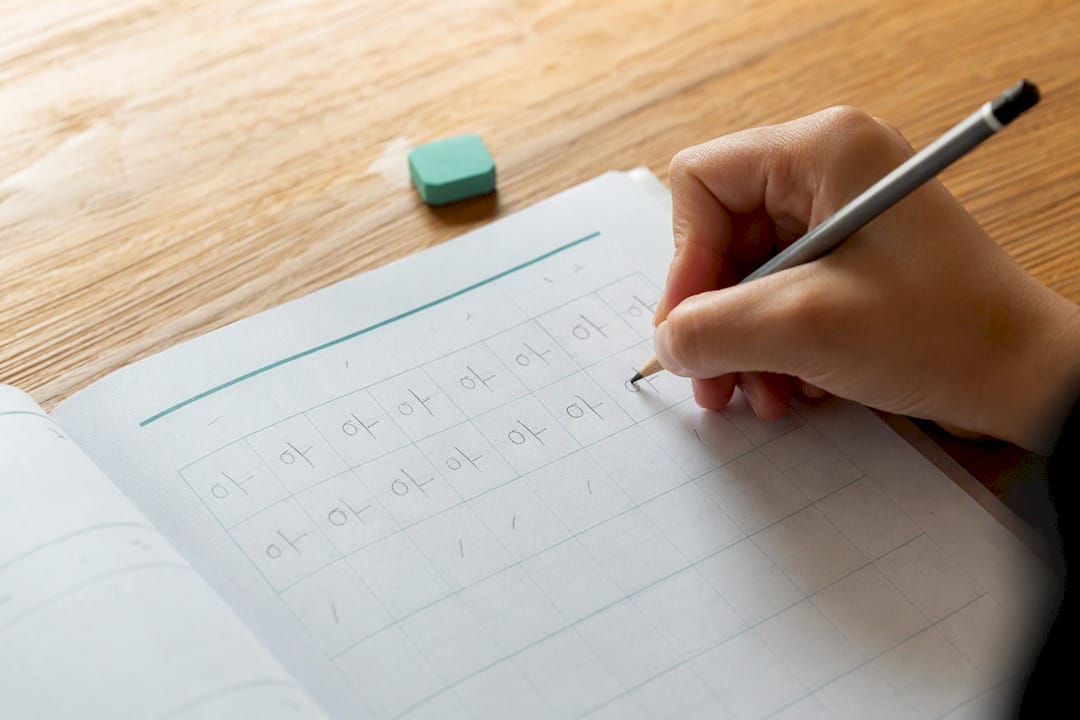
2. Learn Korean: The Language Workbook for Beginners (Jennie Lee)
This one tries to do more in a single volume. It includes stroke-order diagrams, flashcard templates, and calligraphy-style practice across more than 150 pages, aimed squarely at people who have never studied Korean before, per the Barnes & Noble listing. It’s a strong pick if you want one book that carries you from “what is Hangul” to basic reading fluency without buying three separate titles. The tradeoff is that a book covering this much ground can’t drill any single skill as deeply as a dedicated handwriting workbook.
3. Hangeul Master (Talk To Me In Korean)
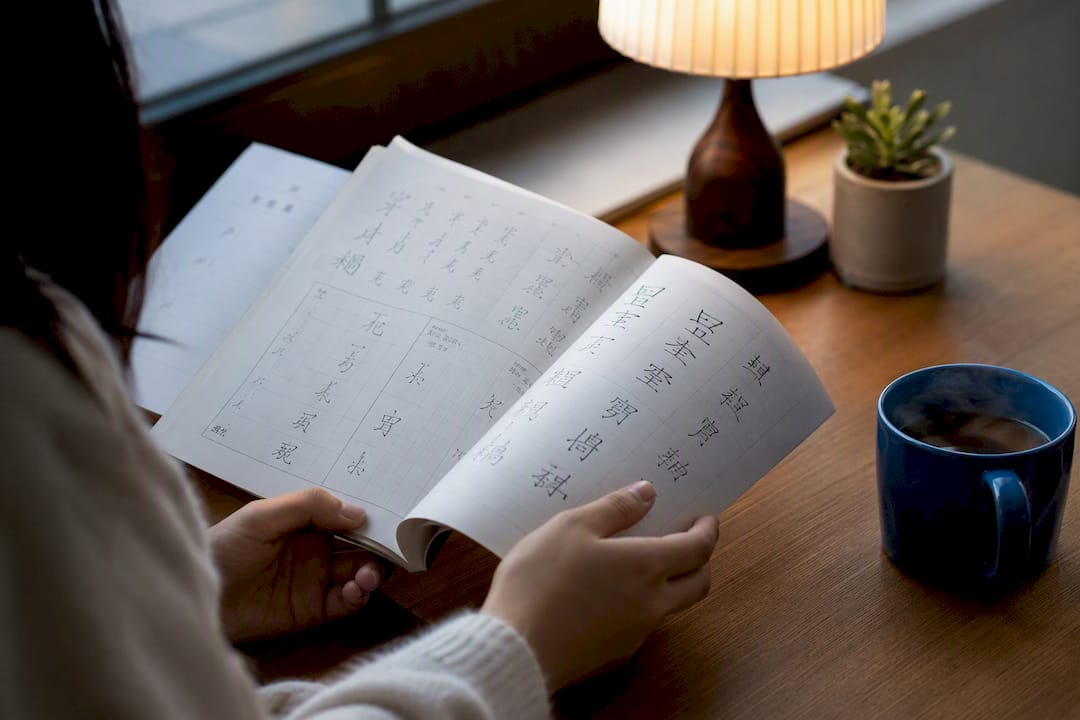
Most beginner workbooks use a clean printed font. Real signs, menus, and handwritten notes don’t look anything like that font, which is where most learners hit a wall. Hangeul Master addresses this directly by walking through actual handwriting samples and building a structured path to decoding them, according to TTMIK’s own product page. It’s available through TTMIK’s store and works well as a second workbook once you’ve got the basic shapes down.
4. Yonsei Korean Workbook 1-2 and Active Korean Workbook 1
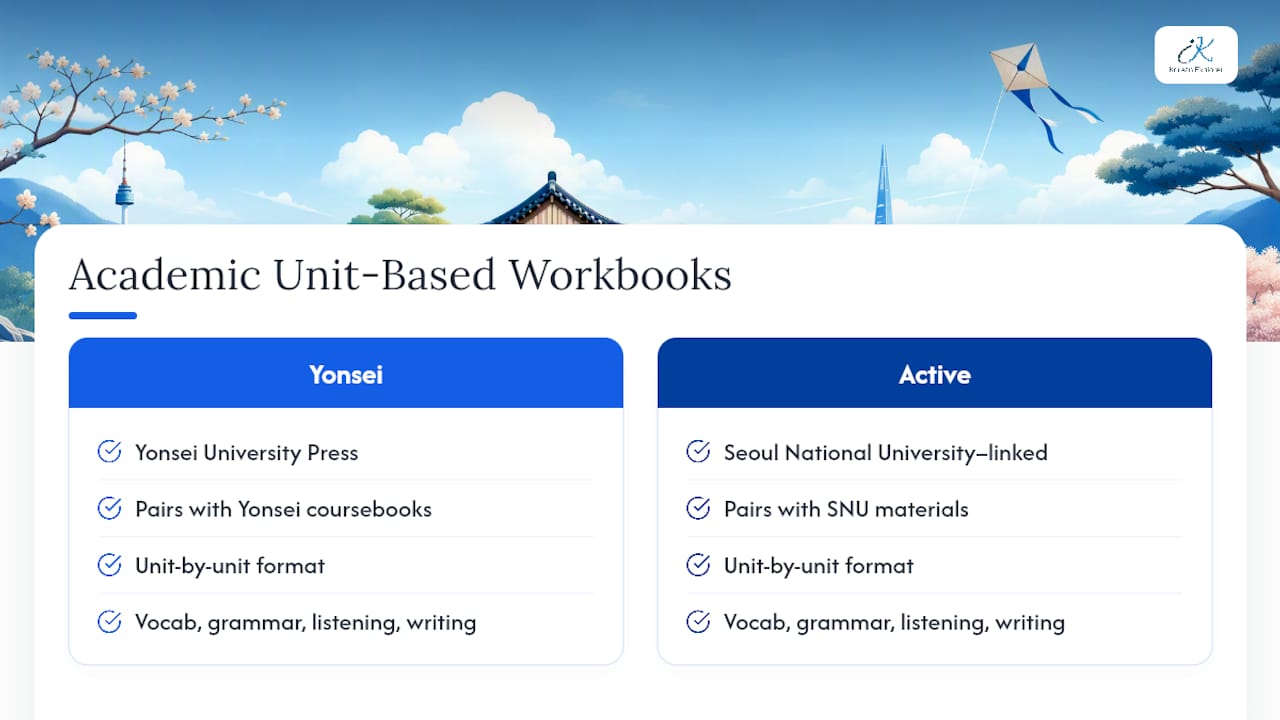
These two come from an academic lineage rather than a trade publisher, and it shows in the structure. The Yonsei Korean Workbook pairs with Yonsei University’s own coursebooks and runs learners through vocabulary, grammar, listening, and writing exercises unit by unit, per Yonsei University Press’s listing. Active Korean Workbook 1, tied to Seoul National University-linked materials, follows a similar unit-based format built around short-term, practical communication skills, according to its Kyobo product listing. Order them together if you want a genuinely structured, semester-style path rather than a grab-bag of drills. Availability leans toward Korean or academic booksellers, so budget extra shipping time if you’re ordering from Singapore.
5. KoreanClass101 Hangul Workbook PDFs
Before spending anything, download the free Hangul workbook PDFs listed on KoreanClass101’s resource page. There are more than a dozen of these, covering everything from letter shapes to basic reading drills, and they cost nothing beyond the paper and ink to print them. They won’t replace a full workbook long term, but they’re the fastest way to find out whether you actually enjoy handwriting practice before committing money to a physical book.
6. Themed vocabulary workbooks for motivation
If straight handwriting drills feel tedious, a themed workbook can keep you going. Some publishers now build Hangul practice around K-pop and K-drama vocabulary, which gives absolute beginners a reason to keep flipping pages, according to Tuttle’s K-Pop and K-Drama Language Workbook listing. Treat it as a supplement to a core handwriting book, not a replacement for one.
How to Choose the Best Hangul Workbook for Your Goals
Not every workbook on a bestseller list is right for you. Before buying, run each option through a few practical filters.
- Stroke order clarity: Look for numbered arrows or sequenced diagrams on every character, not just the first few pages.
- Progressive sequencing: A good workbook moves from single vowels to consonant-vowel pairs to full syllable blocks, rather than throwing complex syllables at you on page one.
- Grid practice pages: Square or Genkouyoushi-style grids help you judge spacing and proportion, which matters more in Hangul than most learners expect.
- Audio or QR support: Written accuracy and correct pronunciation aren’t the same skill, and a workbook with audio closes that gap.
- Cultural or contextual vocabulary: Workbooks that fold in real words and phrases, not just isolated letters, help the practice stick.
- Printability: If you’re leaning on PDFs, check that grid lines print cleanly at full scale rather than shrinking to fit a page.
Format matters as much as content. A physical book forces consistent handwriting practice because you can feel the paper and pen resistance, but it costs money and takes time to ship, especially if you’re ordering Yonsei or Active Korean titles from outside Singapore. A PDF is free or cheap and prints instantly, but only if you actually print it. Left as a file on your laptop, it does nothing. A workbook bundled with audio or QR codes, like Tuttle’s, splits the difference by giving you tactile writing practice and a pronunciation check in one purchase.
Pro Tip: Match the workbook’s intensity to the time you actually have. If you’ve only got 15 minutes a day, a dense academic workbook like Yonsei will frustrate you fast. Save it for weekends and use a lighter handwriting workbook on weekdays.
For general orientation on picking materials and building a study habit, our guide to studying Korean and learning Hangul walks through the same decision points in more depth.
How to Use a Hangul Workbook Effectively
Buying the right book solves half the problem. The other half is using it in a way that actually builds retention. A short daily routine focused on stroke order tends to produce faster literacy gains than occasional long study sessions, based on general language training guidance from the U.S. Department of State. Here’s a simple four-week structure to follow.
- Week 1: Trace every basic vowel and consonant daily, 15 to 20 minutes, following stroke-order arrows exactly. Don’t skip ahead to full syllables yet.
- Week 2: Move to guided writing. Copy syllable blocks from your workbook without tracing, checking your shapes against the printed example.
- Week 3: Start free writing. Write syllables and short words from memory, then check against the book. Add spaced repetition flashcards for anything you keep missing.
- Week 4: Practice timed reading of short words and simple sentences, then test your handwriting speed by copying a paragraph in under five minutes.
Pair your workbook with a few extra tools: audio playback for pronunciation checks, a spaced-repetition app for the syllables that keep tripping you up, and a printable grid if you burn through your workbook’s pages faster than expected. Our step-by-step Hangul writing guide is a useful companion for the tracing and guided-writing weeks, and pairing writing drills with structured pronunciation practice can help you catch mismatches between how a syllable looks and how it should sound. If you notice yourself skipping stroke order just to finish a page faster, slow down. That habit is the single most common reason adult learners develop shaky, inconsistent handwriting months later.
Free Hangul PDFs and Printable Practice Sheets
Free PDFs are the cheapest way to test whether handwriting drills work for you. KoreanClass101’s collection is the most complete free set available, covering letter shapes through basic reading practice, and it’s a sensible starting point before you commit to a paid workbook.
- Download a PDF and check the grid size before printing, scaling to roughly 90 to 110 percent depending on your pen and preferred spacing.
- Use plain printer paper for quick daily drills, and switch to slightly heavier paper if you’re using fountain pens or brush markers.
- Slot free PDFs into your Week 1 and Week 2 tracing practice rather than treating them as a full substitute for a structured workbook.
- Respect publisher copyright: these PDFs are meant for personal practice, not redistribution or resale.
When Guided Lessons Make Workbook Practice Go Further
A workbook can’t tell you that your stroke order is technically wrong, or that you’re pronouncing a syllable slightly off. That’s where a native instructor earns their keep, catching the small errors that self-study misses and holding you accountable to a schedule.
- Corrects stroke order and pronunciation errors a workbook can’t catch on its own.
- Builds accountability into your schedule instead of relying on willpower alone.
- Adds conversational context that pure handwriting drills don’t cover.
Com’s curriculum draws on material developed by Seoul National University, taught by native Korean instructors, and offered through group, private, and online Zoom classes. If you’re based in Singapore, the main training center sits at 10 Anson Road, Level 22, International Plaza, right above Tanjong Pagar MRT. A short course or a handful of private lessons alongside your workbook can turn weeks of guesswork into weeks of measurable progress.
An Editorial Take on Picking a Hangul Workbook
Most advice on this topic treats workbook choice like a shopping decision, weighing page counts and cover design instead of asking what the learner actually struggles with. That’s backward. The real question is whether you fall apart on stroke order, on reading unfamiliar handwriting, or on staying motivated past week two. Answer that first, and the right workbook becomes obvious.
The conventional wisdom oversells comprehensive, do-everything workbooks as the safe default. They’re fine, but a beginner who only ever traces syllables from one thick book often develops accurate shapes and zero ability to read a handwritten note. That’s why pairing a core workbook with something like Hangeul Master, or with free printable PDFs for extra reps, tends to outperform sticking to a single title.
What gets underestimated most is feedback. A workbook can show you the correct stroke order. It cannot tell you that you’re doing it wrong in practice. That gap is exactly where a short run of lessons, even just a handful, pays off far faster than another month of solo tracing.
— Paul
Sources
- Korean Hangul Writing Practice Workbook (Tuttle Publishing)
- Learn Korean – The Language Workbook for Beginners (Barnes & Noble listing)
- Yonsei Korean Workbook 1-2 (NowInSeoul product listing)
FAQ
Which Korean workbook is most effective for beginners?
There’s no single “most effective” workbook, since it depends on your weak point. For handwriting specifically, the Tuttle Korean Hangul Writing Practice Workbook is the strongest choice; for a comprehensive first workbook, Jennie Lee’s Learn Korean workbook covers more ground.
What are some good workbooks for learning Korean?
Strong options include Tuttle’s Hangul writing workbook, Jennie Lee’s Learn Korean workbook, TTMIK’s Hangeul Master, and the Yonsei Korean Workbook paired with Active Korean Workbook 1 for a more academic structure.
How many hours does it take to learn Hangul?
Most adult learners can recognize and write basic Hangul characters within a few weeks of short, consistent daily practice, though full comfort with reading varied handwriting and fonts takes longer.
What is the best book for learning Korean as a total beginner?
For someone starting from zero, Jennie Lee’s Learn Korean: The Language Workbook for Beginners works well because it combines stroke-order diagrams with vocabulary and flashcards in one volume, rather than requiring several separate books.