A Korean language institute, in the sense that matters if you’re a working adult, is a local school offering structured Korean courses built for people who need real conversation skills and business fluency, not just vocabulary drills. The fastest route to actual progress is a structured, instructor-led course, whether group, private, or online, rather than piecing together apps and YouTube videos on your own. If you’re deciding where to start, book a trial class or a placement assessment before committing to a term. That single step tells you more about fit than any brochure will.
Before you book, run through three quick checks:
- Confirm the class format (group, private, or Zoom) matches your weekly schedule.
- Ask about the instructor’s teaching background and whether they’re bilingual.
- Check that the course has a clear syllabus with measurable checkpoints, not just “conversational practice.”
Key Takeaways
Structured, instructor-led Korean courses consistently help adult learners progress faster than self-study because they build in corrective feedback and measurable checkpoints.
| Point | Details |
|---|---|
| Start with a trial or placement test | Confirms your level and whether the class format actually fits before you pay for a full term. |
| Match format to your schedule | Group classes suit routine and peer practice; private and online Zoom suit business needs or unpredictable hours. |
| Ask about feedback loops | Confirm assessment frequency, recorded lesson access, and instructor background before enrolling. |
| Budget for value, not just price | Compare included materials, progress checks, and instructor qualifications, not just the hourly rate. |
| Korean Explorer covers all formats | Group, private, online Zoom, and corporate training are available, with centers above Tanjong Pagar MRT plus Jurong and Tampines. |
Table of Contents
- Why Structured Courses and Instructor Feedback Matter for Adults
- How Do You Choose the Right Korean Course or Institute?
- What Course Format Fits Your Schedule and Goals?
- How Much Does a Korean Course Cost, and How Long Until You Can Speak?
- What Makes Korean Explorer a Strong Fit for These Criteria?
- How Do You Actually Enroll in a Korean Course?
- Where Are Korean Language Institutes Located, and How Accessible Are They?
- What Support Do You Get Beyond the Classroom?
- Ready to Start? Here’s Where Korean Explorer Fits In
- Sources
- FAQ
Why Structured Courses and Instructor Feedback Matter for Adults
Self-study has a ceiling, and most adult learners hit it faster than they expect. You can memorize Hangul and grammar patterns from an app, but without someone correcting your pronunciation or sentence order in real time, mistakes calcify. Structured curricula give learners a clear progression path and consistent feedback, which is precisely what unsupervised study lacks. A textbook can’t tell you that your intonation makes a statement sound like a question.
Structured programs also build in checkpoints, so you know if you’re actually improving or just logging hours. Combining guided instruction with real conversation practice tends to produce faster progress than app-only study, largely because a live instructor adjusts to your specific errors instead of repeating generic exercises.
Pro Tip: Structure your independent study around a five-part weekly loop: catch-up on what you missed, focused listening, grammar review, paired conversation practice, and a short cultural moment (a drama clip, a news headline, a K-pop lyric). It mirrors what a good class already does, and it keeps solo study from drifting into passive scrolling.
How Do You Choose the Right Korean Course or Institute?
Picking a course is less about finding the “best” school and more about matching the format to your actual constraints: time, budget, and goal. Here’s what actually separates a solid institute from one that wastes your evenings.
1. Learning goal alignment. Business Korean and conversational fluency for travel are different tracks. A course that treats them identically is a red flag.
2. Class size and instructor background. Ask whether instructors are native speakers who are also fluent in English. Language schools that pair native instructors with bilingual explanation tend to reduce confusion for adult beginners.
3. Curriculum clarity. You should be able to see, in writing, what you’ll cover by week four and week twelve.
4. Assessment frequency. Adult classes built around regular progress checks help learners see whether they’re actually advancing, rather than just feeling busy.
5. Schedule flexibility and recorded access. If you travel for work or miss a session, can you catch up?
Before signing up, ask these eight questions during a trial or an initial call:
- Is there a placement test before I enroll?
- Can I access recordings of past or missed classes?
- Can I see a sample syllabus for my level?
- What’s the instructor’s teaching background?
- What happens if I miss a class, is there a makeup option?
- How many students are typically in a group class?
- How often will I get a progress check or informal review?
- Can the course be customized for workplace or corporate use?
Walk away if you notice these three things: no placement process before you start, a curriculum description that’s vague (“conversational Korean” with no detail), or a class structure with little to no live speaking practice. A partner guide on adult language learning makes a similar point: adults stick with programs that give them structure and social accountability, not just content.
What Course Format Fits Your Schedule and Goals?
Group classes, private lessons, online sessions, and corporate training each solve a different problem, and picking the wrong one is the most common reason adults drop out mid-course.
- Group classes work best if you want routine, peer accountability, and lower cost per hour. You get regular speaking drills with classmates at a similar level, which mimics the social pressure that keeps most adults showing up week after week.
- Private lessons suit anyone prepping for a specific outcome, like a client meeting in Seoul or an upcoming exam, where pacing needs to bend around your schedule and your particular weak spots.
- Online or Zoom classes fit commuters, shift workers, or anyone managing unpredictable hours. Recorded sessions mean a missed Tuesday doesn’t set you back a full unit.
- Corporate training works when a team needs shared vocabulary for a specific workplace context. Good corporate programs prioritize workplace scenarios and role-play over general vocabulary, so employees leave able to use Korean in the exact situations their job requires.
If you’re unsure which applies to you, a guide to choosing the right course format can help narrow it down before you commit to a term.
How Much Does a Korean Course Cost, and How Long Until You Can Speak?
Most adults who attend weekly classes and put in a few hours of review can hold a basic conversation, ordering food, introducing themselves, asking simple questions, after some consistent practice, though pace depends heavily on how consistently you practice outside class.
Price varies based on a handful of factors, not just the school’s reputation:
- Group versus private format (private costs more per hour but moves faster for your specific goals).
- Total instructional hours and course length.
- Instructor experience level and whether materials are included.
- Corporate customization, which typically involves a scoping conversation before pricing.
When comparing options, don’t just look at the sticker price. Check whether the course includes progress checks, whether you get access to recorded lessons if you miss a session, and what the instructor’s actual teaching background looks like. A cheaper course that leaves you without feedback isn’t actually a better deal.
What Makes Korean Explorer a Strong Fit for These Criteria?
Korean Explorer’s curriculum was developed in partnership with Seoul National University and stays closely aligned with internationally recognized Korean proficiency standards, which gives adult learners a progression path that’s been shaped by an academic institution rather than assembled ad hoc.
Every instructor is a native Korean speaker fluent in English, so explanations land clearly whether you’re a total beginner or brushing up before a work trip. Classes lean into conversation rather than rote memorization, which matters if your goal is speaking with confidence, not passing a quiz.
- Group, private, and online Zoom formats, so your schedule dictates the format, not the other way around.
- Recorded class access for missed sessions or review.
- Corporate training built around workplace scenarios and team goals.
- Multiple physical locations across Singapore for learners who prefer in-person classes.
Adults who commit to a structured course with regular feedback tend to build real conversational ability faster than those relying on self-study alone, because the corrective loop, someone catching your mistakes before they become habits, is what self-guided learners miss most.
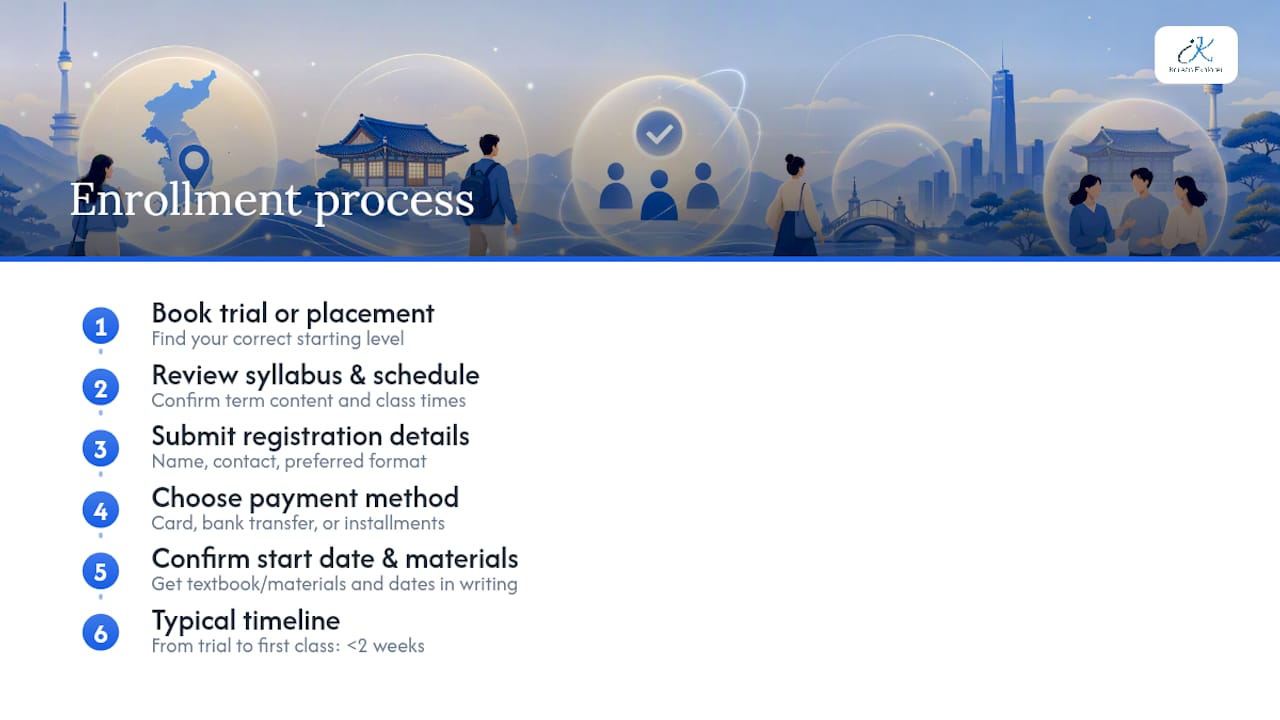
How Do You Actually Enroll in a Korean Course?
Enrollment usually follows a straightforward sequence, though the exact steps can vary slightly by school.
Step 1: Book a trial class or placement assessment. This tells you and the school which level you should start at, and it’s the single best way to avoid signing up for a course that’s either too easy or too fast.
Step 2: Review the syllabus and schedule options. Ask to see what a typical term covers and confirm the class times actually work with your job.
Step 3: Submit basic registration details. Most schools ask for your name, contact information, and preferred course format (group, private, or online). You generally don’t need academic transcripts or formal documentation, this isn’t a university admissions process.
Step 4: Choose a payment method. Schools typically accept major payment cards and bank transfers, and some allow installment arrangements for longer courses. Ask directly what’s available before you commit to a term length.
Step 5: Confirm your start date and materials. Some courses include textbooks or digital materials in the price; others bill separately. Get this in writing before your first class.
The whole process, from trial class to first real session, usually takes less than two weeks if you’re responsive to scheduling emails.
Where Are Korean Language Institutes Located, and How Accessible Are They?
Physical location matters more than most people expect when they’re trying to fit a class around a workday. A school that’s a 40 minute detour from your commute route will quietly kill your attendance rate within a month, no matter how good the curriculum is.
Korean Explorer’s main training center sits at 10 Anson Road, Level 22, International Plaza, Singapore 079903, directly above Tanjong Pagar MRT, which makes it an easy stop before or after work for anyone commuting through the central business district. Additional centers in Jurong and Tampines give learners on the west and east sides of the island a nearby option, so you’re not forced to cross the whole city for a weekly evening class.
Facilities matter too, not just the address. Ask whether classrooms are set up for small-group interaction (rather than lecture-style seating), whether there’s reliable Wi-Fi for hybrid sessions, and whether the location has evening access if you’re coming straight from work. For fully remote learners, accessibility is really about the online platform, so confirm that Zoom sessions include screen sharing, breakout rooms for paired practice, and a stable recording setup before you enroll.
What Support Do You Get Beyond the Classroom?
A good course doesn’t end when the weekly session does. The support structure around it, tutoring access, conversation partners, and cultural programming, often determines whether you actually retain what you learn.

Look for schools that offer some form of language partner or conversation practice outside formal class time. Regular exposure to native speakers in low-pressure settings reinforces what you cover in lessons and gives you a place to test phrases before using them at work or on a trip.
Cultural activities, whether that’s a screening, a food event, or a discussion of current Korean media, aren’t just a nice extra. They give context to the language: idioms, honorifics, and social norms make far more sense once you’ve seen them in action rather than just read them in a textbook.
Ask any institute directly what happens between classes. Is there a way to ask a quick grammar question before your next session? Can you join a casual conversation group even if it’s not part of your paid course? The schools that answer these clearly, rather than vaguely, are usually the ones that built support into the program on purpose rather than as an afterthought.
A Practical Note on Staying Consistent
Steady weekly habits beat sporadic bursts of studying, and that’s the pattern I’d point any working adult toward. Balancing a job with language learning is not about finding more hours, it’s about protecting the few you commit to a class or a review session.
Ready to Start? Here’s Where Korean Explorer Fits In
If you’ve read this far, you already know what to look for: a native bilingual instructor, a clear curriculum, flexible formats, and a location that doesn’t wreck your commute. Korean Explorer was built around exactly those criteria, with courses developed alongside Seoul National University and instructors who teach conversation first, grammar second.
Whether you want a group class for routine and peer practice, private lessons for business Korean on your own timeline, online Zoom sessions if you’re not near Tanjong Pagar, Jurong, or Tampines, or corporate training for a whole team, there’s a format that fits your week. You can browse the full Korean course catalog to compare options, or head straight to the main enrollment page to book a trial class or request a placement assessment. If your goal is workplace Korean for a team, reach out about private lesson options to discuss corporate scheduling. The first step is small: one trial session tells you whether the format and pace actually fit before you commit to a full term.
Sources
- Adult language classes: how to choose, succeed, and stay motivated | Language Learning Legend
- Why learn Korean? 11 practical reasons | Preply
FAQ
What Is a Korea Language Institute for Adults?
In this context, it’s a local school offering structured Korean courses, group, private, or online, built specifically for adult learners pursuing conversational or business fluency rather than academic study.
How Long Does It Take to Speak Basic Korean?
Most adults attending weekly classes with regular practice can hold a basic conversation within a few months, though pace depends on how consistently you review outside class.
Is Online Korean Learning as Effective as In-Person Classes?
Online Zoom classes can be equally effective for building conversation skills, particularly when they include recorded sessions and live speaking practice with an instructor rather than app-only exercises.
What Should I Ask Before Enrolling in a Korean Course?
Ask about placement testing, instructor background, class size, makeup policy for missed sessions, and whether the course includes recorded lesson access.
Does Korean Explorer Offer Corporate Korean Training?
Yes, Korean Explorer provides corporate training built around workplace scenarios, alongside group, private, and online Zoom courses for individual learners.