Take a short free placement test right now if you want a reliable starting point. Save the official Test of Proficiency in Korean for later, once you actually need a certificate. The Nuri online level test from the King Sejong Institute, the TTMIK level test, and the 90 Day Korean test all give you a usable estimate in a short time.
- Nuri (King Sejong Institute): government-linked, tests grammar and vocabulary, gives a rough level band.
- TTMIK level test: fast, built by a well-known Korean learning publisher, good for a gut-check.
- 90 Day Korean test: pairs your score with a suggested study plan, useful if you want direction, not just a number.
None of these are certificates. If a university, employer, or visa office needs proof of your Korean ability, that requires the official exam, not a free quiz. Use the placement test to plan your studies. Use TOPIK when someone else needs to see the result.
Key Takeaways
Free online tests give you a fast, reliable starting estimate, but only the official TOPIK exam produces a certificate that institutions and employers will accept.
| Point | Details |
|---|---|
| Start with a free test | Nuri, TTMIK, or 90 Day Korean each give a usable level estimate in under 20 minutes. |
| Save TOPIK for certification | Register for the official exam only when a visa, employer, or university requires proof. |
| Check the CEFR mapping | TOPIK 1–2 roughly equals A1–A2, TOPIK 3–4 equals B1–B2, and TOPIK 5–6 equals C1–C2. |
| Validate mixed results | Borderline scores often mean speaking lags behind reading, so a short conversation check helps. |
| Consider live placement | Korean Explorer pairs a diagnostic with a speaking and writing check to set an accurate course level. |
Table of Contents
- What a Korean Language Level Test Actually Shows You
- What Do These Tests Actually Measure?
- Which Test Should You Take for Your Goal?
- How to Take a Placement Test the Right Way
- When a Live Placement Check Beats a Free Online Test
- Get an Accurate Placement Plus a Course That Fits
- Sources
- FAQ
What a Korean Language Level Test Actually Shows You
A handful of reputable online tests cover most of what learners need, and each one serves a slightly different purpose. None of them replace formal certification, but they’re the fastest way to stop guessing at your level.
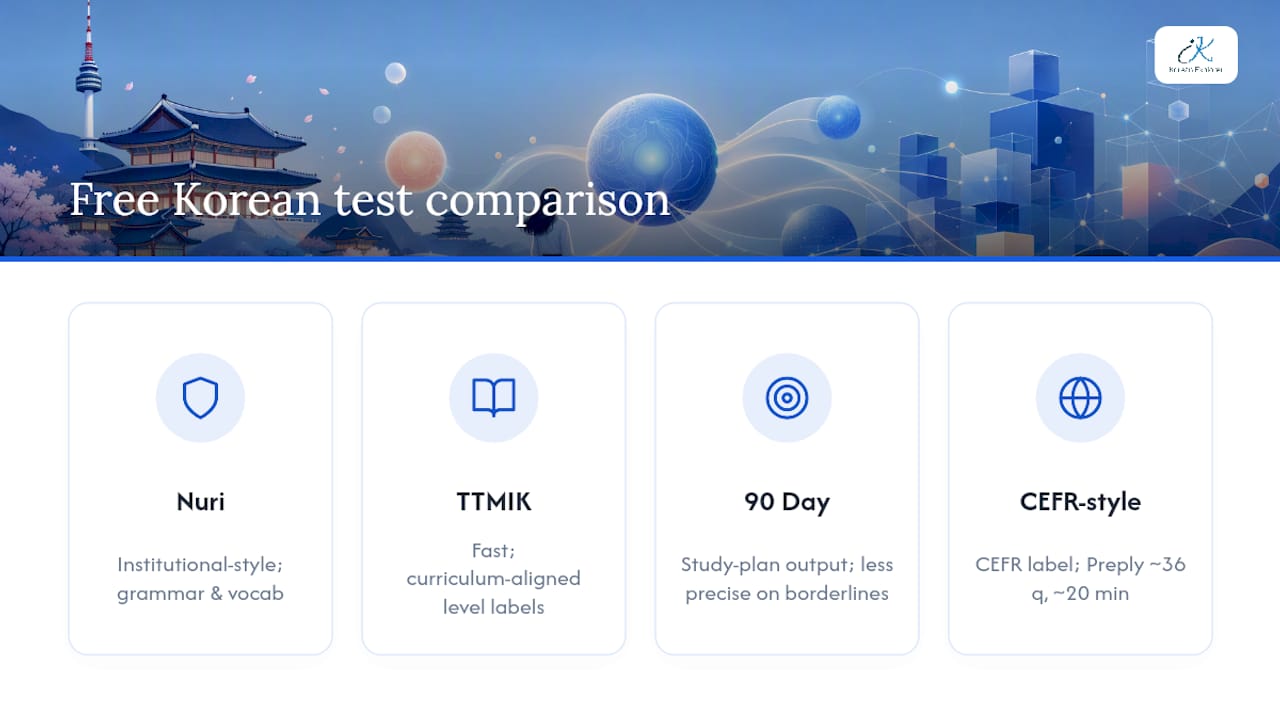
Nuri (King Sejong Institute) online level test. This is the closest thing to an institutional placement tool in the free-test category. It checks grammar and vocabulary through multiple-choice questions and returns a level estimate rather than a certificate. It’s a solid first stop if you want a placement result with some institutional weight behind it, though it won’t validate your speaking ability.
TTMIK level test. Talk To Me In Korean built its test around the same curriculum structure it uses in its own lesson series, so if you’ve studied with their materials before, the result maps cleanly onto what you already know. It runs quickly and gives you a level label (beginner, intermediate, advanced) rather than a granular score. Best for a fast self-check, not a deep diagnostic.
90 Day Korean level test. The output here leans more toward a study plan than a raw score. After you finish, you get a recommendation for what to study next, which matters if you’re the kind of learner who needs a clear next step rather than just a number. It’s less precise on borderline cases, but stronger on direction.
Other CEFR-style options. Sites like Preply and Lenguia run free tests that map your grammar, listening, and sometimes writing to the CEFR scale directly. Preply’s Korean test runs about 36 questions in roughly 20 minutes and focuses heavily on grammar, while Lenguia adds AI-scored writing prompts on top of the standard sections.
Line these tests up by what they’re actually good for: Nuri and TTMIK give you a quick estimate with minimal time investment; 90 Day Korean gives you a plan; the CEFR-style tools give you a label you can compare against international standards. All four are free and diagnostic, not certifying, so treat the result as a starting point for your Korean language classes, not a document you can show anyone else.
What Do These Tests Actually Measure?
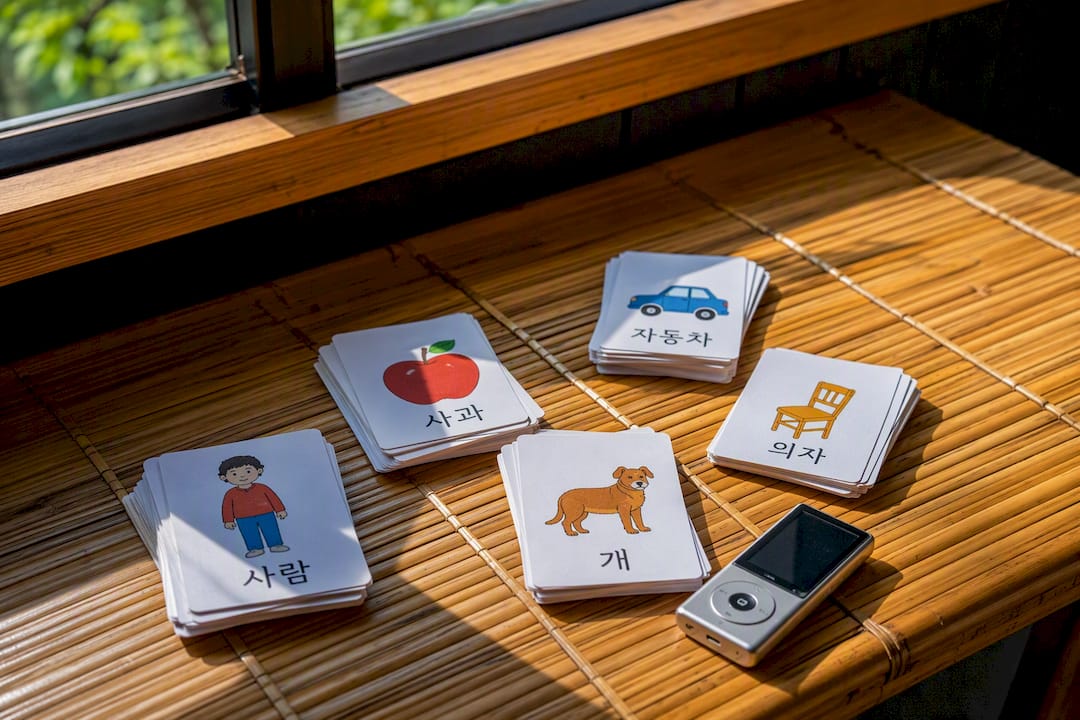
Most online placement tests break down into the same handful of sections: vocabulary, grammar, reading, and listening practice resources. Each one tells you something different. Listening sections measure how well you catch spoken Korean in real time, which is a separate skill from reading comprehension. Grammar sections check whether you can manipulate sentence structure correctly, not just recognize it. Vocabulary sections tend to be the easiest to game and the least reliable on their own.
Here’s the catch: most free tests skip speaking and writing entirely, or bolt on a separate step for it. University programs like Berkeley’s Korean placement process treat the online component as diagnostic only, then follow up with instructor-reviewed speaking and writing validation before finalizing a course placement.
TOPIK and CEFR line up roughly like this:
- TOPIK 1–2 roughly correspond to CEFR A1–A2, TOPIK 3–4 to B1–B2, and TOPIK 5–6 to C1–C2 levels
This mapping, outlined by Crush on Korean, is a rough guide, not an exact conversion. TOPIK score bands differ depending on the test format, and TOPIK Speaking is scored separately out of 200 points with its own level bands. Official TOPIK scores are also only valid for two years from the announcement date under the current Ministry of Education framework, so a score from years ago won’t count for a current application.
Which Test Should You Take for Your Goal?
Pick the test based on what you actually need the result for, not which one shows up first in a search.
- Starting self-study or picking a course level: Take a free test like Nuri, TTMIK, or the CEFR-style options. Any of these will get you close enough to choose a starting point.
- Applying for a visa, university program, or job that requires proof: Register for the official TOPIK exam. A free test result will not satisfy this requirement under any circumstance.
- You want both a quick estimate now and certification later: Take a free test today, then register for TOPIK once you’re closer to your target level, so you don’t spend money testing prematurely.
- Your result lands between two levels: Lean toward the lower level if your listening or speaking feels shakier than your reading, since spoken fluency tends to lag behind recognition skills. If you’re genuinely unsure, ask an instructor to sit in on a short conversation before locking in a course.
Mixed results are common and don’t mean the test failed. They usually mean your reading has outpaced your speaking, or the reverse, which is worth knowing before you commit to a course level.
How to Take a Placement Test the Right Way
Getting a result you can actually trust depends on how you take the test, not just which one you pick.
- Sit somewhere quiet, close other tabs, and treat it like a real assessment, not a quiz you can retake five times.
- Skip the aids. No dictionaries, no translation apps, no asking a friend mid-question.
- Respect single-attempt policies. Programs like Northwestern’s Korean placement process require one sitting within a set time window, and taking it under looser conditions just inflates your score artificially.
- Screenshot or save your result immediately. If a school later asks for validation, you’ll want the original score on hand, not a vague memory of it.
Pro Tip: If your test result feels like a coin flip between two levels, don’t just retake the same quiz hoping for a cleaner number. Take the grammar and reading test once, then book a short speaking check-in with an instructor. The conversation will resolve the ambiguity faster than three more attempts at the same written test ever will.
When a Live Placement Check Beats a Free Online Test
Free tests work fine for most self-study decisions, but a few situations call for something more thorough. Heritage speakers often have this exact problem: strong listening and speaking from growing up around the language, but shaky grammar and reading because they never studied it formally. A written-only test will misjudge them badly in either direction.
High-stakes situations deserve the same caution. If a university, employer, or visa office is going to look at your result, or if you’re eyeing TOPIK certification down the road, a written score alone won’t tell you enough to plan around.
At Korean Explorer, placement conversations happen alongside a curriculum built on Seoul National University’s framework, closely aligned with TOPIK standards, so the level you’re placed into actually reflects what you’ll need for formal certification later. Book a placement check if your free test result feels off, if you’re a heritage speaker, or if you’re planning to sit TOPIK within the next year. Expect a short conversation covering speaking and reading together, not just a multiple-choice score.
Get an Accurate Placement Plus a Course That Fits
A free test gets you close. A live placement gets you right. Korean Explorer’s placement process pairs an online diagnostic with a short speaking and writing check, so you’re not relying on a written score alone to pick a course level.
The process is quick: you complete the diagnostic, sit through a brief speaking validation, and get a recommended class level along with a sample lesson so you know what to expect before enrolling. From there, you choose the format that fits, group classes, private lessons, or online sessions over Zoom, all built around the same curriculum. If certification is your end goal, the TOPIK preparation courses pick up exactly where placement leaves off.
Korean Explorer’s main center sits at 10 Anson Road, Level 22, International Plaza, Singapore 079903, right above Tanjong Pagar MRT, with additional locations in Jurong and Tampines for learners who want an in-person option closer to home. Start with the Korean placement test to get a class recommendation before you commit to a course.
Sources
- Test of Proficiency in Korean
- Placement Test | Korean Language Program
- Korean Language Placement Test 2026-2027
FAQ
How hard is the TOPIK exam?
Difficulty depends on the level you register for. TOPIK I (levels 1–2) tests basic vocabulary and grammar, while TOPIK II (levels 3–6) requires stronger reading comprehension and grammatical control, with score bands differing between the paper and internet-based formats.
How much does TOPIK cost?
TOPIK registration fees vary by location, so check your local test center for accurate pricing before registering.
Can I take the TOPIK test online?
TOPIK now offers an internet-based format (IBT) in addition to the traditional paper-based test, though score bands differ slightly between the two formats.
Which TOPIK level is roughly equal to CEFR B2?
TOPIK level 4 roughly corresponds to CEFR B2, though the two systems don’t map perfectly since TOPIK and CEFR test somewhat different skill combinations.
Do free placement tests replace TOPIK certification?
No. Free tests like Nuri, TTMIK, and 90 Day Korean give you a diagnostic estimate for study planning, but only the official TOPIK exam produces a certificate accepted by universities, employers, and visa offices.